

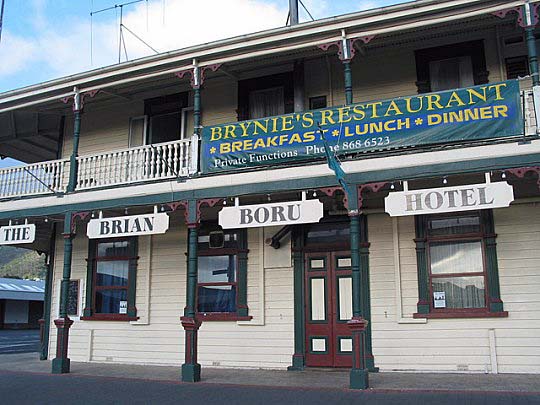
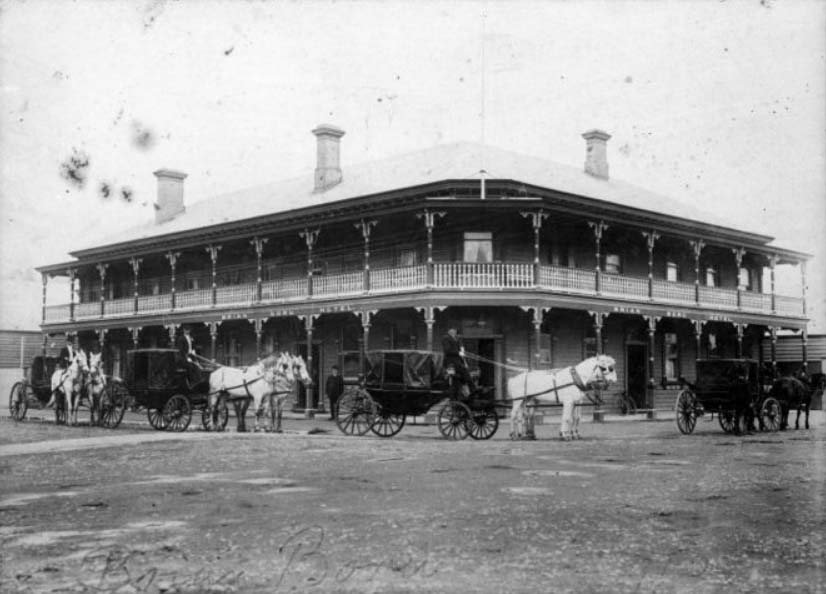
The Brian Boru Hotel was established by a Mr Sainsbury in 1867, as the Reefers' Arms. A year later it was taken over by Edmond (Ned) Twohill who had arrived at Thames before the goldrush. Twohill, originally from County Cork, renamed the establishment after Brian Boru, the Irish King (941-1014). Twohill's appointment as Treasurer of the Thames Irish National League at the inaugural meeting held 20 October 1884 confirms his commitment to his country of origin. Following his death in 1896, the licence was taken over by his widow, Kate, who had the present hotel built in 1904.
The new 40-roomed hotel, capable of accommodating upwards of 70 guests at a time, replaced the less imposing two-storeyed structure which had previously occupied the site. The identity of the builder and architect is not known. The hotel was under construction in mid-July 1904. It opened for business on 5 October, 1904. The price for the newly completed building was £3,140 but this bankrupted the contractor.
Eight months after completion, the hotel was extensively damaged by fire. Early on the morning of 11 June 1905, fire broke out above the kitchen in the southeastern wing. The interior of the top storey of the eastern wing was totally destroyed. The bedrooms along the Pollen and Richmond street frontages were partially burnt, requiring refurbishment. The lower floor suffered extensive smoke and water damage. By early February the following year rebuilding, renovating and furnishing the hotel had been completed.
The two hotels on this site were managed continuously by members of the Twohill family from 1868 until 1974.
List Entry Information
Status
Listed
List Entry Status
Historic Place Category 1
Access
Private/No Public Access
List Number
129
Date Entered
28th June 1990
Date of Effect
28th June 1990
City/District Council
Thames-Coromandel District
Region
Waikato Region
Extent of List Entry
Extent includes the land described as Lots 146, 148 and Pt Lot 149 Rangiriri A Blk and Lot 147 Rangiriri D Blk (RT SA34B/664), South Auckland Land District, and the building known as Brian Boru Hotel thereon.
Legal description
Lots 146, 148 and Pt Lot 149 Rangiriri A Blk and Lot 147 Rangiriri D Blk (RT SA34B/664), South Auckland Land District.
Status
Listed
List Entry Status
Historic Place Category 1
Access
Private/No Public Access
List Number
129
Date Entered
28th June 1990
Date of Effect
28th June 1990
City/District Council
Thames-Coromandel District
Region
Waikato Region
Extent of List Entry
Extent includes the land described as Lots 146, 148 and Pt Lot 149 Rangiriri A Blk and Lot 147 Rangiriri D Blk (RT SA34B/664), South Auckland Land District, and the building known as Brian Boru Hotel thereon.
Legal description
Lots 146, 148 and Pt Lot 149 Rangiriri A Blk and Lot 147 Rangiriri D Blk (RT SA34B/664), South Auckland Land District.
Why is this place significant?
Historic Significance
Historical Significance or Value The significance of the Brian Boru Hotel lies in its association with the earlier hotel of the same name, which was established on the site during the gold rush of 1867. The historical link between the old and new hotels is strengthened by the fact that members of the Twohill family managed the Brian Boru establishment continuously for 106 years (1868-1974). The Brian Boru is one of only seven of Thames' 112 hotel establishments to have survived from the gold rush era to present times.
Physical Significance
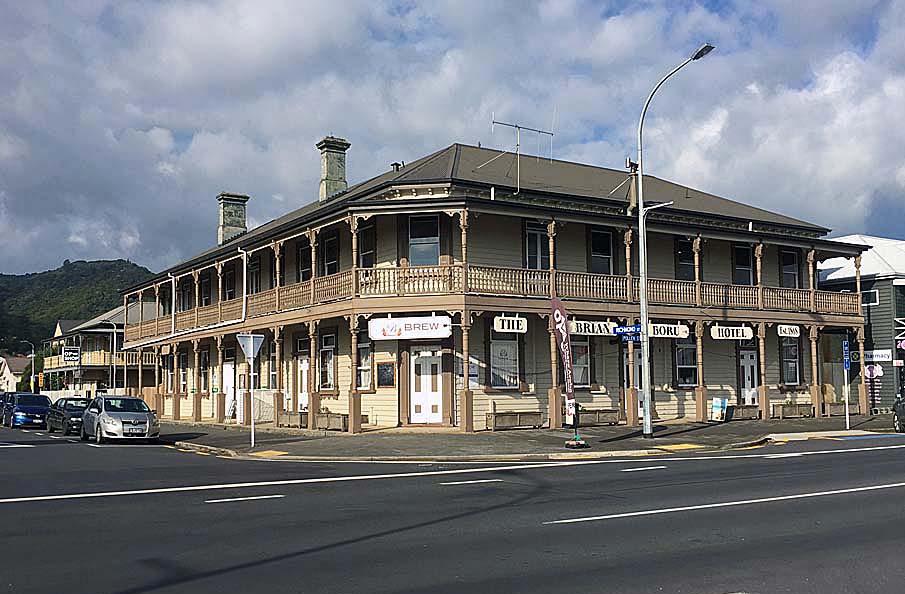
ARCHITECTURAL QUALITY: The form of the Brian Boru Hotel is archetypal of turn of the century hotel design in New Zealand. Characteristics of such hotels include the sweeping verandah, hipped roof and the manner in which it addresses its corner site. Hotels such as this are becoming increasingly rare and the Brian Boru is a particularly elegant example. TOWNSCAPE/LANDMARK VALUE: The Brian Boru Hotel is a prominent building on the main road of Thames. Its presence is derived from the corner site and from the similar treatment of the two street facades.
Why is this place significant?
Historic Significance
Historical Significance or Value The significance of the Brian Boru Hotel lies in its association with the earlier hotel of the same name, which was established on the site during the gold rush of 1867. The historical link between the old and new hotels is strengthened by the fact that members of the Twohill family managed the Brian Boru establishment continuously for 106 years (1868-1974). The Brian Boru is one of only seven of Thames' 112 hotel establishments to have survived from the gold rush era to present times.
Physical Significance
ARCHITECTURAL QUALITY: The form of the Brian Boru Hotel is archetypal of turn of the century hotel design in New Zealand. Characteristics of such hotels include the sweeping verandah, hipped roof and the manner in which it addresses its corner site. Hotels such as this are becoming increasingly rare and the Brian Boru is a particularly elegant example. TOWNSCAPE/LANDMARK VALUE: The Brian Boru Hotel is a prominent building on the main road of Thames. Its presence is derived from the corner site and from the similar treatment of the two street facades.
Construction Details
Start Year
1974
Type
Modification
Description
Foundations reblocked, Re-roofed, Walls and ceilings relined
Start Year
1904
Type
Original Construction
Construction Materials
Concrete foundations; timber frame with weatherboard cladding; long run steel roofing.
Notable Features
Elegant verandah.
Construction Details
Start Year
1974
Type
Modification
Description
Foundations reblocked, Re-roofed, Walls and ceilings relined
Start Year
1904
Type
Original Construction
Construction Materials
Concrete foundations; timber frame with weatherboard cladding; long run steel roofing.
Notable Features
Elegant verandah.
ARCHITECTURAL DESCRIPTION: Sited on the corner of Richmond and Pollen Streets, this two storeyed Edwardian hotel is L-shaped in plan and has two similar street facades with hipped roofs, a prominent verandah and regular fenestration. The verandah runs the length of both facades and is supported on a series of turned posts with decorative brackets at both levels. It has balustrading at first floor level and a lean-to roof beneath the eaves brackets of the hipped roof. On the ground floor casement windows are hung horizontally. Window and door cases are in the form of pilasters. The two street facades are linked by a diagonal corner section which forms the guest entry and lobby of the hotel. This area provides access to the dining and kitchen wing to the left and bars to the right. While few ground floor rooms remain unaltered, panelling in the public bar remains intact. Bedrooms retain some original elements, particularly those in the east wing which have panelled ceilings, original doors, architraves, skirtings and double hung sash windows. MODIFICATIONS: Dates Unknown:- Removal of walls to enlarge public bar - New public bar added - Bathroom facilities added to bedrooms - Cellar blocked up - Double hung windows replaced with horizontally hung casement windows - Chimney removed - Stair balustrading covered with plywood 1974:- Foundations reblocked - Re-roofed - Walls and ceilings relined
ARCHITECTURAL DESCRIPTION: Sited on the corner of Richmond and Pollen Streets, this two storeyed Edwardian hotel is L-shaped in plan and has two similar street facades with hipped roofs, a prominent verandah and regular fenestration. The verandah runs the length of both facades and is supported on a series of turned posts with decorative brackets at both levels. It has balustrading at first floor level and a lean-to roof beneath the eaves brackets of the hipped roof. On the ground floor casement windows are hung horizontally. Window and door cases are in the form of pilasters. The two street facades are linked by a diagonal corner section which forms the guest entry and lobby of the hotel. This area provides access to the dining and kitchen wing to the left and bars to the right. While few ground floor rooms remain unaltered, panelling in the public bar remains intact. Bedrooms retain some original elements, particularly those in the east wing which have panelled ceilings, original doors, architraves, skirtings and double hung sash windows. MODIFICATIONS: Dates Unknown:- Removal of walls to enlarge public bar - New public bar added - Bathroom facilities added to bedrooms - Cellar blocked up - Double hung windows replaced with horizontally hung casement windows - Chimney removed - Stair balustrading covered with plywood 1974:- Foundations reblocked - Re-roofed - Walls and ceilings relined
Historical and Associated Iwi / Hapū / Whānau
Information Sources
Auckland Star
Auckland Star
Auckland Weekly News
Auckland Weekly News
Hocken Library
Hocken Library, University of Otago, Dunedin
McNeish, 1984
James McNeish, Tavern in the Town, A.H. and A.W. Reed, Wellington, 1984 [first published 1957]
New Zealand Herald
New Zealand Herald, 12 July 1932, p. 6; 28 September 1933, p. 6.
Baglin, 1984
D Baglin & A Austin. N.Z. Pub Crawl, Auckland, 1984
Bolinger, 1967
C Bolinger. Grog's Own Country: The Story of Liquor Licensing in New Zealand, Auckland, 1967
Grainger, 1951
J Grainger. The Amazing Thames: The Story of the Town and The Famous Goldfield From Which It Grew, Wellington, 1951
Kelly, 1968
W A Kelly. Thames: The First Hundred Years, Thames, 1968
New Zealand Graphic
New Zealand Graphic
Thames Star
Thames Star
Other Information
This historic place was registered under the Historic Places Act 1980. This report includes the text from the original Building Classification Committee report considered by the NZHPT Board at the time of registration. Please note that entry on the New Zealand Heritage List/Rarangi Korero identifies only the heritage values of the property concerned, and should not be construed as advice on the state of the property, or as a comment of its soundness or safety, including in regard to earthquake risk, safety in the event of fire, or insanitary conditions.
Historical and Associated Iwi / Hapū / Whānau
Information Sources
Auckland Star
Auckland Star
Auckland Weekly News
Auckland Weekly News
Hocken Library
Hocken Library, University of Otago, Dunedin
McNeish, 1984
James McNeish, Tavern in the Town, A.H. and A.W. Reed, Wellington, 1984 [first published 1957]
New Zealand Herald
New Zealand Herald, 12 July 1932, p. 6; 28 September 1933, p. 6.
Baglin, 1984
D Baglin & A Austin. N.Z. Pub Crawl, Auckland, 1984
Bolinger, 1967
C Bolinger. Grog's Own Country: The Story of Liquor Licensing in New Zealand, Auckland, 1967
Grainger, 1951
J Grainger. The Amazing Thames: The Story of the Town and The Famous Goldfield From Which It Grew, Wellington, 1951
Kelly, 1968
W A Kelly. Thames: The First Hundred Years, Thames, 1968
New Zealand Graphic
New Zealand Graphic
Thames Star
Thames Star
Other Information
This historic place was registered under the Historic Places Act 1980. This report includes the text from the original Building Classification Committee report considered by the NZHPT Board at the time of registration. Please note that entry on the New Zealand Heritage List/Rarangi Korero identifies only the heritage values of the property concerned, and should not be construed as advice on the state of the property, or as a comment of its soundness or safety, including in regard to earthquake risk, safety in the event of fire, or insanitary conditions.
Former Usages
General Usage: Accommodation
Specific Usage: Hotel
Former Usages
General Usage: Accommodation
Specific Usage: Hotel
Location
Sign up to hear more
Get the latest heritage news, features and events delivered
straight to your inbox.
