

The kiln was the third to be erected in the area by Alfred Emeny, a brickmaker from Wanganui. On discovering a fine seam of clay, Emeny purchased land in the Huiakama Block in 1921 and built a temporary box-kiln. Bricks were the required building material in many town centres and just three years later, the demand enabled Emeny and his partners to erect a Hoffman Continuous Kiln, whose multiple chambers allowed for the continuous production of bricks. The Hoffman Kiln arrived in New Zealand in the late 1870s, replacing the downdraught kiln that had been used since the beginning of that decade. Nearly 20 workers were required to operate the Hoffman kiln efficiently and, following the sharp decrease in demand for bricks after the 1931 Hawke's Bay earthquake, it soon became uneconomic. Around 1937 Emeny replaced the Hoffman with a downdraught kiln, and concentrated on producing round field tiles for drainage.
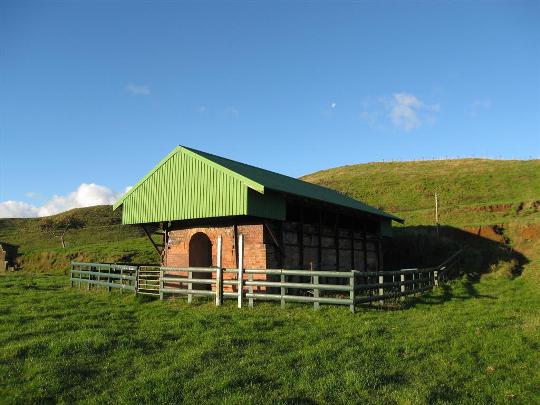
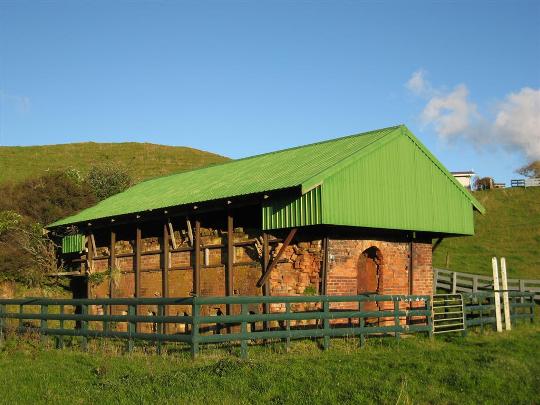
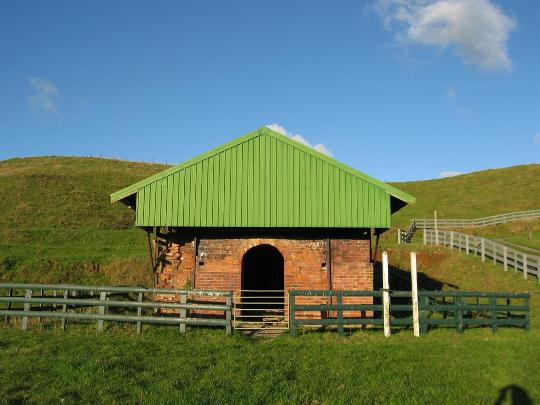
The Downdraught Kiln is made of brick and has a single chamber with an arched roof. It was economical on fuel and could be run by between two and six workers. To fire clay, air was drawn into firing ports that were spaced evenly along two sides of the building. Brick structures inside the chamber directed hot air up to the arched ceiling of the chamber. Streams of hot air met in the middle of the arch and were forced downwards, past the new tiles, and through outlet flues in the floor. Flues were normally connected to a chimney at the rear of the kiln but Emeny connected his to the old Hoffman chimney located 20 metres away. The Downdraught Kiln reached temperatures of between 1000 to 1100 degrees centigrade and was run for two to three days at a time. The tiles were retrieved after the kiln had cooled. Three sizes of tile were produced and at peak production the kiln could produce just over 91 kilometres [300,000 feet] of tile per year, over 30 burns.
In 1949 Emeny sold his brickworks to Harry and Richard Lampitt. The Lampitt brothers continued to produce bricks and field tiles using mudstone mined from hills close to the kiln. In 1978 the brickworks were the focus of a fundraising 'Brickarama' that attracted over 1000 visitors to the area to watch the brick-making process. Shortly afterwards the Lampitts sold Douglas Brick and Field Tiles Ltd to Ron Ward, an employee of the company. Ward planned to modernise and renovate the brickworks but financial problems forced him to close the works in 1981. Ward demolished the Hoffman Kiln in 1980 and the Hoffman chimney five years later, to recoup losses by sale of the bricks. The Downdraught Kiln was saved when its new owners, who had purchased the land for dairy farming, agreed to enter into a Heritage Covenant with the New Zealand Historic Places Trust in 1988. The kiln was restored and a protective shelter erected by local builder Frank Mathews.
The Downdraught Kiln at Douglas has great significance as one of the few remaining examples of this type of kiln in New Zealand. It has great educational potential as a means of providing insight into New Zealand's industrial history. The kiln has high technological value as it is in good condition and remains sufficiently intact to successfully illustrate how the firing process occurred. The Douglas kiln is a late example of a kiln type that had been superseded by the technologically advanced Hoffman Continuous Kiln in the late 1870s. Its construction during the 1930s is an important reminder of the enormity of the impact that the 1931 earthquake had upon policies governing building materials used in towns throughout the North Island. The kiln has local historical significance as a source of past employment and industry in the small town of Douglas and it is now a feature of the South Taranaki Heritage Trail.
List Entry Information
Status
Listed
List Entry Status
Historic Place Category 1
Access
Private/No Public Access
List Number
152
Date Entered
27th June 1985
Date of Effect
27th June 1985
City/District Council
Stratford District
Region
Taranaki Region
Extent of List Entry
Extent includes the land described as Pt Lot 8 DP 312B (RT TNF4/1343), Taranaki Land District and the building known as the Downdraught Kiln and its fittings and fixtures.
Legal description
Pt Lot 8 DP 312B (RT TNF4/1343), Taranaki Land District
Status
Listed
List Entry Status
Historic Place Category 1
Access
Private/No Public Access
List Number
152
Date Entered
27th June 1985
Date of Effect
27th June 1985
City/District Council
Stratford District
Region
Taranaki Region
Extent of List Entry
Extent includes the land described as Pt Lot 8 DP 312B (RT TNF4/1343), Taranaki Land District and the building known as the Downdraught Kiln and its fittings and fixtures.
Legal description
Pt Lot 8 DP 312B (RT TNF4/1343), Taranaki Land District
Construction Details
Start Year
1937
Type
Original Construction
Start Year
1980
Type
Modification
Description
Kiln chimney demolished
Start Year
1988
Type
Modification
Description
Protective roof erected over the kiln
Construction Materials
A single chamber kiln with an arched roof constructed of brick.
Construction Details
Start Year
1937
Type
Original Construction
Start Year
1980
Type
Modification
Description
Kiln chimney demolished
Start Year
1988
Type
Modification
Description
Protective roof erected over the kiln
Construction Materials
A single chamber kiln with an arched roof constructed of brick.
Historical and Associated Iwi / Hapū / Whānau
Completion Date
5th December 2002
Report Written By
Rebecca O'Brien
Information Sources
Olsen, 1981
F. Olsen, The Kiln Book: Materials, Specifications and Construction, London, 1981
Thornton, 1982
Geoffrey G. Thornton, New Zealand's Industrial Heritage, A.H. & A.W. Reed, Wellington, 1982
Walter, 1981
B. Walter, (ed.), Douglas; A Taranaki Rural Community, Douglas, 1981
Other Information
This place was identified as significant under previous legislation with different information requirements. It remains significant under the current legislation. There is opportunity under our legislation and policies to add to this information. Further information about this place may be available from the Central Regional Office of Heritage New Zealand Pouhere Taonga. A fully referenced version of this report is available from the NZHPT Central Region office Please note that entry on the New Zealand Heritage List/Rarangi Korero identifies only the heritage values of the property concerned, and should not be construed as advice on the state of the property, or as a comment of its soundness or safety, including in regard to earthquake risk, safety in the event of fire, or insanitary conditions.
Historical and Associated Iwi / Hapū / Whānau
Completion Date
5th December 2002
Report Written By
Rebecca O'Brien
Information Sources
Olsen, 1981
F. Olsen, The Kiln Book: Materials, Specifications and Construction, London, 1981
Thornton, 1982
Geoffrey G. Thornton, New Zealand's Industrial Heritage, A.H. & A.W. Reed, Wellington, 1982
Walter, 1981
B. Walter, (ed.), Douglas; A Taranaki Rural Community, Douglas, 1981
Other Information
This place was identified as significant under previous legislation with different information requirements. It remains significant under the current legislation. There is opportunity under our legislation and policies to add to this information. Further information about this place may be available from the Central Regional Office of Heritage New Zealand Pouhere Taonga. A fully referenced version of this report is available from the NZHPT Central Region office Please note that entry on the New Zealand Heritage List/Rarangi Korero identifies only the heritage values of the property concerned, and should not be construed as advice on the state of the property, or as a comment of its soundness or safety, including in regard to earthquake risk, safety in the event of fire, or insanitary conditions.
Current Usages
Uses: Civic Facilities
Specific Usage: Historic Property
Current Usages
Uses: Civic Facilities
Specific Usage: Historic Property
Location
Sign up to hear more
Get the latest heritage news, features and events delivered
straight to your inbox.
