

In 1872-1873, the building committee of the church called for designs from four architects; Farr, Benjamin Mountfort, William Armson and R.A. Lawson. Interestingly it was Mountfort's design (himself a committed Anglo-Catholic), rather than Samuel Farr's that was chosen for the church, although Farr was a deacon of the church and, as stated above, had helped to design the church's first building.
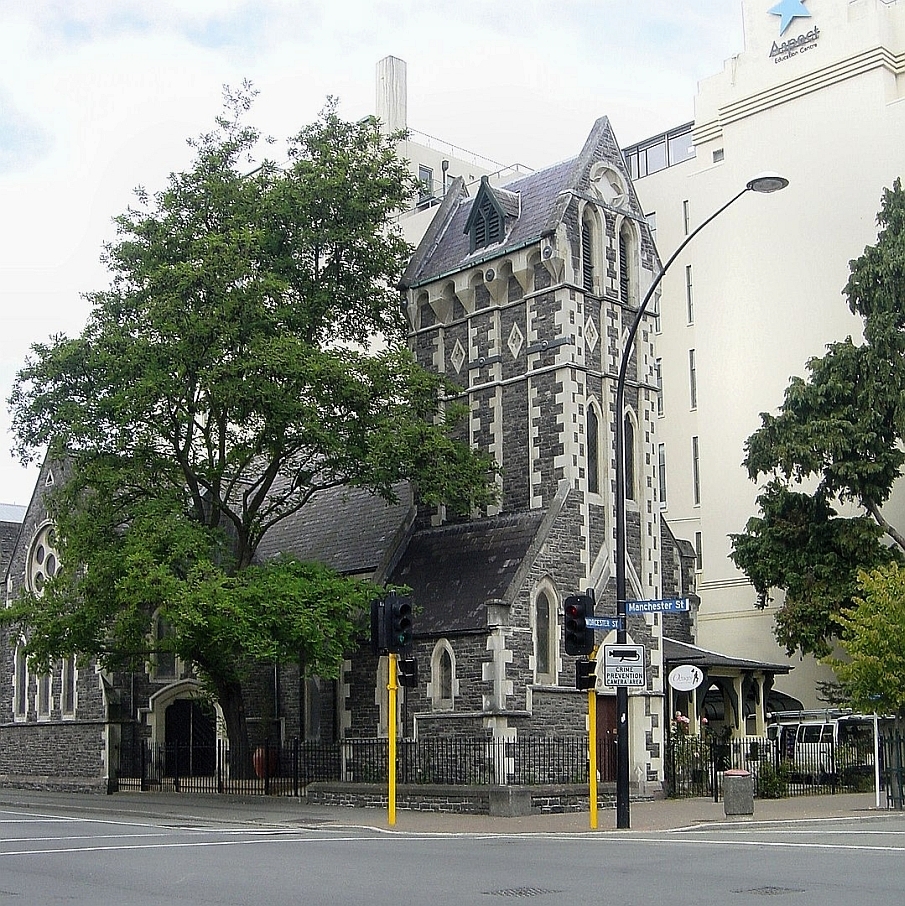
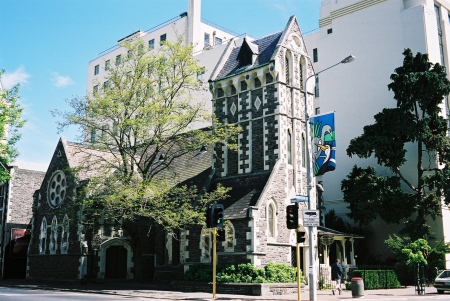
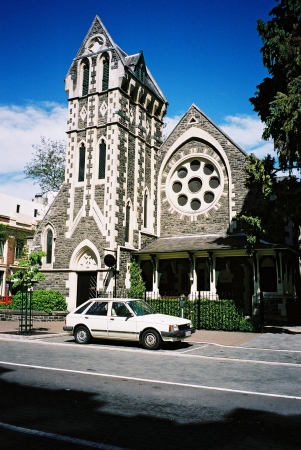
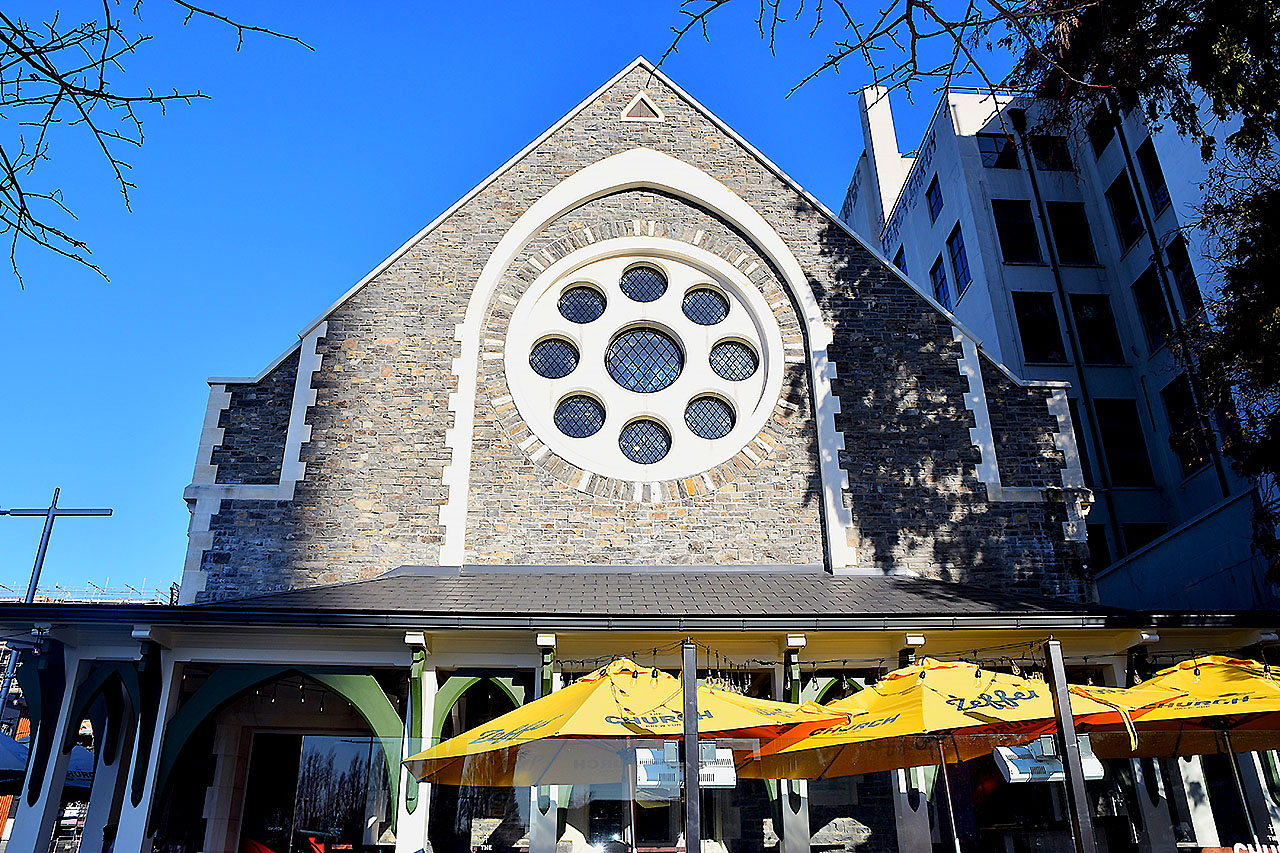
The Gothic Revival church Mountfort designed for the Trinity Congregational Church was his first stone church built in Canterbury. Mountfort had earlier designed a number of churches in stone, but congregations had not had the funds to have them built. Mountfort's design reflected the demands of the Congregationalists by providing a central space with a gallery at the rear, which ensured all members of the congregation could see the minister. The church was cruciform in plan with very short transepts which made the central space octagonal in shape. Mountfort's ceiling for this space is a double-barrel vault panelled in timber which has been described as 'one of Mountfort's most impressive and original inventions'. (Lochhead, 1999; 198) The exterior of the church is stone with a striking asymmetrical composition dominated by the tower on the corner of Worcester and Manchester Streets.
During the 1960s the Christchurch community of the Pacific Islanders' Congregational Church also began to hold their services at Trinity Congregational Church, and in 1968 the two congregations, Pakeha and Pacific Islander, were formally combined. The next year the Trinity-Pacific Congregational Church combined with the Presbyterian church of St Paul's in Cashel Street. (Now known as St Paul's-Trinity-Pacific Presbyterian Church, it is also registered by the New Zealand Historic Places Trust/Pouhere Taonga.) This uniting of Presbyterian and Congregationalism took place throughout New Zealand at this time, partly because a common international denominational body already existed; the World Alliance of Reformed Churches. The modest number of Congregational churches and their small congregations also influenced the decision to join the Presbyterians. The creation of the St Paul's-Trinity-Pacific Presbyterian Church led ultimately to the sale of Trinity Church. The congregation could not support two churches and required money for a new church hall and social centre in Cashel Street. Consequently in 1973 Trinity Church was put up for sale. After much public debate over its fate, it was purchased by the State Insurance Company who opened it as a community performing arts centre in 1975. It has since become a chapel for Japanese wedding blessings.
Trinity Church is significant as the first of Mountfort's churches to be built in stone. The internal timber roof with its double barrel vault is an elegant solution to the difficulty of roofing an octagonal space, a space created by the requirements of the Congregational way of worship. The exterior is an impressive composition of strong Gothic forms and the church forms a distinctive part of the townscape of Worcester and Manchester Streets.
List Entry Information
Status
Listed
List Entry Status
Historic Place Category 1
Access
Private/No Public Access
List Number
306
Date Entered
2nd April 1985
Date of Effect
2nd April 1985
City/District Council
Christchurch City
Region
Canterbury Region
Legal description
Lot 1 DP 7778 Pt Town Section 749
Status
Listed
List Entry Status
Historic Place Category 1
Access
Private/No Public Access
List Number
306
Date Entered
2nd April 1985
Date of Effect
2nd April 1985
City/District Council
Christchurch City
Region
Canterbury Region
Legal description
Lot 1 DP 7778 Pt Town Section 749
Construction Professional
Name
Mountfort, Benjamin Woolfield
Type
Architect
Biography
Benjamin Woolfield Mountfort (1825-98) trained as an architect in England, in the office of Richard Cromwell Carpenter, a member of the Cambridge Camden Society (later the Ecclesiological Society). He arrived in Canterbury in 1850. Mountfort was New Zealand's pre-eminent Gothic Revival architect and, according to architectural historian Ian Lochhead, 'did most to shape the architectural character of nineteenth-century Christchurch.' The buildings he designed were almost exclusively in the Gothic Revival style. During his career he designed many churches and additions to churches; those still standing include the Trinity Congregational Church in Christchurch (1874), St Mary's Church in Parnell, Auckland and the Church of the Good Shepherd in Phillipstown, Christchurch (1884). In 1857 he became the first architect to the province of Canterbury. He designed the Canterbury Provincial Council Buildings in three stages from 1858 to 1865. The stone chamber of this building can be considered the greatest accomplishment of his career. He was involved in many important commissions from the 1870s, including the Canterbury Museum (1869-82) and the Clock-tower Block on the Canterbury College campus (1876-77). He was also involved in the construction of Christchurch's Cathedral and made several major modifications to the original design. Mountfort introduced a number of High Victorian elements to New Zealand architecture, such as the use of constructional polychromy, probably first used in New Zealand in the stone tower of the Canterbury Provincial Government Buildings (1859). Overall, his oeuvre reveals a consistent and virtually unerring application of Puginian principles including a commitment to the Gothic style, honest use of materials and picturesque utility. The result was the construction of inventive and impressive buildings of outstanding quality. He died in Christchurch in 1898. A belfry at the Church of the Good Shepherd in Phillipstown, the church he attended for the last ten years of his life, was erected in his honour.
Construction Details
Start Year
1873
Type
Designed
Start Year
1873
Finish Year
1875
Type
Original Construction
Start Year
1913
Type
Modification
Description
Vestry demolished to allow for construction of parish hall
Construction Professional
Name
Mountfort, Benjamin Woolfield
Type
Architect
Biography
Benjamin Woolfield Mountfort (1825-98) trained as an architect in England, in the office of Richard Cromwell Carpenter, a member of the Cambridge Camden Society (later the Ecclesiological Society). He arrived in Canterbury in 1850. Mountfort was New Zealand's pre-eminent Gothic Revival architect and, according to architectural historian Ian Lochhead, 'did most to shape the architectural character of nineteenth-century Christchurch.' The buildings he designed were almost exclusively in the Gothic Revival style. During his career he designed many churches and additions to churches; those still standing include the Trinity Congregational Church in Christchurch (1874), St Mary's Church in Parnell, Auckland and the Church of the Good Shepherd in Phillipstown, Christchurch (1884). In 1857 he became the first architect to the province of Canterbury. He designed the Canterbury Provincial Council Buildings in three stages from 1858 to 1865. The stone chamber of this building can be considered the greatest accomplishment of his career. He was involved in many important commissions from the 1870s, including the Canterbury Museum (1869-82) and the Clock-tower Block on the Canterbury College campus (1876-77). He was also involved in the construction of Christchurch's Cathedral and made several major modifications to the original design. Mountfort introduced a number of High Victorian elements to New Zealand architecture, such as the use of constructional polychromy, probably first used in New Zealand in the stone tower of the Canterbury Provincial Government Buildings (1859). Overall, his oeuvre reveals a consistent and virtually unerring application of Puginian principles including a commitment to the Gothic style, honest use of materials and picturesque utility. The result was the construction of inventive and impressive buildings of outstanding quality. He died in Christchurch in 1898. A belfry at the Church of the Good Shepherd in Phillipstown, the church he attended for the last ten years of his life, was erected in his honour.
Construction Details
Start Year
1873
Type
Designed
Start Year
1873
Finish Year
1875
Type
Original Construction
Start Year
1913
Type
Modification
Description
Vestry demolished to allow for construction of parish hall
Historical and Associated Iwi / Hapū / Whānau
Completion Date
17th October 2001
Report Written By
Melanie Lovell-Smith
Information Sources
Keey, 1974
R.B. Keey, To Him be the Glory: The Story of Trinity Congregational Church, Christchurch, Christchurch, 1974.
Lochhead, 1999
Ian Lochhead, A Dream of Spires: Benjamin Mountfort and the Gothic Revival, Christchurch, 1999
Other Information
This place was identified as significant under previous legislation with different information requirements. It remains significant under the current legislation. There is opportunity under our legislation and policies to add to this information. Further information about this place may be available from the Southern Regional Office of Heritage New Zealand Pouhere Taonga. Trinity Congregational Church won the supreme award and heritage retention award at the 2012 Canterbury Heritage Awards. Please note that entry on the New Zealand Heritage List/Rarangi Korero identifies only the heritage values of the property concerned, and should not be construed as advice on the state of the property, or as a comment of its soundness or safety, including in regard to earthquake risk, safety in the event of fire, or insanitary conditions.
Historical and Associated Iwi / Hapū / Whānau
Completion Date
17th October 2001
Report Written By
Melanie Lovell-Smith
Information Sources
Keey, 1974
R.B. Keey, To Him be the Glory: The Story of Trinity Congregational Church, Christchurch, Christchurch, 1974.
Lochhead, 1999
Ian Lochhead, A Dream of Spires: Benjamin Mountfort and the Gothic Revival, Christchurch, 1999
Other Information
This place was identified as significant under previous legislation with different information requirements. It remains significant under the current legislation. There is opportunity under our legislation and policies to add to this information. Further information about this place may be available from the Southern Regional Office of Heritage New Zealand Pouhere Taonga. Trinity Congregational Church won the supreme award and heritage retention award at the 2012 Canterbury Heritage Awards. Please note that entry on the New Zealand Heritage List/Rarangi Korero identifies only the heritage values of the property concerned, and should not be construed as advice on the state of the property, or as a comment of its soundness or safety, including in regard to earthquake risk, safety in the event of fire, or insanitary conditions.
Current Usages
Uses: Religion
Specific Usage: Chapel
Former Usages
General Usage: Civic Facilities
Specific Usage: Art Centre
General Usage: Religion
Specific Usage: Church
Current Usages
Uses: Religion
Specific Usage: Chapel
Former Usages
General Usage: Civic Facilities
Specific Usage: Art Centre
General Usage: Religion
Specific Usage: Church
Location
Sign up to hear more
Get the latest heritage news, features and events delivered
straight to your inbox.
