

The Waimāhaka Estate has had a long association with the Holms family. James Holms (d.1908) took up Crown grants on the land in the early 1870s. Following his death in 1908, his son Alexander Scott Holms (1873-1953) took over the property and extended the estate. On 12 September 1928, Invercargill architects C.J. Brodrick (1867-1946) and T.P. Royds (1884-1935) invited tenders for the ‘erection of two-storey Brick Residence at Waimāhaka for A.S. Holmes.’ Ruth Helms writes that Waimāhaka resembles Cecil Wood’s Anderson Park Homestead (1924) in Invercargill, and this property likely inspired Brodrick and Royds.
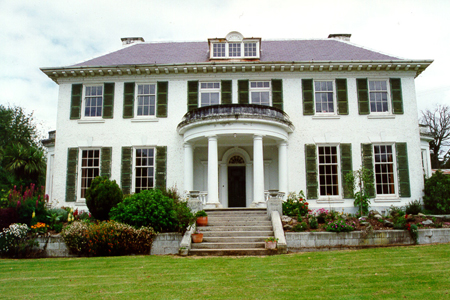
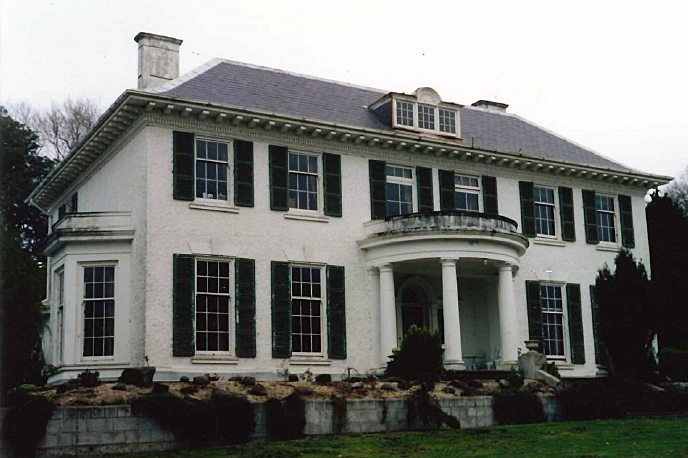
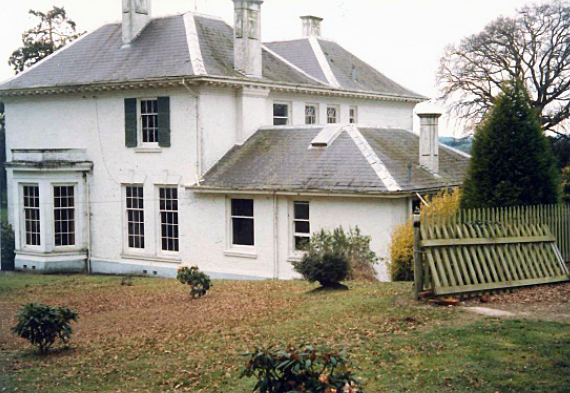
This two storied double brick building is set on a knoll in park-like surroundings with mature trees and shrubs. It is covered with white roughcast and bears a slated hipped roof which flares outwards as it reaches the eaves. The brackets and dentil course under the eaves and the window shutters are wooden. The sash windows have small square panes with the lower sashes larger than the top sashes. The top story windows are smaller than those of the lower story and are surmounted by a keystone. The combined effect is a sense of elevation. Additional bay windows project laterally from the ground floor rooms at each side. The main entrance is located in the centre of the garden front which is emphasised by a semi-circular concrete portico projecting from the ground floor supported by four columns with Doric capitals. The doorway is placed within a Serliana arch, with a palmette fanlight. In the attic a three sash dormer window is set into the roof with a shell tympanum over it, reflecting the design of fanlight below. At the rear of the building, a covered porch leads to a row of one storied outhouse rooms. The interior of the homestead has a typically Georgian layout with the main rooms aligned on either side of a central hallway which is lined with heart rimu. The house has seven bedrooms, and five living rooms. The fireplaces in the reception rooms are brick with dark-stained timber surrounds and the drawing room has a decorative plaster ceiling. A Jacobean staircase with barley sugar balustrade rises from a large hall with specially carved furniture made by P. Swanson.
In 1950, the property passed to sons James Holms and Henderson Holms, and these two continued to uphold the Waimāhaka Estate’s reputation. In 2019, the property remains in the ownership of the Holms family.
[The information above comes from an upgrade report completed in July 2019].
List Entry Information
Status
Listed
List Entry Status
Historic Place Category 1
Access
Private/No Public Access
List Number
381
Date Entered
27th July 1988
Date of Effect
27th July 1988
City/District Council
Southland District
Region
Southland Region
Extent of List Entry
Extent includes part of the land described as Pt Sec 52 Blk IV Toetoes SD (RT SL178/2), Southland Land District, and the building known as the Waimāhaka Homestead thereon, and its fittings and fixtures. Refer to the extent map tabled at the Rārangi Kōrero Committee meeting on 25 July 2019.
Legal description
Pt Sec 52 Blk IV Toetoes SD (RT SL178/2), Southland Land District
Status
Listed
List Entry Status
Historic Place Category 1
Access
Private/No Public Access
List Number
381
Date Entered
27th July 1988
Date of Effect
27th July 1988
City/District Council
Southland District
Region
Southland Region
Extent of List Entry
Extent includes part of the land described as Pt Sec 52 Blk IV Toetoes SD (RT SL178/2), Southland Land District, and the building known as the Waimāhaka Homestead thereon, and its fittings and fixtures. Refer to the extent map tabled at the Rārangi Kōrero Committee meeting on 25 July 2019.
Legal description
Pt Sec 52 Blk IV Toetoes SD (RT SL178/2), Southland Land District
Why is this place significant?
Historic Significance
This historic place was registered under the Historic Places Act 1980. The information below comes from the original Building Classification Committee report considered by the NZHPT Board at the time of registration. Historical Significance or Value The Crown grants on the land in this area were taken up by James Holms (a settlers from Scotland) from the early 1870s onwards. James built a large Gothic house on the site and his son, Alexander Scott Holms, replaced it with this house in 1929. James Holms started what is now the oldest continuously maintained Hereford stud in New Zealand, buying three heifers and a bull from R and E McLean of Auckland in 1876, and making further imports from Australia. He also established the earliest Romney stud in New Zealand but this has not been continuously maintained.
Physical Significance
This historic place was registered under the Historic Places Act 1980. The information below comes from the original Building Classification Committee report considered by the NZHPT Board at the time of registration. Architectural Significance or Value Georgian was not as popular a style in New Zealand as Gothic, classic and after 1900, the Arts and Crafts English cottage were. This building is more like some of the great Australian houses built in the early nineteenth century. The style however is a harmonious development from the early cottages such as Ewelme which was a Colonial Georgian form. Waimahaka's setting and grounds are particularly in keeping. TOWNSCAPE/LANDMARK SIGNIFICANCE: The position of the house makes it visible from several miles around.
Why is this place significant?
Historic Significance
This historic place was registered under the Historic Places Act 1980. The information below comes from the original Building Classification Committee report considered by the NZHPT Board at the time of registration. Historical Significance or Value The Crown grants on the land in this area were taken up by James Holms (a settlers from Scotland) from the early 1870s onwards. James built a large Gothic house on the site and his son, Alexander Scott Holms, replaced it with this house in 1929. James Holms started what is now the oldest continuously maintained Hereford stud in New Zealand, buying three heifers and a bull from R and E McLean of Auckland in 1876, and making further imports from Australia. He also established the earliest Romney stud in New Zealand but this has not been continuously maintained.
Physical Significance
This historic place was registered under the Historic Places Act 1980. The information below comes from the original Building Classification Committee report considered by the NZHPT Board at the time of registration. Architectural Significance or Value Georgian was not as popular a style in New Zealand as Gothic, classic and after 1900, the Arts and Crafts English cottage were. This building is more like some of the great Australian houses built in the early nineteenth century. The style however is a harmonious development from the early cottages such as Ewelme which was a Colonial Georgian form. Waimahaka's setting and grounds are particularly in keeping. TOWNSCAPE/LANDMARK SIGNIFICANCE: The position of the house makes it visible from several miles around.
Construction Professional
Name
Brodrick and Royds
Type
Architectural Partnership
Biography
uthbert John Brodrick (1867-1946) was born in Invercargill, the fifth son of Thomas Brodrick. He was named for his uncle, the well-known Victorian architect Cuthbert Brodrick (1822-1905). Brodrick was educated at Southland Boys High School. In 1884 Brodrick was articled to F.W. Burwell and trained in the classical tradition, travelling to Melbourne with Burwell to complete his training. Brodrick returned to New Zealand in 1891 after architectural draughting in Queensland for the Government. In 1906 he married Jemima ('Nonnie') Thomson, stepdaughter of surveyor John Turnbull Thomson. After practising in Hawera for six years he returned to Invercargill. Brodrick entered into a partnership with his pupil Thomas Royds during World War One. Royds died in 1936. Brodrick retired from practice about 1943. During his career, he served as President of the Institute of Architects in 1911, as Vice-President in 1917, and as a member of the council in 1935. The first building he designed in Invercargill was the Alexandra building. Others (with partner Thomas Royds) included the Italian Renaissance Bank of New South Wales (1912), the Kaiapoi building, the Grand Hotel (1914), the Edwardian Baroque Southland Daily News (1913), the stripped Classical Invercargill Savings Bank (1926), the classical temple Masonic Lodge of St John (1926), the Georgian Waimahaka Homestead, and grandstands for the Southland Racing Club. Brodrick was also a member of the Borough Council for three terms and became Deputy Mayor. Thomas Parry Royds (c.1884-1936) was the son of Thomas Royds, an Invercargill accountant and estate agent. On leaving school, Royds trained as an architect in C J Brodrick’s office. He became a partner in the practice during World War One.
Name
Blue, John (1870-1952)
Type
Builder
Biography
John Blue was an Invercargill contractor active in the early-mid twentieth century in the city and surrounding districts. His father, also John Blue, was from West Kilbride in Ayrshire, Scotland, where he trained as a carpenter. He settled in Waianiwa in Southland, carrying on his trade as a builder.
Construction Details
Finish Year
2009
Type
Maintenance/repairs
Description
Replacement of roof
Construction Materials
This historic place was registered under the Historic Places Act 1980. The information below comes from the original Building Classification Committee report considered by the NZHPT Board at the time of registration. The house is built in double brick covered with white cast. The roof is covered with slated thought to be from Wales and the ridges covered with galvanised metal. The building is two storied with a hipped roof which curves elegantly outwards close to the eaves. The house is symmetrical about the front porch which is a colonnaded drum with simple Ionic columns rising to a balcony. The porch is built in concrete. The brackets and dentil course under the eaves and the window shutters are wooden. Bay windows project laterally from the ground floor rooms at each side. The sash windows have small square panes and have larger lower sashes than top sashes. The top story windows are smaller than those of the lower story. Each is surmounted by a keystone. At the back a covered porch leads to a row of one storied outhouse rooms. From the front a three sash dormer window is set into the roof with a shell arch over it, letting light into the attics. The house has seven bedrooms, and five living rooms. The walls are lined with heart Rimu, and the original brick fireplaces are still in place. The decorative plaster ceilings and original light fittings are still present in some of the rooms. A Jacobean staircase with barley sugar balustrade rises from a large hall with specially carved furniture made by P Swanson. The house is set on a knoll in park like surroundings with mature trees and shrubs. The front lawn runs down to a ha-ha built by the present owner, presenting a view of continuous grass running out to the paddocks where stud Hereford cows graze.
Notable Features
This historic place was registered under the Historic Places Act 1980. The information below comes from the original Building Classification Committee report considered by the NZHPT Board at the time of registration. Its complete Georgian character and setting, its association with early Hereford and Romney studs.
Construction Professional
Name
Brodrick and Royds
Type
Architectural Partnership
Biography
uthbert John Brodrick (1867-1946) was born in Invercargill, the fifth son of Thomas Brodrick. He was named for his uncle, the well-known Victorian architect Cuthbert Brodrick (1822-1905). Brodrick was educated at Southland Boys High School. In 1884 Brodrick was articled to F.W. Burwell and trained in the classical tradition, travelling to Melbourne with Burwell to complete his training. Brodrick returned to New Zealand in 1891 after architectural draughting in Queensland for the Government. In 1906 he married Jemima ('Nonnie') Thomson, stepdaughter of surveyor John Turnbull Thomson. After practising in Hawera for six years he returned to Invercargill. Brodrick entered into a partnership with his pupil Thomas Royds during World War One. Royds died in 1936. Brodrick retired from practice about 1943. During his career, he served as President of the Institute of Architects in 1911, as Vice-President in 1917, and as a member of the council in 1935. The first building he designed in Invercargill was the Alexandra building. Others (with partner Thomas Royds) included the Italian Renaissance Bank of New South Wales (1912), the Kaiapoi building, the Grand Hotel (1914), the Edwardian Baroque Southland Daily News (1913), the stripped Classical Invercargill Savings Bank (1926), the classical temple Masonic Lodge of St John (1926), the Georgian Waimahaka Homestead, and grandstands for the Southland Racing Club. Brodrick was also a member of the Borough Council for three terms and became Deputy Mayor. Thomas Parry Royds (c.1884-1936) was the son of Thomas Royds, an Invercargill accountant and estate agent. On leaving school, Royds trained as an architect in C J Brodrick’s office. He became a partner in the practice during World War One.
Name
Blue, John (1870-1952)
Type
Builder
Biography
John Blue was an Invercargill contractor active in the early-mid twentieth century in the city and surrounding districts. His father, also John Blue, was from West Kilbride in Ayrshire, Scotland, where he trained as a carpenter. He settled in Waianiwa in Southland, carrying on his trade as a builder.
Construction Details
Finish Year
2009
Type
Maintenance/repairs
Description
Replacement of roof
Construction Materials
This historic place was registered under the Historic Places Act 1980. The information below comes from the original Building Classification Committee report considered by the NZHPT Board at the time of registration. The house is built in double brick covered with white cast. The roof is covered with slated thought to be from Wales and the ridges covered with galvanised metal. The building is two storied with a hipped roof which curves elegantly outwards close to the eaves. The house is symmetrical about the front porch which is a colonnaded drum with simple Ionic columns rising to a balcony. The porch is built in concrete. The brackets and dentil course under the eaves and the window shutters are wooden. Bay windows project laterally from the ground floor rooms at each side. The sash windows have small square panes and have larger lower sashes than top sashes. The top story windows are smaller than those of the lower story. Each is surmounted by a keystone. At the back a covered porch leads to a row of one storied outhouse rooms. From the front a three sash dormer window is set into the roof with a shell arch over it, letting light into the attics. The house has seven bedrooms, and five living rooms. The walls are lined with heart Rimu, and the original brick fireplaces are still in place. The decorative plaster ceilings and original light fittings are still present in some of the rooms. A Jacobean staircase with barley sugar balustrade rises from a large hall with specially carved furniture made by P Swanson. The house is set on a knoll in park like surroundings with mature trees and shrubs. The front lawn runs down to a ha-ha built by the present owner, presenting a view of continuous grass running out to the paddocks where stud Hereford cows graze.
Notable Features
This historic place was registered under the Historic Places Act 1980. The information below comes from the original Building Classification Committee report considered by the NZHPT Board at the time of registration. Its complete Georgian character and setting, its association with early Hereford and Romney studs.
This historic place was registered under the Historic Places Act 1980. The information below comes from the original Building Classification Committee report considered by the NZHPT Board at the time of registration. ARCHITECTURAL DESCRIPTION (Style): This is a particularly fine Georgian house similar to Andersons Park, Invercargill. The symmetry, restrained classical detail and gentle curve to the hipped roof and panelled chimneys are typical of this style. MODIFICATIONS: The facades are unmodified. Inside the kitchen had been modernised and brick surfaces revealed. The grounds are being modified to provide the vistas appropriate to such a house and new plantings of Rhododendrons made. [Also attributed to Brodrick and Royd of Invercargill in information provided by NZHPT branch committee and members of the Holms family]
This historic place was registered under the Historic Places Act 1980. The information below comes from the original Building Classification Committee report considered by the NZHPT Board at the time of registration. ARCHITECTURAL DESCRIPTION (Style): This is a particularly fine Georgian house similar to Andersons Park, Invercargill. The symmetry, restrained classical detail and gentle curve to the hipped roof and panelled chimneys are typical of this style. MODIFICATIONS: The facades are unmodified. Inside the kitchen had been modernised and brick surfaces revealed. The grounds are being modified to provide the vistas appropriate to such a house and new plantings of Rhododendrons made. [Also attributed to Brodrick and Royd of Invercargill in information provided by NZHPT branch committee and members of the Holms family]
Historical and Associated Iwi / Hapū / Whānau
Completion Date
27th June 2019
Report Written By
Sarah Gallagher and Heather Bauchop
Information Sources
Helms, 1999
Helms, Ruth, ‘Georgian in Southland’, New Zealand Historic Places, May 1999, pp. 14-16.
Other Information
A fully referenced upgrade report is available on request from the Otago/Southland Office of Heritage New Zealand. This historic place was registered under the Historic Places Act 1980. This report includes the text from the original Building Classification Committee report considered by the NZHPT Board at the time of registration. Please note that entry on the New Zealand Heritage List/Rarangi Korero identifies only the heritage values of the property concerned, and should not be construed as advice on the state of the property, or as a comment of its soundness or safety, including in regard to earthquake risk, safety in the event of fire, or insanitary conditions.
Historical and Associated Iwi / Hapū / Whānau
Completion Date
27th June 2019
Report Written By
Sarah Gallagher and Heather Bauchop
Information Sources
Helms, 1999
Helms, Ruth, ‘Georgian in Southland’, New Zealand Historic Places, May 1999, pp. 14-16.
Other Information
A fully referenced upgrade report is available on request from the Otago/Southland Office of Heritage New Zealand. This historic place was registered under the Historic Places Act 1980. This report includes the text from the original Building Classification Committee report considered by the NZHPT Board at the time of registration. Please note that entry on the New Zealand Heritage List/Rarangi Korero identifies only the heritage values of the property concerned, and should not be construed as advice on the state of the property, or as a comment of its soundness or safety, including in regard to earthquake risk, safety in the event of fire, or insanitary conditions.
Current Usages
Uses: Accommodation
Specific Usage: House
Former Usages
General Usage: Accommodation
Specific Usage: House
Current Usages
Uses: Accommodation
Specific Usage: House
Former Usages
General Usage: Accommodation
Specific Usage: House
Location
Sign up to hear more
Get the latest heritage news, features and events delivered
straight to your inbox.
