

Remuera has been associated with the settlement of rich and successful Aucklanders since the middle of the nineteenth century. From about 1900, the palatial houses of the wealthiest settlers of the 1800s made room for the smaller, but often grander townhouses of the city’s commercial and professional élite. During the 1880s, the site of Stansfield House was occupied by well-known solicitor Robert Browning and his wife Kate (nee Buckland). In 1912, part of the Browning property was sold to Ida Stansfield. Ida’s husband, Harry Stansfield, was a highly skilled mining engineer.
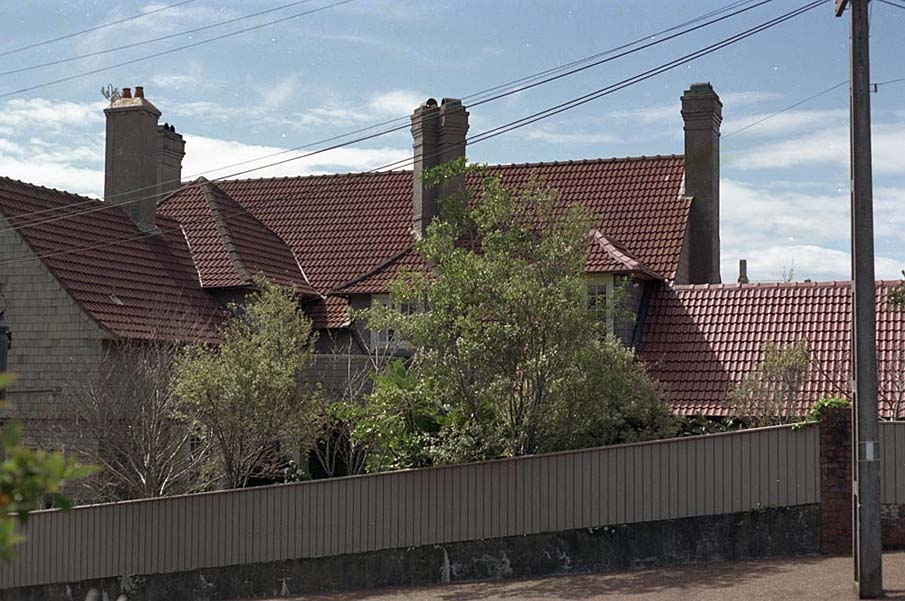
As designed by Bamford and Pierce, Stansfield House had an L-shaped plan. It was clad with weatherboards on its lower storey, shingles on the upper storey and Marseille tiles on its sloping roofs. The ground floor contained three reception rooms, each with a fireplace, behind which ran a corridor or gallery. A rounded portico, with a small verandah above, marked the front entrance. The house was orientated to the north to maximise views of scenic Rangitoto Island from its drawing room, open verandahs, principal bedrooms, and sleeping porch set in its sloping roof. A service wing at the rear created a semi-courtyard, and contained the kitchen and laundry, with servant’s bedroom above. The residence also incorporated a large garden.
The design exhibits similarities to a number of other Bamford and Pierce houses. Although of similar scale to the former Coolangatta, Stansfield House - with its sweeping roofs, large gables and exterior treatment - is more cottage-like. A large rounded bay window in the drawing room and the ‘Juliet balconies’ were similar to those in the house designed for Dr Alexander Kinder in Parnell. The Stansfield house was recognised as architecturally important soon after its completion: it featured in the Building Progress in 1914, and in the Ladies Mirror in 1922.
In 1928, the property was purchased by Isabella Whitelaw, a single woman. In 1931 Isabella sold the house to her sister Enid, who was also unmarried. After 1940, the house passed through other owners, including the major Pacific trader Alexander Bell Donald junior, who owned the property between 1953 and 1978. Alterations were made in the 1950s-1960s, and again in the 1980s. More recent modifications have included the removal of the rounded portico; and construction of a substantial two-storey extension (to the north), a new garage and porte cochere and the reversal of a number of earlier changes - open verandahs have been reinstated on the ground and first floors.
In 2015, the house remained in use as a private dwelling.
List Entry Information
Status
Listed
List Entry Status
Historic Place Category 2
Access
Private/No Public Access
List Number
604
Date Entered
26th November 1981
Date of Effect
26th November 1981
City/District Council
Auckland Council
Region
Auckland Council
Extent of List Entry
Extent includes the land described as Lot 17, Pt Lot 10 DP 222 (RT NA205/246) North Auckland Land District, and the buildings and structures known as Stansfield House (Former) thereon.
Legal description
Lot 17, Pt Lot 10 DP 222 (RT NA205/246), North Auckland Land District
Status
Listed
List Entry Status
Historic Place Category 2
Access
Private/No Public Access
List Number
604
Date Entered
26th November 1981
Date of Effect
26th November 1981
City/District Council
Auckland Council
Region
Auckland Council
Extent of List Entry
Extent includes the land described as Lot 17, Pt Lot 10 DP 222 (RT NA205/246) North Auckland Land District, and the buildings and structures known as Stansfield House (Former) thereon.
Legal description
Lot 17, Pt Lot 10 DP 222 (RT NA205/246), North Auckland Land District
Construction Professional
Name
Bamford & Pierce
Type
Architectural Partnership
Biography
F Noel Bamford and A P Hector Pierce were born in New Zealand. Pierce was the pupil of architect A.P. Wilson and Bamford studied under Edward Bartley during the building of St Matthew's Church, which was commenced in 1902. Bamford worked for the renowned English architect Edwin Lutyens in England before 1907. Bamford and Pierce were in partnership in 1906 and again from 1909 to 1917. Pierce was considered to be the steady worker of the partnership; Bamford the more flamboyant and creative. Bamford and Pierce designed buildings for the Auckland Exhibition of which the Tea Kiosk in the Domain (1914) is the sole survivor. They were also responsible for the house at 1 St Georges Bay Rd (1910) and Neligan House, Parnell (1910). After the death of Pierce in 1916 little is known of Bamford. He designed the house at 28 Gilgit Road for his brother Dean in 1917 and worked for Gummer and Ford for several months in 1920. At some time he was employed by the Hamilton Construction Company as Clerk of Works. Bamford was Vice-President of the Auckland Architectural Students' Association in 1918 and was the Association's first "visiting architect".
Construction Details
Type
Modification
Description
Kitchen altered; one front verandah (of two) enclosed; upstairs sleeping porch enclosed
Period
1950s-60s
Type
Addition
Description
Deck; garage
Period
1980s
Type
Modification
Description
Second verandah enclosed; internal alterations
Period
1980s
Type
Addition
Description
Two-storey extension (north); garage; porte cochere
Period
2014-15
Type
Modification
Description
Porte cochere (1913) removed; open verandahs reinstated; bay windows added; some earlier changes reversed
Period
2014-15
Type
Other
Description
Demolition – 1980s deck and garage
Construction Professional
Name
Bamford & Pierce
Type
Architectural Partnership
Biography
F Noel Bamford and A P Hector Pierce were born in New Zealand. Pierce was the pupil of architect A.P. Wilson and Bamford studied under Edward Bartley during the building of St Matthew's Church, which was commenced in 1902. Bamford worked for the renowned English architect Edwin Lutyens in England before 1907. Bamford and Pierce were in partnership in 1906 and again from 1909 to 1917. Pierce was considered to be the steady worker of the partnership; Bamford the more flamboyant and creative. Bamford and Pierce designed buildings for the Auckland Exhibition of which the Tea Kiosk in the Domain (1914) is the sole survivor. They were also responsible for the house at 1 St Georges Bay Rd (1910) and Neligan House, Parnell (1910). After the death of Pierce in 1916 little is known of Bamford. He designed the house at 28 Gilgit Road for his brother Dean in 1917 and worked for Gummer and Ford for several months in 1920. At some time he was employed by the Hamilton Construction Company as Clerk of Works. Bamford was Vice-President of the Auckland Architectural Students' Association in 1918 and was the Association's first "visiting architect".
Construction Details
Type
Modification
Description
Kitchen altered; one front verandah (of two) enclosed; upstairs sleeping porch enclosed
Period
1950s-60s
Type
Addition
Description
Deck; garage
Period
1980s
Type
Modification
Description
Second verandah enclosed; internal alterations
Period
1980s
Type
Addition
Description
Two-storey extension (north); garage; porte cochere
Period
2014-15
Type
Modification
Description
Porte cochere (1913) removed; open verandahs reinstated; bay windows added; some earlier changes reversed
Period
2014-15
Type
Other
Description
Demolition – 1980s deck and garage
Historical and Associated Iwi / Hapū / Whānau
Completion Date
3rd December 2015
Report Written By
Elizabeth Cox
Information Sources
New Zealand Building Progress
New Zealand Building Progress
Carlyon and Morrow, 2011
Carlyon, Jenny, and Diana Morrow, A Fine Prospect: A History of Remuera, Meadowbank and St Johns, Auckland, 2011.
Macky & White, 2010
Macky, Peter and Paul Waite, Coolangatta A Homage: The Life and Times of Auckland’s Most Admired Residence, Auckland, 2010.
Carnachan & Heath, 1969
Carnachan, J.S. and Heath, T.W., ‘Report Donald House, Corner of Arney Road and Arney Crescent, Remuera’, B.Arch. assignment, University of Auckland, 1969.
Ladies Mirror
Archives New Zealand
Archives New Zealand, ‘Posting Boxes’, n.d., BAEH A867 22779 [9/1].
Other Information
This place was identified as significant under previous legislation with different information requirements. It remains significant under the current legislation. There is opportunity under our legislation and policies to add to this information. Further information about this place may be available from the Northern Regional Office of Heritage New Zealand Pouhere Taonga. Please note that entry on the New Zealand Heritage List/Rarangi Korero identifies only the heritage values of the property concerned, and should not be construed as advice on the state of the property, or as a comment of its soundness or safety, including in regard to earthquake risk, safety in the event of fire, or insanitary conditions. A fully referenced upgrade report is available on request from the Northern Region Office of Heritage New Zealand
Historical and Associated Iwi / Hapū / Whānau
Completion Date
3rd December 2015
Report Written By
Elizabeth Cox
Information Sources
New Zealand Building Progress
New Zealand Building Progress
Carlyon and Morrow, 2011
Carlyon, Jenny, and Diana Morrow, A Fine Prospect: A History of Remuera, Meadowbank and St Johns, Auckland, 2011.
Macky & White, 2010
Macky, Peter and Paul Waite, Coolangatta A Homage: The Life and Times of Auckland’s Most Admired Residence, Auckland, 2010.
Carnachan & Heath, 1969
Carnachan, J.S. and Heath, T.W., ‘Report Donald House, Corner of Arney Road and Arney Crescent, Remuera’, B.Arch. assignment, University of Auckland, 1969.
Ladies Mirror
Archives New Zealand
Archives New Zealand, ‘Posting Boxes’, n.d., BAEH A867 22779 [9/1].
Other Information
This place was identified as significant under previous legislation with different information requirements. It remains significant under the current legislation. There is opportunity under our legislation and policies to add to this information. Further information about this place may be available from the Northern Regional Office of Heritage New Zealand Pouhere Taonga. Please note that entry on the New Zealand Heritage List/Rarangi Korero identifies only the heritage values of the property concerned, and should not be construed as advice on the state of the property, or as a comment of its soundness or safety, including in regard to earthquake risk, safety in the event of fire, or insanitary conditions. A fully referenced upgrade report is available on request from the Northern Region Office of Heritage New Zealand
Current Usages
Uses: Accommodation
Specific Usage: House
Former Usages
General Usage: Accommodation
Specific Usage: House
Current Usages
Uses: Accommodation
Specific Usage: House
Former Usages
General Usage: Accommodation
Specific Usage: House
Location
Sign up to hear more
Get the latest heritage news, features and events delivered
straight to your inbox.
