Quick links


Quick links
Quick links
Quick links
Quick links
Quick links
602 Mackay Street and Mary Street, THAMES
Private
Historic Place Category 1
List No. 721
List Entry Information
Status
Listed
List Entry Status
Historic Place Category 1
Access
Private/No Public Access
List Number
721
Date Entered
28th June 1990
Date of Effect
28th June 1990
City/District Council
Thames-Coromandel District
Region
Waikato Region
Extent of List Entry
Extent includes the land described as Lots 555, 573 Whakaupapa Blk, and part of the land described as Lots 556‐558 Whakaupapa Blk (RT SA562/179), South Auckland Land District, and the building known as St George’s Church (Anglican) thereon.
Legal description
Lots 555‐558, 573 Whakaupapa Blk (RT SA562/179), South Auckland Land District
Status
Listed
List Entry Status
Historic Place Category 1
Access
Private/No Public Access
List Number
721
Date Entered
28th June 1990
Date of Effect
28th June 1990
City/District Council
Thames-Coromandel District
Region
Waikato Region
Extent of List Entry
Extent includes the land described as Lots 555, 573 Whakaupapa Blk, and part of the land described as Lots 556‐558 Whakaupapa Blk (RT SA562/179), South Auckland Land District, and the building known as St George’s Church (Anglican) thereon.
Legal description
Lots 555‐558, 573 Whakaupapa Blk (RT SA562/179), South Auckland Land District
Why is this place significant?
Historic Significance
Historical Significance or Value This historic place was registered under the Historic Places Act 1980. This report includes the text from the original Building Classification Committee report considered by the NZHPT Board at the time of registration. The building is significant because of its association with the goldrush day's and with Vicesimus Lush and the other early incumbents.
Physical Significance
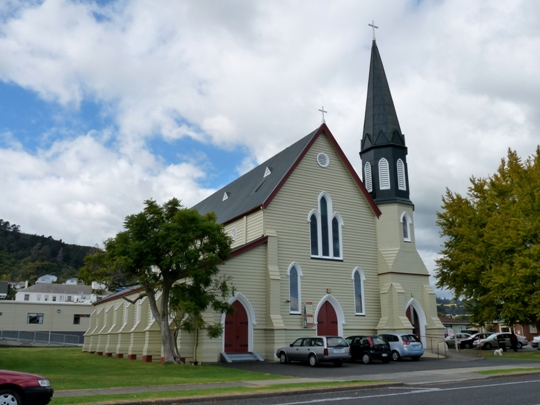
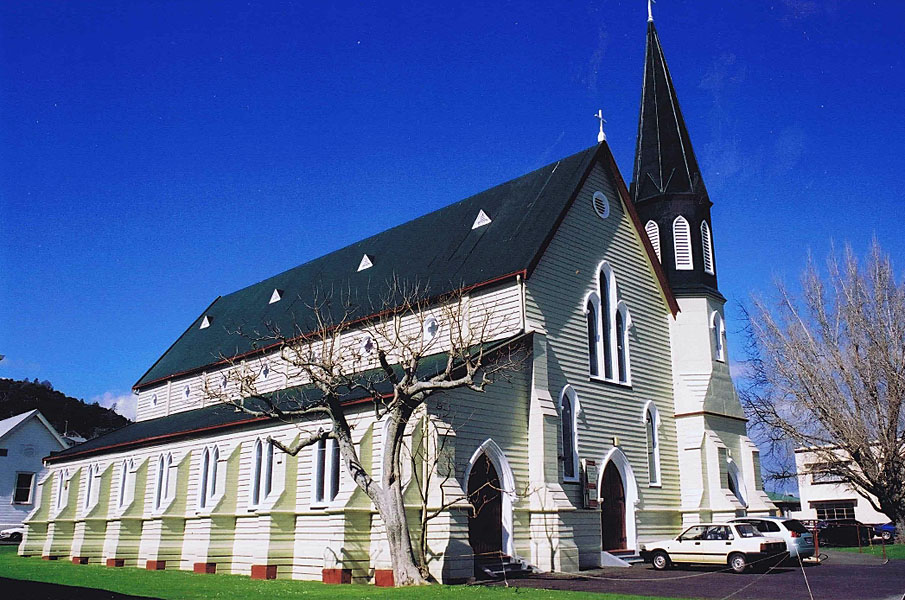
This historic place was registered under the Historic Places Act 1980. This report includes the text from the original Building Classification Committee report considered by the NZHPT Board at the time of registration. ARCHITECTURAL QUALITY: St George's Church, Thames, is another in the fine tradition of wooden neo-Gothic churches in New Zealand. A substantial provincial church with good streetscape quality it has remained largely in its original condition. The robust exterior, with its touches of Gothic decoration, is complemented admirably by the elegant interior. TOWNSCAPE/LANDMARK VALUE: A prominent building in Thames, with considerable streets cape quality
Why is this place significant?
Historic Significance
Historical Significance or Value This historic place was registered under the Historic Places Act 1980. This report includes the text from the original Building Classification Committee report considered by the NZHPT Board at the time of registration. The building is significant because of its association with the goldrush day's and with Vicesimus Lush and the other early incumbents.
Physical Significance
This historic place was registered under the Historic Places Act 1980. This report includes the text from the original Building Classification Committee report considered by the NZHPT Board at the time of registration. ARCHITECTURAL QUALITY: St George's Church, Thames, is another in the fine tradition of wooden neo-Gothic churches in New Zealand. A substantial provincial church with good streetscape quality it has remained largely in its original condition. The robust exterior, with its touches of Gothic decoration, is complemented admirably by the elegant interior. TOWNSCAPE/LANDMARK VALUE: A prominent building in Thames, with considerable streets cape quality
Construction Professional
Name
Mahoney, Edward
Type
Architect
Biography
Edward Mahoney (1824-1895) Edward Mahoney emigrated from Cork, Ireland with his wife Margaret and three children. The Mahoneys arrived in Auckland in 1856 where Edward set up as a building and timber merchant. In 1876 he established the architectural practice that later became Edward Mahoney & Sons, which for over thirty years designed and supervised construction of many Catholic buildings as well as churches for other denominations. The Church of St John the Baptist, Parnell (1861) and St Mary's Convent Chapel (1866) are two of the earliest surviving ecclesiastical buildings designed by Edward Mahoney and reflect the gradual evolution from simple Gothic Revival structures to more ambitious and creative use of the Gothic form such as may be seen in the Church of the Holy Sepulchre, Khyber Pass (1881); and St Patrick's Cathedral, the latter completed in 1901. Edward Mahoney was a founding member of the Auckland Institute of Architects, attending the first meeting in December 1880 where he was appointed honorary treasurer. He became president of the Institute in 1883. His sons Thomas (1855?-1923) and Robert (1862-1895) joined him in practice in 1876 and the early 1880s respectively. Upon Edward's retirement in 1885, Thomas and Robert carried on the practice. After Robert's death in 1895, Thomas changed the firm's name to E. Mahoney & Son. The Mahoneys designed a wide variety of buildings including the Auckland Customhouse, hotels, commercial buildings and houses, their best-known surviving domestic buildings being the Pah, at Hillsborough (1877) and the Dilworth Terrace Houses, Parnell (1899). Their ecclesiastical buildings included St Mary's Church of the Assumption, Onehunga (1888) and St Benedict's Church, Newton (1888). The firm of Edward Mahoney & Son continued to practice for a short period after Thomas Mahoney’s death in 1923, but was eventually dissolved in 1926. Source: NZHPT Registration Report for Bank of New Zealand (Former), Devonport (Register no. 4511).
Construction Details
Start Year
1922
Type
Modification
Description
New altar installed, designed by Warren and Blechynden, Hamilton; made of Siberian oak and dedicated as a peace altar memorialising the dead of World War I.
Start Year
1925
Finish Year
1926
Type
Modification
Description
Alterations and renovations to design of a Mr Palmer of Auckland. Work carried out to strengthen the exterior.
Type
Modification
Description
Spire reclad
Start Year
1872
Type
Original Construction
Start Year
1937
Type
Modification
Description
Lady chapel formed in south aisle. Alterations made to internal arches.
Construction Materials
Framing, weatherboards and roof trusses, kauri timber; corrugated iron roof.
Notable Features
Broach spire
Construction Professional
Name
Mahoney, Edward
Type
Architect
Biography
Edward Mahoney (1824-1895) Edward Mahoney emigrated from Cork, Ireland with his wife Margaret and three children. The Mahoneys arrived in Auckland in 1856 where Edward set up as a building and timber merchant. In 1876 he established the architectural practice that later became Edward Mahoney & Sons, which for over thirty years designed and supervised construction of many Catholic buildings as well as churches for other denominations. The Church of St John the Baptist, Parnell (1861) and St Mary's Convent Chapel (1866) are two of the earliest surviving ecclesiastical buildings designed by Edward Mahoney and reflect the gradual evolution from simple Gothic Revival structures to more ambitious and creative use of the Gothic form such as may be seen in the Church of the Holy Sepulchre, Khyber Pass (1881); and St Patrick's Cathedral, the latter completed in 1901. Edward Mahoney was a founding member of the Auckland Institute of Architects, attending the first meeting in December 1880 where he was appointed honorary treasurer. He became president of the Institute in 1883. His sons Thomas (1855?-1923) and Robert (1862-1895) joined him in practice in 1876 and the early 1880s respectively. Upon Edward's retirement in 1885, Thomas and Robert carried on the practice. After Robert's death in 1895, Thomas changed the firm's name to E. Mahoney & Son. The Mahoneys designed a wide variety of buildings including the Auckland Customhouse, hotels, commercial buildings and houses, their best-known surviving domestic buildings being the Pah, at Hillsborough (1877) and the Dilworth Terrace Houses, Parnell (1899). Their ecclesiastical buildings included St Mary's Church of the Assumption, Onehunga (1888) and St Benedict's Church, Newton (1888). The firm of Edward Mahoney & Son continued to practice for a short period after Thomas Mahoney’s death in 1923, but was eventually dissolved in 1926. Source: NZHPT Registration Report for Bank of New Zealand (Former), Devonport (Register no. 4511).
Construction Details
Start Year
1922
Type
Modification
Description
New altar installed, designed by Warren and Blechynden, Hamilton; made of Siberian oak and dedicated as a peace altar memorialising the dead of World War I.
Start Year
1925
Finish Year
1926
Type
Modification
Description
Alterations and renovations to design of a Mr Palmer of Auckland. Work carried out to strengthen the exterior.
Type
Modification
Description
Spire reclad
Start Year
1872
Type
Original Construction
Start Year
1937
Type
Modification
Description
Lady chapel formed in south aisle. Alterations made to internal arches.
Construction Materials
Framing, weatherboards and roof trusses, kauri timber; corrugated iron roof.
Notable Features
Broach spire
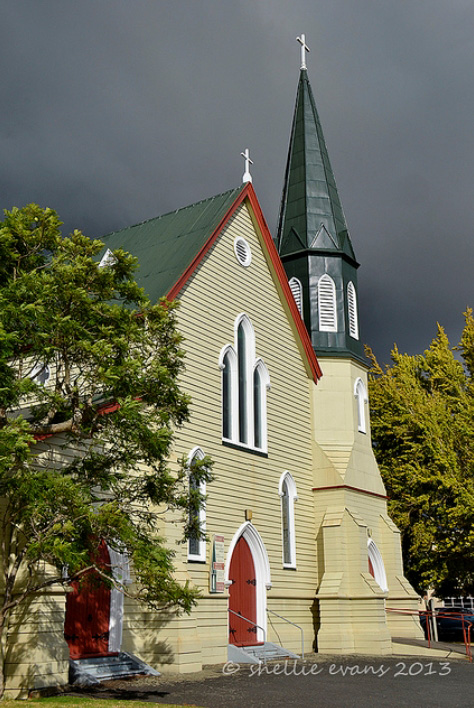
This historic place was registered under the Historic Places Act 1980. This report includes the text from the original Building Classification Committee report considered by the NZHPT Board at the time of registration. ARCHITECTURAL DESCRIPTION: This timber neo-Gothic church consists of a large nave with flanking aisles, an octagonal tower and spire, and a polygonal apse. The interior is embellished with a variety of Gothic motifs. All windows and entrances are lancet-shaped with hood moulds. A triple light window dominates the main street façade with two single windows below and to the sides. There are three entrances across this elevation. The broach spire is sheathed in metal. Paired windows are arranged uniformly along the sides. The clerestory above has round windows with quatrefoil decoration. Small triangular ventilators with trefoil decoration project through the main roofline. An attractive apse with stained glass windows completes the rear of the building; numerous buttresses support the structure. The spacious interior is dominated by two screens of slender arches separating the nave from the aisles. Most of the internal woodwork is stained although the arches are painted white. The roof is supported by an arched brace and tie rods. MODIFICATIONS: Substantially unaltered from the original state but with some minor modifications
This historic place was registered under the Historic Places Act 1980. This report includes the text from the original Building Classification Committee report considered by the NZHPT Board at the time of registration. ARCHITECTURAL DESCRIPTION: This timber neo-Gothic church consists of a large nave with flanking aisles, an octagonal tower and spire, and a polygonal apse. The interior is embellished with a variety of Gothic motifs. All windows and entrances are lancet-shaped with hood moulds. A triple light window dominates the main street façade with two single windows below and to the sides. There are three entrances across this elevation. The broach spire is sheathed in metal. Paired windows are arranged uniformly along the sides. The clerestory above has round windows with quatrefoil decoration. Small triangular ventilators with trefoil decoration project through the main roofline. An attractive apse with stained glass windows completes the rear of the building; numerous buttresses support the structure. The spacious interior is dominated by two screens of slender arches separating the nave from the aisles. Most of the internal woodwork is stained although the arches are painted white. The roof is supported by an arched brace and tie rods. MODIFICATIONS: Substantially unaltered from the original state but with some minor modifications
Historical and Associated Iwi / Hapū / Whānau
Completion Date
12th January 1990
Information Sources
Morrell, 1973
W. P. Morrell, The Anglican Church in New Zealand: A History, Dunedin, 1973
Hays, 1968
Raymond Bruce Hays, St George's Parish Thames. 1868 1968, Thames, 1968
Drummond, 1975
A. Drummond (ed), The Thames Journals of Vicesimus Lush, 1868-1882. Christchurch, 1975
Watson, 1981
W Watson, Sermons in Wood: Waikato Hauraki, 19th century wooden churches, Norton Watson, 1981
Other Information
A copy of this report is available from the NZHPT Northern Region office Please note that entry on the New Zealand Heritage List/Rarangi Korero identifies only the heritage values of the property concerned, and should not be construed as advice on the state of the property, or as a comment of its soundness or safety, including in regard to earthquake risk, safety in the event of fire, or insanitary conditions. 'This historic place was registered under the Historic Places Act 1980. This report includes the text from the original Building Classification Committee report considered by the NZHPT Board at the time of registration.
Historical and Associated Iwi / Hapū / Whānau
Completion Date
12th January 1990
Information Sources
Morrell, 1973
W. P. Morrell, The Anglican Church in New Zealand: A History, Dunedin, 1973
Hays, 1968
Raymond Bruce Hays, St George's Parish Thames. 1868 1968, Thames, 1968
Drummond, 1975
A. Drummond (ed), The Thames Journals of Vicesimus Lush, 1868-1882. Christchurch, 1975
Watson, 1981
W Watson, Sermons in Wood: Waikato Hauraki, 19th century wooden churches, Norton Watson, 1981
Other Information
A copy of this report is available from the NZHPT Northern Region office Please note that entry on the New Zealand Heritage List/Rarangi Korero identifies only the heritage values of the property concerned, and should not be construed as advice on the state of the property, or as a comment of its soundness or safety, including in regard to earthquake risk, safety in the event of fire, or insanitary conditions. 'This historic place was registered under the Historic Places Act 1980. This report includes the text from the original Building Classification Committee report considered by the NZHPT Board at the time of registration.
Current Usages
Uses: Religion
Specific Usage: Church
Former Usages
General Usage: Religion
Specific Usage: Church
Current Usages
Uses: Religion
Specific Usage: Church
Former Usages
General Usage: Religion
Specific Usage: Church
Location
Get the latest heritage news, features and events delivered
straight to your inbox.
