

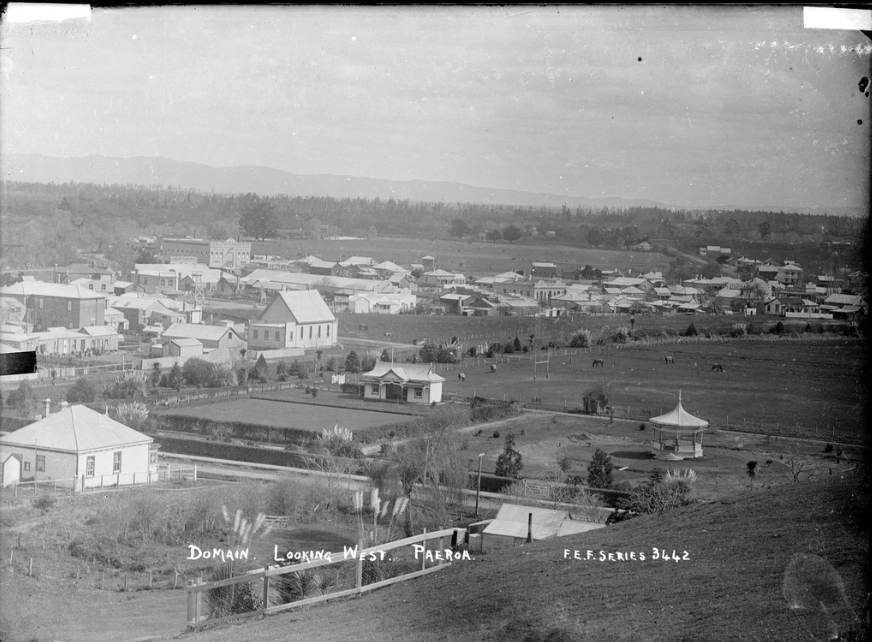
The suggestion of a band rotunda was considered by the Board late in 1905. A local brass band had been established in 1894 and contained ten performing members by 1900. In July 1906, the Board received a tender from H. Carter for £142 7s for the erection of band rotunda with an extra £3 3s for a roof similar to that erected in the Government Gardens at Rotorua. Rotorua was a fashionable leisure destination, and its rotunda - constructed in 1900 - was particularly ornate. The final contract price was modified to £130 pounds for the structure and £3 3s for the roof. By November 1906, the rotunda was nearing completion, surrounded by what was to be a circular pond or moat. A dispute with another contractor about the pond not holding water was resolved when C. Olsen offered to regrade the puddling. Access to the rotunda, when completed, was via a pair of bridges which, combined with the design of the rotunda itself, provided the pleasure gardens at the eastern end of the Domain with a slightly exotic atmosphere.
On November 17 a committee of 36 citizens and representatives of various interested groups was elected at a public meeting to organise a moonlight concert to open the band rotunda on Friday 30 1906. A half-day holiday was moved from Wednesday to the Friday, and agreed to by almost all of the local business community. The concert programme included a haka by local Maori, which was considered to have been the first time that many people at the event would have seen it performed. Admission to the Domain to attend the concert was one shilling each, and an additional shilling for access to the enclosure immediately around the pond. The rotunda was officially declared open by H. Poland, MHR, the local member of the House of Representatives, who noted that the cost of the rotunda had been raised by the people of Paeroa. The concert, which comprised of local performers and a brass band, was considered a great success.
In following years the rotunda hosted further concerts as well as official functions, such as the welcoming of Governor-Generals and early Anzac Day commemoration services. The moat was later filled in and changes were made to the gardens, which included the replacement of tennis courts by croquet lawns. A popular backdrop for picnics and local wedding parties, the structure was refurbished by the Paeroa Council during the 1970s. For most of the twentieth century, the rotunda lay close to a 1907 bowling pavilion with a distinctive 'Japanese-style' roof, which unfortunately burnt down in the late 1990s.
List Entry Information
Status
Listed
List Entry Status
Historic Place Category 2
Access
Able to Visit
List Number
726
Date Entered
7th April 1983
Date of Effect
7th April 1983
City/District Council
Hauraki District
Region
Waikato Region
Legal description
Pt Blks IX X XI All Blk XIV Paeroa Town-Recreation Reserve
Status
Listed
List Entry Status
Historic Place Category 2
Access
Able to Visit
List Number
726
Date Entered
7th April 1983
Date of Effect
7th April 1983
City/District Council
Hauraki District
Region
Waikato Region
Legal description
Pt Blks IX X XI All Blk XIV Paeroa Town-Recreation Reserve
Why is this place significant?
Historic Significance
Historical Significance or Value It is historically important for reflecting aspects of Paeroa's prosperity and civic identity in the early 1900s, the impact of gold-mining in the Hauraki region, and the development of the domain movement in provincial towns.
Physical Significance
The band rotunda is aesthetically significant for its visual appearance, adding to the landscape qualities of its park setting.
Why is this place Category 1 / Category 2?
Detail Of Assessed Criteria
The rotunda reflects important and representative aspects of New Zealand history, notably the rise of leisure activities and outdoor recreation in New Zealand. It is also associated with attitudes to music, public commemoration and civic reception. The structure can be considered to enjoy public esteem, having been used for Anzac Day commemorations and other official gatherings. It forms part of a broader historical and cultural landscape in the Domain, which includes exotic trees, the Cenotaph on Primrose Hill, and a memorial to George Bradford (?-1899), commemorated as 'the first from any of the colonial contingents to give his life for the Empire' in the South African War (1899-1902).
Why is this place significant?
Historic Significance
Historical Significance or Value It is historically important for reflecting aspects of Paeroa's prosperity and civic identity in the early 1900s, the impact of gold-mining in the Hauraki region, and the development of the domain movement in provincial towns.
Physical Significance
The band rotunda is aesthetically significant for its visual appearance, adding to the landscape qualities of its park setting.
Why is this place Category 1 / Category 2?
Detail Of Assessed Criteria
The rotunda reflects important and representative aspects of New Zealand history, notably the rise of leisure activities and outdoor recreation in New Zealand. It is also associated with attitudes to music, public commemoration and civic reception. The structure can be considered to enjoy public esteem, having been used for Anzac Day commemorations and other official gatherings. It forms part of a broader historical and cultural landscape in the Domain, which includes exotic trees, the Cenotaph on Primrose Hill, and a memorial to George Bradford (?-1899), commemorated as 'the first from any of the colonial contingents to give his life for the Empire' in the South African War (1899-1902).
Construction Professional
Name
Carter, H.
Type
Builder
Biography
No biography is currently available for this construction professional
Construction Details
Start Year
1906
Type
Original Construction
Type
Modification
Description
Modifications, including placement of corrugated iron roof.
Period
1970s
Construction Materials
Concrete base and steps, with timber superstructure and corrugated iron roof.
Construction Professional
Name
Carter, H.
Type
Builder
Biography
No biography is currently available for this construction professional
Construction Details
Start Year
1906
Type
Original Construction
Type
Modification
Description
Modifications, including placement of corrugated iron roof.
Period
1970s
Construction Materials
Concrete base and steps, with timber superstructure and corrugated iron roof.
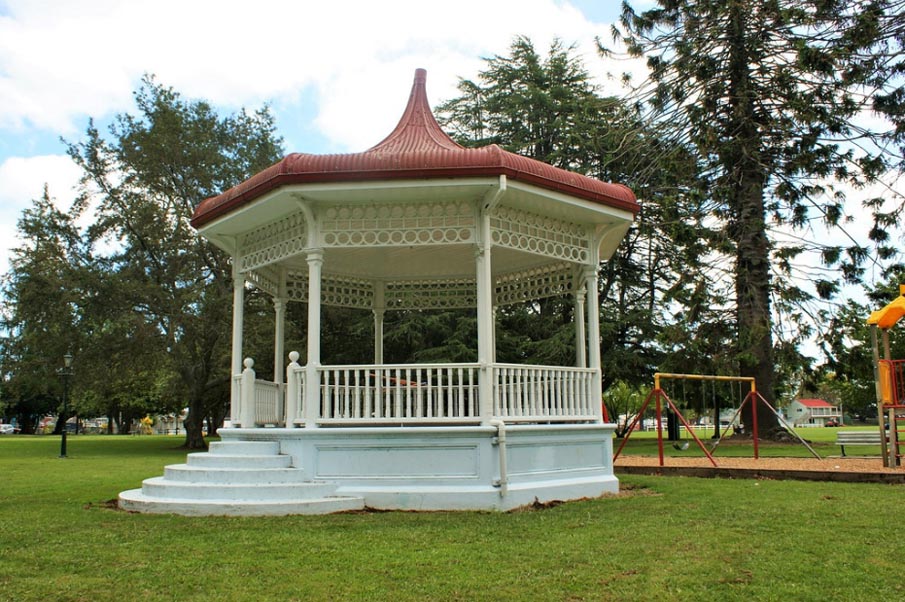
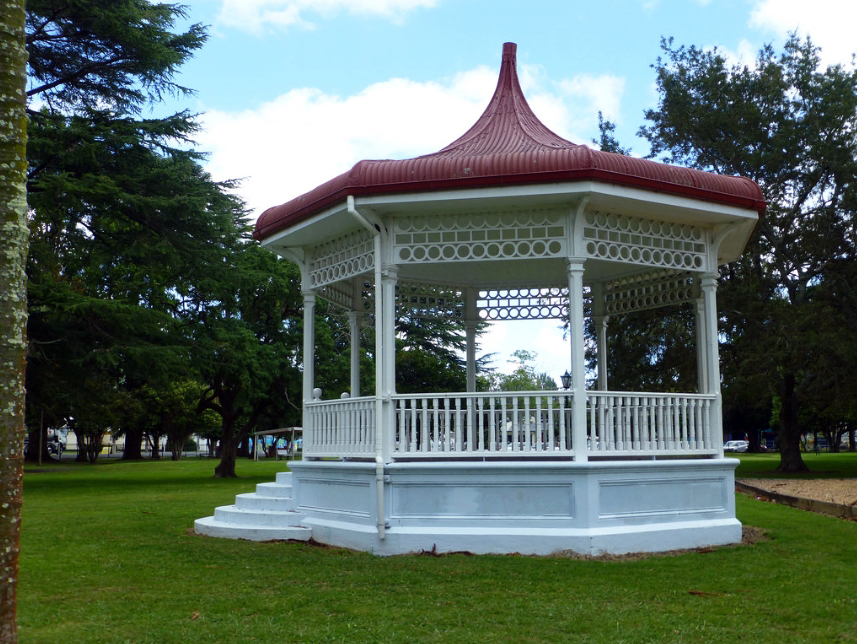
The Band Rotunda is located in that part of Paeroa Domain that is bounded by Willoughby Street, Arney Street, King Street and properties fronting Corbett Street. It is positioned on a flat lawn adjacent to the eastern boundary of the area, with bowling greens to the south and a croquet lawn to the north. The lawns contain numerous exotic trees, and lie to the east of a large sports field. They are overlooked by an elevated section of the Domain to the east of Arney Street, which incorporates the Cenotaph on Primrose Hill. The rotunda is octagonal in plan, with open balustraded sides and an ogee-shaped roof. It is partly modelled on the cast iron bandstand in the Government gardens at Rotorua, although less ornate. Its entrance lies on the eastern side of the structure, looking out towards Arney Street. The raised floor of the rotunda is accessed from ground level via five semi-circular steps.. The steps and raised base of the rotunda are made of concrete, with the base containing rectangular recessed panels on each facet. The top of the base forms the rotunda platform or floor, which is currently tar-sealed. A timber balustrade surmounts the platform, with large newel posts marking the entrance. The main superstructure is held up by posts at each corner of the rotunda. The posts incorporate capitals bearing horizontal fretwork, which consists of two horizontal layers of circles separated by a third layer of rectangles. Brackets at the top of each column support the projecting eaves of the roof. The curved octagonal roof is now slightly asymmetrical, with its pointed apex leaning to one side. This bears an empty socket, which once held a timber finial.
The Band Rotunda is located in that part of Paeroa Domain that is bounded by Willoughby Street, Arney Street, King Street and properties fronting Corbett Street. It is positioned on a flat lawn adjacent to the eastern boundary of the area, with bowling greens to the south and a croquet lawn to the north. The lawns contain numerous exotic trees, and lie to the east of a large sports field. They are overlooked by an elevated section of the Domain to the east of Arney Street, which incorporates the Cenotaph on Primrose Hill. The rotunda is octagonal in plan, with open balustraded sides and an ogee-shaped roof. It is partly modelled on the cast iron bandstand in the Government gardens at Rotorua, although less ornate. Its entrance lies on the eastern side of the structure, looking out towards Arney Street. The raised floor of the rotunda is accessed from ground level via five semi-circular steps.. The steps and raised base of the rotunda are made of concrete, with the base containing rectangular recessed panels on each facet. The top of the base forms the rotunda platform or floor, which is currently tar-sealed. A timber balustrade surmounts the platform, with large newel posts marking the entrance. The main superstructure is held up by posts at each corner of the rotunda. The posts incorporate capitals bearing horizontal fretwork, which consists of two horizontal layers of circles separated by a third layer of rectangles. Brackets at the top of each column support the projecting eaves of the roof. The curved octagonal roof is now slightly asymmetrical, with its pointed apex leaning to one side. This bears an empty socket, which once held a timber finial.
Historical and Associated Iwi / Hapū / Whānau
Information Sources
Bradbury, 1929
Ernest Bradbury, The Settlement and Development of the Thames Valley and the Coromandel Peninsula, (2nd edn.), Auckland, 1918; (4th edn.), Auckland, 1929
Bradbury, 1940
Ernest Bradbury, The Settlement and Development of South Auckland, (6th edn.), Auckland, 1940
Cyclopedia of New Zealand, 1902
Cyclopedia Company, Industrial, descriptive, historical, biographical facts, figures, illustrations, Wellington, N.Z, 1897-1908, Vol.2, Christchurch, 1902
Watton, 2003
Graham Watton, 'Paeroa Domain Band Rotunda', unpublished ms., Paeroa, 2003 (copy held by NZHPT, Auckland)
Other Information
A fully referenced version of this report is available from the NZHPT Northern Region Office. Please note that entry on the New Zealand Heritage List/Rarangi Korero identifies only the heritage values of the property concerned, and should not be construed as advice on the state of the property, or as a comment of its soundness or safety, including in regard to earthquake risk, safety in the event of fire, or insanitary conditions.
Historical and Associated Iwi / Hapū / Whānau
Information Sources
Bradbury, 1929
Ernest Bradbury, The Settlement and Development of the Thames Valley and the Coromandel Peninsula, (2nd edn.), Auckland, 1918; (4th edn.), Auckland, 1929
Bradbury, 1940
Ernest Bradbury, The Settlement and Development of South Auckland, (6th edn.), Auckland, 1940
Cyclopedia of New Zealand, 1902
Cyclopedia Company, Industrial, descriptive, historical, biographical facts, figures, illustrations, Wellington, N.Z, 1897-1908, Vol.2, Christchurch, 1902
Watton, 2003
Graham Watton, 'Paeroa Domain Band Rotunda', unpublished ms., Paeroa, 2003 (copy held by NZHPT, Auckland)
Other Information
A fully referenced version of this report is available from the NZHPT Northern Region Office. Please note that entry on the New Zealand Heritage List/Rarangi Korero identifies only the heritage values of the property concerned, and should not be construed as advice on the state of the property, or as a comment of its soundness or safety, including in regard to earthquake risk, safety in the event of fire, or insanitary conditions.
Current Usages
Uses: Civic Facilities
Specific Usage: Bandstand/Rotunda
Former Usages
General Usage: Civic Facilities
Specific Usage: Bandstand/Rotunda
Current Usages
Uses: Civic Facilities
Specific Usage: Bandstand/Rotunda
Former Usages
General Usage: Civic Facilities
Specific Usage: Bandstand/Rotunda
Location
Sign up to hear more
Get the latest heritage news, features and events delivered
straight to your inbox.
