

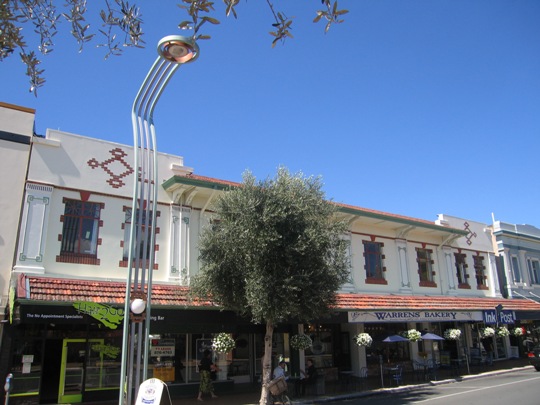
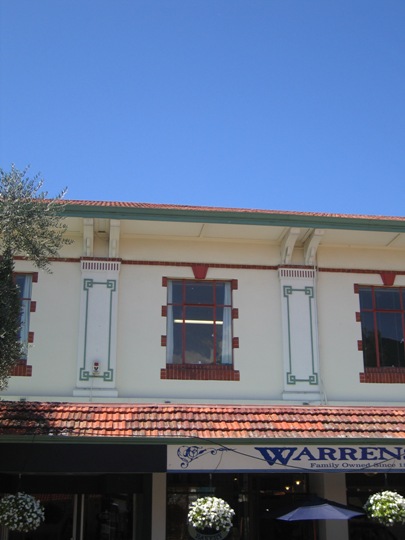
The building demonstrates Alfred Garnett's skill with Spanish Mission architecture. Garnett did as much as any architect to make Spanish Mission architecture synonymous with Hastings and this building, with its deep bracketed eaves, tile-roofed verandah and decorative brickwork, is an important part of the streetscape. It is also a rare survivor of the Hawkes Bay earthquake and the structure has technical interest for this reason.
The building has local historic significance for its long and varied use as commercial premises. With its distinctive design, it has been a familiar landmark on Russell Street since its construction.
List Entry Information
Status
Listed
List Entry Status
Historic Place Category 2
Access
Private/No Public Access
List Number
1100
Date Entered
27th June 2008
Date of Effect
27th June 2008
City/District Council
Hastings District
Region
Hawke's Bay Region
Extent of List Entry
This registration includes all of the land comprised in RT HBL3/1387, (as shown on the 'Extent of Registration' map in Appendix 2) and the whole of the building contained thereon.
Legal description
Lots 4 - 5 DP 2709 (RT HBL3/1387), Hawkes Bay Land District
Status
Listed
List Entry Status
Historic Place Category 2
Access
Private/No Public Access
List Number
1100
Date Entered
27th June 2008
Date of Effect
27th June 2008
City/District Council
Hastings District
Region
Hawke's Bay Region
Extent of List Entry
This registration includes all of the land comprised in RT HBL3/1387, (as shown on the 'Extent of Registration' map in Appendix 2) and the whole of the building contained thereon.
Legal description
Lots 4 - 5 DP 2709 (RT HBL3/1387), Hawkes Bay Land District
Why is this place significant?
Cultural Significance
SOCIAL VALUE: Poppelwells Building has stood in Hastings for over 80 years and has retained, to a large extent, its original commercial purpose. Over its life it has been entered and used by many thousands of people. It is a familiar Hastings' landmark.
Historic Significance
Historical Significance or Value Poppelwells Building has considerable local significance for its long history of retailing and general commercial use. It is particularly associated with Poppelwells, the clothing firm whose association with the building stretched back to the 1920s and only ended in the first decade of the 21st century. The building has had some significant occupants over the years, arguably the most important being New Zealand Aerial Mapping, which spent its first two decades in the building and is today the country's oldest aviation firm. Another is Warrens Bakery, regarded as a Hastings' institution. In a city with few buildings that pre-date the Hawkes Bay earthquake, Poppelwells Building is a long-standing and familiar landmark.
Physical Significance
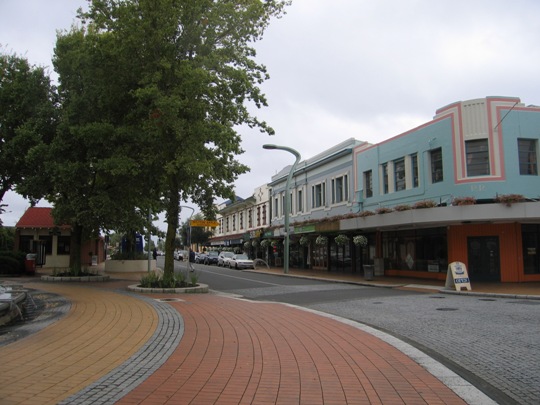
AESTHETIC VALUE: Poppelwells Building has aesthetic value for the role its plays in perhaps the most important group of period buildings in the city, those along the eastern side of Russell Street, stretching several blocks from Queens Street East to Eastbourne Street East. The consistent scale of these buildings, their visual interest, their common materials, add up to a streetscape of exceptional quality. They are well seen buildings because of the open space of the wide streets and railway line. ARCHITECTURAL VALUE: The building is the work of a competent and original architect, Alfred Garnett, who played an important role in the development of the city. While drawing on period details for its inspiration, it combines elements of the Stripped Classical and Spanish Mission styles in novel ways, to make a well-ordered, modulated and interesting building of the mid-1920s. Its architectural importance is enhanced by the fact that it is a substantial commercial building of the pre-earthquake period, rare in the city, and in authentic condition in its main façade. TECHNOLOGICAL VALUE: The building has quite specific technical value for its structure and detailing, since it survived the Hawkes Bay earthquake with no significant damage. It is a very good example of best trade practice and design of the decade of the 1920s, before the advent of a national structural building code. That it survived the earthquake unscathed is a tribute to the designer.
Why is this place Category 1 / Category 2?
Detail Of Assessed Criteria
Category of historic place (section 23(2)): This place was assigned a category status having regard to the following criteria: g, k (g) The technical accomplishment or value, or design of the place: The building has quite specific technical value for its structure and detailing, since it survived the Hawkes Bay earthquake with no significant damage. It is a very good example of best trade practice and design of the decade of the 1920s, before the advent of a national structural building code. The architectural design is significant too, the building being the work of a competent and original architect. It draws on period details for its inspiration, combining elements of the Stripped Classical and Spanish Mission styles to make a well-ordered, modulated and interesting building of the mid-1920s. It makes a significant contribution to the townscape qualities of the area. (k) The extent to which the place forms part of a wider historical and cultural complex or historical and cultural landscape: Hastings is, like Napier, a city substantially shaped by the one event - the Hawkes Bay earthquake in 1931 - which led to the destruction and rebuilding of much of the city centre. This building survived the earthquake, but in terms of its general style and appearance it takes its place comfortably with the buildings constructed in the post-earthquake period and which so strongly define the character of the city. It forms part of the Hastings Historic Area, which takes in two blocks on Russell Street. Category: Category II
Why is this place significant?
Cultural Significance
SOCIAL VALUE: Poppelwells Building has stood in Hastings for over 80 years and has retained, to a large extent, its original commercial purpose. Over its life it has been entered and used by many thousands of people. It is a familiar Hastings' landmark.
Historic Significance
Historical Significance or Value Poppelwells Building has considerable local significance for its long history of retailing and general commercial use. It is particularly associated with Poppelwells, the clothing firm whose association with the building stretched back to the 1920s and only ended in the first decade of the 21st century. The building has had some significant occupants over the years, arguably the most important being New Zealand Aerial Mapping, which spent its first two decades in the building and is today the country's oldest aviation firm. Another is Warrens Bakery, regarded as a Hastings' institution. In a city with few buildings that pre-date the Hawkes Bay earthquake, Poppelwells Building is a long-standing and familiar landmark.
Physical Significance
AESTHETIC VALUE: Poppelwells Building has aesthetic value for the role its plays in perhaps the most important group of period buildings in the city, those along the eastern side of Russell Street, stretching several blocks from Queens Street East to Eastbourne Street East. The consistent scale of these buildings, their visual interest, their common materials, add up to a streetscape of exceptional quality. They are well seen buildings because of the open space of the wide streets and railway line. ARCHITECTURAL VALUE: The building is the work of a competent and original architect, Alfred Garnett, who played an important role in the development of the city. While drawing on period details for its inspiration, it combines elements of the Stripped Classical and Spanish Mission styles in novel ways, to make a well-ordered, modulated and interesting building of the mid-1920s. Its architectural importance is enhanced by the fact that it is a substantial commercial building of the pre-earthquake period, rare in the city, and in authentic condition in its main façade. TECHNOLOGICAL VALUE: The building has quite specific technical value for its structure and detailing, since it survived the Hawkes Bay earthquake with no significant damage. It is a very good example of best trade practice and design of the decade of the 1920s, before the advent of a national structural building code. That it survived the earthquake unscathed is a tribute to the designer.
Why is this place Category 1 / Category 2?
Detail Of Assessed Criteria
Category of historic place (section 23(2)): This place was assigned a category status having regard to the following criteria: g, k (g) The technical accomplishment or value, or design of the place: The building has quite specific technical value for its structure and detailing, since it survived the Hawkes Bay earthquake with no significant damage. It is a very good example of best trade practice and design of the decade of the 1920s, before the advent of a national structural building code. The architectural design is significant too, the building being the work of a competent and original architect. It draws on period details for its inspiration, combining elements of the Stripped Classical and Spanish Mission styles to make a well-ordered, modulated and interesting building of the mid-1920s. It makes a significant contribution to the townscape qualities of the area. (k) The extent to which the place forms part of a wider historical and cultural complex or historical and cultural landscape: Hastings is, like Napier, a city substantially shaped by the one event - the Hawkes Bay earthquake in 1931 - which led to the destruction and rebuilding of much of the city centre. This building survived the earthquake, but in terms of its general style and appearance it takes its place comfortably with the buildings constructed in the post-earthquake period and which so strongly define the character of the city. It forms part of the Hastings Historic Area, which takes in two blocks on Russell Street. Category: Category II
Construction Professional
Name
Hill, T
Type
Builder
Biography
No biography is currently available for this construction professional
Name
Garnett, Albert (1878-1956)
Type
Architect
Biography
Albert Garnett (1878-1956) was one of Hastings' most important architects. Born in Hastings in 1878, he lived all his life in the town. His father James Garnett, later mayor of Hastings, was a builder and his son began his career working for his father before becoming an architect. He practised mainly on his own account, although he formed a brief association with Davies and Phillips in the immediate aftermath of the Hawkes Bay earthquake. Garnett ended his partnership with Davies and Phillips in 1933 but continued to practice into the 1950s. Albert Garnett was also a borough councillor in the 1920s. Among his other Hastings' buildings were the Wesley Methodist Church (1911), Municipal Chambers (1917) and Atkins House (1935). One of Albert Garnett's greatest contributions to Hastings was his early use of the Spanish Mission style, which went on to become synonymous with central Hastings. In Russell Street alone he designed three of Hastings' best examples of Spanish Mission architecture - Poppelwells Building (1927), R & R Building (1927) and Harvey's Building (1933).
Construction Details
Start Year
1924
Type
Original Construction
Description
Building constructed for Fitzpatrick & Co.
Start Year
1948
Type
Modification
Description
Changes made to New Zealand Aerial Mapping's offices.
Start Year
2000
Type
Other
Description
Building consent issued for changes to Warrens Bakery kitchen.
Start Year
2001
Type
Other
Description
Building consent issued for conversion to café.
Start Year
2002
Type
Other
Description
Building consent issued for alterations for conversion to hair salon.
Construction Materials
Reinforced concrete, post and beam structure.
Construction Professional
Name
Hill, T
Type
Builder
Biography
No biography is currently available for this construction professional
Name
Garnett, Albert (1878-1956)
Type
Architect
Biography
Albert Garnett (1878-1956) was one of Hastings' most important architects. Born in Hastings in 1878, he lived all his life in the town. His father James Garnett, later mayor of Hastings, was a builder and his son began his career working for his father before becoming an architect. He practised mainly on his own account, although he formed a brief association with Davies and Phillips in the immediate aftermath of the Hawkes Bay earthquake. Garnett ended his partnership with Davies and Phillips in 1933 but continued to practice into the 1950s. Albert Garnett was also a borough councillor in the 1920s. Among his other Hastings' buildings were the Wesley Methodist Church (1911), Municipal Chambers (1917) and Atkins House (1935). One of Albert Garnett's greatest contributions to Hastings was his early use of the Spanish Mission style, which went on to become synonymous with central Hastings. In Russell Street alone he designed three of Hastings' best examples of Spanish Mission architecture - Poppelwells Building (1927), R & R Building (1927) and Harvey's Building (1933).
Construction Details
Start Year
1924
Type
Original Construction
Description
Building constructed for Fitzpatrick & Co.
Start Year
1948
Type
Modification
Description
Changes made to New Zealand Aerial Mapping's offices.
Start Year
2000
Type
Other
Description
Building consent issued for changes to Warrens Bakery kitchen.
Start Year
2001
Type
Other
Description
Building consent issued for conversion to café.
Start Year
2002
Type
Other
Description
Building consent issued for alterations for conversion to hair salon.
Construction Materials
Reinforced concrete, post and beam structure.
Poppelwells Building, as it would later become known, was designed by architect Alfred Garnett and constructed by T. Hill as an investment property for Fitzpatrick and Co. in 1924. The property was leasehold, being land originally set aside for railway use but not required directly for that purpose. Land records are not available for this land until 1929, by which time Herbert Knight is shown as holding the lease of this land. Poppelwells Building survived the Hawkes Bay earthquake of 1931. Knight retained ownership of the building until 1964, when he transferred the lease to Poppelwell Building Ltd. It is this family firm and its long-standing association with the building that gives it its name. Wises Street Directories from the 1920s and 30s do not show street numbers for Russell Street, so it is difficult to be precise in establishing early occupants of the building. The building had commercial tenants on both floors, and, having a long street frontage, up to 12 occupants during its early period of use. By 1930, Poppelwell & Co., mercers, were occupying the building and the family business would remain associated with the building into the 21st century. They were joined in the building by its architect, Alfred Garnett, clearly pleased with his design. There was a range of other occupants, some of whom became long-standing tenants. Among them were businesses such as Anderson's tearooms, the Dominion Fish Co., and the stationers and booksellers at the northern end of the building, which changed hands a number of times but retained its original use. The New Zealand Aerial Mapping Co. was another early and significant tenant. The company was established in 1936 and, from 1937 until 1956, its founder Piet van Asch and his small staff ran New Zealand's first private aerial mapping company from Poppelwells Building. During this period - in 1948 - the company made internal alterations to its premises. In these early years, the company got most of its work from the government, including some vital mapping work undertaken during World War II. In 1956 it moved to purpose-built premises in Avenue Street. It is now New Zealand's oldest aviation firm. Links to early uses were maintained through the decades. The tearooms later became the Cake Shop, and then the Warren tearooms (now Warrens Bakery), another long-standing Hastings business, which dates back to 1891. Another interesting occupant in the middle of the 20th century was a piano tutor. The lease of the buildings remained in the hands of Poppelwell Building Ltd, who also remained occupants of the building. In 1988, the company sold the majority of the lease to William Dent and Peter Clifford. Three years later they sold it to John and Hilary Poppelwell. Building consents were issued in 2000 (changes to a kitchen for Warrens Bakery), 2001 (alterations for a café involving the demolition of internal walls) and 2002 (conversion of a shop to a hair cutting bar). After John Poppelwell's death in 2002, Hilary Poppelwell kept the building for two more years before selling it to Tainui Reserve Ltd. It continues to be used commercially. Among the current occupiers are a hairdressers, Warrens Bakery, a café and Paperfun. Poppelwells continues as a fashion store in Havelock North.
Poppelwells Building, as it would later become known, was designed by architect Alfred Garnett and constructed by T. Hill as an investment property for Fitzpatrick and Co. in 1924. The property was leasehold, being land originally set aside for railway use but not required directly for that purpose. Land records are not available for this land until 1929, by which time Herbert Knight is shown as holding the lease of this land. Poppelwells Building survived the Hawkes Bay earthquake of 1931. Knight retained ownership of the building until 1964, when he transferred the lease to Poppelwell Building Ltd. It is this family firm and its long-standing association with the building that gives it its name. Wises Street Directories from the 1920s and 30s do not show street numbers for Russell Street, so it is difficult to be precise in establishing early occupants of the building. The building had commercial tenants on both floors, and, having a long street frontage, up to 12 occupants during its early period of use. By 1930, Poppelwell & Co., mercers, were occupying the building and the family business would remain associated with the building into the 21st century. They were joined in the building by its architect, Alfred Garnett, clearly pleased with his design. There was a range of other occupants, some of whom became long-standing tenants. Among them were businesses such as Anderson's tearooms, the Dominion Fish Co., and the stationers and booksellers at the northern end of the building, which changed hands a number of times but retained its original use. The New Zealand Aerial Mapping Co. was another early and significant tenant. The company was established in 1936 and, from 1937 until 1956, its founder Piet van Asch and his small staff ran New Zealand's first private aerial mapping company from Poppelwells Building. During this period - in 1948 - the company made internal alterations to its premises. In these early years, the company got most of its work from the government, including some vital mapping work undertaken during World War II. In 1956 it moved to purpose-built premises in Avenue Street. It is now New Zealand's oldest aviation firm. Links to early uses were maintained through the decades. The tearooms later became the Cake Shop, and then the Warren tearooms (now Warrens Bakery), another long-standing Hastings business, which dates back to 1891. Another interesting occupant in the middle of the 20th century was a piano tutor. The lease of the buildings remained in the hands of Poppelwell Building Ltd, who also remained occupants of the building. In 1988, the company sold the majority of the lease to William Dent and Peter Clifford. Three years later they sold it to John and Hilary Poppelwell. Building consents were issued in 2000 (changes to a kitchen for Warrens Bakery), 2001 (alterations for a café involving the demolition of internal walls) and 2002 (conversion of a shop to a hair cutting bar). After John Poppelwell's death in 2002, Hilary Poppelwell kept the building for two more years before selling it to Tainui Reserve Ltd. It continues to be used commercially. Among the current occupiers are a hairdressers, Warrens Bakery, a café and Paperfun. Poppelwells continues as a fashion store in Havelock North.
Poppelwells Building stands out in Hastings for its unusual design, with references to both the Stripped Classical style, and of Spanish Mission. Stripped Classical is seen in the quoins and keystones of the window openings, and in Greek key-patterned pilasters dividing the façade into six bays; Spanish Mission is seen especially in the deeply overhanging eaves breaking through the parapet, and in the red clay Cordova roof tiles both of this part of the main roof and the verandah roof. In addition, the main facade has several idiosyncratic details of the architects own imagination - the decorative brickwork panels on the parapet at either end of the elevation, standing out strongly against the plain plaster wall finish, and the pitched-roof verandah (supported with steel ties from the structure, there being no verandah posts) which is clad on the outside face in the clay tiles; these features render the building unusual in the city. There are four window openings under the central eaves, with a pair of windows at either end, making a well modulated façade that has plenty of visual interest. Despite changes to the retail outlets on the ground floor, above the level of the verandah the façade is completely unchanged from the original design. It fits well in the streetscape, an important component of the group of period buildings along the east side of Russell Street. Despite stylistic differences, its scale, colour and visual interest means it relates well to its neighbours. It is a two storey building, in reinforced concrete; the first floor is concrete, and the roof timber framed. The structure was clearly sound, since the building survived the Hawkes Bay earthquake with no recorded damage. UPDATE: (Based on site visit Imelda Bargas, March 2008) The interior of the first floor of the building remains largely intact including original fixtures and fittings. Features of interest on the interior include original fireplaces.
Poppelwells Building stands out in Hastings for its unusual design, with references to both the Stripped Classical style, and of Spanish Mission. Stripped Classical is seen in the quoins and keystones of the window openings, and in Greek key-patterned pilasters dividing the façade into six bays; Spanish Mission is seen especially in the deeply overhanging eaves breaking through the parapet, and in the red clay Cordova roof tiles both of this part of the main roof and the verandah roof. In addition, the main facade has several idiosyncratic details of the architects own imagination - the decorative brickwork panels on the parapet at either end of the elevation, standing out strongly against the plain plaster wall finish, and the pitched-roof verandah (supported with steel ties from the structure, there being no verandah posts) which is clad on the outside face in the clay tiles; these features render the building unusual in the city. There are four window openings under the central eaves, with a pair of windows at either end, making a well modulated façade that has plenty of visual interest. Despite changes to the retail outlets on the ground floor, above the level of the verandah the façade is completely unchanged from the original design. It fits well in the streetscape, an important component of the group of period buildings along the east side of Russell Street. Despite stylistic differences, its scale, colour and visual interest means it relates well to its neighbours. It is a two storey building, in reinforced concrete; the first floor is concrete, and the roof timber framed. The structure was clearly sound, since the building survived the Hawkes Bay earthquake with no recorded damage. UPDATE: (Based on site visit Imelda Bargas, March 2008) The interior of the first floor of the building remains largely intact including original fixtures and fittings. Features of interest on the interior include original fireplaces.
Historical and Associated Iwi / Hapū / Whānau
Completion Date
15th June 2008
Report Written By
Michael Kelly; Chris Cochran
Information Sources
Wises Post Office Directories
Wises Post Office Directories
Hawkes Bay Herald Tribune
Hawkes Bay Herald Tribune
Land Information New Zealand (LINZ)
Land Information New Zealand
Other Information
A fully referenced registration report is available from the NZHPT Central Region office Please note that entry on the New Zealand Heritage List/Rarangi Korero identifies only the heritage values of the property concerned, and should not be construed as advice on the state of the property, or as a comment of its soundness or safety, including in regard to earthquake risk, safety in the event of fire, or insanitary conditions.
Historical and Associated Iwi / Hapū / Whānau
Completion Date
15th June 2008
Report Written By
Michael Kelly; Chris Cochran
Information Sources
Wises Post Office Directories
Wises Post Office Directories
Hawkes Bay Herald Tribune
Hawkes Bay Herald Tribune
Land Information New Zealand (LINZ)
Land Information New Zealand
Other Information
A fully referenced registration report is available from the NZHPT Central Region office Please note that entry on the New Zealand Heritage List/Rarangi Korero identifies only the heritage values of the property concerned, and should not be construed as advice on the state of the property, or as a comment of its soundness or safety, including in regard to earthquake risk, safety in the event of fire, or insanitary conditions.
Current Usages
Uses: Trade
Specific Usage: Office building/Offices
Uses: Trade
Specific Usage: Shop
Former Usages
General Usage: Trade
Specific Usage: Office building/Offices
General Usage: Trade
Specific Usage: Shop
Current Usages
Uses: Trade
Specific Usage: Office building/Offices
Uses: Trade
Specific Usage: Shop
Former Usages
General Usage: Trade
Specific Usage: Office building/Offices
General Usage: Trade
Specific Usage: Shop
Location
Stay up to date with Heritage this month
