

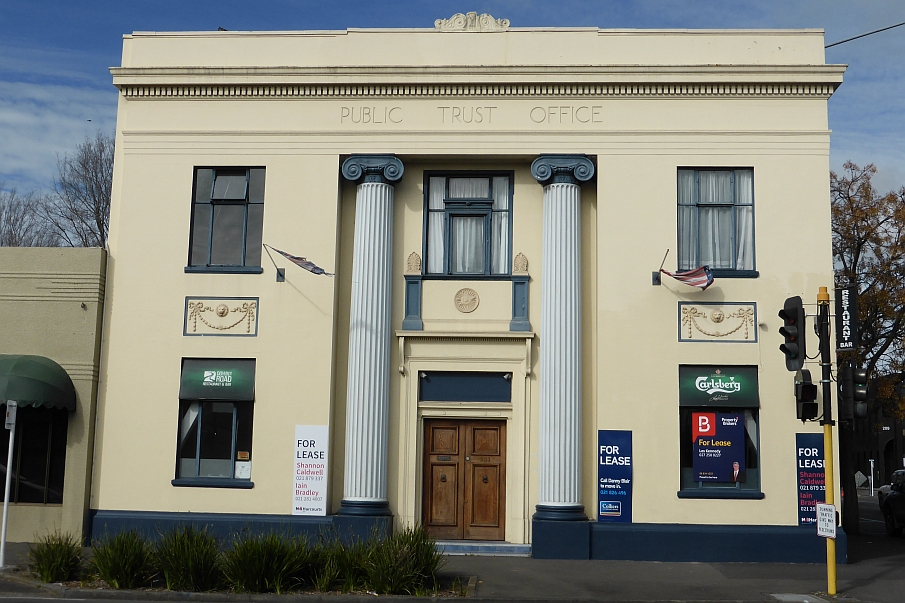
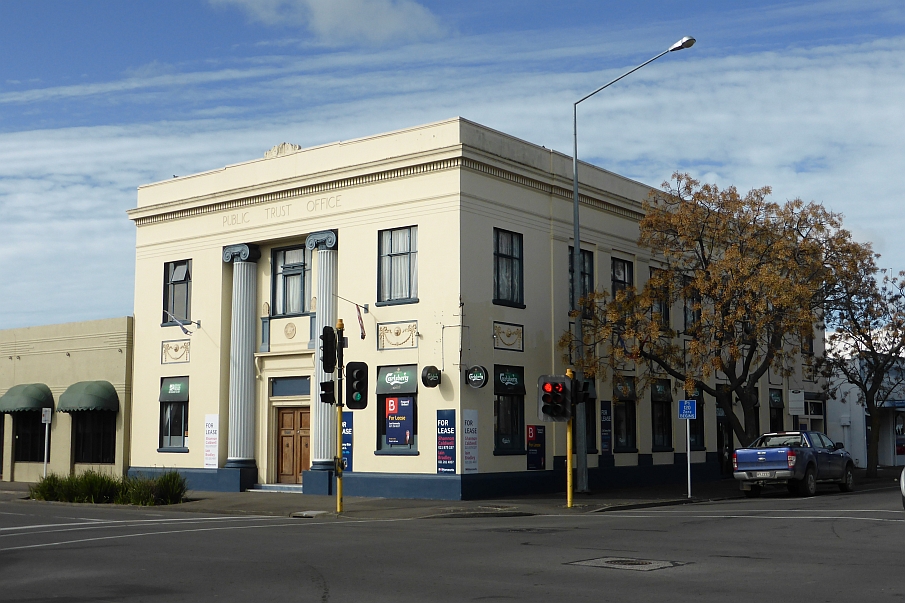
The former Public Trust Building is of stripped Classical design, a carefully articulated design that makes use of columns, pilasters, cornices and other Classical motifs to provide an ordered and functional building. The impressive full height Ionic columns that stand either side of the main entrance doors on Karamu Road, and dwarf them, are particularly impressive features. The building is architecturally significant as a very good example of the style; as the work of an important architect of the period, and for its contribution to the townscape quality of this financial/legal quarter of the city. That it was built before the Hawkes Bay earthquake and survived its shocks is tribute to the architect and engineer.
The building's historic and social significance is derived from the approximately 70 years the building was owned and occupied by the Public Trust. In that period the building was visited by generations of Hastings citizens and the business conducted there affected the lives of many. The building has lost its original use but its accessibility is retained today in its new role as a tavern.
List Entry Information
Status
Listed
List Entry Status
Historic Place Category 2
Access
Private/No Public Access
List Number
1101
Date Entered
27th June 2008
Date of Effect
27th June 2008
City/District Council
Hastings District
Region
Hawke's Bay Region
Extent of List Entry
The registration includes all of the land in RT HBB1/1008 and the building and its fittings and fixtures thereon.
Legal description
Lot 1 DP 4893 (RT HBB1/1008), Hawkes Bay Land District
Location Description
Corner of Karamu Road North and Queen Street East
Status
Listed
List Entry Status
Historic Place Category 2
Access
Private/No Public Access
List Number
1101
Date Entered
27th June 2008
Date of Effect
27th June 2008
City/District Council
Hastings District
Region
Hawke's Bay Region
Extent of List Entry
The registration includes all of the land in RT HBB1/1008 and the building and its fittings and fixtures thereon.
Legal description
Lot 1 DP 4893 (RT HBB1/1008), Hawkes Bay Land District
Location Description
Corner of Karamu Road North and Queen Street East
Why is this place significant?
Historic Significance
Historical Significance or Value The Public Trust is one of the country's most enduring crown entities, and the country's oldest trustee organisation. Established in 1872, it has played a considerable role in the country's history, through its role in will, estate and trust administration. A great many New Zealanders have had their affairs administered by the Public Trust. The Hastings office was part of a collection of buildings the Public Trust constructed to house its nationwide network of agencies. In one sense the Hastings office was a typical Public Trust office, but it operated for 70 years providing a service to the people of Hastings and further afield, a considerable period. The building is no longer associated with the Public Trust but its period of use remains easily the most significant. The building has some local significance for surviving the Hawkes Bay earthquake intact, while modest significance also comes via building's designer, Stanley Fearn, who was an architect of some status in Wellington.
Physical Significance
AESTHETIC SIGNIFICANCE OR VALUE: The former Public Trust building has aesthetic value for the formal and precise architectural composition of the street facades (see below), and for the contribution it makes to the townscape quality of the area. It is the eastern anchor of an impressive group of period buildings that is grouped around the Karamu Road/Queen Street intersection, and which stretches west along Queen Street. ARCHITECTURAL SIGNIFCANCE OR VALUE: The building is a very good example of the stripped Classical style, which gives it an air of authority and dependability that is appropriate to the use. While typical of its time in many respects, it uses Classical elements in an original way, especially in the giant order columns on either side of the main entrance. It is cleverly arranged with access to the separate tenancy of the first floor at the far end of the building, a thoughtful response to the particular requirements of the time. It is the work of a regionally important architect, Stanley Fearn, and extends our understanding of his work. TECHNOLOGICAL SIGNIFICANCE OR VALUE: The building has technical value because it is a major commercial building from the time before the Hawkes Bay earthquake of 1931. The structure was engineer-designed, and it survived the earthquake with no recorded damage; the existence of construction details, showing reinforcing details and concrete profiles, enhances this value. It is somewhat unusual in that the reinforced concrete construction, used for foundations, floors and walls, also extends to the roof.
Why is this place Category 1 / Category 2?
Detail Of Assessed Criteria
Category of historic place (section 23(2)): This place was assigned a category status having regard to the following criteria: b, g, k (b) The association of the place with events, persons, or ideas of importance in New Zealand history: The Public Trust was an important and early example of state intervention on behalf of its citizens when it was established in 1872. The Public Trust has played a role in the life of a great many New Zealanders since its inception. The buildings the Public Trust built around New Zealand were examples of the importance with which it regarded 'bricks and mortar' investment. Those days have long gone, but the Public Trust buildings still standing, such as the Hastings branch, are a strong reminder of the prominent role the Trust has played in local and national life. (g) The technical accomplishment or value, or design of the place: The structure of the building is illustrative of good design practice of the 1920s; that it is well designed is confirmed by its survival of the Hawkes Bay earthquake. It is a very competent piece of architectural design, both for its classically inspired form and decoration and for the functional attributes of the building. It is a well designed building that enhances the reputation of an architect known for his design skill. (k) The extent to which the place forms part of a wider historical and cultural complex or historical and cultural landscape: Hastings is a city substantially shaped by the one event - the Hawkes Bay earthquake of 1931 - which led to the destruction and rebuilding of much of the city centre. This building survived the earthquake, but in terms of its general style and appearance it sits very well with many of the post-earthquake buildings and plays its own strong part in defining the character of the city. In the general vicinity of this building are a number of other buildings constructed during a similar period. Category: Category II
Why is this place significant?
Historic Significance
Historical Significance or Value The Public Trust is one of the country's most enduring crown entities, and the country's oldest trustee organisation. Established in 1872, it has played a considerable role in the country's history, through its role in will, estate and trust administration. A great many New Zealanders have had their affairs administered by the Public Trust. The Hastings office was part of a collection of buildings the Public Trust constructed to house its nationwide network of agencies. In one sense the Hastings office was a typical Public Trust office, but it operated for 70 years providing a service to the people of Hastings and further afield, a considerable period. The building is no longer associated with the Public Trust but its period of use remains easily the most significant. The building has some local significance for surviving the Hawkes Bay earthquake intact, while modest significance also comes via building's designer, Stanley Fearn, who was an architect of some status in Wellington.
Physical Significance
AESTHETIC SIGNIFICANCE OR VALUE: The former Public Trust building has aesthetic value for the formal and precise architectural composition of the street facades (see below), and for the contribution it makes to the townscape quality of the area. It is the eastern anchor of an impressive group of period buildings that is grouped around the Karamu Road/Queen Street intersection, and which stretches west along Queen Street. ARCHITECTURAL SIGNIFCANCE OR VALUE: The building is a very good example of the stripped Classical style, which gives it an air of authority and dependability that is appropriate to the use. While typical of its time in many respects, it uses Classical elements in an original way, especially in the giant order columns on either side of the main entrance. It is cleverly arranged with access to the separate tenancy of the first floor at the far end of the building, a thoughtful response to the particular requirements of the time. It is the work of a regionally important architect, Stanley Fearn, and extends our understanding of his work. TECHNOLOGICAL SIGNIFICANCE OR VALUE: The building has technical value because it is a major commercial building from the time before the Hawkes Bay earthquake of 1931. The structure was engineer-designed, and it survived the earthquake with no recorded damage; the existence of construction details, showing reinforcing details and concrete profiles, enhances this value. It is somewhat unusual in that the reinforced concrete construction, used for foundations, floors and walls, also extends to the roof.
Why is this place Category 1 / Category 2?
Detail Of Assessed Criteria
Category of historic place (section 23(2)): This place was assigned a category status having regard to the following criteria: b, g, k (b) The association of the place with events, persons, or ideas of importance in New Zealand history: The Public Trust was an important and early example of state intervention on behalf of its citizens when it was established in 1872. The Public Trust has played a role in the life of a great many New Zealanders since its inception. The buildings the Public Trust built around New Zealand were examples of the importance with which it regarded 'bricks and mortar' investment. Those days have long gone, but the Public Trust buildings still standing, such as the Hastings branch, are a strong reminder of the prominent role the Trust has played in local and national life. (g) The technical accomplishment or value, or design of the place: The structure of the building is illustrative of good design practice of the 1920s; that it is well designed is confirmed by its survival of the Hawkes Bay earthquake. It is a very competent piece of architectural design, both for its classically inspired form and decoration and for the functional attributes of the building. It is a well designed building that enhances the reputation of an architect known for his design skill. (k) The extent to which the place forms part of a wider historical and cultural complex or historical and cultural landscape: Hastings is a city substantially shaped by the one event - the Hawkes Bay earthquake of 1931 - which led to the destruction and rebuilding of much of the city centre. This building survived the earthquake, but in terms of its general style and appearance it sits very well with many of the post-earthquake buildings and plays its own strong part in defining the character of the city. In the general vicinity of this building are a number of other buildings constructed during a similar period. Category: Category II
Construction Professional
Name
Fearn, Stanley
Type
Architect
Biography
Stanley Fearn was a contemporary of Gary Young and at one time was in partnership with Gary Young and Austin Quick. Fearn's work is distinguished for his houses in the English Vernacular style. Stanley W. Fearn (1887-1976) was a British-born, Wellington based architect who had a long career spanning a large part of the 20th century and incorporating a wide range of styles. He was still working as late as the 1960s. Most of his work was domestic but he designed a range of buildings, both in the capital, where he designed over 70 buildings, and further afield. In Wellington he is best known for the William Booth Memorial Training College in Aro Street (1913), which he designed with Austen Quick. This building won the first ever gold medal of the NZ Institute of Architects in 1927. His other Wellington buildings included Cambridge Pharmacy (1932) and the Dominion Arcade (1959). Among his houses was the Frederic Wallis House, Lower Hutt (1927), the grand country house Rototawai, near Featherston (1929), as well as houses in Hobson Street, Thorndon. He was involved in the rebuilding of Napier and Hastings after the Hawkes Bay earthquake and among his surviving designs is the former Bestall's Building, Napier (1932). His son Detmar was also an architect.
Name
Silver, S. T.
Type
Engineer
Biography
No biography is currently available for this construction professional
Name
Munn, J.W.C
Type
Builder
Biography
No biography is currently available for this construction professional
Construction Details
Start Year
1925
Type
Original Construction
Description
Public Trust Building constructed by Hastings builder J.W.C. Monk for a cost of £10,925 to a design by Stanley Fearn.
Start Year
1972
Type
Modification
Description
Roof replaced with long-run iron.
Start Year
1978
Type
Modification
Description
Substantial changes made to ground floor as part of transition to open-plan office.
Start Year
1995
Type
Modification
Description
Resource consent issued to erect two internally illuminated signs.
Start Year
2001
Type
Other
Description
Building consent issued for upgrade of former Public Trust premises to restaurant and bar.
Start Year
2001
Type
Modification
Description
Resource consent issued to convert building into restaurant/bar, with seating for 40 patrons.
Start Year
2002
Type
Modification
Description
Grant issued for façade enhancement.
Construction Materials
The structural elements of the building are all reinforced concrete - the foundations, ground and first floors, walls and roof.
Construction Professional
Name
Fearn, Stanley
Type
Architect
Biography
Stanley Fearn was a contemporary of Gary Young and at one time was in partnership with Gary Young and Austin Quick. Fearn's work is distinguished for his houses in the English Vernacular style. Stanley W. Fearn (1887-1976) was a British-born, Wellington based architect who had a long career spanning a large part of the 20th century and incorporating a wide range of styles. He was still working as late as the 1960s. Most of his work was domestic but he designed a range of buildings, both in the capital, where he designed over 70 buildings, and further afield. In Wellington he is best known for the William Booth Memorial Training College in Aro Street (1913), which he designed with Austen Quick. This building won the first ever gold medal of the NZ Institute of Architects in 1927. His other Wellington buildings included Cambridge Pharmacy (1932) and the Dominion Arcade (1959). Among his houses was the Frederic Wallis House, Lower Hutt (1927), the grand country house Rototawai, near Featherston (1929), as well as houses in Hobson Street, Thorndon. He was involved in the rebuilding of Napier and Hastings after the Hawkes Bay earthquake and among his surviving designs is the former Bestall's Building, Napier (1932). His son Detmar was also an architect.
Name
Silver, S. T.
Type
Engineer
Biography
No biography is currently available for this construction professional
Name
Munn, J.W.C
Type
Builder
Biography
No biography is currently available for this construction professional
Construction Details
Start Year
1925
Type
Original Construction
Description
Public Trust Building constructed by Hastings builder J.W.C. Monk for a cost of £10,925 to a design by Stanley Fearn.
Start Year
1972
Type
Modification
Description
Roof replaced with long-run iron.
Start Year
1978
Type
Modification
Description
Substantial changes made to ground floor as part of transition to open-plan office.
Start Year
1995
Type
Modification
Description
Resource consent issued to erect two internally illuminated signs.
Start Year
2001
Type
Other
Description
Building consent issued for upgrade of former Public Trust premises to restaurant and bar.
Start Year
2001
Type
Modification
Description
Resource consent issued to convert building into restaurant/bar, with seating for 40 patrons.
Start Year
2002
Type
Modification
Description
Grant issued for façade enhancement.
Construction Materials
The structural elements of the building are all reinforced concrete - the foundations, ground and first floors, walls and roof.
The Public Trust Building was completed in February 1926, to a design by Wellington architect Stanley W. Fearn. The plans for the building had been finalised in November 1924 and the contract awarded to Hastings builder J.W.C. Monk. It was built at a cost of £10,925. The site occupied by the Public Trust Building - the corner of Karamu Road North and Queen Street East - was once used for horse sales, while another (unreferenced) source states that it was the site of the residence of one James O'Neil. Stock and station agents Williams and Kettle built sale yards and a rostrum on the site around 1900. The land was acquired by the Public Trustee in 1924, presumably with no buildings on it. The Public Trust Building was one of several significant public building works undertaken in Hastings around this time, including a new high school and hospital and extensions to the post office. The Public Trust Office was established in 1872 by central government to prevent the misappropriation of trust funds upon a person's death. Initially the main task was to administer the estates of deceased persons who had named the Public Trustee as executor of their wills. In 1873 the Public Trust was given the power to administer the estates of persons who died intestate (i.e. without having made a will), to act as trustee of settlements, to manage the properties of living persons and, where empowered by the Court, to manage the estates of mentally ill patients. Later the Public Trust acquired certain duties regarding the estates of minors, the aged and infirm, and the discharging of mortgages when the mortgagee was dead, overseas, or could not be found. It established a network of agencies throughout the country and progressively erected a number of buildings to house its offices, many of which it has now disposed of, although it retains customer centres in some 35 places. A crown entity, it remains New Zealand's oldest trustee organisation. The Hawkes Bay Herald described Hastings' new Public Trust building as an 'imposing modern street reinforced concrete structure' and 'further evidence of the steady growth of the town and surroundings.' The building was designed to allow the construction of a second storey at a later date. The building survived the Hawkes Bay earthquake of 1931, something that can probably be attributed to its reinforced concrete construction. The Public Trust Building was occupied by the Public Trust for many years, during which time there were relatively few changes, and none to the exterior. In 1972, the roof was replaced in long-run iron. In 1978, the ground floor interior was extensively renovated to create an open plan style of office. These alterations involved the removal of many of the original fittings and partitions. In July 1996, the property was transferred from the Public Trustee to Peter Hue Dalrymple and Joanne Dalrymple. The new owners looked to lease the building, but experienced difficulties in securing tenants. By mid-1997 they were considering the option of demolishing the building to create a car park. In response to this threat, the New Zealand Historic Places Trust commissioned a report that considered alternative development possibilities. The threat of demolition was not carried out. In March 2001, the property was transferred to the present owner, Kenneth Wheadon. The Public Trust Building was then altered to create a restaurant and bar, and a resource consent was issued for this use. The ground floor is presently occupied by Rosie O'Gradys Irish Pub.
The Public Trust Building was completed in February 1926, to a design by Wellington architect Stanley W. Fearn. The plans for the building had been finalised in November 1924 and the contract awarded to Hastings builder J.W.C. Monk. It was built at a cost of £10,925. The site occupied by the Public Trust Building - the corner of Karamu Road North and Queen Street East - was once used for horse sales, while another (unreferenced) source states that it was the site of the residence of one James O'Neil. Stock and station agents Williams and Kettle built sale yards and a rostrum on the site around 1900. The land was acquired by the Public Trustee in 1924, presumably with no buildings on it. The Public Trust Building was one of several significant public building works undertaken in Hastings around this time, including a new high school and hospital and extensions to the post office. The Public Trust Office was established in 1872 by central government to prevent the misappropriation of trust funds upon a person's death. Initially the main task was to administer the estates of deceased persons who had named the Public Trustee as executor of their wills. In 1873 the Public Trust was given the power to administer the estates of persons who died intestate (i.e. without having made a will), to act as trustee of settlements, to manage the properties of living persons and, where empowered by the Court, to manage the estates of mentally ill patients. Later the Public Trust acquired certain duties regarding the estates of minors, the aged and infirm, and the discharging of mortgages when the mortgagee was dead, overseas, or could not be found. It established a network of agencies throughout the country and progressively erected a number of buildings to house its offices, many of which it has now disposed of, although it retains customer centres in some 35 places. A crown entity, it remains New Zealand's oldest trustee organisation. The Hawkes Bay Herald described Hastings' new Public Trust building as an 'imposing modern street reinforced concrete structure' and 'further evidence of the steady growth of the town and surroundings.' The building was designed to allow the construction of a second storey at a later date. The building survived the Hawkes Bay earthquake of 1931, something that can probably be attributed to its reinforced concrete construction. The Public Trust Building was occupied by the Public Trust for many years, during which time there were relatively few changes, and none to the exterior. In 1972, the roof was replaced in long-run iron. In 1978, the ground floor interior was extensively renovated to create an open plan style of office. These alterations involved the removal of many of the original fittings and partitions. In July 1996, the property was transferred from the Public Trustee to Peter Hue Dalrymple and Joanne Dalrymple. The new owners looked to lease the building, but experienced difficulties in securing tenants. By mid-1997 they were considering the option of demolishing the building to create a car park. In response to this threat, the New Zealand Historic Places Trust commissioned a report that considered alternative development possibilities. The threat of demolition was not carried out. In March 2001, the property was transferred to the present owner, Kenneth Wheadon. The Public Trust Building was then altered to create a restaurant and bar, and a resource consent was issued for this use. The ground floor is presently occupied by Rosie O'Gradys Irish Pub.
The former Public Trust building is a two-storied structure, built up to the street boundary on the corner of Karamu Road and Queen Street. Karamu Street is the shorter of the two facades, and is impressive for the two giant order columns that frame the doorway. The columns are set in a recess in the wall, and rise through two floors; they have simple bases, fluted shafts and Ionic capitals. The façade is otherwise quite plain, with flush wall surfaces and a cornice and plain parapet at roof level; there is a patterned dog-tooth moulding supporting the cornice. This treatment continues down the long façade of nine bays to Queen Street, although here, in shallow relief, is a pattern of Doric pilasters between the windows. Spandrel panels between the ground and first floor windows have a frame with a wreath and lions head. The building is Stripped Classical in style, its almost utilitarian character and solid block-like form being relieved by a Classical ordering and subtle decoration. As well as the Public Trust, banks and other financial institutions commonly employed this style through the 1920s and 30s as suitably serious for such business premises. The original drawing shows most of the ground floor as a general office (now a bar), with a safe, and offices at the front, on the north side and at the eastern end. There is an entrance from Queen Street here and a staircase to the first floor; this floor was fully divided into 'letting offices'. There was also a basement which housed the heating plant. That the building survived the Hawkes Bay earthquake of 1931 is indicative of the desire of the Public Trust to build in a substantial manner in an earthquake-prone country; it had done this from the beginning, and especially in the head office it built in Wellington in 1909.
The former Public Trust building is a two-storied structure, built up to the street boundary on the corner of Karamu Road and Queen Street. Karamu Street is the shorter of the two facades, and is impressive for the two giant order columns that frame the doorway. The columns are set in a recess in the wall, and rise through two floors; they have simple bases, fluted shafts and Ionic capitals. The façade is otherwise quite plain, with flush wall surfaces and a cornice and plain parapet at roof level; there is a patterned dog-tooth moulding supporting the cornice. This treatment continues down the long façade of nine bays to Queen Street, although here, in shallow relief, is a pattern of Doric pilasters between the windows. Spandrel panels between the ground and first floor windows have a frame with a wreath and lions head. The building is Stripped Classical in style, its almost utilitarian character and solid block-like form being relieved by a Classical ordering and subtle decoration. As well as the Public Trust, banks and other financial institutions commonly employed this style through the 1920s and 30s as suitably serious for such business premises. The original drawing shows most of the ground floor as a general office (now a bar), with a safe, and offices at the front, on the north side and at the eastern end. There is an entrance from Queen Street here and a staircase to the first floor; this floor was fully divided into 'letting offices'. There was also a basement which housed the heating plant. That the building survived the Hawkes Bay earthquake of 1931 is indicative of the desire of the Public Trust to build in a substantial manner in an earthquake-prone country; it had done this from the beginning, and especially in the head office it built in Wellington in 1909.
Historical and Associated Iwi / Hapū / Whānau
Completion Date
15th June 2008
Report Written By
Michael Kelly; Chris Cochran
Information Sources
Encyclopaedia of NZ, 1966
Encyclopaedia of New Zealand, Wellington, 1966
Hastings District Council
Hastings District Council building files.
Hawke's Bay Daily Herald
Hawke's Bay Daily Herald
Heretaunga Intermediate School, 1961
Swamp to City: History of Hastings, Hastings: Heretaunga Intermediate School, 1961.
Land Information New Zealand (LINZ)
Land Information New Zealand
New Zealand Historic Places Trust (NZHPT)
New Zealand Historic Places Trust
Public Trust Office
The Public Trust Office
Van Zijll de Jong, 2002
Madelon Van Zijll de Jong, Historic Overview of Buildings and Houses in Hawkes Bay (former Public Trust Office), Hastings Central Library: Hastings, 2002.
Wright, 2001 (3)
Matthew Wright, Town and Country: The History of Hastings and District, Hastings, 2001.
Other Information
A fully referenced registration report is available from the NZHPT Central Region office Please note that entry on the New Zealand Heritage List/Rarangi Korero identifies only the heritage values of the property concerned, and should not be construed as advice on the state of the property, or as a comment of its soundness or safety, including in regard to earthquake risk, safety in the event of fire, or insanitary conditions.
Historical and Associated Iwi / Hapū / Whānau
Completion Date
15th June 2008
Report Written By
Michael Kelly; Chris Cochran
Information Sources
Encyclopaedia of NZ, 1966
Encyclopaedia of New Zealand, Wellington, 1966
Hastings District Council
Hastings District Council building files.
Hawke's Bay Daily Herald
Hawke's Bay Daily Herald
Heretaunga Intermediate School, 1961
Swamp to City: History of Hastings, Hastings: Heretaunga Intermediate School, 1961.
Land Information New Zealand (LINZ)
Land Information New Zealand
New Zealand Historic Places Trust (NZHPT)
New Zealand Historic Places Trust
Public Trust Office
The Public Trust Office
Van Zijll de Jong, 2002
Madelon Van Zijll de Jong, Historic Overview of Buildings and Houses in Hawkes Bay (former Public Trust Office), Hastings Central Library: Hastings, 2002.
Wright, 2001 (3)
Matthew Wright, Town and Country: The History of Hastings and District, Hastings, 2001.
Other Information
A fully referenced registration report is available from the NZHPT Central Region office Please note that entry on the New Zealand Heritage List/Rarangi Korero identifies only the heritage values of the property concerned, and should not be construed as advice on the state of the property, or as a comment of its soundness or safety, including in regard to earthquake risk, safety in the event of fire, or insanitary conditions.
Current Usages
Uses: Government
Specific Usage: Public Trust Office
Uses: Trade
Specific Usage: Pub/bar/tavern/public hotel
Former Usages
General Usage: Government
Specific Usage: Government - other
Current Usages
Uses: Government
Specific Usage: Public Trust Office
Uses: Trade
Specific Usage: Pub/bar/tavern/public hotel
Former Usages
General Usage: Government
Specific Usage: Government - other
