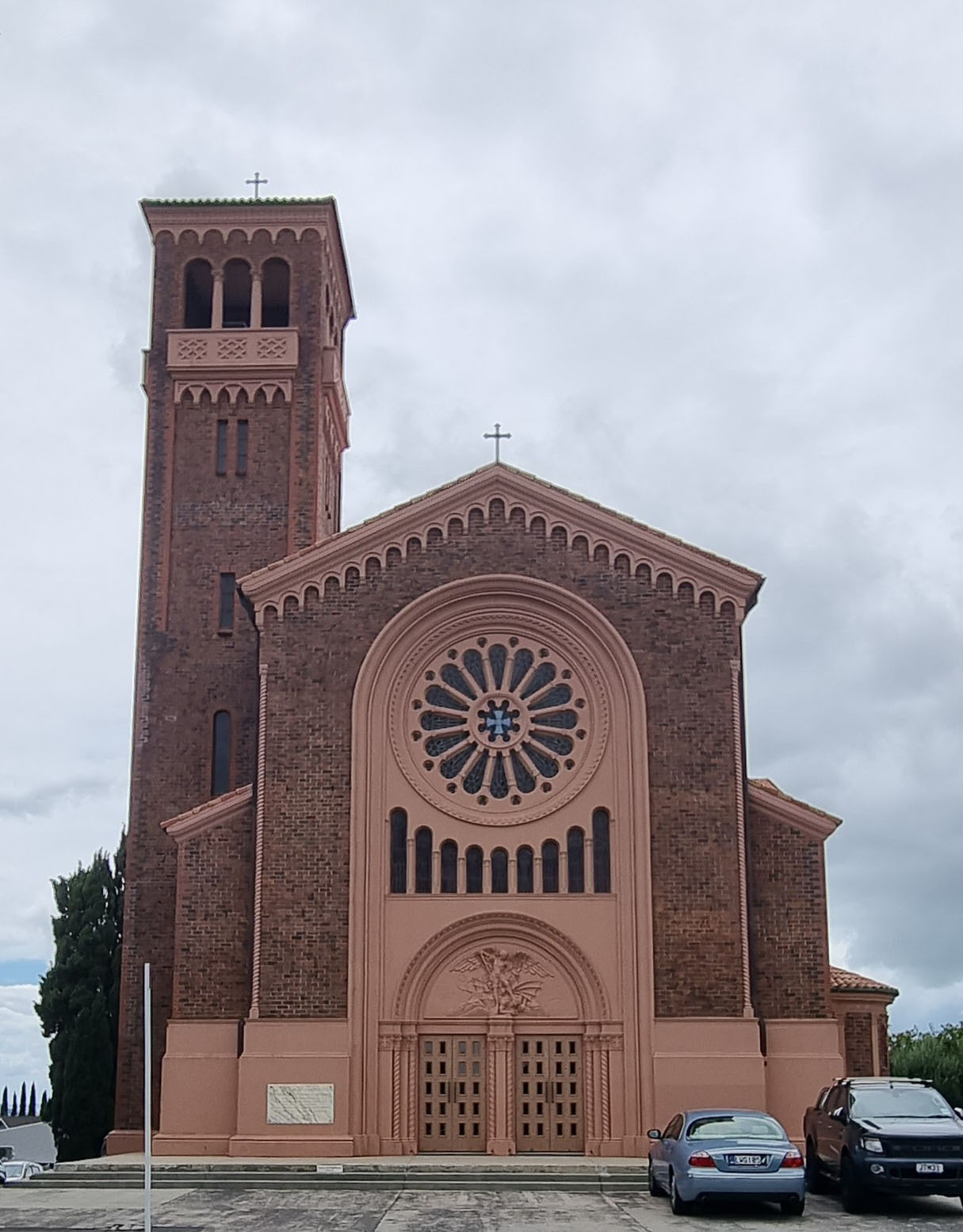
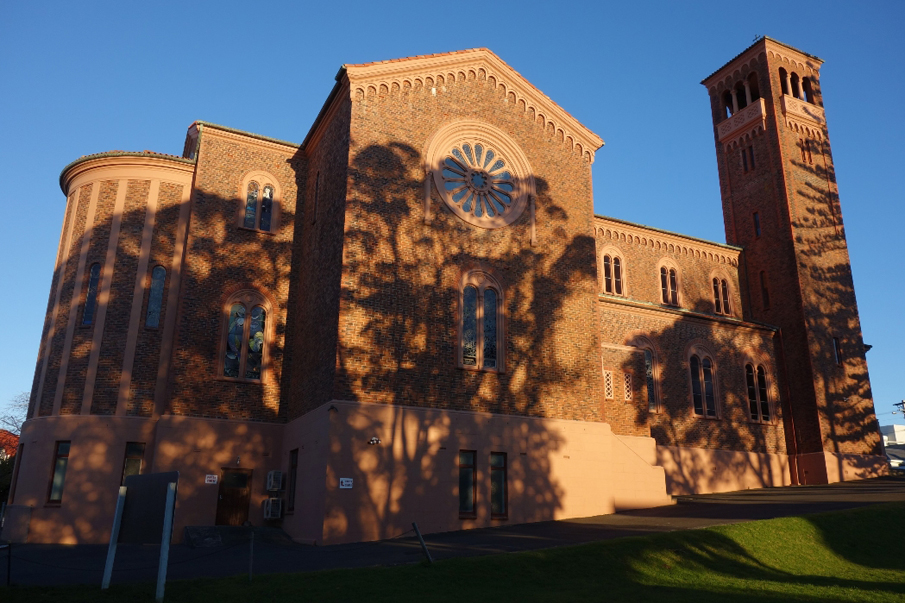
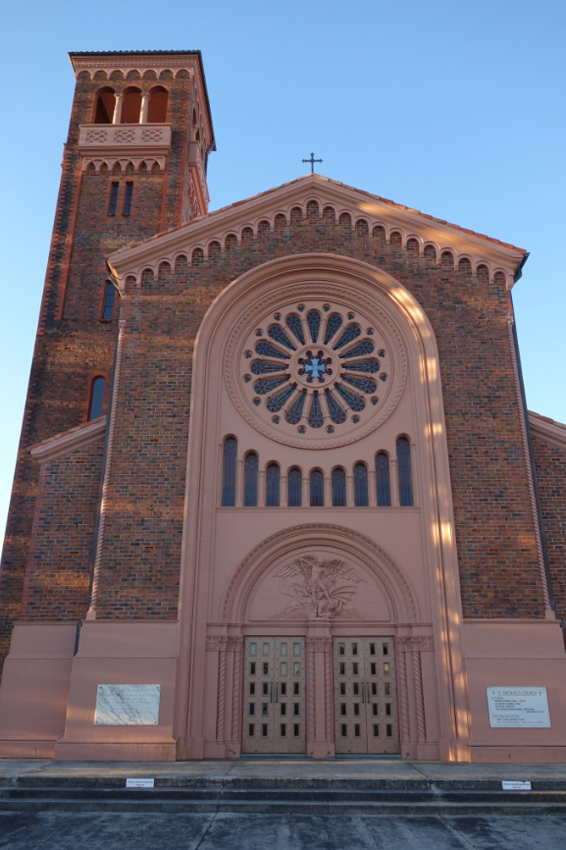
Noted as an excellent example of Gothic and Italian Romanesque styles, the Catholic Church of St. Michael’s on Beatrice Road, Remuera was opened in 1933 and is known for its striking brickwork structure and bold campanile designed by the partnership of Tole and Massey; and bas relief of St Michael, sculpted by R. O. Gross, over the main entrance. The building has outstanding significance as an NZIA Gold Medal award winning building, described as ‘one of the finest ecclesiastical buildings in Auckland’. The church also reflects developments in a distinguished tradition of brick construction by the Auckland Catholic Diocese, following in the footsteps of other notable brick-built structures such as St Benedict’s Church and Presbytery, Newton (1887-8; List No.640) and the Bishop’s House, Ponsonby (1893-4; List No.555). It has historical importance for its connections with attempts to assist the poor during the Great Depression through construction schemes, and as the largest such building project undertaken by Bishop James Liston in the early years of his bishopric. Since its construction, the place has been a significant place of worship and congregation for the local Catholic community, and forms part of a notable larger complex of ecclesiastical buildings.
The land occupied by St Michael’s was originally owned by Robert Kelly who was granted eleven acres here in 1848. After Kelly’s death, the land was subdivided and Grandvue Place (later known as Beatrice Road) was laid out. Part of this land was bought by Thomas Ching, who built his house ‘Deane’ on the property in 1874. The Catholic community at Remuera had been worshipping in a small hall on Middleton Road since 1894; this building shortly became too small for the Catholic population of Remuera and alternatives were sought. After Ching’s death, Father Owen Doyle speculatively bought Deane and its surroundings for £4,000 in 1915, intending that a new church, school and convent would be built.
The new church of St. Michael’s was designed by the architects George Tole and Horace Massey. Tenders were advertised in December 1930, the successful contractors being J. T. Julian and Sons. The commencement of work was interrupted by the Depression and did not begin until 1932 at a cost of about £13,000. The finished building was of brick on a reinforced concrete frame, laid out in a cruciform pattern with a narthex, a long nave, large transepts and apsidal sanctuary; a 100ft (30.5m) campanile tower with an open loggia was constructed onto the southwestern end of the nave. Exterior features such as Cordova tiled roofs, rose windows and Lombard band decoration are consistent with medieval European Romanesque influence on the design – the first time that this style was said to have been used for a church in Auckland. The finest exterior feature was the bas relief above the main entrance, created by R. O. Gross, featuring St. Michael impaling Lucifer. A notable artist, Gross made a major contribution to public sculpture during the inter-war years and also gave New Zealand sculpture a professional image. The interior featured vieux rose brickwork and plastered arches leading up to a plastered roof. The church accommodated over 1000 people on 1 October 1933, when it was consecrated by Bishop James M. Liston – arguably Auckland’s greatest Catholic bishop, who maintained the Diocesan building programme during the period after his ascension in December 1929 to provide work during a time of economic depression. The design work on the church was instantly recognised, winning the Tole and Massey partnership the NZIA Gold Medal.
The exterior aspect has remained relatively unchanged; stained-glass depictions of Hope and Charity were added to the transeptual rose windows in 1954 along with depictions of the apostles on the four apsidal windows in the sanctuary. Inside, the marble high altar was installed along with a plaster baldachino in 1950. Minor structural strengthening was carried out on the tower in 1998; large-scale strengthening occurred in 2009-10. The church remains in use as a place of worship.
The land occupied by St Michael’s was originally owned by Robert Kelly who was granted eleven acres here in 1848. After Kelly’s death, the land was subdivided and Grandvue Place (later known as Beatrice Road) was laid out. Part of this land was bought by Thomas Ching, who built his house ‘Deane’ on the property in 1874. The Catholic community at Remuera had been worshipping in a small hall on Middleton Road since 1894; this building shortly became too small for the Catholic population of Remuera and alternatives were sought. After Ching’s death, Father Owen Doyle speculatively bought Deane and its surroundings for £4,000 in 1915, intending that a new church, school and convent would be built.
The new church of St. Michael’s was designed by the architects George Tole and Horace Massey. Tenders were advertised in December 1930, the successful contractors being J. T. Julian and Sons. The commencement of work was interrupted by the Depression and did not begin until 1932 at a cost of about £13,000. The finished building was of brick on a reinforced concrete frame, laid out in a cruciform pattern with a narthex, a long nave, large transepts and apsidal sanctuary; a 100ft (30.5m) campanile tower with an open loggia was constructed onto the southwestern end of the nave. Exterior features such as Cordova tiled roofs, rose windows and Lombard band decoration are consistent with medieval European Romanesque influence on the design – the first time that this style was said to have been used for a church in Auckland. The finest exterior feature was the bas relief above the main entrance, created by R. O. Gross, featuring St. Michael impaling Lucifer. A notable artist, Gross made a major contribution to public sculpture during the inter-war years and also gave New Zealand sculpture a professional image. The interior featured vieux rose brickwork and plastered arches leading up to a plastered roof. The church accommodated over 1000 people on 1 October 1933, when it was consecrated by Bishop James M. Liston – arguably Auckland’s greatest Catholic bishop, who maintained the Diocesan building programme during the period after his ascension in December 1929 to provide work during a time of economic depression. The design work on the church was instantly recognised, winning the Tole and Massey partnership the NZIA Gold Medal.
The exterior aspect has remained relatively unchanged; stained-glass depictions of Hope and Charity were added to the transeptual rose windows in 1954 along with depictions of the apostles on the four apsidal windows in the sanctuary. Inside, the marble high altar was installed along with a plaster baldachino in 1950. Minor structural strengthening was carried out on the tower in 1998; large-scale strengthening occurred in 2009-10. The church remains in use as a place of worship.