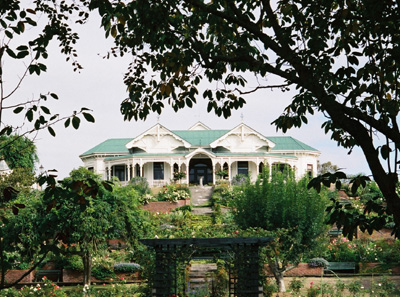
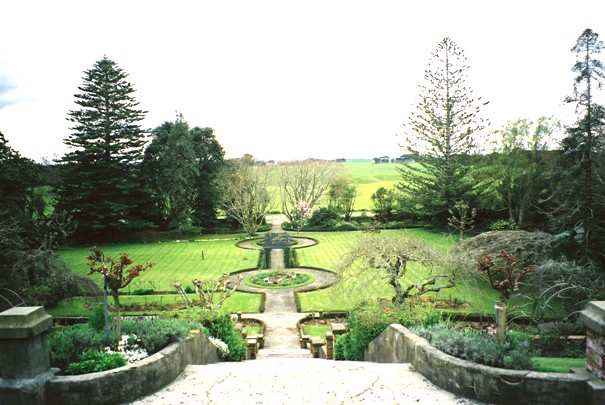
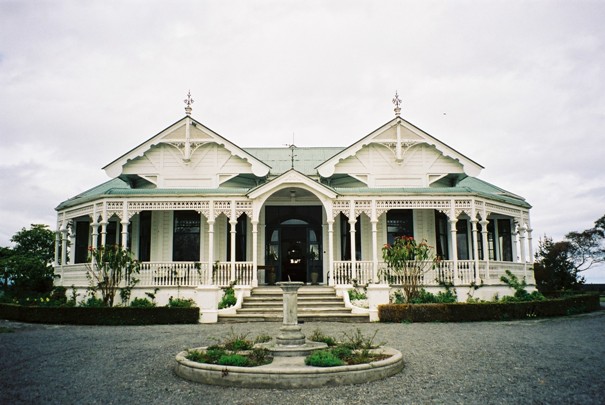
Pukemarama, constructed on the highest point between the mouth of the Rangitikei River and Palmerston North, is a complement of buildings constructed in 1900 for James McKelvie. The Homestead and Stable were built by notable Wanganui firm, Russell and Bignell, and along with its garden, the large, ornate, late-Victorian timber Homestead is among the most celebrated of the Manawatu’s rural residences.
Maori had occupied the Rangitikei-Manawatu Block for centuries before European incursion into the area. The potential of this area as a farming district lead to a protracted period of negotiation between local iwi and the Crown and then resulted in lengthy Native Land Court proceedings in the 1860s. However, by the early 1870s earnest European settlement had begun; townships were being founded and the areas surrounding them were gradually occupied and developed into farmland. The farm on which Pukemarama was eventually constructed was established in the early 1870s and later sold to James McKelvie in 1900. The McKelvie family were themselves early European farmers in the area. The prosperity they gained in this enterprise is reflected in the grand villa and accompanying stables that McKelvie immediately constructed at what he called Pukemarama, or ‘Hill Moon.’ The McKelvie family continue to occupy this property and are an important local family with some of the largest farm holdings in the Manawatu.
Pukemarama Homestead, with its symmetry, deep verandahs and high level of ornamentation, is a typical late-Victorian, Queen Anne style inspired, grand, rural villa. However, the form of the building is remarkable because of its organisation around a central oval room. This atypical layout may be because the builders, Russell and Bignell are said to have designed the residence in conjunction with its owner. Like the house, the form of the contemporary stable block is unusual due to its H shape. It has two distinct wings which are divided by a carriageway, and it is visually linked to the Homestead through the inclusion of decorative features which elevate it above its purely utilitarian function and are in keeping with the elegance of the Homestead. Other small buildings which contribute to Pukemarama’s story which were also constructed in the same period as the Homestead include the house’s outbuilding, Tom’s Hut, and a lean-to remnant of the property’s original farmhouse.
In particular, Pukemarama’s Homestead and Stables are of significance as an immaculately preserved example of the rural coupling of a grand early twentieth-century villa and stable. The house is architecturally noteworthy for its unusual layout and the excellence of its construction. The necessity for stables in close proximity to the main house is indicative of the reliance on horses for transport and farming, and as such these buildings have historical significance for the insight they provide into the lifestyle of wealthy rural landowners in New Zealand at the turn of the twentieth-century. Pukemarama is of local importance as one of the district's finest country homes and is held in high esteem by that community, as are its longstanding family, the McKelvies.
Maori had occupied the Rangitikei-Manawatu Block for centuries before European incursion into the area. The potential of this area as a farming district lead to a protracted period of negotiation between local iwi and the Crown and then resulted in lengthy Native Land Court proceedings in the 1860s. However, by the early 1870s earnest European settlement had begun; townships were being founded and the areas surrounding them were gradually occupied and developed into farmland. The farm on which Pukemarama was eventually constructed was established in the early 1870s and later sold to James McKelvie in 1900. The McKelvie family were themselves early European farmers in the area. The prosperity they gained in this enterprise is reflected in the grand villa and accompanying stables that McKelvie immediately constructed at what he called Pukemarama, or ‘Hill Moon.’ The McKelvie family continue to occupy this property and are an important local family with some of the largest farm holdings in the Manawatu.
Pukemarama Homestead, with its symmetry, deep verandahs and high level of ornamentation, is a typical late-Victorian, Queen Anne style inspired, grand, rural villa. However, the form of the building is remarkable because of its organisation around a central oval room. This atypical layout may be because the builders, Russell and Bignell are said to have designed the residence in conjunction with its owner. Like the house, the form of the contemporary stable block is unusual due to its H shape. It has two distinct wings which are divided by a carriageway, and it is visually linked to the Homestead through the inclusion of decorative features which elevate it above its purely utilitarian function and are in keeping with the elegance of the Homestead. Other small buildings which contribute to Pukemarama’s story which were also constructed in the same period as the Homestead include the house’s outbuilding, Tom’s Hut, and a lean-to remnant of the property’s original farmhouse.
In particular, Pukemarama’s Homestead and Stables are of significance as an immaculately preserved example of the rural coupling of a grand early twentieth-century villa and stable. The house is architecturally noteworthy for its unusual layout and the excellence of its construction. The necessity for stables in close proximity to the main house is indicative of the reliance on horses for transport and farming, and as such these buildings have historical significance for the insight they provide into the lifestyle of wealthy rural landowners in New Zealand at the turn of the twentieth-century. Pukemarama is of local importance as one of the district's finest country homes and is held in high esteem by that community, as are its longstanding family, the McKelvies.