

The first Anglican service was held in Bulls in July 1878 by Reverend Arthur Towgood. For three years afterwards, services conducted by Reverend Arthur Towgood and Reverend Archdeacon Thorpe took place in the Bulls town hall. By 1881 the need for a church had become pressing, and local residents held a meeting to discuss how to 'put the Church of England on an equal footing with the other religious denominations in Bulls'. James Bull, after whom the township is named, was active in promoting the construction of a church building. In April that year, the Bulls Church of England Building Committee selected a design for the proposed church. The design was based on the stone St Stephens Church (1880) in Waverley, but was adapted for construction in wood by surveyor Thomas William Downes.
A site for an Anglican church was donated by Captain Edward Daniell, one of the earliest Pakeha land proprietors in Bulls. However, Captain Daniell failed to formally transfer the land to the parish prior to his death. Alternative locations were considered, but on 8 July 1881, the daughter of Captain Daniell, Juliette Danielle Deane, formally transferred the original site to the parish.
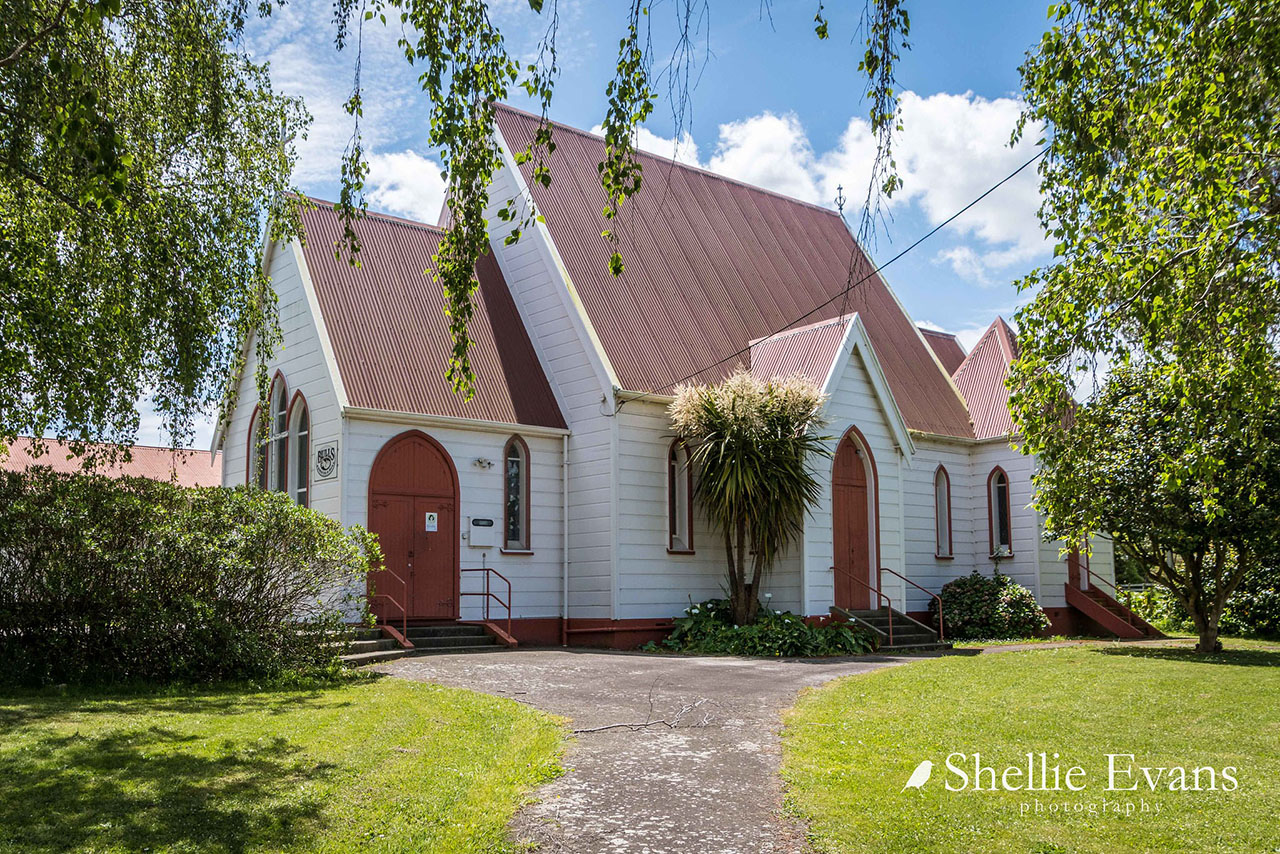
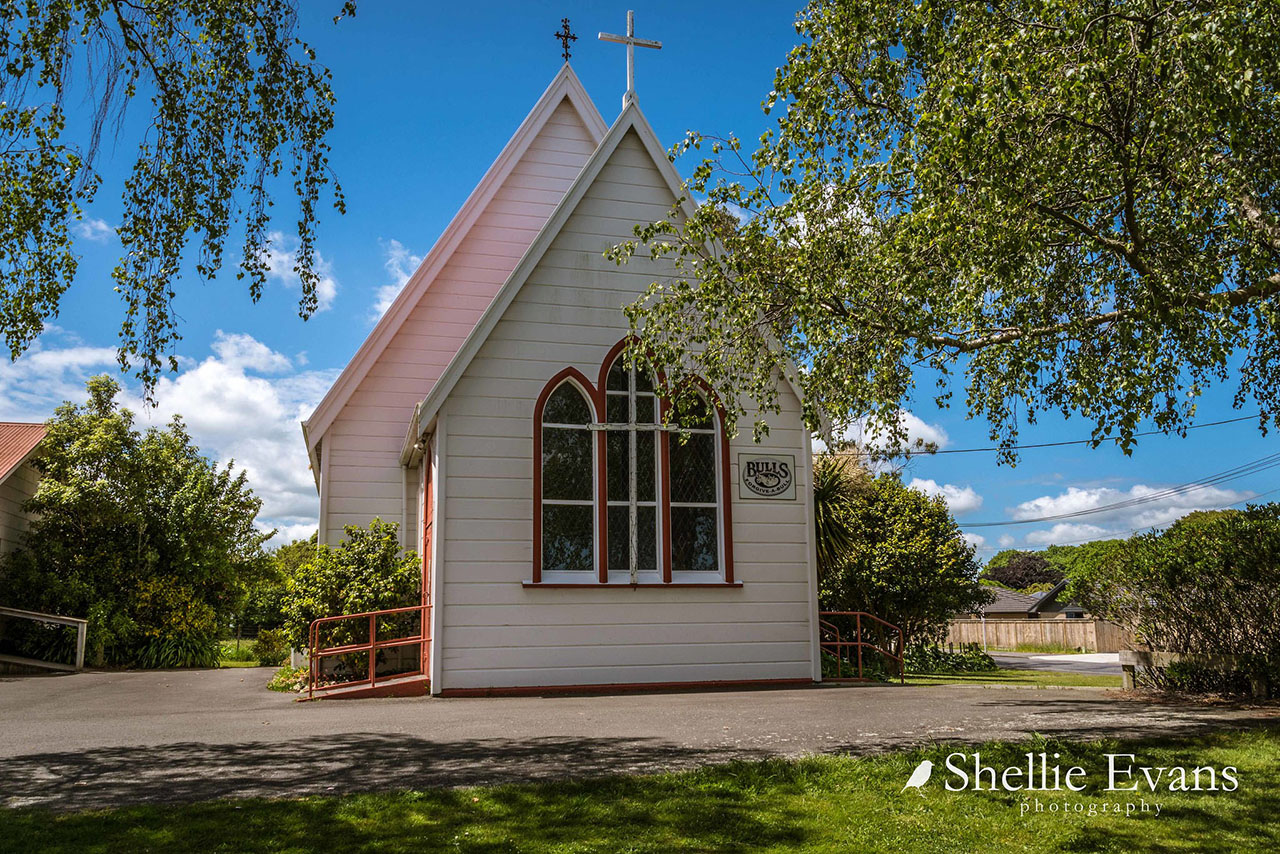
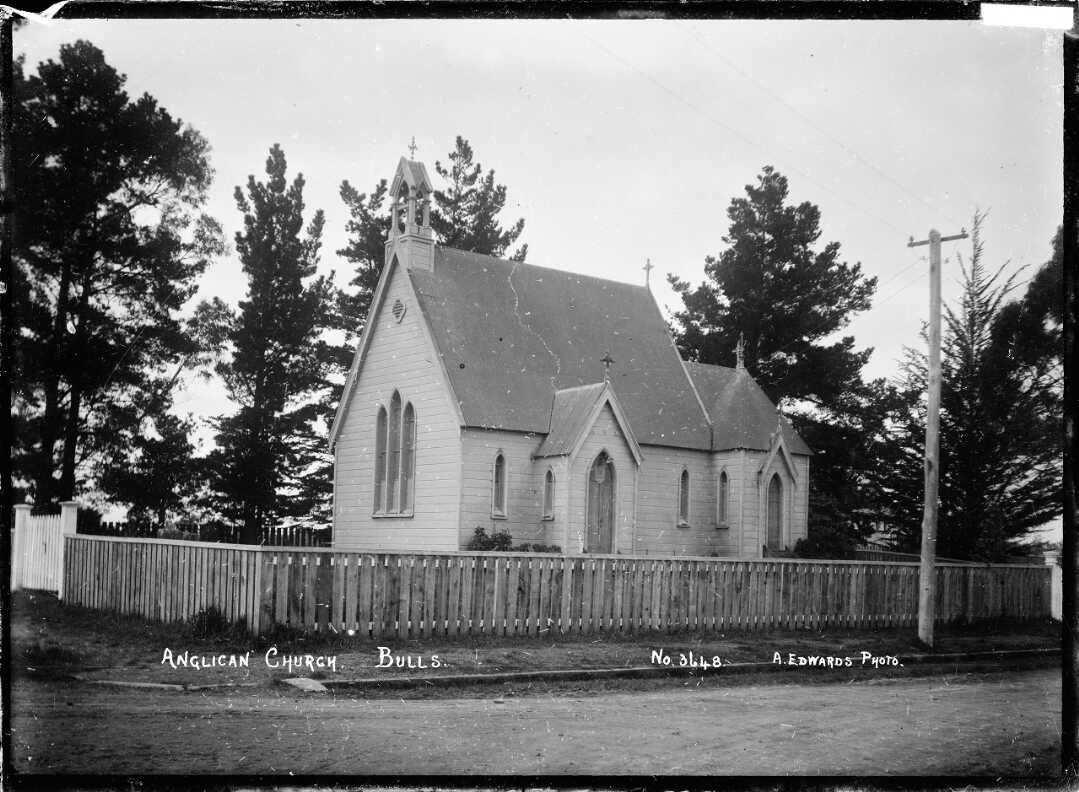
In 1881, James and Charles Bull constructed the church building. It was Victorian Gothic in style and could accommodate approximately 130-140 parishioners. It was consecrated and named 'St Andrews Anglican Church' by Bishop Octavius Hadfield (1814?-1904) on 23 February 1882.
St Andrews Anglican Church has been well maintained and remains in excellent condition. The church has had minor modifications. A fire in February 1955 that started in the vestry meant that the sanctuary and ceiling of the nave had to be relined. A number of stained glass windows donated by the Wilson family were installed near the altar in 1963, and a west porch was added in 1979.
St Andrews Anglican Church is of significance to the local community. The church was constructed for and by local settlers and is associated with James Bull and Captain Edward Daniell, who were prominent residents in the Bulls township.
List Entry Information
Status
Listed
List Entry Status
Historic Place Category 2
Access
Private/No Public Access
List Number
1215
Date Entered
11th December 2003
Date of Effect
11th December 2003
City/District Council
Rangitīkei District
Region
Horizons (Manawatū-Whanganui) Region
Extent of List Entry
Registration includes the building and land on which it rests.
Legal description
Pt Blk III Rangitikei (RT 330/240), Wellington Land District
Location Description
Located on the corner of Bridge Street (198) and Wilson Street, Bulls.
Status
Listed
List Entry Status
Historic Place Category 2
Access
Private/No Public Access
List Number
1215
Date Entered
11th December 2003
Date of Effect
11th December 2003
City/District Council
Rangitīkei District
Region
Horizons (Manawatū-Whanganui) Region
Extent of List Entry
Registration includes the building and land on which it rests.
Legal description
Pt Blk III Rangitikei (RT 330/240), Wellington Land District
Location Description
Located on the corner of Bridge Street (198) and Wilson Street, Bulls.
Why is this place significant?
Historic Significance
Historical Significance or Value St Andrews Anglican Church is of historical significance. The church was formed as a result of the contribution from two of the key figures in the founding of Bulls, Captain Edward Daniell and James Bull. St Andrews also had social and spiritual value. It was designed and built by local residents, and has continued to serve the Parish for over 120 years. It is held in high esteem by local members of the community.
Why is this place Category 1 / Category 2?
Detail Of Assessed Criteria
(b) The association of the place with events, persons, or ideas of importance in New Zealand history St Andrews Anglican Church is associated with two key figures in the history of the Bulls township, Captain Edward Daniell and James Bull. The land on which the church was built was originally granted by Captain Edward Daniell, one of the earliest Pakeha land proprietors in the area. James Bull, after whom the township is named, was active in the meetings about the formation of the church, and constructed the church itself. (e) The community association with, or public esteem for, the place The church has had an important role in the history of the township and is held in high regard by the local community. This can be seen in the fundraising campaigns that funded the construction of the church, along with over 120 years of continuous use by parishioners. (h) The symbolic or commemorative value of the place There is a strong commemorative value assigned to St Andrews Anglican Church by the local community. This can be seen in the windows throughout the church that have been donated by different families in memory of their loved ones. The three windows in the sanctuary were donated by the Wilson family. The windows to the north are in memory of Mrs Levett. In the entrance porch of the church windows have been dedicated to the memory of Alison and Lewin Taverner.
Why is this place significant?
Historic Significance
Historical Significance or Value St Andrews Anglican Church is of historical significance. The church was formed as a result of the contribution from two of the key figures in the founding of Bulls, Captain Edward Daniell and James Bull. St Andrews also had social and spiritual value. It was designed and built by local residents, and has continued to serve the Parish for over 120 years. It is held in high esteem by local members of the community.
Why is this place Category 1 / Category 2?
Detail Of Assessed Criteria
(b) The association of the place with events, persons, or ideas of importance in New Zealand history St Andrews Anglican Church is associated with two key figures in the history of the Bulls township, Captain Edward Daniell and James Bull. The land on which the church was built was originally granted by Captain Edward Daniell, one of the earliest Pakeha land proprietors in the area. James Bull, after whom the township is named, was active in the meetings about the formation of the church, and constructed the church itself. (e) The community association with, or public esteem for, the place The church has had an important role in the history of the township and is held in high regard by the local community. This can be seen in the fundraising campaigns that funded the construction of the church, along with over 120 years of continuous use by parishioners. (h) The symbolic or commemorative value of the place There is a strong commemorative value assigned to St Andrews Anglican Church by the local community. This can be seen in the windows throughout the church that have been donated by different families in memory of their loved ones. The three windows in the sanctuary were donated by the Wilson family. The windows to the north are in memory of Mrs Levett. In the entrance porch of the church windows have been dedicated to the memory of Alison and Lewin Taverner.
Construction Professional
Name
Bull, James and Charles
Type
Builder
Biography
No biography is currently available for this construction professional
Name
Downes, T. W
Type
Architect
Biography
No biography is currently available for this construction professional
Construction Details
Start Year
1882
Type
Original Construction
Description
Constructed by James and Charles Bull
Start Year
1955
Type
Other
Description
Fire destroyed ceilings in nave and sanctuary (later relined)
Start Year
1963
Type
Addition
Description
Wilson family donated stained glass windows for church sanctuary
Start Year
1979
Type
Addition
Description
West porch added
Construction Materials
Timber, with corrugated iron roof, and concrete piles.
Construction Professional
Name
Bull, James and Charles
Type
Builder
Biography
No biography is currently available for this construction professional
Name
Downes, T. W
Type
Architect
Biography
No biography is currently available for this construction professional
Construction Details
Start Year
1882
Type
Original Construction
Description
Constructed by James and Charles Bull
Start Year
1955
Type
Other
Description
Fire destroyed ceilings in nave and sanctuary (later relined)
Start Year
1963
Type
Addition
Description
Wilson family donated stained glass windows for church sanctuary
Start Year
1979
Type
Addition
Description
West porch added
Construction Materials
Timber, with corrugated iron roof, and concrete piles.
The design of St Andrews Anglican Church is based on St Stephens Church in Waverley. St Andrews Church is Victorian Gothic in style. It was originally built of timber and had a shingled roof, which has since been replaced by corrugated iron. The timber piles have also been replaced by concrete. The church was built to seat an estimated 130-140 parishioners. The nave of the church features spectacular stained glass windows, and the ceiling is supported by a series of exposed timber arches.
The design of St Andrews Anglican Church is based on St Stephens Church in Waverley. St Andrews Church is Victorian Gothic in style. It was originally built of timber and had a shingled roof, which has since been replaced by corrugated iron. The timber piles have also been replaced by concrete. The church was built to seat an estimated 130-140 parishioners. The nave of the church features spectacular stained glass windows, and the ceiling is supported by a series of exposed timber arches.
Historical and Associated Iwi / Hapū / Whānau
Completion Date
11th December 2003
Report Written By
Laura Burbery
Information Sources
St Stephen's Church, Waverley, 1955
St Stephen's Church, Waverley, 75th Jubilee 1880-1955, Hawera, 1955
Tannock, 1982
D. Tannock, People of his pasture: a history of the Parochial District of Bulls-Rongotea, Bulls, 1982
Other Information
A fully referenced version of this report is available from the Central Region of the NZHPT. Please note that entry on the New Zealand Heritage List/Rarangi Korero identifies only the heritage values of the property concerned, and should not be construed as advice on the state of the property, or as a comment of its soundness or safety, including in regard to earthquake risk, safety in the event of fire, or insanitary conditions.
Historical and Associated Iwi / Hapū / Whānau
Completion Date
11th December 2003
Report Written By
Laura Burbery
Information Sources
St Stephen's Church, Waverley, 1955
St Stephen's Church, Waverley, 75th Jubilee 1880-1955, Hawera, 1955
Tannock, 1982
D. Tannock, People of his pasture: a history of the Parochial District of Bulls-Rongotea, Bulls, 1982
Other Information
A fully referenced version of this report is available from the Central Region of the NZHPT. Please note that entry on the New Zealand Heritage List/Rarangi Korero identifies only the heritage values of the property concerned, and should not be construed as advice on the state of the property, or as a comment of its soundness or safety, including in regard to earthquake risk, safety in the event of fire, or insanitary conditions.
Current Usages
Uses: Religion
Specific Usage: Church
Former Usages
General Usage: Religion
Specific Usage: Church
Current Usages
Uses: Religion
Specific Usage: Church
Former Usages
General Usage: Religion
Specific Usage: Church
Location
Sign up to hear more
Get the latest heritage news, features and events delivered
straight to your inbox.
