Before the arrival of Maori from Taranaki in the 1820s, the Wellington area was populated primarily by people of Kurahaupo waka descent, including Ngai Tara, Rangitane, Muaupoko, Ngati Apa and Ngati Ira. The Waitangi Tribunal referred to these as ‘Whatonga-descent peoples’ since all claimed descent from Whatonga, an early Maori explorer, who named the harbour Te Whanganui a Tara, for his son Tara. The people from the Taranaki region were often given the common name of ‘Ngati Awa’ (and later Te Atiawa) by outsiders, but they comprised a number of tribes. These ‘incoming tribes’ included Ngati Toa (also known as Ngati Toa Rangatira), Ngati Rangatahi, Te Atiawa, Ngati Tama, Ngati Mutunga, Taranaki, and Ngati Ruanui.
By the 1820s, Europeans were arriving at Port Nicholson (as it came to be known, after John Nicholson, the Sydney harbourmaster). In May 1839 the New Zealand Company advertised in London 990 lots of Port Nicholson land for sale. Each lot was to consist of 101 acres – comprising 100 rural acres and one urban acre – at a cost of £1 per acre. All 990 lots were sold by July 1839 and in August 1839 Colonel William Wakefield arrived and began negotiating with Maori to purchase land. The first immigrants began arriving in January 1840.
Sir William Fox (1812?–1893), and his wife Sarah, arrived in New Zealand in 1842. In 1843 Fox, who had trained as a lawyer in England, was appointed the New Zealand Company Agent to Nelson and, in 1848, Principal Agent for the company. However, the company was in decline and Fox spent a lot of his time travelling around the company settlements tidying up loose ends of land distribution and negotiating compensation with disappointed purchasers.
In March 1843, Captain Edward Daniell chose the adjoining country sections Kaiwarra 4 and 5, comprising the greater part of the present Wellington suburb of Ngaio. He lived there for three years, and in 1848, when moving to the Hutt, sold a block of 14 acres to William Fox. There was a sawmill in the area – near the present day corner of Kenya Street and Crofton Road – and the area was described as a thickly wooded valley in the early 1840s. When Fox bought the land for £100 he had to provide a right of way along the ‘sawmillers road’ (later to develop into Crofton Road) for the sawmillers, and for Daniell to his adjoining land. In January 1851, the land (‘partly cleared and laid down in grass’) was advertised to let, as was Fox’s residence in Wellington city. In that year he and Sarah returned to England and did not arrive back in New Zealand until 1854. In June 1854 he won a seat on the Wellington Provincial Council and in 1855 was elected to represent Wanganui in the House of Representatives. His first term as Premier, in 1856, lasted only a fortnight. In the year Crofton was built he stood for the Wellington Provincial Council and was Chief Land Commissioner for Wellington.
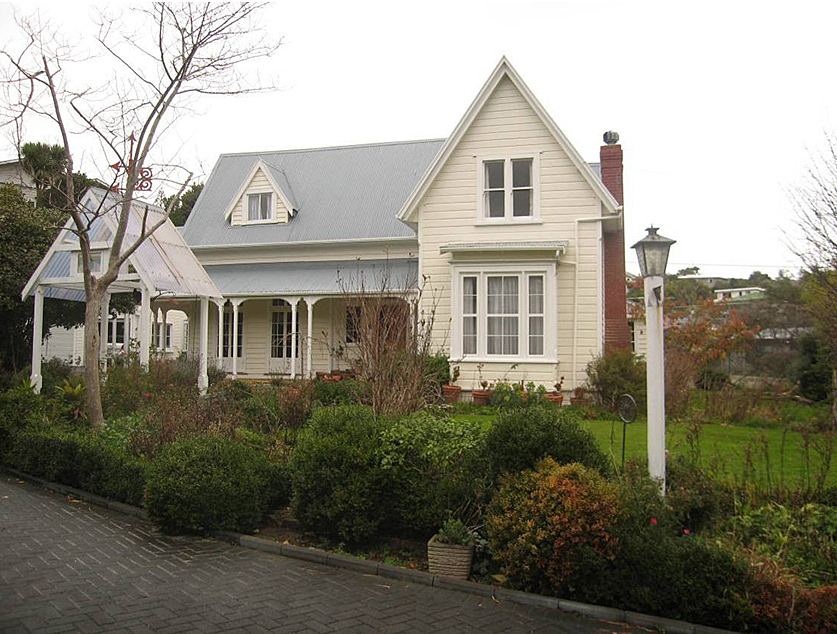
Crofton was built in 1857. Nothing is known of any architect or builder and no original plans are known to exist. However, it may have been based on plans available in pattern books, such as the American A J Downing’s The Architecture of Country Houses 1850, which could be adapted and built by a carpenter. Hence the style is sometimes called ‘Carpenter Gothic’ – being built in a simple Gothic Revival style. There were also other country houses with some similarities around Wellington that could have provided a model, such as Alfred Ludlam’s circa 1850 house in the Hutt, and Justice Chapman’s late 1840s house (‘Homewood’, Register no. 1368, Category 1) in Karori. Although Crofton is sometimes said to have been built around an earlier house, the advertisement letting the land in 1851 did not mention a house.
Fox’s address was listed in the newspaper in December 1857 as ‘Crofton, near Wellington’ when he took five shares in a company to promote steam ship navigation for Wellington. However he also signed a ‘letter to the electors of Wellington’ as ‘William Fox, Rangitikei’ in October 1857, saying he would try to meet with them after his return from the country. The Carter family were guests at Crofton for a time when they first arrived in Wellington in 1858 as settlers. Fox named the house Crofton after his mother’s maiden name. This was also the name of the suburb until 1908 when it was changed to Ngaio (due to Fox naming another place Crofton, near Marton). The adjacent suburb of Crofton Downs, developed in the 1960s, retains the historical link in its naming.
In 1858 Fox obtained a Crown grant for the Crofton property. A few of his watercolour paintings depict the area, including ‘My Bath, Crofton’ which shows a stream; but none are known to show his house. He may not have lived at Crofton often, and he certainly did not live there for long as it was advertised for sale in 1858, when it was described as being located on the Porirua Road, and containing a double drawing room, dining room, three good bedrooms, servants’ bedrooms, kitchen and scullery, storerooms, pantries, harness room, ‘etc’. It is unlikely that it was intended as a working farm, but more a gentleman’s country residence (the advertisement for sale said it had three fenced and grassed paddocks and many fruit trees). Fox had no children at this time, but in keeping with his status and means, the house was large enough for entertaining and for servants. His reasons for selling are unknown, but his loyalties may have been more with the Rangitikei area where he owned 3,639 acres and represented Wanganui or Rangitikei as an MP. He purchased the Rangitikei land in 1849 (later to become Westoe, Register no. 156, Category 1).
Crofton continued to be regularly advertised for sale throughout 1858 and into 1859. In 1860 Fox became unofficial leader of the opposition to the Stafford government, and in 1861 he became Premier for a second time. In August 1862 Fox’s government was defeated and he was back in opposition until he returned to office in May 1863, but this government lasted only a year.
For over thirty years Fox influenced New Zealand political life. During his varied public career Fox was to hold the position of Colonial Secretary, Attorney General, and was four times the Premier. In later life Fox was to hold the position of the Commissioner of Land Claims arising from the confiscation of Maori lands on the west coast of Taranaki. Fox was also a talented painter, explorer, and keen advocate for the temperance movement which aimed to reduce alcohol consumption. He was knighted in 1879. He is said to have been more impressive in opposition than in government – ‘He was not a great leader…, but few New Zealand leaders have made a mark in so many areas – constitutional development, politics, social reform, painting and exploration.’ The town of Foxton, and a glacier in the South Island is named after him.
In 1862, Fox finally sold the house to Bishop Charles Abraham (1814–1903), the first Bishop of Wellington, who opened the Church of England Grammar School in it the following year. Abraham was Bishop of Wellington from 1858 to 1870, although he returned to England in 1868, and was an advocate for education, being particularly critical of the Church Missionary Society’s failure to establish an ‘adequate network of schools for Maori throughout the country.’ At the time of sale it was found that the house was actually built on Daniell’s adjoining land, but an accommodation was reached with two acres being exchanged between Fox and Daniell and two days later the land was conveyed to Bishop Abraham. The sale was reported in the Otago Daily Times: ‘it comprises a large house, built some years ago…at a cost of nearly £1200, and stands on 14 acres of freehold ground (sown grass and park like bush)… The selling price was £700… It had stood empty for the last three years’. The report went on to note that prices were depressed due to the uncertainty ‘engendered by the Maori troubles of the past two years having exercised a most depressing effect on real property’.
Known as Crofton College, Kaiwarra or the Church of England Grammar School at Crofton, the school educated many of the sons of leading Anglican families. It was one of Wellington’s early colleges; although by no means the first. There were ‘grammar’ schools in Wellington in the 1850s, usually providing education for boys of all ages – Reverend Edward Wheeler’s Te Aro Grammar School, which had about a dozen boarders, is thought to be the first to offer some secondary level education. There were also numerous (but often short lived) boarding and day schools for girls, usually operated from the teacher’s homes. Crofton’s first principal was Walter Martin (‘late of Her Majesty’s 15th Regiment’); its fees were £15 for tuition and £50 for board per year. Martin left at the end of 1864. In 1866 the property was sold to the school’s principal, the Reverend H. Woodford St Hill for £1300. The second master was a Mr Chepnell, and some of the family surnames of pupils include Bidwell, Hadfield, Johnston, Fitzherbert, Beetham, France and Barton. Access to the school was still via Sawmill (later Crofton) Road, with a drive through what would become No. 8 Holmes (later Orari) Street. There were few other houses in the area.
The school most likely closed in 1875 when St Hill paid off two mortgages in full and appointed trustees to hold the land in trust for his wife and children. It is thought that falling rolls due to other secondary schools opening may have caused the closure, and St Hill accepted the vicarate of Havelock North and Clive. However the plan for building the railway line in 1879 still referred to the nearby ‘property known as Crofton College’.
Mr William Berry, accountant, leased the property from December 1877, as noted at a meeting of his creditors in 1880 after he filed for bankruptcy. The terms were for seven years at £85 per annum, with a purchasing clause at £1300 within the term of the lease. It was put up for sale in 1882 and 1884; the 1884 advertisement noted that it was at present occupied by Mrs Berry. Elsdon Best’s mother and sister were said to have visited Mrs Berry at Crofton and commented upon the ‘style in which they carried off their poverty’. A photograph of the house taken by William Berry in the 1880s shows the verandah had been enclosed by this time. A letter in 1883 from St Hill to John Chew asked if the coming railway may make it possible to sell Crofton. The railway made the area more accessible, however by 1896 there were still only 18 houses at Crofton.
Mr and Mrs Berry’s daughter Jeannie was married ‘at Crofton House’ in December 1885; however by then the house was the residence of the bridegroom’s father, Mr Littlejohn. Wilson Littlejohn was the first mayor of the Borough of Onslow (proclaimed a borough on 13 March 1890). He was a watchmaker and jeweller with a business in Lambton Quay and he held Presbyterian services and a Sunday school in the kitchen at Crofton. For six years this was the only place holding religious services in the area. Littlejohn subdivided Crofton in 1895 and the plan shows a drawing of Crofton as ‘the family residence on section no. 17’. The advertisement for sale noted he was selling it due to his increasing weak health; the house was described thus: ‘The family residence of two stories contains a hall 12ft 9in x 12ft 3in [3.8m x 3.7m], Drawing room, 18ft x 14ft [5.5m x 4.3m], with large square bay window and folding doors leading into Breakfast-room, 14ft x 10ft [4.3m x 3m], Dining-room 16ft x 14ft [4.9m x 4.3m], six Bedrooms, Kitchen, Scullery, Bath-room, Wash-house, Verandah, and Conservatory. It is built of heart totara and is in first-class condition.’
Two acres of land and several out-buildings were also included (a coach house, stables, dairy, cow-house, granary, coal-house, tool-house, photographic dark-room, fowl-house, etc). William Berry had been a keen amateur photographer, which no doubt accounts for the dark room. John Holmes, a Kaiwharawhara tanner, bought Crofton in 1895. A photograph of the Holmes’s at Crofton, circa 1900, shows the verandah has been partially opened again.
John Holmes was an early Wellington settler, arriving on the Oriental in January 1840 and, like Littlejohn, he had a long association with the Onslow borough, being a councillor and mayor for four consecutive years. He was also a strong supporter of the Methodist Church, holding services at Crofton and later donating part of the Crofton property to build a local church. After the first service at the new church on 11 December 1904 the congregation went to Crofton for refreshments. By 1916, the Ngaio suburb’s population was 1906. After John died in 1923, his family continued to own Crofton until about 1929. The land was subdivided in 1907 and again in 1929. The 1929 plan shows A B Tracey as the owner; this family retained the property until 1979. Arthur Tracey was a tailor and at some time is thought to have had a workshop upstairs at Crofton. However, in the late 1930s and during World War Two he had a workshop in Wellington city (at 96 Courtenay Place in the 1940s). In 1941 Tracey and Sons, on behalf of the eldest son Brian, appealed his call up for overseas service; however, this appeal failed and Brian Tracey was killed in action in 1943.
The Traceys may have converted the house to flats soon after purchasing it as in September 1929 a fire destroyed part of the house and the newspaper reported that it was a 15-room building used as an ‘apartment house’ owned by Arthur Tracey. Two rooms on the ground floor occupied by Owen Casey were damaged by fire and water and a kitchen and passage received some damage. This part was replaced by a single-storeyed Californian bungalow style building on the south-west elevation. In 1947 Mrs Tracey applied for a licence to keep the premises as a boarding house. The assessment of the property by the City Engineer’s Department said the house was divided into four flats and listed the 14 occupants as Mr and Mrs Tracey and three sons, Mr and Mrs Lieven and one child, Mr and Mrs Pailthorpe and two sons, and Mr and Mrs Mark. The premises needed further work to bring them up to an acceptable standard for a boarding house ‘or alternatively that plans be submitted for the conversion of the building into self-contained flats’. No further correspondence exists on the file.
Dormer windows have been added to the first floor at some time after 1895. Nineteenth-century photos show decorative barge boards on the front gable, which are no longer there, as well as a shingled roof, which is now corrugated iron. When the current owners bought the house in 1979 it was in a poor state, with rotten piles, uneven floors, etc. However, they bought it with the intention of restoring it to a single home, which has since been done.
In the early 1980s, the current owners restored the main two-storey part more to its original design, including opening the front verandah. When the verandah walls were removed part of the original verandah posts and brackets had remained, allowing accurate copies to be made. As it had been in flats, a number of walls needed removing. It was also repiled. It was found that the two-storey building of ‘balloon’ frame construction was of larger than usual timber (studs 150mm x 75mm or 6 inches x 3 inches; bottom plates 150 x 100 or 6 x 4), tenoned together and pegged. Conservation architect Chris Cochran notes that mid-nineteenth century pegged mortise and tenon joints are now quite rare. The 1920s bungalow addition was largely rebuilt. There was a minimum of change upstairs, although the dormer windows which did not exist in Fox’s time were retained, but their roof was ‘gabled’ to match the main roof pitch. The old farm outbuildings were demolished in 1981. The original staircase, front door ‘of generous size and weight’ with its lock and handle and also the French doors which had given access to the verandah were retained, but no original fireplaces or over mantels, or panelled or plastered ceilings remained. Other original or early features include the cupboard under the stairs, a beam and window in the kitchen, post and rail on the verandah and the verandah ceiling, skirting boards under the lounge window, windows in two bedrooms, and bedroom doors with their locks and handles. In 2006 a new conservatory and toilet were added to the rear (south) of the building.
There have been a number of articles about Crofton in the local Onslow Historical Society magazine, and it is included in the Wellington City Council’s northern heritage trail brochures.