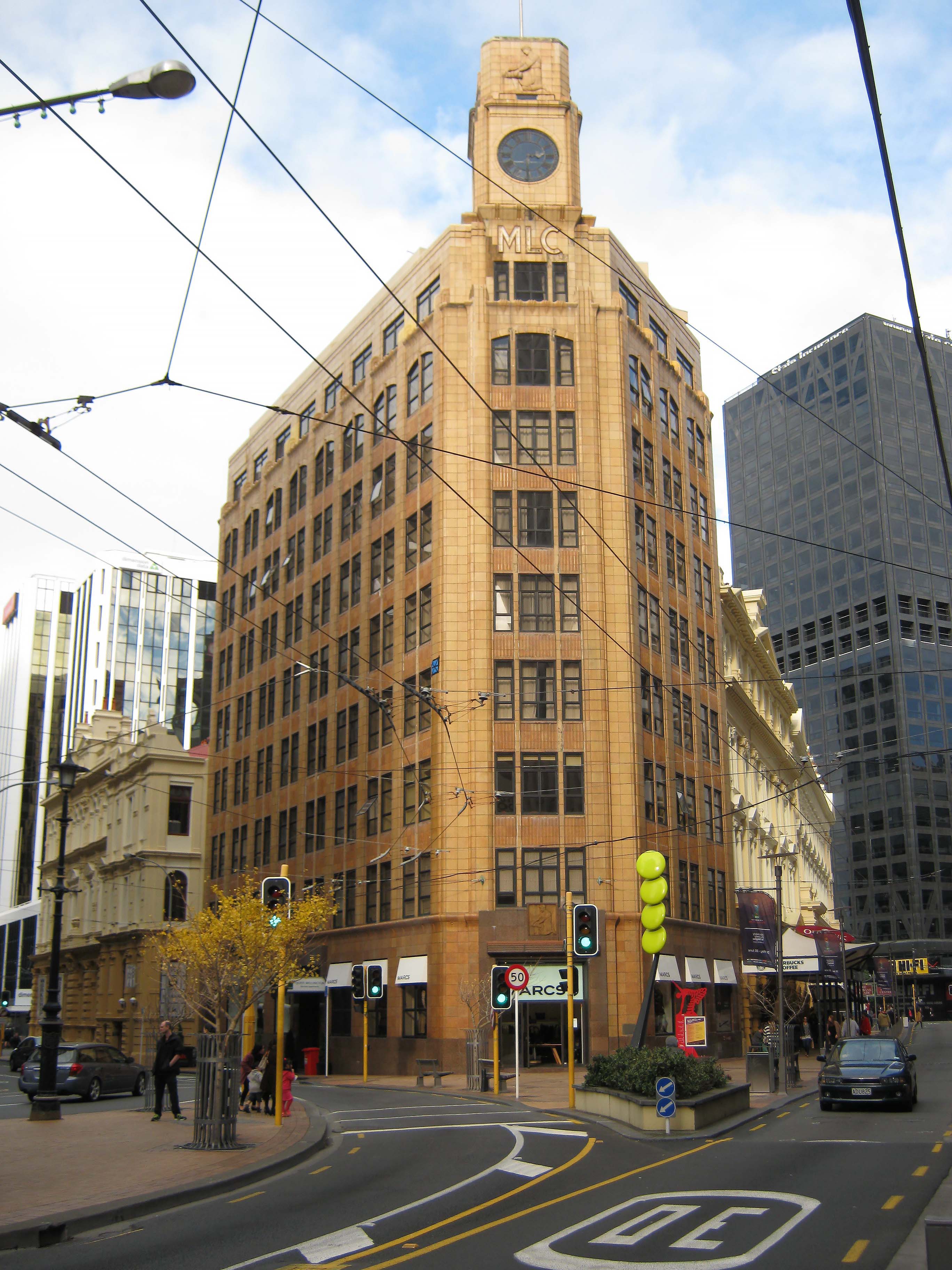
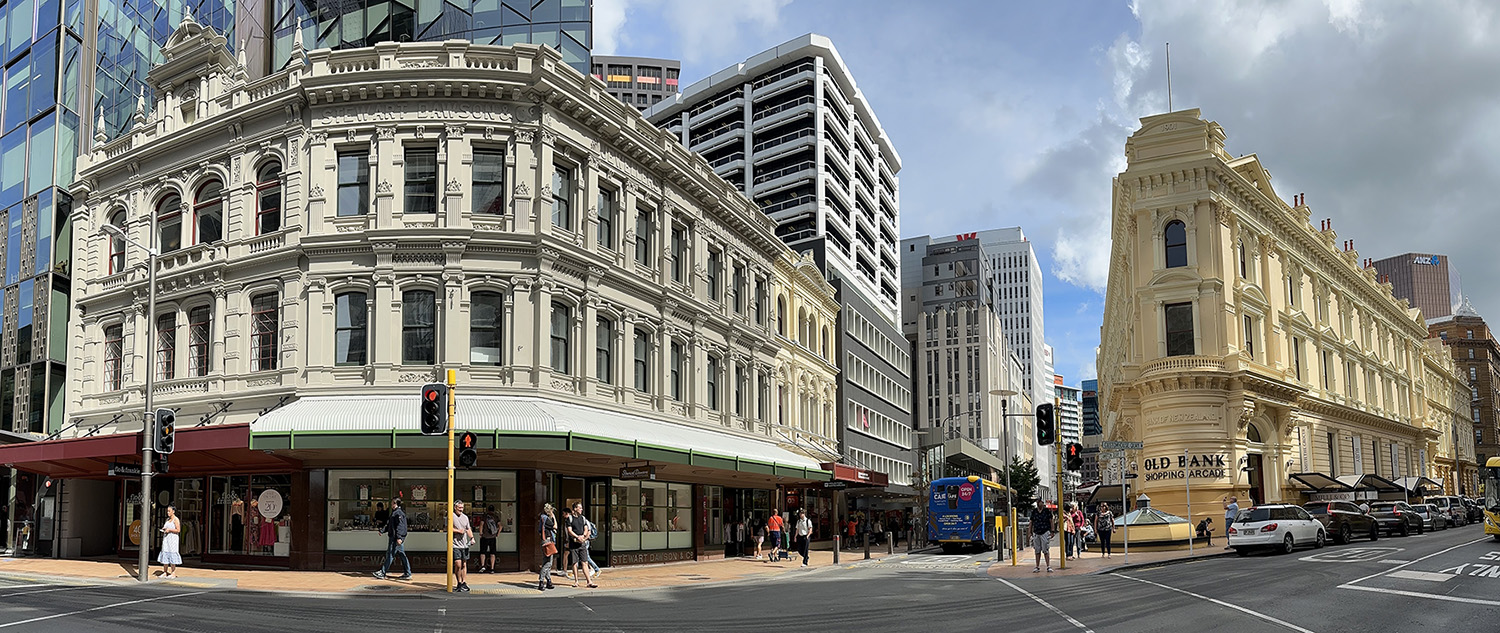
Distinctly elegant with a vertically sweeping Art Deco façade, MLC Building (Former) stands tall on the corner of Hunter Street and Lambton Quay in Wellington. An important component of the South Lambton Quay Historic Area, the MLC Building has aesthetic significance as an excellent example of the late Art Deco movement Streamline Moderne, social value as a landmark of the central business district, and historical value as the former head office for one of New Zealand’s largest insurance and investment companies of the twentieth century, the Mutual Life and Citizens Assurance Company (MLC).
Kupe and his crew are often recognised as the first people to visit the Wellington region, but it was Ngāi Tara who were the first people to settle there, and whose eponymous ancestor gave Te Whanganui-a-Tara its name. By the early 1800s Ngāti Ira, who originated in the Wairarapa, had gradually become dominant in the area through intermarriages. During the Musket Wars (1818-35), raids from invading forces compelled many whānau and hapū to flee the region and migrate southwards. Te Ātiawa, Ngāti Tama and Ngāti Mutunga settled in the area. Ngāti Mutunga established a pā at the mouth of the Kumutoto river, two hundred metres north of the future MLC Building site. In 1835 the pā was transferred to Te Ātiawa when Ngāti Mutunga migrated to Rēkohu / Wharekauri (Chatham Islands). Four years later, the New Zealand Company struck a ‘very lopsided deal’ with Te Ātiawa that saw local Māori lose most of their land. Māori protested but were overwhelmed by an influx of European settlers, and eventually many moved away.
In 1857 Wellington Provincial Council began a project of extensive land reclamation. Right on the border of the original coastline, opposite a landmark then known as Clay Point, some of the first reclamations took place. This new land was first occupied by St Andrews, Wellington’s first Presbyterian Church, which was subsequently transformed into the Central Hotel. A popular drinking spot, it was demolished in 1939 to make way for the MLC Building.
The Mutual Life and Citizens Assurance Company was an Australian-based insurance, asset management and investment company. It set up offices in New Zealand in 1894 and grew to become one of the country’s largest ‘assurance’ companies, expanding rapidly after the Great Depression. Like many other financial companies at the time, the MLC wanted a new office headquarters that would project an image of strength and success. The building, making good use of a prominent corner site in the midst of Wellington’s business district, was an advertisement in itself. The MLC promoted its new headquarters as a ‘stately and palatial’ structure that was a testament to the company’s ‘fine public spirit’ and ‘high ideals and honourable practice.’
A Wellington landmark, the building’s historical significance is complemented by its clear architectural value as an exemplification of Art Deco. Soaring lines, continuous mullions, and terracotta faience tiling – cleverly, subtly graded from dark at the bottom to light at the top – give the building a strong sense of verticality. The gradient and warmth of the terracotta also make the nine-storey building seem perpetually sunlit. The ground floor is made of heavy, rich red Kanimbla granite, and above this the building rises another seven storeys, topped by a patterned cornice. The eighth floor is set back slightly, and features on the corner elevation the letters ‘MLC,’ fitted with now-defunct neon lights. Imitating a New York skyscraper, a two-storey tower caps the structure. The uppermost storey is decorated on all four sides with a carved relief sculpture of the MLC’s symbol, created by Francis A. Shurrock. The symbol depicts a man failing to break a bundle of sticks over his knee, a reference to an Aesop’s fable about the idea that unity is strength; for the MLC, strength came from the union of their many policy-holders. A fifth sculpture also sits above the building’s main entry, bearing the MLC’s slogan, ‘union is strength.’ This main entrance is emphasised by both sitting at the apex of the building’s wedge shape, and by a square stepped triumphal arch design in granite.
Many of the building’s features are inspired by its Sydney counterpart, completed in 1938, which is also an exemplary Art Deco structure featuring a red granite base and a tower with the MLC symbol. The MLC clearly felt it was important to retain a design language so that its buildings would be recognisable. In 1956 it commissioned Mitchell & Mitchell to design another wedge-shaped building, very similar to the Wellington structure, at 380 Queen Street in Auckland.
The exterior of the MLC Building has been only minimally altered since it was erected in 1939. The most significant change was the addition of a working clock to the lower half of the tower, with large, 2.4-metre faces on each of the four sides. The 1889 clock was originally part of Wellington’s Chief Post Office but was removed after earthquakes in 1942 and installed on the MLC Building in 1955. More recent exterior work has been for maintenance and repairs, particularly in the latter 2010s after it was discovered that water ingress had rusted the original steel window panes and caused the mortar attaching the faience tiles to weaken and fall off. Much of the original heritage fabric of the interior was lost when the building was converted into apartments in 1996. This conversion included removing the clock’s bells and turning the tower into an apartment. As of 2026, MLC Building (Former) continues to operate primarily as private residential apartments.