

The two men celebrated as the college’s founders, minister of St John’s Church Dr James Gibb, and Hon. J.G.W. Aitken, a member of the Legislative Council, had long campaigned with the Bible in Schools League, which aimed to re-institute religious education to the state school system. In 1914, the League’s failure to gain the support of the Parliamentary Education Committee galvanised Gibb and Aitken, with the backing of the Wellington Presbytery, to constitute a college themselves, for day boys and boarders. A substantial donation from Aitken assisted the process and on 8 February 1916 Scots College held its first classes – occupying a historic house in Hobson Street, Thorndon for the first three years. However the plan had always been for a purpose-built school, and land in Miramar was purchased in 1917.
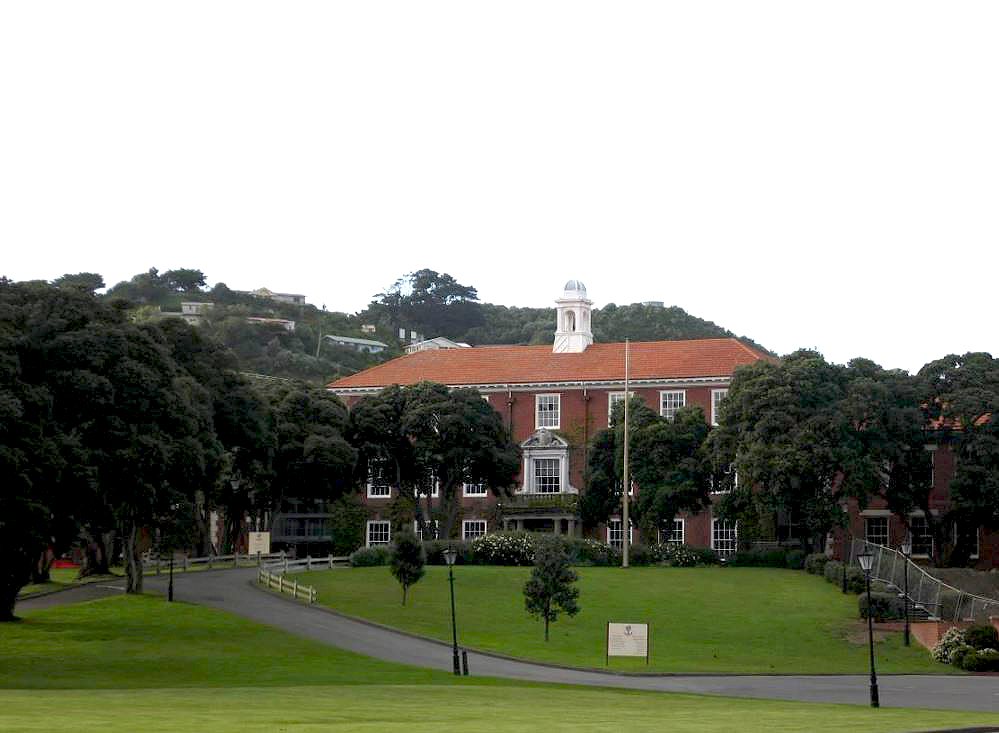
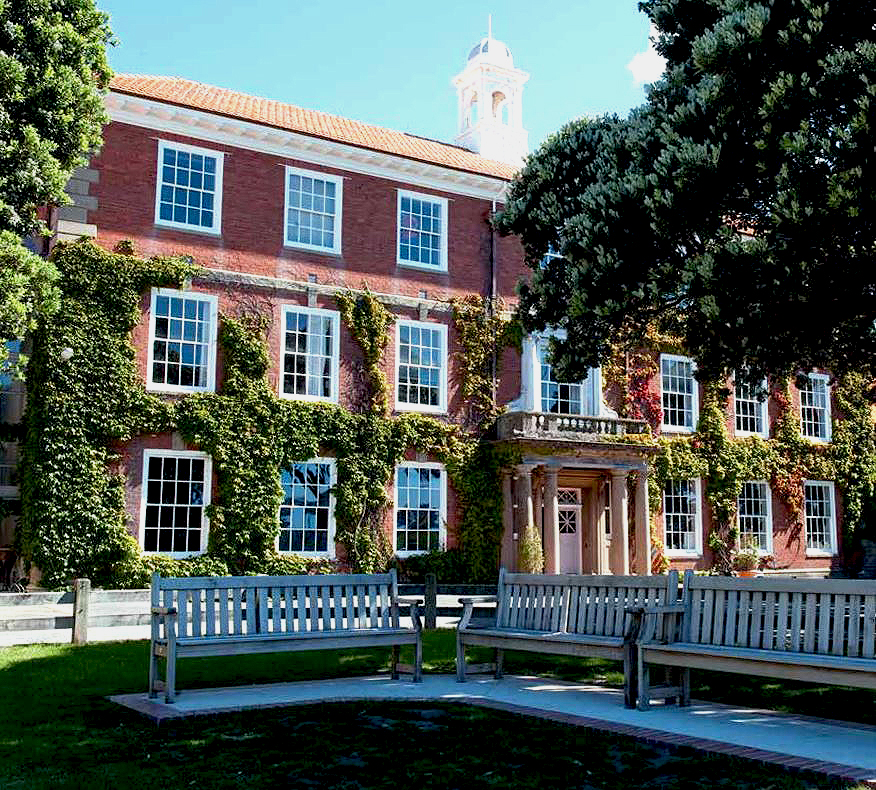
Prominent architect William Gray Young won the design commission for the new campus, and Howie and Matthews’ tender of £20,000 was accepted for the construction. The foundation stone of the main classroom building was laid by Aitken on 13 April 1918. The three-storeyed brick building achieves the impression of an English stately home, encountered at the end of a driveway winding through the grounds. A Doric portico frames the main entrance, with an aedicule window above featuring Ionic columns and a pediment emblazoned with the college crest. The multi-paned windows are arranged symmetrically on either side of this central bay, and a domed bell tower sits atop the tiled hipped roof. Gray Young’s original design also included wings to either side of the main block; however, only the central portion was built. The original campus also included a separate building (named Gibb House after the other founder), for accommodation and dining.
Delays due to weather and shortages in materials meant that while Gibb House was ready for the beginning of the 1919 school year, the Aitken Building was not; so for most of the first year classes were held outside when weather permitted, or in the dining room, dormitories or rooms where no workmen were working. Scots College came close to closure a few times during the 1920s, a situation which came to a head in 1929 when the Board agreed to sell the grounds and buildings to the Education Department to settle their debts. However, parents, Old Boys and the government rallied to show their esteem and the sale was cancelled. While the campus has grown over the years with additional buildings for accommodation, a primary school, specialist classroom space, a gymnasium, assembly hall and chapel, the Aitken Building appears to have gone largely unchanged until 1982, when it underwent strengthening and interior refurbishment. Adjoining buildings have been added either side of it since 1959, and the ground floor reception area was expanded in 2008.
List Entry Information
Status
Listed
List Entry Status
Historic Place Category 2
Access
Private/No Public Access
List Number
1426
Date Entered
10th September 1981
Date of Effect
10th September 1981
City/District Council
Wellington City
Region
Wellington Region
Extent of List Entry
Extent includes part of the land described as Pt Lot 12 DP 3995 (RT WN631/98), Wellington Land District and the building known as Scots College Aitken Building thereon, and a curtilage to the north of the building to allow for the sightlines of this place. The extent is limited to the Aitken Building as identified in the extent map tabled at the Rārangi Kōrero Committee meeting on 6 September 2017, and does not include other additions or buildings on the school site.
Legal description
Pt Lot 12 DP 3995 (RT WN631/98), Wellington Land District
Status
Listed
List Entry Status
Historic Place Category 2
Access
Private/No Public Access
List Number
1426
Date Entered
10th September 1981
Date of Effect
10th September 1981
City/District Council
Wellington City
Region
Wellington Region
Extent of List Entry
Extent includes part of the land described as Pt Lot 12 DP 3995 (RT WN631/98), Wellington Land District and the building known as Scots College Aitken Building thereon, and a curtilage to the north of the building to allow for the sightlines of this place. The extent is limited to the Aitken Building as identified in the extent map tabled at the Rārangi Kōrero Committee meeting on 6 September 2017, and does not include other additions or buildings on the school site.
Legal description
Pt Lot 12 DP 3995 (RT WN631/98), Wellington Land District
Construction Professional
Name
Howie and Matthews
Type
Builder
Biography
No biography is currently available for this construction professional
Name
Young, William G
Type
Architect
Biography
William Gray Young (1885-1962) was born in Oamaru. When he was a child his family moved to Wellington where he was educated. After leaving school he was articled to the Wellington architectural firm of Crichton and McKay. In 1906 he won a competition for the design of Knox College, Dunedin, and shortly after this he commenced practice on his own account. He became a prominent New Zealand architect and during a career of 60 years he designed over 500 buildings. His major buildings include the Wellington and Christchurch Railway Stations (1936 and 1954 respectively), Scot's College (1919), Phoenix Assurance Building (1930) and the Australian Mutual Provident Society (AMP) Chambers (1950). At Victoria University College of Wellington he was responsible for the Stout (1930), Kirk (1938), and Easterfield (1957) buildings, and Weir House (1930). Gray Young also achieved recognition for his domestic work such as the Elliott House Wellington, (1913). His design for the Wellesley Club (1925) earned him the Gold Medal of the New Zealand Institute of Architects in 1932. He was elected a Fellow of the Institute in 1913, served on the executive committee from 1914-35 and was President from 1935-36. He was also elected a Fellow of the Royal Institute of British Architects, and achieved prominence in public affairs.
Construction Details
Start Year
1918
Finish Year
1919
Type
Original Construction
Start Year
1959
Type
Addition
Description
First extension wing built, to the east of the Aitken building
Start Year
1962
Type
Additional building added to site
Description
Toilet block and two small classrooms built to the rear of the building
Type
Addition
Description
Wing built to the west of the Aitken building
Period
Unknown date
Construction Professional
Name
Howie and Matthews
Type
Builder
Biography
No biography is currently available for this construction professional
Name
Young, William G
Type
Architect
Biography
William Gray Young (1885-1962) was born in Oamaru. When he was a child his family moved to Wellington where he was educated. After leaving school he was articled to the Wellington architectural firm of Crichton and McKay. In 1906 he won a competition for the design of Knox College, Dunedin, and shortly after this he commenced practice on his own account. He became a prominent New Zealand architect and during a career of 60 years he designed over 500 buildings. His major buildings include the Wellington and Christchurch Railway Stations (1936 and 1954 respectively), Scot's College (1919), Phoenix Assurance Building (1930) and the Australian Mutual Provident Society (AMP) Chambers (1950). At Victoria University College of Wellington he was responsible for the Stout (1930), Kirk (1938), and Easterfield (1957) buildings, and Weir House (1930). Gray Young also achieved recognition for his domestic work such as the Elliott House Wellington, (1913). His design for the Wellesley Club (1925) earned him the Gold Medal of the New Zealand Institute of Architects in 1932. He was elected a Fellow of the Institute in 1913, served on the executive committee from 1914-35 and was President from 1935-36. He was also elected a Fellow of the Royal Institute of British Architects, and achieved prominence in public affairs.
Construction Details
Start Year
1918
Finish Year
1919
Type
Original Construction
Start Year
1959
Type
Addition
Description
First extension wing built, to the east of the Aitken building
Start Year
1962
Type
Additional building added to site
Description
Toilet block and two small classrooms built to the rear of the building
Type
Addition
Description
Wing built to the west of the Aitken building
Period
Unknown date
Historical and Associated Iwi / Hapū / Whānau
Completion Date
30th March 2017
Report Written By
Blyss Wagstaff
Information Sources
Dictionary of New Zealand Biography
Dictionary of New Zealand Biography
Wellington City Council
Wellington City Council
Brodie, 1991
Brodie, James, The First Seven Thousand: A Jubilee History of Scots College 1916-1990, The Board of Governors of Scots College, Wellington, 1991
Other Information
This place was identified as significant under previous legislation with different information requirements. It remains significant under the current legislation. There is opportunity under our legislation and policies to add to this information. Further information about this place may be available from the Central Regional Office of Heritage New Zealand Pouhere Taonga. Please note that entry on the New Zealand Heritage List/Rarangi Korero identifies only the heritage values of the property concerned, and should not be construed as advice on the state of the property, or as a comment of its soundness or safety, including in regard to earthquake risk, safety in the event of fire, or insanitary conditions. A fully referenced upgrade report is available on request from the Central Region Office of Heritage New Zealand.
Historical and Associated Iwi / Hapū / Whānau
Completion Date
30th March 2017
Report Written By
Blyss Wagstaff
Information Sources
Dictionary of New Zealand Biography
Dictionary of New Zealand Biography
Wellington City Council
Wellington City Council
Brodie, 1991
Brodie, James, The First Seven Thousand: A Jubilee History of Scots College 1916-1990, The Board of Governors of Scots College, Wellington, 1991
Other Information
This place was identified as significant under previous legislation with different information requirements. It remains significant under the current legislation. There is opportunity under our legislation and policies to add to this information. Further information about this place may be available from the Central Regional Office of Heritage New Zealand Pouhere Taonga. Please note that entry on the New Zealand Heritage List/Rarangi Korero identifies only the heritage values of the property concerned, and should not be construed as advice on the state of the property, or as a comment of its soundness or safety, including in regard to earthquake risk, safety in the event of fire, or insanitary conditions. A fully referenced upgrade report is available on request from the Central Region Office of Heritage New Zealand.
Current Usages
Uses: Education
Specific Usage: Church School
Uses: Education
Specific Usage: School
Current Usages
Uses: Education
Specific Usage: Church School
Uses: Education
Specific Usage: School
Location
Sign up to hear more
Get the latest heritage news, features and events delivered
straight to your inbox.
