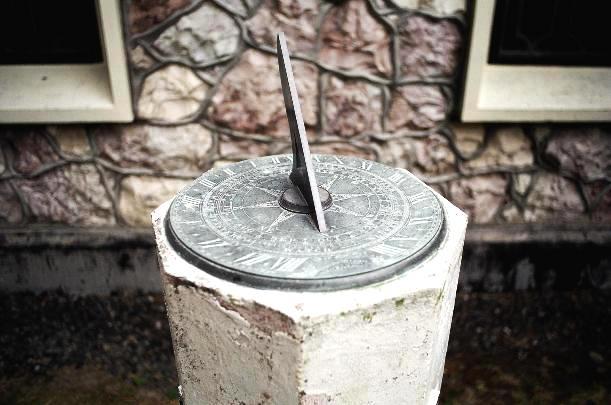
The Sundial situated in the churchyards of the Holy Trinity Church in Picton since 1872, serves as a reminder of a younger New Zealand in which centres of political power were still being decided, and also of a town determined to retain its official timepiece. When the province of Marlborough was formed, Picton was named as its capital, and for a time it was seriously considered for the national capital of New Zealand. During the years when Picton was the capital of the Marlborough province, there was only one official timepiece in Picton and this was the town clock situated at the Provincial Offices. In 1865 Picton lost the political power struggle and Blenhiem became the new provincial capital. All furniture and records were removed to Blenhiem on 10th November 1865, and to add insult to injury the town clock was removed also to adorn the new council building in Blenhiem, thus leaving Picton without an official timepiece. For a number of years Picton was without a clock.
The Sundial was purchased from Troughton & Simms makers of philosophical instruments in London. The date of purchase is not certain because of differing historical accounts, but most accounts suggest that Arthur Penrose Seymour purchased the Sundial in 1871. Possibly it was ordered from England in the late 1860s and sat in the Survey Office at Blenheim until 1871. It was decided that this timepiece should be protected so that Picton should never again suffer the indignity of having its official timepiece removed. It was, therefore, placed in the Holy Trinity Church grounds in 1872. A conflicting account is that the Sundial was situated in the original provincial council grounds in Picton and was removed with the clock, when it was eventually returned to Picton after much protestation it was placed in the church grounds to protect it so that it would never again be removed.
When the H.M.S. Wallaroo came to Picton, either in 1896 or 1902, the ship's captain, Captain Graham, was approached regarding the Sundial, so he and his ships officers proceeded to the Church to check Picton's official timepiece, they found it correctly set and revealing excellent time.
The Sundial was originally situated to the right of the path leading up to the church, but was moved around behind the church in the 1960s. In 1987 the Sundial was vandalised with the shadow arm broken off and removed. In 1988 the church requested funding from the Picton Borough Council to restore the Sundial. This request was turned down, so in 1989 restoration work was undertaken funded by parishioner donations. The Sundial was restored using photos of the original as a reference point. It is likely that a new shadow arm was ordered from Troughton & Simms and London to replaced the stolen arm.
An eight pointed brass compass rose adorns the centre of the dial, encircled by equation of time scales within the outer hour-ring. The hour-ring is engraved with Roman numerals from 4am to 8pm, graduated in half-hours, ten-minute and two-minute intervals. The dial is configured for latitude of 41°17'30'' (S), and is inscribed with the signature 'Troughton & Simms, London'. It is set on a white painted octagonal pillar displaying the date '1872' on its side in brass.
The Sundial was brought both to provide an official timepiece, when no other reliable timekeeping device was present in Picton, and to symbolise a restoration of the towns pride after its status as provincial capital was removed. It was placed in the grounds of the Holy Trinity Church in order to protect it from the same fate as the original town clock. This desire to protect the Sundial shows the esteem in which the residents of Picton held it. The Sundial provides a reminder of the changes and uncertainties of life in early New Zealand settlements in relation to governance, and also symbolises the importance of the towns status to the individual residents identity. Thus the Sundial forms a part of the wider historical and cultural landscape of Picton.