Quick links


Quick links
Quick links
Quick links
Quick links
Quick links
St Patrick's Catholic Church
19 St James Street, ROSS
Private
Historic Place Category 2
List No. 1693
Quick links:
List GalleryLocationDetails
19 St James Street, ROSS
Private
Historic Place Category 2
List No. 1693
List Entry Information
Status
Listed
List Entry Status
Historic Place Category 2
Access
Private/No Public Access
List Number
1693
Date Entered
2nd April 2004
Date of Effect
2nd April 2004
City/District Council
Westland District
Region
West Coast Region
Extent of List Entry
Extent includes the land described as Lot 2 DP 2387 (RT WS5B/1030), Westland Land District and the building known as St Patrick’s Catholic Church thereon.
Legal description
Lot 2 DP 2387 (RT WS5B/1030), Westland Land District
Location Description
St Patrick's Catholic Church is on the northern side of St James Street, near the intersection with Bold Street. On recent maps the place where St James Street changes to Aylmer Street is located at the intersection with Simpson Street. There is some confusion and frequently St Patrick's Church and the Grimmond House are described as fronting Aylmer Street.
Status
Listed
List Entry Status
Historic Place Category 2
Access
Private/No Public Access
List Number
1693
Date Entered
2nd April 2004
Date of Effect
2nd April 2004
City/District Council
Westland District
Region
West Coast Region
Extent of List Entry
Extent includes the land described as Lot 2 DP 2387 (RT WS5B/1030), Westland Land District and the building known as St Patrick’s Catholic Church thereon.
Legal description
Lot 2 DP 2387 (RT WS5B/1030), Westland Land District
Location Description
St Patrick's Catholic Church is on the northern side of St James Street, near the intersection with Bold Street. On recent maps the place where St James Street changes to Aylmer Street is located at the intersection with Simpson Street. There is some confusion and frequently St Patrick's Church and the Grimmond House are described as fronting Aylmer Street.
Why is this place significant?
Cultural Significance
St Patrick's Catholic Church, Ross, has social and spiritual significance as an expression of the piety of the (mainly Irish) Catholic mining community in Ross, and as a focus of Catholic worship in the Ross area since the establishment of the town.
Historic Significance
Historical Significance or Value It has historical significance as the second oldest church in the Christchurch Catholic diocese and the oldest Catholic church on the West Coast.
Why is this place Category 1 / Category 2?
Detail Of Assessed Criteria
(a) It is the oldest Catholic church on the West Coast. (b) Through its association with the first wave of gold discovery on the West Coast of the South Island. (e) It has important community associations as the centre of Catholic worship in the Ross area since the town's inception. (h) The church also has value as a symbol of the piety of the (mainly Irish) Catholic community in goldrush era Ross, and of the significance of the Catholic church to the West Coast. (j) It is important too as a rare survivor of the buildings erected during the first wave of gold discovery and settlement on the West Coast.
Why is this place significant?
Cultural Significance
St Patrick's Catholic Church, Ross, has social and spiritual significance as an expression of the piety of the (mainly Irish) Catholic mining community in Ross, and as a focus of Catholic worship in the Ross area since the establishment of the town.
Historic Significance
Historical Significance or Value It has historical significance as the second oldest church in the Christchurch Catholic diocese and the oldest Catholic church on the West Coast.
Why is this place Category 1 / Category 2?
Detail Of Assessed Criteria
(a) It is the oldest Catholic church on the West Coast. (b) Through its association with the first wave of gold discovery on the West Coast of the South Island. (e) It has important community associations as the centre of Catholic worship in the Ross area since the town's inception. (h) The church also has value as a symbol of the piety of the (mainly Irish) Catholic community in goldrush era Ross, and of the significance of the Catholic church to the West Coast. (j) It is important too as a rare survivor of the buildings erected during the first wave of gold discovery and settlement on the West Coast.
Construction Details
Start Year
1866
Type
Original Construction
Start Year
1869
Type
Modification
Description
Transepts added.
Start Year
1900
Type
Modification
Description
Entrance porch and kauri dado.
Construction Materials
Timber (mainly Baltic Pine), with an iron roof.
Construction Details
Start Year
1866
Type
Original Construction
Start Year
1869
Type
Modification
Description
Transepts added.
Start Year
1900
Type
Modification
Description
Entrance porch and kauri dado.
Construction Materials
Timber (mainly Baltic Pine), with an iron roof.
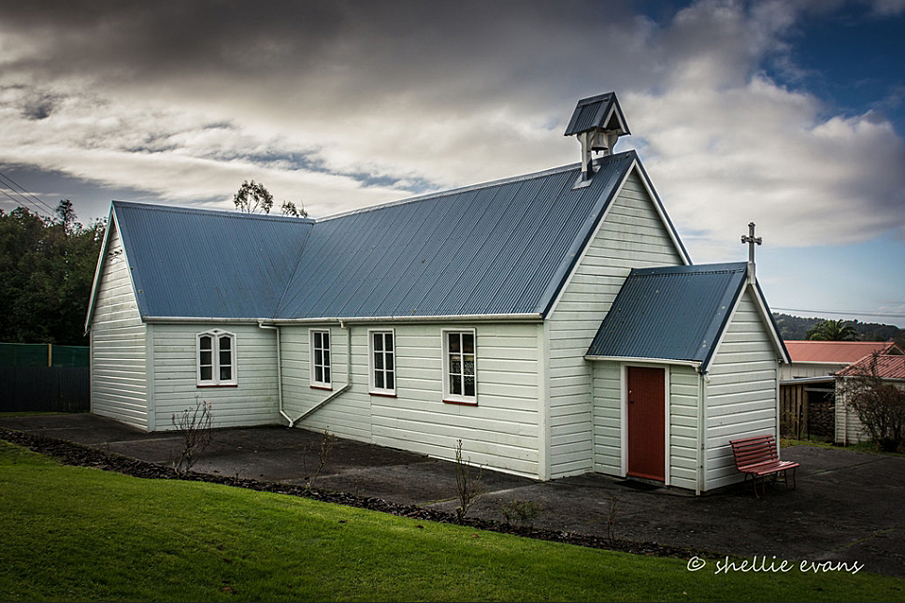
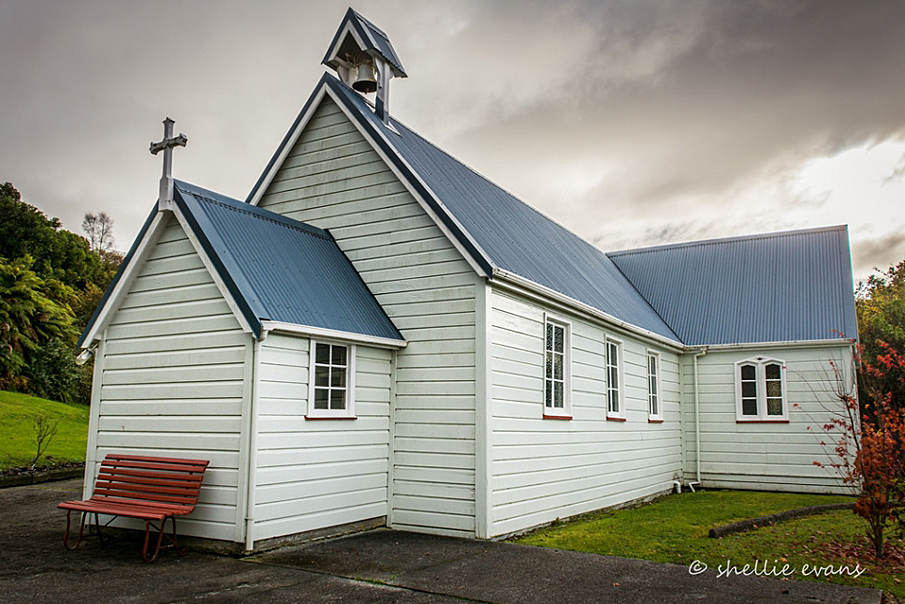
St Patrick's is a simple 't' shaped timber church seating 150, with elements of the Carpenter Gothic style. The exterior is flush weather-boarded, with single rectangular fixed-sash windows along the nave, and paired fixed-sash lancet windows in the transepts. A small belfry with surmounting cross caps the western end of the roof. The very original interior is lined with tongue-and-groove timber, with a (possibly later) kauri dado. The chancel is not expressed on the exterior but is set within an internal arch and lit by a small stained glass window above the altar. As this is the only stained glass in the church the interior is very light. The original altar made of silver pine has been brought forward slightly so that it remains within the shallow chancel space The interior contains many of the original furnishings. There are plain timber pews and kneelers, painted Stations of the Cross, a lectern, and a stone font. At the rear is the organ and choir loft accessed by a steep, narrow stair.
St Patrick's is a simple 't' shaped timber church seating 150, with elements of the Carpenter Gothic style. The exterior is flush weather-boarded, with single rectangular fixed-sash windows along the nave, and paired fixed-sash lancet windows in the transepts. A small belfry with surmounting cross caps the western end of the roof. The very original interior is lined with tongue-and-groove timber, with a (possibly later) kauri dado. The chancel is not expressed on the exterior but is set within an internal arch and lit by a small stained glass window above the altar. As this is the only stained glass in the church the interior is very light. The original altar made of silver pine has been brought forward slightly so that it remains within the shallow chancel space The interior contains many of the original furnishings. There are plain timber pews and kneelers, painted Stations of the Cross, a lectern, and a stone font. At the rear is the organ and choir loft accessed by a steep, narrow stair.
Historical and Associated Iwi / Hapū / Whānau
Completion Date
7th September 2004
Report Written By
Pam Wilson
Information Sources
New Zealand Historic Places Trust (NZHPT)
New Zealand Historic Places Trust
Other Information
A fully referenced version of this report is available from the NZHPT Southern Region Office. Please note that entry on the New Zealand Heritage List/Rarangi Korero identifies only the heritage values of the property concerned, and should not be construed as advice on the state of the property, or as a comment of its soundness or safety, including in regard to earthquake risk, safety in the event of fire, or insanitary conditions.
Historical and Associated Iwi / Hapū / Whānau
Completion Date
7th September 2004
Report Written By
Pam Wilson
Information Sources
New Zealand Historic Places Trust (NZHPT)
New Zealand Historic Places Trust
Other Information
A fully referenced version of this report is available from the NZHPT Southern Region Office. Please note that entry on the New Zealand Heritage List/Rarangi Korero identifies only the heritage values of the property concerned, and should not be construed as advice on the state of the property, or as a comment of its soundness or safety, including in regard to earthquake risk, safety in the event of fire, or insanitary conditions.
Current Usages
Uses: Religion
Specific Usage: Church
Former Usages
General Usage: Religion
Specific Usage: Church
Current Usages
Uses: Religion
Specific Usage: Church
Former Usages
General Usage: Religion
Specific Usage: Church
Get the latest heritage news, features and events delivered
straight to your inbox.