

Akaroa Harbour is a large, long harbour on the southern coast of Horomaka/Te Pātaka-a-Rākaihautū (Banks Peninsula). Tuhiraki (Mount Bossu) is the kō (digging stick) of the famous Waitaha explorer Rākaihautū. Akaroa was occupied by iwi such as Hāwea, Waitaha, Rapuwai, and Kāti Māmoe prior to the southern Kāi Tūhaitara migration to Canterbury. Te Ake was one of several Ngāi Tahu tūpuna (ancestors) who claimed land during this migration, placing his tokotoko at the head of the harbour. Akaroa continues to be a renowned mahinga kai (food-gathering area) for the local Kāi Tahu hapū based at the small kāika of Ōnuku which is located just to the south of Paka Ariki, Akaroa township.
By the early nineteenth century, Akaroa Harbour had become a favourite port of call for whaling ships. French whaler, Jean François Langlois became involved in land transactions in the area in the late 1830s, which eventually lead to the founding of the Nanto-Bordelaise Company and ultimately, in August 1840, French (and some German) settlers from the Comte de Paris landing at Paka Ariki/Akaroa. While the British had already annexed New Zealand by the time the settlers arrived, most stayed on and settled in the area. In the 1840s, the northern part of Akaroa was known as the ‘French Town’, while the southern part was the ‘English Town’. The latter was where Dundee-born former whaler James Bruce decided to establish one of Akaroa’s earliest hotels (Bruce’s Hotel, early 1840s) and settle both himself and eventually the family of his late sister, the Donnets. John Donnet (also spelt Donnett), a cooper and seafarer, had married Bruce’s sister, Margaret, in Scotland. In 1855, after Margaret’s death, the widowed Donnet and his five daughters and a son-in-law emigrated to join Bruce in Akaroa. Bruce had two identical cottages built on his town sections 75 and 76 in the mid-1850s, one for Donnet’s married daughter (Bruce’s niece), Isabella and her husband, engineer William Fogie Bruce (no relation) and the other for John Donnet and his other daughters. It would appear that this cottage (List No. 1722) was the one occupied by Isabella and William Bruce, since it was conveyed to them in 1860.
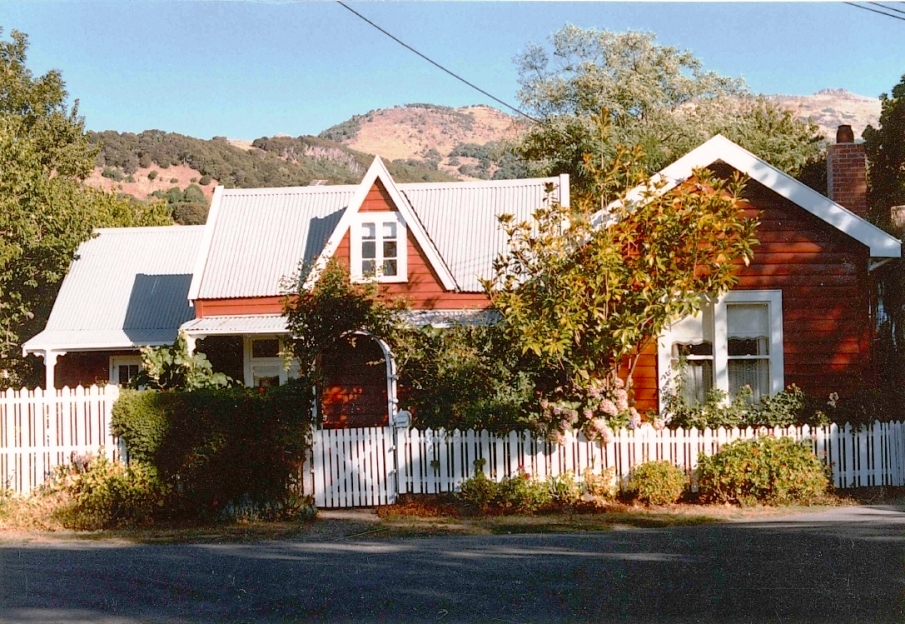
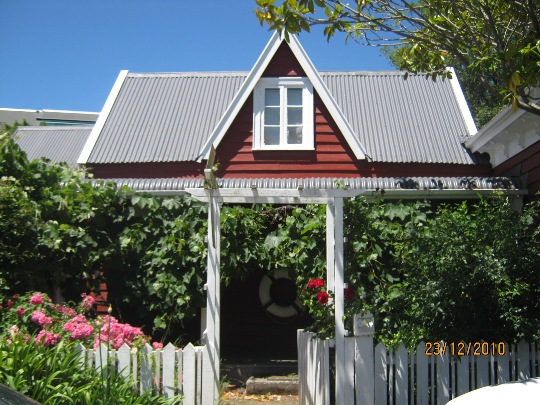
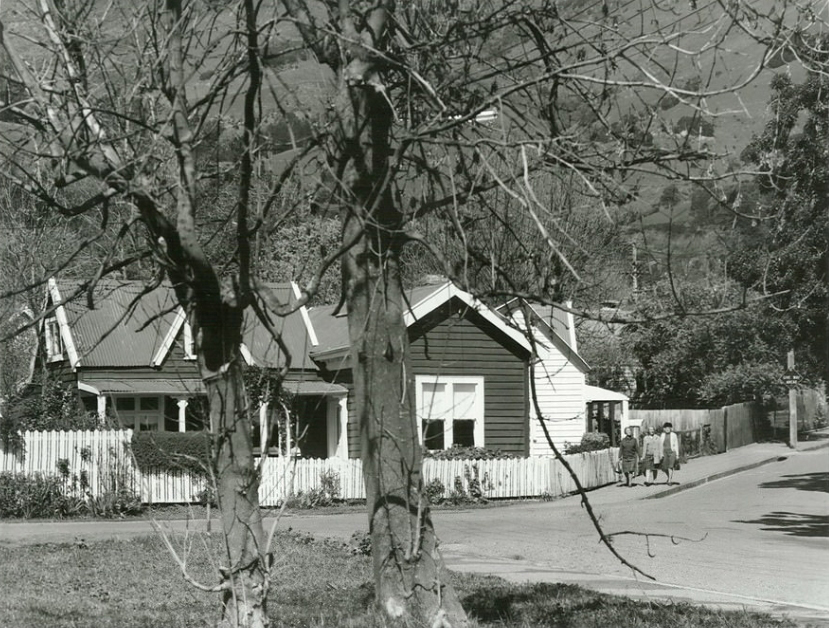
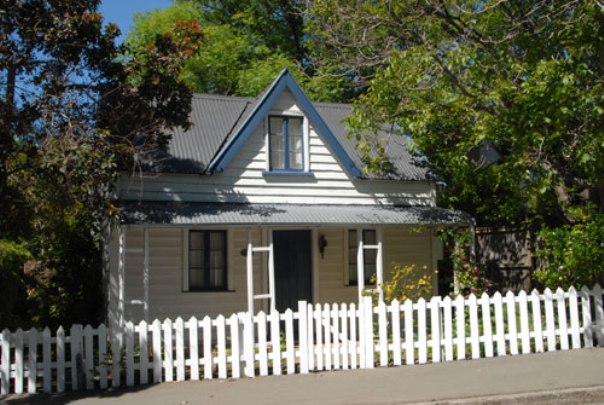
Situated on the corner of Aubrey Street and Bruce Terrace, fronting Aubrey Street, the original timber cottage, consisting of four rooms (two up, two down) with lean-to is still readable, but has been altered over time with the early addition of bullnosed verandah, a relocated timber addition to the south and smaller timber addition to the north. Like many other early Akaroa cottages, including its neighbour to the east, a notable feature of the original cottage, is the steeply pitched (now corrugated steel-clad) roof with a sharp triangular cross-gable (called a fronton in French) that is flush with the main elevation.
After the unmarried James Bruce died in 1858, Town Section 75 was conveyed to William Bruce in 1860 and, at the same time, the neighbouring property was conveyed to John Donnet. In circa 1922 the house was extended to the south by a large addition that is thought to have been another cottage shifted from William Street. A small addition to the north dates from the late twentieth century. Both this and the cottage at 9A Aubrey Street remained on the same Record of Title until 1992, when a cross-lease was established – both being on part of Town Sections 75 and 76.
List Entry Information
Status
Listed
List Entry Status
Historic Place Category 2
Access
Private/No Public Access
List Number
1722
Date Entered
23rd June 1983
Date of Effect
23rd June 1983
City/District Council
Christchurch City
Region
Canterbury Region
Extent of List Entry
Extent includes the land described as Flat 1 DP 62524 on Lot 2 DP 4975 (RT CB36D/105), Canterbury Land District and the building known as Cottage thereon.
Legal description
Flat 1 DP 62524 on Lot 2 DP 4975 (RT CB36D/105), Canterbury Land District
Status
Listed
List Entry Status
Historic Place Category 2
Access
Private/No Public Access
List Number
1722
Date Entered
23rd June 1983
Date of Effect
23rd June 1983
City/District Council
Christchurch City
Region
Canterbury Region
Extent of List Entry
Extent includes the land described as Flat 1 DP 62524 on Lot 2 DP 4975 (RT CB36D/105), Canterbury Land District and the building known as Cottage thereon.
Legal description
Flat 1 DP 62524 on Lot 2 DP 4975 (RT CB36D/105), Canterbury Land District
Construction Details
Start Year
1856
startYearCirca
Type
Original Construction
Start Year
1922
startYearCirca
Type
Addition
Description
large south addition (a cottage relocated from William Street)
startYearCirca
Type
Addition
Description
addition to the north
Period
1980s
Construction Details
Start Year
1856
startYearCirca
Type
Original Construction
Start Year
1922
startYearCirca
Type
Addition
Description
large south addition (a cottage relocated from William Street)
startYearCirca
Type
Addition
Description
addition to the north
Period
1980s
Historical and Associated Iwi / Hapū / Whānau
Completion Date
16th May 2022
Report Written By
Robyn Burgess
Information Sources
Tremewan, 1990
P.Tremewan, French Akaroa: An attempt to colonise southern New Zealand. Christchurch,1990 [University of Canterbury Press, with the Historical Branch of the Department of Internal Affairs]
Wilson, 2009
Wilson, John and Louise Beaumont, Akaroa Historical Overview, for Christchurch City Council, June 2009
Akaroa Civic Trust, 2011
Akaroa Civic Trust, Akaroa Five Historic Walks, 2011
Other Information
This place was identified as significant under previous legislation with different information requirements. It remains significant under the current legislation. There is opportunity under our legislation and policies to add to this information. Further information about this place may be available from the Southern Regional Office of Heritage New Zealand Pouhere Taonga. A fully referenced upgrade report is available on request from the Southern Regional Office of Heritage New Zealand Pouhere Taonga Please note that entry on the New Zealand Heritage List/Rarangi Korero identifies only the heritage values of the property concerned, and should not be construed as advice on the state of the property, or as a comment of its soundness or safety, including in regard to earthquake risk, safety in the event of fire, or insanitary conditions.
Historical and Associated Iwi / Hapū / Whānau
Completion Date
16th May 2022
Report Written By
Robyn Burgess
Information Sources
Tremewan, 1990
P.Tremewan, French Akaroa: An attempt to colonise southern New Zealand. Christchurch,1990 [University of Canterbury Press, with the Historical Branch of the Department of Internal Affairs]
Wilson, 2009
Wilson, John and Louise Beaumont, Akaroa Historical Overview, for Christchurch City Council, June 2009
Akaroa Civic Trust, 2011
Akaroa Civic Trust, Akaroa Five Historic Walks, 2011
Other Information
This place was identified as significant under previous legislation with different information requirements. It remains significant under the current legislation. There is opportunity under our legislation and policies to add to this information. Further information about this place may be available from the Southern Regional Office of Heritage New Zealand Pouhere Taonga. A fully referenced upgrade report is available on request from the Southern Regional Office of Heritage New Zealand Pouhere Taonga Please note that entry on the New Zealand Heritage List/Rarangi Korero identifies only the heritage values of the property concerned, and should not be construed as advice on the state of the property, or as a comment of its soundness or safety, including in regard to earthquake risk, safety in the event of fire, or insanitary conditions.
Current Usages
Uses: Accommodation
Specific Usage: House
Former Usages
General Usage: Accommodation
Specific Usage: House
Current Usages
Uses: Accommodation
Specific Usage: House
Former Usages
General Usage: Accommodation
Specific Usage: House
Sign up to hear more
Get the latest heritage news, features and events delivered
straight to your inbox.
