

The decision to select Seager's design was, therefore, controversial, and it was criticised for both the architectural style of the elevations and the layout of the rooms. Despite the controversy, construction began in March 1886. In August of the same year Councillor Andrews called for an independent assessment of the building, claiming it was structurally unstable. Two architects, Benjamin Mountfort and John Whitelaw, and an engineer, Edward Dobson, inspected the building and found it to be completely safe, clearing Seager's name. Their only suggestion was that the roof of the Council Chamber be strengthened in a different and more costly way. Marisa Wilson, in her paper on the Municipal Chambers, suggests that the above controversy was due to the combination of a young and unknown architect (Seager was in his early thirties) and an unfamiliar style. As Wilson quips 'unfamiliarity bred contempt'.
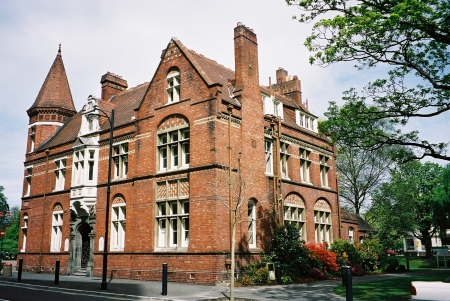
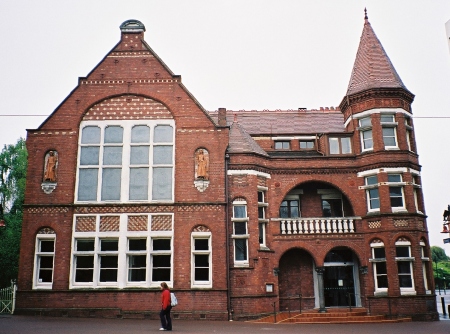
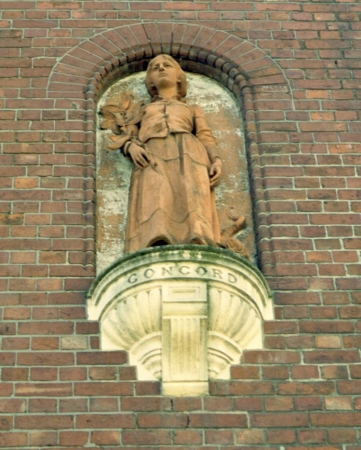
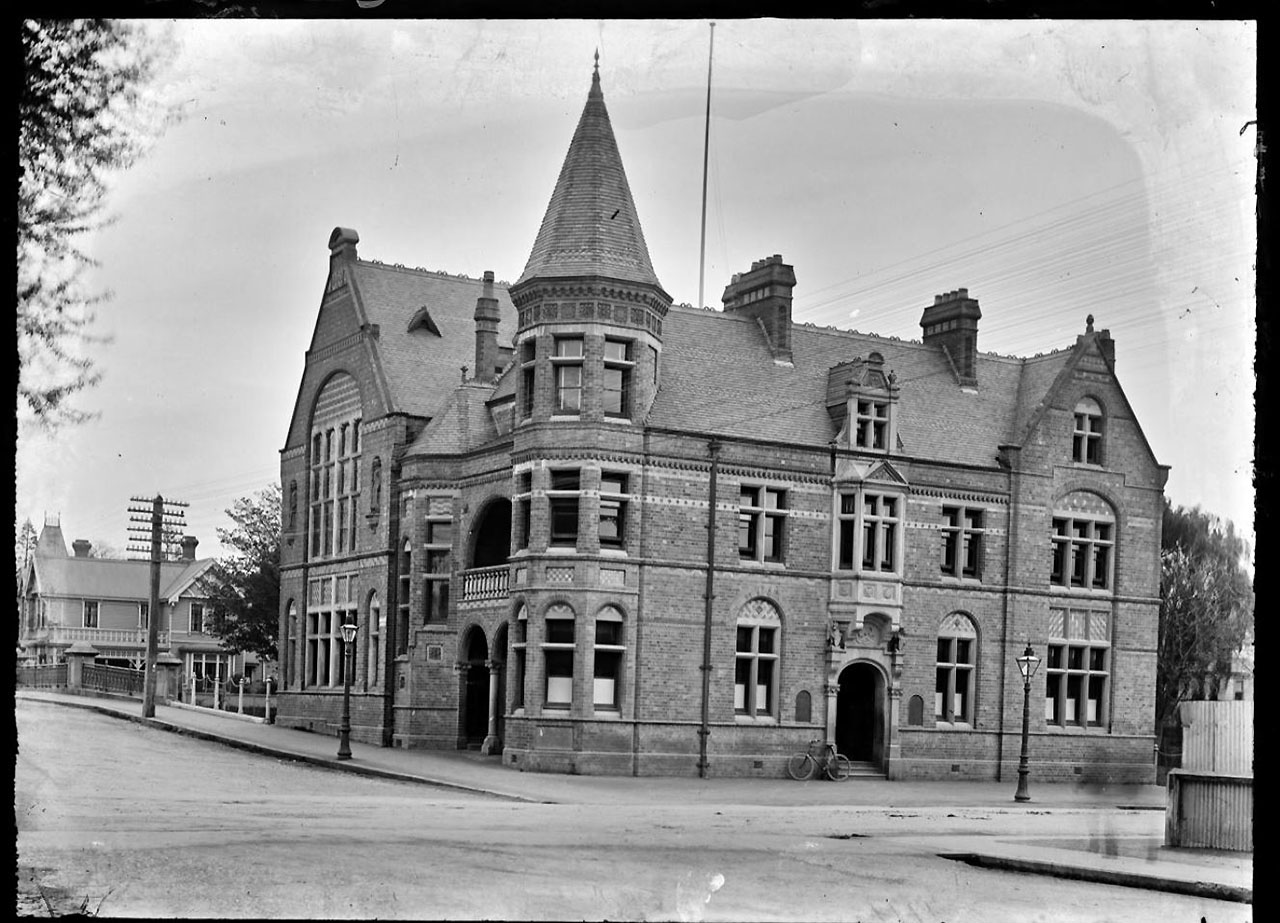
The building, which was officially opened in 1887, was built with bricks from the Glentunnel Brickworks, and Oamaru and White Rock stone facings. It is decorated with floral terracotta panels, also designed by Seager and fired at the Glentunnel Brickworks. Two terracotta figures stand in niches on the Worcester Street facade. Designed by George Frampton (1860-1928), who was part of the late nineteenth-century 'New Sculpture' movement, the figures represent 'Industry' and 'Concorde'. The wrought iron gates over the entrance were also designed by Seager. The overall effect is both sympathetic to the surrounding park and richly decorative.
This three-storey building was used by the Christchurch City Council until 1924, when the council moved into the larger space of Canterbury Hall in Manchester Street. The Canterbury Chamber of Commerce occupied the building until 1967. The Chamber was involved in a number of significant events in Canterbury including the building of the railway to the West Coast, the establishment of the Lyttelton Harbour Board, and the Tunnel Road. After the Chamber of Commerce left the building in 1967 it was used by the Public Relations Office and the Citizens Advice Bureau and then by the Christchurch Information Centre. More recently the building has been renovated to house 'Our City', an exhibition space for shows related to Christchurch's environment and people.
The Municipal Chambers building is a rare example of a town hall built in the Queen Anne style and it is an accomplished work in the style. It was Seager's first major commission upon returning to New Zealand and provided him with extensive public exposure. His design was a notable departure from the prevailing Gothic Revival architecture of the period. The building is a distinctive feature of the townscape along the Avon River and has historical significance as the centre of city government for over 20 years, and subsequently as the home of the local Chamber of Commerce for over 60 years.
List Entry Information
Status
Listed
List Entry Status
Historic Place Category 1
Access
Private/No Public Access
List Number
1844
Date Entered
2nd April 1985
Date of Effect
2nd April 1985
City/District Council
Christchurch City
Region
Canterbury Region
Extent of List Entry
Extent of registration includes the land described as Lot 1 DP 54196 (RT CB31K/794), Canterbury Land District and the building known as Municipal Chambers (Former), thereon.
Legal description
Lot 1 DP 54196 (RT CB31K/794), Canterbury Land District
Status
Listed
List Entry Status
Historic Place Category 1
Access
Private/No Public Access
List Number
1844
Date Entered
2nd April 1985
Date of Effect
2nd April 1985
City/District Council
Christchurch City
Region
Canterbury Region
Extent of List Entry
Extent of registration includes the land described as Lot 1 DP 54196 (RT CB31K/794), Canterbury Land District and the building known as Municipal Chambers (Former), thereon.
Legal description
Lot 1 DP 54196 (RT CB31K/794), Canterbury Land District
Construction Professional
Name
Seager, Samuel Hurst
Type
Architect
Biography
Seager (1855-1933) studied at Canterbury College between 1880-82. He trained in Christchurch in the offices of Benjamin Woolfield Mountfort (1825-1898) and Alfred William Simpson before completing his qualifications in London in 1884. In 1885, shortly after his return to Christchurch, he won a competition for the design of the new Municipal Chambers, and this launched his career. Seager achieved renown for his domestic architecture. He was one of the earliest New Zealand architects to move away from historical styles and seek design with a New Zealand character. The Sign of the Kiwi, Christchurch (1917) illustrates this aspect of his work. He is also known for his larger Arts and Crafts style houses such as Daresbury, Christchurch (1899). Between 1893 and 1903 Seager taught architecture and design at the Canterbury University College School of Art. He was a pioneer in town planning, having a particular interest in the "garden city" concept. Some of these ideas were expressed in a group of houses designed as a unified and landscaped precinct on Sumner Spur (1902-14). He became an authority on the lighting of art galleries. After World War I he was appointed by the Imperial War Graves Commission to design war memorials in Gallipoli, Belgium and France. In New Zealand he designed the Massey Memorial, Point Halswell, Wellington (1925).
Construction Details
Start Year
1886
Finish Year
1887
Type
Original Construction
Start Year
1885
Type
Designed
Construction Professional
Name
Seager, Samuel Hurst
Type
Architect
Biography
Seager (1855-1933) studied at Canterbury College between 1880-82. He trained in Christchurch in the offices of Benjamin Woolfield Mountfort (1825-1898) and Alfred William Simpson before completing his qualifications in London in 1884. In 1885, shortly after his return to Christchurch, he won a competition for the design of the new Municipal Chambers, and this launched his career. Seager achieved renown for his domestic architecture. He was one of the earliest New Zealand architects to move away from historical styles and seek design with a New Zealand character. The Sign of the Kiwi, Christchurch (1917) illustrates this aspect of his work. He is also known for his larger Arts and Crafts style houses such as Daresbury, Christchurch (1899). Between 1893 and 1903 Seager taught architecture and design at the Canterbury University College School of Art. He was a pioneer in town planning, having a particular interest in the "garden city" concept. Some of these ideas were expressed in a group of houses designed as a unified and landscaped precinct on Sumner Spur (1902-14). He became an authority on the lighting of art galleries. After World War I he was appointed by the Imperial War Graves Commission to design war memorials in Gallipoli, Belgium and France. In New Zealand he designed the Massey Memorial, Point Halswell, Wellington (1925).
Construction Details
Start Year
1886
Finish Year
1887
Type
Original Construction
Start Year
1885
Type
Designed
Historical and Associated Iwi / Hapū / Whānau
Completion Date
8th December 2001
Report Written By
Melanie Lovell-Smith
Information Sources
Girouard, 1977
Mark Girouard, Sweetness and Light: the Queen Anne Movement, 1860 - 1900, Oxford, 1977
Wilson, 1996
Marisa Wilson, 'Design with Beauty, Build with Truth': Samuel Hurst Seager's Christchurch Municipal Chambers', Research Paper, BA (Hons), University of Canterbury, 1996
Other Information
This place was identified as significant under previous legislation with different information requirements. It remains significant under the current legislation. There is opportunity under our legislation and policies to add to this information. Further information about this place may be available from the Southern Regional Office of Heritage New Zealand Pouhere Taonga. See Christchurch City (Old Municipal Chambers) Empowering Act 1989. Please note that entry on the New Zealand Heritage List/Rarangi Korero identifies only the heritage values of the property concerned, and should not be construed as advice on the state of the property, or as a comment of its soundness or safety, including in regard to earthquake risk, safety in the event of fire, or insanitary conditions.
Historical and Associated Iwi / Hapū / Whānau
Completion Date
8th December 2001
Report Written By
Melanie Lovell-Smith
Information Sources
Girouard, 1977
Mark Girouard, Sweetness and Light: the Queen Anne Movement, 1860 - 1900, Oxford, 1977
Wilson, 1996
Marisa Wilson, 'Design with Beauty, Build with Truth': Samuel Hurst Seager's Christchurch Municipal Chambers', Research Paper, BA (Hons), University of Canterbury, 1996
Other Information
This place was identified as significant under previous legislation with different information requirements. It remains significant under the current legislation. There is opportunity under our legislation and policies to add to this information. Further information about this place may be available from the Southern Regional Office of Heritage New Zealand Pouhere Taonga. See Christchurch City (Old Municipal Chambers) Empowering Act 1989. Please note that entry on the New Zealand Heritage List/Rarangi Korero identifies only the heritage values of the property concerned, and should not be construed as advice on the state of the property, or as a comment of its soundness or safety, including in regard to earthquake risk, safety in the event of fire, or insanitary conditions.
Current Usages
Uses: Civic Facilities
Specific Usage: Community centre
Former Usages
General Usage: Civic Facilities
Specific Usage: Information/Visitors Centre
General Usage: Government
Specific Usage: Council/local government building
General Usage: Trade
Specific Usage: Office building/Offices
Current Usages
Uses: Civic Facilities
Specific Usage: Community centre
Former Usages
General Usage: Civic Facilities
Specific Usage: Information/Visitors Centre
General Usage: Government
Specific Usage: Council/local government building
General Usage: Trade
Specific Usage: Office building/Offices
Location
Sign up to hear more
Get the latest heritage news, features and events delivered
straight to your inbox.
