

A form of shorthand phonography had been invented in the 1830s by Isaac Pitman and in the nineteenth century internationally recognised training and certification was developed. Around the same time, the ‘writing machine’ known as the typewriter became mass produced in the late 1870s and the apparatus was soon in common use in New Zealand. Following international examples, commercial schools teaching shorthand, typewriting, bookkeeping and related subjects were established throughout New Zealand. By the late nineteenth century, Christchurch had at least two. In 1893 Miss Annie M Carr opened a school of shorthand and typewriting, considered ‘a new channel for the utilisation of female labour’, in Lichfield Street. Carr then went into partnership with her acclaimed ex-pupil, Henry Digby, in 1898. By 1901 Miss E E Digby, was part of the teaching team and by 1905 she was joined by Miss M D Digby at their High Street premises. In December 1924 Henry William Lockyer Digby and Miss Maude Donald Digby became tenants in common for the property at 69 Worcester Street and their new commercial school building was constructed.
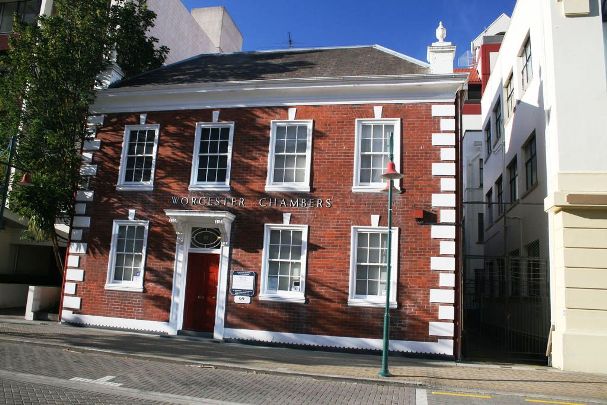
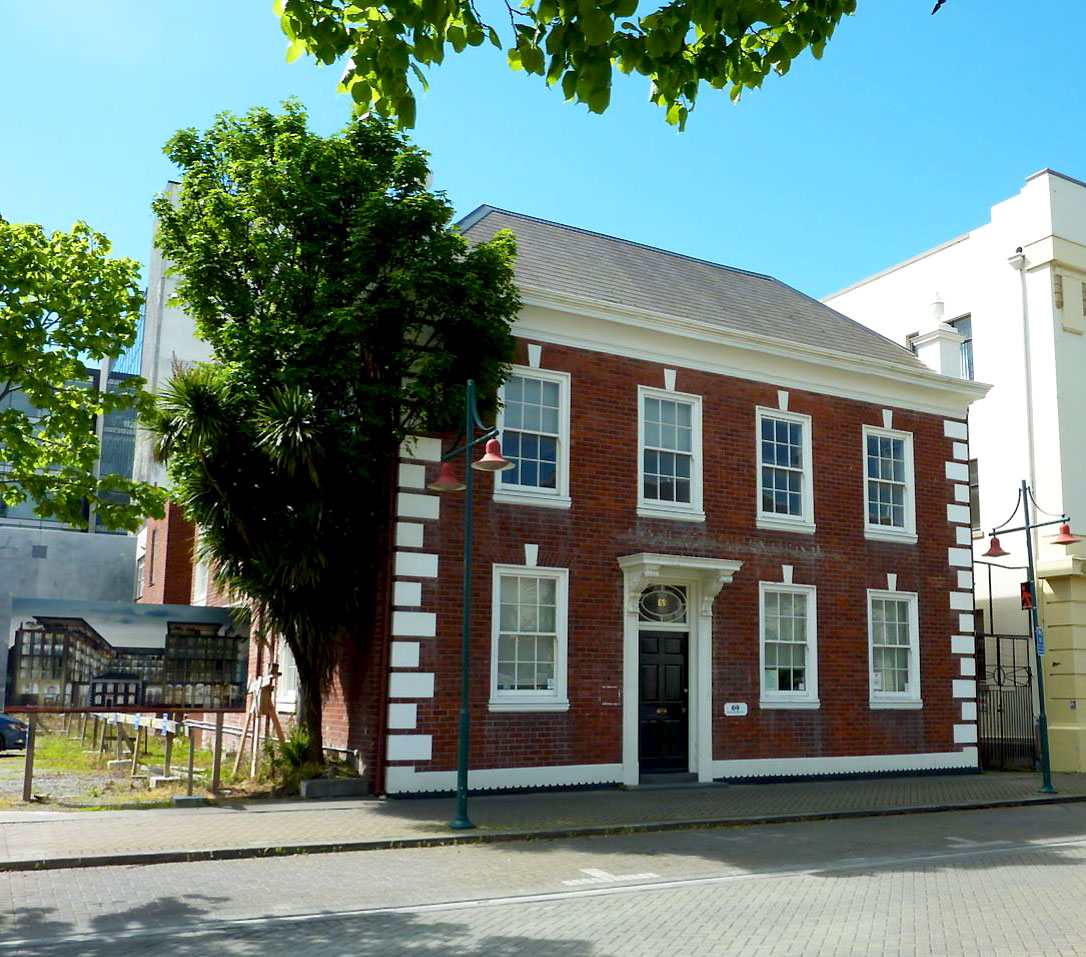
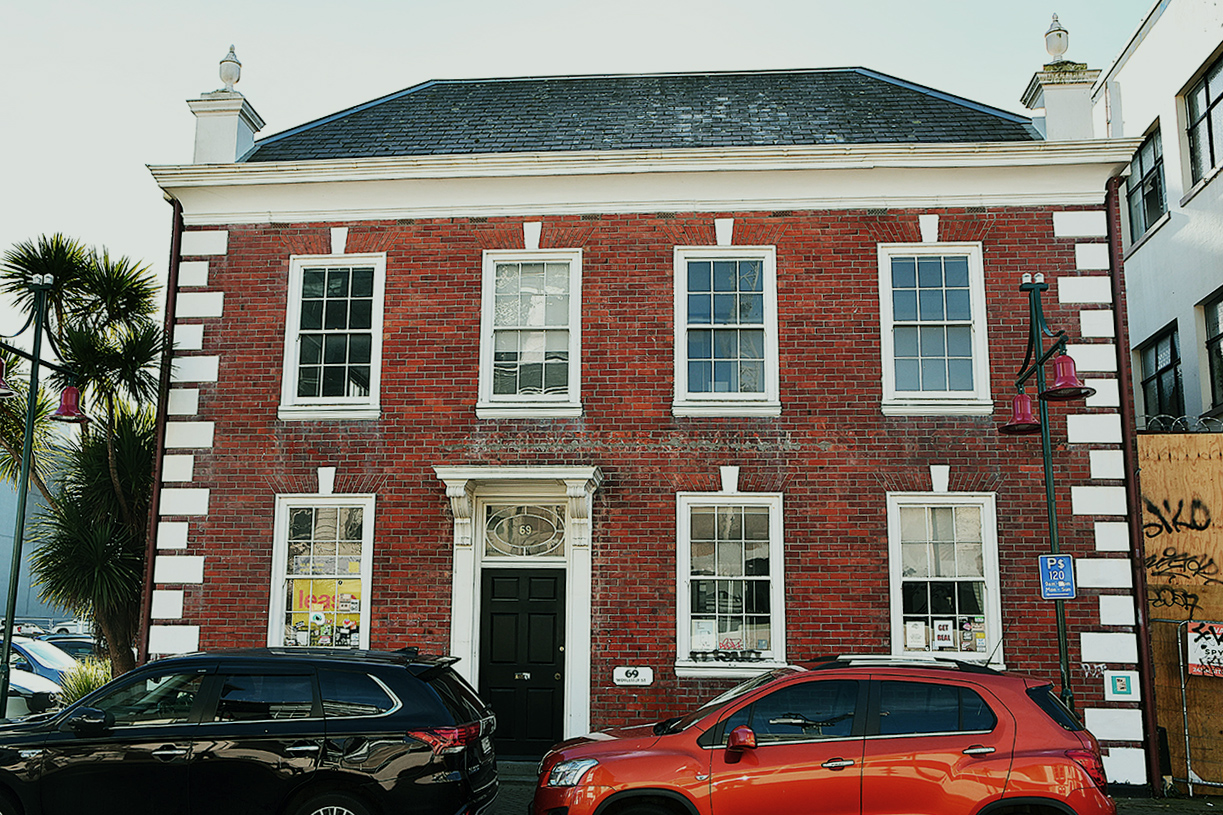
Designed by leading inter-war architect, Cecil Wood, Worcester Chambers is a two-storeyed Georgian Revival style building. Its hipped roof is clad in slate facing the street, while the rear of the building is roofed with corrugated steel. The Worcester Street façade is near symmetrical, with a door and three multi-paned sash windows on the ground floor and four evenly spaced sash windows at first floor level. The red brick is contrasted by cream coloured cement quoins, window surrounds with cement keystones and door architraves. Above the quoins and cornice is a pair of decorative urns. The east, west and north elevations the fenestration is more varied and comparatively plainer.
In 1950 the property passed out of the Digby ownership and it has had a number of commercial owners since that time. It is likely that the building was named Worcester Chambers in the 1980s. Since 1995 it is well known for its use as an English language school for international students. Alterations were carried out to the building in 1958, including a substantial addition to the rear, to the design of Miles Warren. Alterations for internal office fit-outs were carried out in 1963, 1981, 1987, 1995-6, 2001 and 2006. After the Canterbury earthquakes of 2010-11, a chimney on the east wall was partially dismantled and capped at roof height.
List Entry Information
Status
Listed
List Entry Status
Historic Place Category 2
Access
Private/No Public Access
List Number
1950
Date Entered
26th November 1981
Date of Effect
26th November 1981
City/District Council
Christchurch City
Region
Canterbury Region
Extent of List Entry
Extent includes the land described as Lot 2 DP 6773 (RT CB415/82), Canterbury Land District and the building known as Worcester Chambers thereon.
Legal description
Lot 2 DP 6773 (RT CB415/82), Canterbury Land District
Status
Listed
List Entry Status
Historic Place Category 2
Access
Private/No Public Access
List Number
1950
Date Entered
26th November 1981
Date of Effect
26th November 1981
City/District Council
Christchurch City
Region
Canterbury Region
Extent of List Entry
Extent includes the land described as Lot 2 DP 6773 (RT CB415/82), Canterbury Land District and the building known as Worcester Chambers thereon.
Legal description
Lot 2 DP 6773 (RT CB415/82), Canterbury Land District
Construction Professional
Name
Wood, Cecil Walter
Type
Architect
Biography
Born in Christchurch, Wood (1878-1947) was articled to the local architect Frederick Strouts between 1894 and 1899. He worked for a short time as a draughtsman with the firm Clarkson and Ballantyne before travelling to England in 1901. Here Wood was exposed to a high quality of architectural design in the Edwardian Free Style, and was employed by two leading Edwardian architects Robert Weir Shultz and Leonard Stokes. In 1907 Wood returned to New Zealand to take up partnership with Samuel Hurst Seager. The partnership lasted for only one year for Wood set up his own practice in 1908. The years 1908-1915 were dominated by domestic commissions, but it was also during this time that he began his association with Christ's College, which included such commissions as Hare Memorial Library (1915), the Memorial Dining Hall (1923-5), Jacob's House (1931) and Open Air Classrooms (1932). During the 1920s Wood's practice began to expand and a Georgian influence can be seen in such works as Weston House Park Terrace (1923-4) and Bishopscourt (1926-7). A short lived partnership in 1927 with R S D Harman allowed Wood to travel to the United States while another in 1937 with Paul Pascoe allowed him to travel to England, Europe and the United States without neglecting his practice. During this second trip he made preparations for the design of St Paul's Anglican Cathedral in Wellington, which was erected after his death. During his life Wood had made a substantial contribution to the architecture of Christchurch, having an enthusiasm for both European and American styles.
Name
Neil McGillivray
Type
Builder
Biography
No biography is currently available for this construction professional
Construction Details
Start Year
1958
Type
Addition
Description
Addition to the north
Start Year
1963
Type
Modification
Description
Internal alterations
Start Year
1981
Type
Modification
Description
Internal alterations
Type
Modification
Description
Internal alterations
Period
1995-6
Start Year
2001
Type
Modification
Description
1995
Start Year
2006
Type
Modification
Description
1995
Start Year
1924
Finish Year
1925
Type
Original Construction
Construction Professional
Name
Wood, Cecil Walter
Type
Architect
Biography
Born in Christchurch, Wood (1878-1947) was articled to the local architect Frederick Strouts between 1894 and 1899. He worked for a short time as a draughtsman with the firm Clarkson and Ballantyne before travelling to England in 1901. Here Wood was exposed to a high quality of architectural design in the Edwardian Free Style, and was employed by two leading Edwardian architects Robert Weir Shultz and Leonard Stokes. In 1907 Wood returned to New Zealand to take up partnership with Samuel Hurst Seager. The partnership lasted for only one year for Wood set up his own practice in 1908. The years 1908-1915 were dominated by domestic commissions, but it was also during this time that he began his association with Christ's College, which included such commissions as Hare Memorial Library (1915), the Memorial Dining Hall (1923-5), Jacob's House (1931) and Open Air Classrooms (1932). During the 1920s Wood's practice began to expand and a Georgian influence can be seen in such works as Weston House Park Terrace (1923-4) and Bishopscourt (1926-7). A short lived partnership in 1927 with R S D Harman allowed Wood to travel to the United States while another in 1937 with Paul Pascoe allowed him to travel to England, Europe and the United States without neglecting his practice. During this second trip he made preparations for the design of St Paul's Anglican Cathedral in Wellington, which was erected after his death. During his life Wood had made a substantial contribution to the architecture of Christchurch, having an enthusiasm for both European and American styles.
Name
Neil McGillivray
Type
Builder
Biography
No biography is currently available for this construction professional
Construction Details
Start Year
1958
Type
Addition
Description
Addition to the north
Start Year
1963
Type
Modification
Description
Internal alterations
Start Year
1981
Type
Modification
Description
Internal alterations
Type
Modification
Description
Internal alterations
Period
1995-6
Start Year
2001
Type
Modification
Description
1995
Start Year
2006
Type
Modification
Description
1995
Start Year
1924
Finish Year
1925
Type
Original Construction
Historical and Associated Iwi / Hapū / Whānau
Completion Date
26th January 2017
Report Written By
Robyn Burgess
Information Sources
Helms, 1996
Ruth M. Helms, 'The architecture of Cecil Wood', PhD thesis, University of Canterbury, 1996
Other Information
This place was identified as significant under previous legislation with different information requirements. It remains significant under the current legislation. There is opportunity under our legislation and policies to add to this information. Further information about this place may be available from the Southern Regional Office of Heritage New Zealand Pouhere Taonga. Please note that entry on the New Zealand Heritage List/Rarangi Korero identifies only the heritage values of the property concerned, and should not be construed as advice on the state of the property, or as a comment of its soundness or safety, including in regard to earthquake risk, safety in the event of fire, or insanitary conditions. A fully referenced upgrade report is available on request from the Southern Region Office of Heritage New Zealand.
Historical and Associated Iwi / Hapū / Whānau
Completion Date
26th January 2017
Report Written By
Robyn Burgess
Information Sources
Helms, 1996
Ruth M. Helms, 'The architecture of Cecil Wood', PhD thesis, University of Canterbury, 1996
Other Information
This place was identified as significant under previous legislation with different information requirements. It remains significant under the current legislation. There is opportunity under our legislation and policies to add to this information. Further information about this place may be available from the Southern Regional Office of Heritage New Zealand Pouhere Taonga. Please note that entry on the New Zealand Heritage List/Rarangi Korero identifies only the heritage values of the property concerned, and should not be construed as advice on the state of the property, or as a comment of its soundness or safety, including in regard to earthquake risk, safety in the event of fire, or insanitary conditions. A fully referenced upgrade report is available on request from the Southern Region Office of Heritage New Zealand.
Current Usages
Uses: Trade
Specific Usage: Office building/Offices
Former Usages
General Usage: Education
Specific Usage: Adult Education/training
Current Usages
Uses: Trade
Specific Usage: Office building/Offices
Former Usages
General Usage: Education
Specific Usage: Adult Education/training
Location
Sign up to hear more
Get the latest heritage news, features and events delivered
straight to your inbox.
