

A handsome two-roomed school was built to serve this district on a two acre reserve. When it opened on 28 July 1879 there were 26 pupils which gives an indication of the size of the community. In November 1885 a meeting was held in the school to discuss the village's need for a Post Office and daily mail service. After it was resolved that their request be relayed to the Post Master General, attention was turned to the provision of a public library. The school committee had already discussed this issue and one of their members, David Fyffe, had promised to provide stone for the building's construction. Mr Timaru Rhodes from the nearby Hadlow Estate showed the meeting a plan for a library building which he was prepared to erect and present to the district.
The plan showed "every accommodation" for the library which would have a "large, well-lighted, comfortable reading room together with another most convenient room at the main entrance". Permission was obtained from the South Canterbury Education Board to site the library on the school property and the facility was completed in 1887. Mr Rhodes was a public spirited landowner who concerned himself with all local issues and was active in advancing community interests.
With 28 subscribers to the library in the 1880s the lending library contained over 300 volumes, with newspapers and magazines provided in the reading room. Lectures were frequently held here.
Over the years Timaru developed and the small village became part of the city. In 1961 the library committee handed over the building, its contents and funds to the school. The school could no longer accommodate the increased numbers of pupils and for a brief period the library was used as a classroom. In 1975 a new district school was opened and this site was vacated. The two buildings on their two acre site were transferred to the Timaru District Council. Since that date the South Canterbury Arts Society has leased the two buildings and the school grounds are now a public park. In recent years the Arts Society has made little use of the library which is currently used by the council for storage.
List Entry Information
Status
Listed
List Entry Status
Historic Place Category 2
Access
Private/No Public Access
List Number
2060
Date Entered
2nd April 2004
Date of Effect
2nd April 2004
City/District Council
Timaru District
Region
Canterbury Region
Extent of List Entry
Extent includes part of the land described as RS 40849 (RT CB18B/1391), Canterbury Land District and the building known as Gleniti Library thereon. Refer to the extent map tabled at the Heritage New Zealand Board meeting on 3 September 2015.
Legal description
RS 40849 (RT CB18B/1391), Canterbury Land District
Status
Listed
List Entry Status
Historic Place Category 2
Access
Private/No Public Access
List Number
2060
Date Entered
2nd April 2004
Date of Effect
2nd April 2004
City/District Council
Timaru District
Region
Canterbury Region
Extent of List Entry
Extent includes part of the land described as RS 40849 (RT CB18B/1391), Canterbury Land District and the building known as Gleniti Library thereon. Refer to the extent map tabled at the Heritage New Zealand Board meeting on 3 September 2015.
Legal description
RS 40849 (RT CB18B/1391), Canterbury Land District
Why is this place significant?
Cultural Significance
The former Gleniti Library has cultural significance as it demonstrates the ambitions of a small community to provide themselves with such a facility.
Historic Significance
Historical Significance or Value It has historical values as it was built in the earliest days when the township of Gleniti was being established.
Physical Significance
It is unusual for a pioneering settlement to build such an imposing structure of stone and this adds architectural value.
Why is this place Category 1 / Category 2?
Detail Of Assessed Criteria
(a) In many small settlements around New Zealand the local residents worked together to establish the facilities they needed, like schools, churches, public halls and libraries. The importance of having a library was recognised by the people in the Gleniti District who organised the construction of this building in 1887, and this represents an aspect of the district's history. (c) A knowledge of New Zealand's early history can be gained by learning of this building's early usage at a time when the library was a vital source of practical information, entertainment and culture. Everyone was able to access the material held in the library so it provided educational opportunities not available in the 19th century as they are today. (e) The public esteem for the place was demonstrated through the 1960s when the future of the building seemed uncertain and the local residents lobbied for its retention. Various schemes were suggested for its use to encourage the District Council to take responsibility for it. (g) The building is of simple design but is very well constructed of bluestone blocks at a time when there were few people available with the necessary skills to use this material. This gives it technical value.
Why is this place significant?
Cultural Significance
The former Gleniti Library has cultural significance as it demonstrates the ambitions of a small community to provide themselves with such a facility.
Historic Significance
Historical Significance or Value It has historical values as it was built in the earliest days when the township of Gleniti was being established.
Physical Significance
It is unusual for a pioneering settlement to build such an imposing structure of stone and this adds architectural value.
Why is this place Category 1 / Category 2?
Detail Of Assessed Criteria
(a) In many small settlements around New Zealand the local residents worked together to establish the facilities they needed, like schools, churches, public halls and libraries. The importance of having a library was recognised by the people in the Gleniti District who organised the construction of this building in 1887, and this represents an aspect of the district's history. (c) A knowledge of New Zealand's early history can be gained by learning of this building's early usage at a time when the library was a vital source of practical information, entertainment and culture. Everyone was able to access the material held in the library so it provided educational opportunities not available in the 19th century as they are today. (e) The public esteem for the place was demonstrated through the 1960s when the future of the building seemed uncertain and the local residents lobbied for its retention. Various schemes were suggested for its use to encourage the District Council to take responsibility for it. (g) The building is of simple design but is very well constructed of bluestone blocks at a time when there were few people available with the necessary skills to use this material. This gives it technical value.
Construction Details
Start Year
1887
Type
Original Construction
Type
Modification
Description
Internal partition removed.
Period
1960s
Construction Materials
Bluestone with limestone dressings, Corrugated iron roof.
Construction Details
Start Year
1887
Type
Original Construction
Type
Modification
Description
Internal partition removed.
Period
1960s
Construction Materials
Bluestone with limestone dressings, Corrugated iron roof.
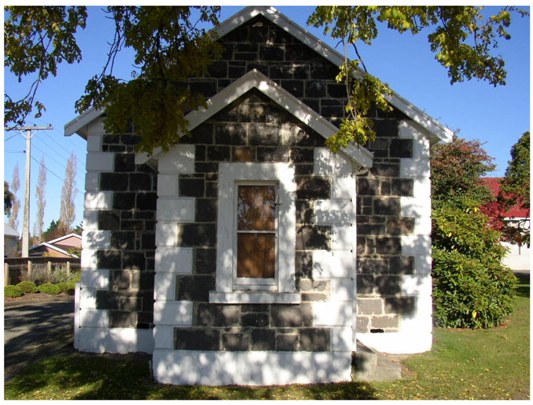
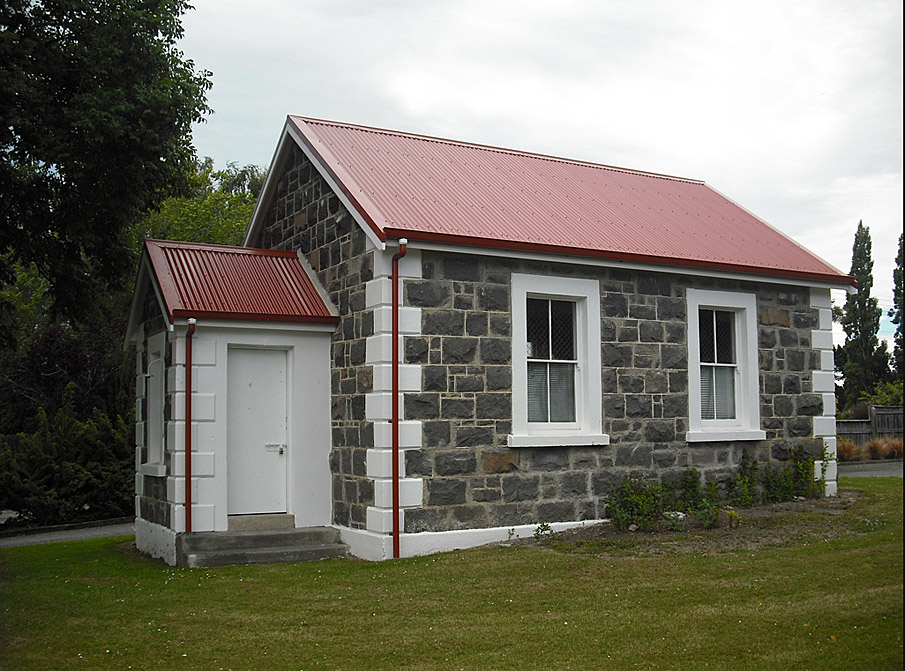
It is a single storeyed, gable roofed structure with a small separately roofed entrance porch facing Gleniti Road. The porch is lit by a single two paned sash window and there are two windows on each side of the main body of the building. The library originally contained two rooms but the dividing partition was removed in the 1960s. Limestone quoins outline the building's corners while plain limestone blocks form the window surrounds and the base structure of the front section.
It is a single storeyed, gable roofed structure with a small separately roofed entrance porch facing Gleniti Road. The porch is lit by a single two paned sash window and there are two windows on each side of the main body of the building. The library originally contained two rooms but the dividing partition was removed in the 1960s. Limestone quoins outline the building's corners while plain limestone blocks form the window surrounds and the base structure of the front section.
Historical and Associated Iwi / Hapū / Whānau
Completion Date
7th September 2004
Report Written By
Pam Wilson
Information Sources
Charteris, 1979
W. Charteris, Cheerful Yesterdays: A Centennial History of Gleniti (Wai-iti) School, 1879-1979.
Cyclopedia of New Zealand, 1903
Cyclopedia Company, Industrial, descriptive, historical, biographical facts, figures, illustrations, Wellington, N.Z, 1897-1908, Vol. 3, Canterbury Provincial District, Christchurch, 1903
New Zealand Historic Places Trust (NZHPT)
New Zealand Historic Places Trust
South Canterbury Museum
South Canterbury Museum, Timaru
Other Information
A fully referenced version of this report is available from the NZHPT Southern Region Office. Please note that entry on the New Zealand Heritage List/Rarangi Korero identifies only the heritage values of the property concerned, and should not be construed as advice on the state of the property, or as a comment of its soundness or safety, including in regard to earthquake risk, safety in the event of fire, or insanitary conditions.
Historical and Associated Iwi / Hapū / Whānau
Completion Date
7th September 2004
Report Written By
Pam Wilson
Information Sources
Charteris, 1979
W. Charteris, Cheerful Yesterdays: A Centennial History of Gleniti (Wai-iti) School, 1879-1979.
Cyclopedia of New Zealand, 1903
Cyclopedia Company, Industrial, descriptive, historical, biographical facts, figures, illustrations, Wellington, N.Z, 1897-1908, Vol. 3, Canterbury Provincial District, Christchurch, 1903
New Zealand Historic Places Trust (NZHPT)
New Zealand Historic Places Trust
South Canterbury Museum
South Canterbury Museum, Timaru
Other Information
A fully referenced version of this report is available from the NZHPT Southern Region Office. Please note that entry on the New Zealand Heritage List/Rarangi Korero identifies only the heritage values of the property concerned, and should not be construed as advice on the state of the property, or as a comment of its soundness or safety, including in regard to earthquake risk, safety in the event of fire, or insanitary conditions.
Former Usages
General Usage: Civic Facilities
Specific Usage: Library
Former Usages
General Usage: Civic Facilities
Specific Usage: Library
Location
Stay up to date with Heritage this month
