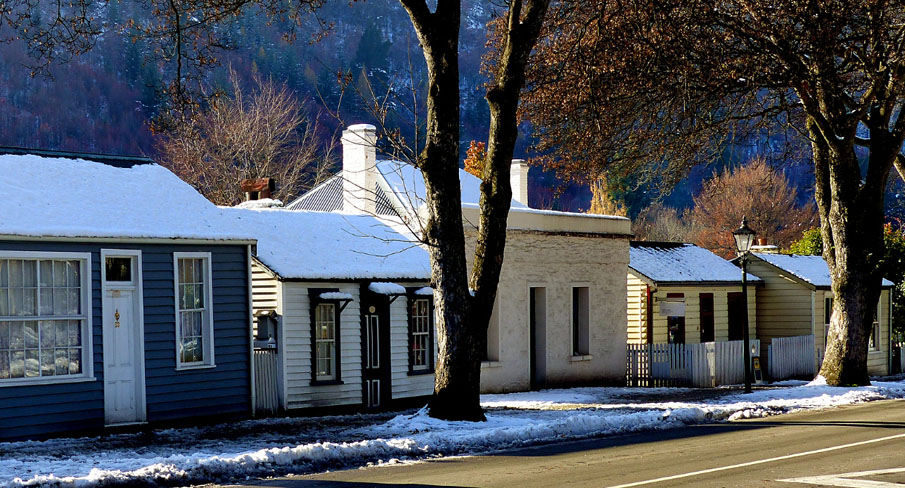
One of several small nineteenth century cottages on Arrowtown’s historic Buckingham Street, number 55 is a tiny 1870s weatherboard. The cottage has high aesthetic values and contributes to the heritage character of Arrowtown. It is one of several small nineteenth century cottages which form, along with retail and business structures, the Buckingham Street historic area (Register No. 7071). Although humble and utilitarian, the cottage stands as a testament to the development of Arrowtown, from ragtag gold-mining settlement to historic tourist attraction.
The land was granted to Bernard Rushton (c. 1838-1917) in September 1874. A cottage was built by 1877 when rates records show Rushton residing on site. Married to Adelaide, the cottage was home to the couple’s eight children.
The cottage was a typical early timber framed cottage with a symmetrical rectangular layout, two rooms wide, with a central front door. The small paned sash windows, medium pitch roof, symmetry and simplicity evoke the Georgian period. Small canopies over the door and windows were picturesque additions. Constructed right on the street boundary, it is consistent with the English village vernacular. At a later date, an extension was added running perpendicular to the rear of the cottage.
In 1878, Rushton sold the small cottage to John Thomas Burrell (c.1854-1941). Burrell was Mayor of Arrowtown 1882-1883 and a Borough Councillor. In 1887, Peter Butel (c.1837-1912) purchased the cottage. A native of France, Butel arrived at Arrowtown in 1862. By 1864, he and his brother had established two successful farms, a flour mill, a saw milling business and a watercourse that would provide Arrowtown’s water supply. The remains of Butel’s Mill Farm now form the hub of the restored buildings at Millbrook, Arrowtown’s golf resort.
Butel rented the property to William Marsh (c.1863-1943). Marsh was proprietor of the Lake County Press from around 1886 until 1895. Around 1905, Butel rented the cottage to Amy Smith (1857-1936), the Town Clerk’s widow. His death in 1902 had forced her to sell their house, furniture and possessions and move into rental accommodation.
In 1929, the cottage was purchased by George Scoles. Around 1940, Stewart Stevenson, labourer, leased the cottage from Scoles. Stevenson purchased the cottage in 1945 only to sell it in 1946. Stevenson continued to rent the cottage until around 1964. Locally, it became known as Stevenson’s Cottage.
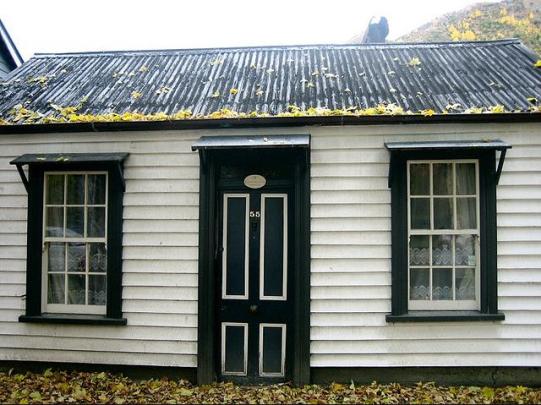
Cottage, 55 Buckingham Street, Arrowtown. Image courtesy of www.flickr.com | Florence3 | 15/04/2006 | Florence3

Cottage, 55 Buckingham Street, Arrowtown. September 2013 | Susan Irvine | Heritage New Zealand Pouhere Taonga

Cottage, 55 Buckingham Street, Arrowtown. Cottage on the right. CC Licence 2.0 Image courtesy of www.flickr.com | Jocelyn Kinghorn | 08/03/2014 | Jocelyn Kinghorn
Cottage, 55 Buckingham Street, Arrowtown. Image courtesy of www.flickr.com | Florence3 | 15/04/2006 | Florence3
Cottage, 55 Buckingham Street, Arrowtown. September 2013 | Susan Irvine | Heritage New Zealand Pouhere Taonga
Cottage, 55 Buckingham Street, Arrowtown. Cottage on the right. CC Licence 2.0 Image courtesy of www.flickr.com | Jocelyn Kinghorn | 08/03/2014 | Jocelyn Kinghorn