

From its source, the Taiari River flows almost entirely around Pātearoa (the Rock & Pillar Range) before discharging into Te Tai-o-Āraiteuru (the Otago coastline). Kōrero tuku iho tells us the Taiari and its various waterways was created by the taniwha Makaka who is immortalised as Pukemakamaka / Saddle Hill. Kāi Tahu ki Otago used all areas of the Taiari / Taieri Plain as evidenced by the hundreds of mahika kai sites associated with the numerous waterways, lakes and wetlands in the area, which was one of the most significant food baskets of the Otago region.
Salisbury from its establishment in 1857 in North Taieri by Donald Reid became the centre of early European settlement in the area. In 1856 he moved out to the Taieri Plain where his property ‘Salisbury’ was to become a model farm. His first house was a wattle and daub cottage which was expanded, upgraded and replaced with the current house. Reid used his business acumen during the 1861 goldrush to further expand and fund a bigger residence and in 1864 he employed architect R.A. Lawson to design a brick house. However, in the same year financial difficulties hit for Reid as pleuro-pneumonia affected his cattle and prices also fell for his produce as the gold rush population diminished. The house was not as grand as initially planned (that was to come in Stage 2) but did have improvements such as cement covered brick walls and a slate roof, as well as boasting a high-pressure hot water system and a large plunge bath with a cold shower – very rare for Otago country houses.
The Salisbury estate was an integral part of the wider landscape, with Reid donating land for the nearby North Taieri Church and Manse, and as a landlord for the development of tenant farms in the area. Reid was a busy politician and in his political roles he was significant in ensuring that European settlement in Otago would be by small holders on freehold farms. Reid became a very successful farmer and his stock and station agency ‘Donald Reid and Company’ founded in 1878 operated for over 100 years. The Estate's subsequent subdivision is also part of the landscape of the area, marked by the end of the larger estates, and the closer settlement of the Taieri Plains.
The design of Salisbury is significant as a restrained example of Lawson's residential work, as many of the original plans were not carried out, perhaps due to Reid's economic realities. The 1873 house had 14 rooms and took 9 months to complete. The outer brick walls were covered with cement and the interior brick division walls were thick, making the space soundproof. Joists were of black pine and the inside woodwork was mainly kauri. The roof was blue slate with ridging made of lead. The staircase had banisters of polished cedar and handrails and posts of mahogany. With limited resources, the house illustrates the technologies of the day with its hand burnt bricks made from local clay, and foundations of local stone. The exterior is plainly detailed with a sense of solidity, without the decorative detailing noted in Lawson’s commercial and religious architecture.
Salisbury, and the life of Donald Reid, reflects the change from settler to established citizen, a representative aspect of New Zealand history. The development from small cottage to substantial estate homestead was a path that epitomised the idea that European settlement should be small holders on freehold farms. It is an important example of the development of larger estates which were later broken up into smaller holdings.
List Entry Information
Status
Listed
List Entry Status
Historic Place Category 2
Access
Private/No Public Access
List Number
2125
Date Entered
9th December 2005
Date of Effect
9th December 2005
City/District Council
Dunedin City
Region
Otago Region
Extent of List Entry
Registration includes the house known as Salisbury, its fittings and fixtures, and the part of the land in Certificate of Title 6322 on which the house sits. Registration does not include the outbuildings. (Refer to Plan in Appendix 4 of Registration Report)
Legal description
Pt Lot 1 DP 301501 (RT 6322), Otago Land District
Status
Listed
List Entry Status
Historic Place Category 2
Access
Private/No Public Access
List Number
2125
Date Entered
9th December 2005
Date of Effect
9th December 2005
City/District Council
Dunedin City
Region
Otago Region
Extent of List Entry
Registration includes the house known as Salisbury, its fittings and fixtures, and the part of the land in Certificate of Title 6322 on which the house sits. Registration does not include the outbuildings. (Refer to Plan in Appendix 4 of Registration Report)
Legal description
Pt Lot 1 DP 301501 (RT 6322), Otago Land District
Why is this place significant?
Historic Significance
Historical Significance or Value Salisbury has historical importance as the residence for close to fifty years of farmer, businessman and politician Donald Reid. Scottish-born Reid was self made - starting out in New Zealand in 1849 as a 15 year old, by his death in 1919 he was a wealthy business and land owner. He was an important figure in the history of Otago as a member of the Otago Provincial Council, and a later Member of the House of Representatives. He founded stock and station agency Donald Reid and Company which operated for over 100 years. He played a significant role in ensuring that European settlement in late nineteenth and early twentieth century Otago would be by small holders on freehold farms.
Physical Significance
Salisbury has architectural significance as one of the earlier residential designs by outstanding Victorian architect Robert Arthur Lawson, and as one of the most substantial nineteenth century estate houses on the Taieri Plain. The house was built in two stages, a small residence in 1863, and the current house in 1873. It is a significant example of Lawson's residential work. The exterior is plainly detailed with a sense of solidity, without the decorative detailing noted in Lawson's commercial and religious architecture.
Why is this place Category 1 / Category 2?
Detail Of Assessed Criteria
Salisbury and the life of Donald Reid reflects the change from settler to established citizen, a representative aspect of New Zealand history. The development of the estate from small wattle and daub cottage, to small brick house, to substantial estate homestead was a path that not all settlers could follow, but one which epitomized the idea that European settlement should be small holders on freehold farms. In the history of the Taieri Plains it is an important example of the development of larger estates which were later broken up into smaller holdings. Salisbury has significance in its association with both Donald Reid and architect Robert Arthur Lawson. Both men were important in shaping colonial Dunedin - one in farming, politics and business, and the other in architecture. Donald Reid was an important nineteenth century figure active in the Otago Provincial Government, and as a Member of the House of Representatives. His estate was recognised as a model farm, and he was a successful farmer. His stock and station agency Donald Reid and Company founded in 1878 operated for over 100 years. Architect Robert Arthur Lawson, primarily known for his church buildings in Otago, shaped the face of Victorian Dunedin, and Salisbury is an important element in his oeuvre, especially as he was less known for his residential work. The design of Salisbury is significant as a restrained example Lawson's residential work, perhaps reflecting his client's noted down to earth, straight talking approach to life, as well as Reid's economic realities. It illustrates the technologies of the time with its hand burnt bricks made from local clay, and foundations of local stone. In its two stage construction it illustrates the change in fortunes of Donald Reid, and illustrates the style in which a gentleman of Reid's standing wished to live. Salisbury is an important part of the wider historical landscape. The Taieri Plain is noted for its early farmhouses representing the establishment of small farming on the outskirts of Dunedin. Salisbury represents the next step in the development of large estates that were also a part of the development of the Taieri. Salisbury and Donald Reid were an integral part of that wider landscape, with Reid donating land for the nearby North Taieri Church and Manse, and as a landlord for the development of tenant farms in the area. The Estate's subsequent subdivision is also part of the landscape of the area, marked by the end of the larger estates, and the closer settlement of the Taieri Plains.
Why is this place significant?
Historic Significance
Historical Significance or Value Salisbury has historical importance as the residence for close to fifty years of farmer, businessman and politician Donald Reid. Scottish-born Reid was self made - starting out in New Zealand in 1849 as a 15 year old, by his death in 1919 he was a wealthy business and land owner. He was an important figure in the history of Otago as a member of the Otago Provincial Council, and a later Member of the House of Representatives. He founded stock and station agency Donald Reid and Company which operated for over 100 years. He played a significant role in ensuring that European settlement in late nineteenth and early twentieth century Otago would be by small holders on freehold farms.
Physical Significance
Salisbury has architectural significance as one of the earlier residential designs by outstanding Victorian architect Robert Arthur Lawson, and as one of the most substantial nineteenth century estate houses on the Taieri Plain. The house was built in two stages, a small residence in 1863, and the current house in 1873. It is a significant example of Lawson's residential work. The exterior is plainly detailed with a sense of solidity, without the decorative detailing noted in Lawson's commercial and religious architecture.
Why is this place Category 1 / Category 2?
Detail Of Assessed Criteria
Salisbury and the life of Donald Reid reflects the change from settler to established citizen, a representative aspect of New Zealand history. The development of the estate from small wattle and daub cottage, to small brick house, to substantial estate homestead was a path that not all settlers could follow, but one which epitomized the idea that European settlement should be small holders on freehold farms. In the history of the Taieri Plains it is an important example of the development of larger estates which were later broken up into smaller holdings. Salisbury has significance in its association with both Donald Reid and architect Robert Arthur Lawson. Both men were important in shaping colonial Dunedin - one in farming, politics and business, and the other in architecture. Donald Reid was an important nineteenth century figure active in the Otago Provincial Government, and as a Member of the House of Representatives. His estate was recognised as a model farm, and he was a successful farmer. His stock and station agency Donald Reid and Company founded in 1878 operated for over 100 years. Architect Robert Arthur Lawson, primarily known for his church buildings in Otago, shaped the face of Victorian Dunedin, and Salisbury is an important element in his oeuvre, especially as he was less known for his residential work. The design of Salisbury is significant as a restrained example Lawson's residential work, perhaps reflecting his client's noted down to earth, straight talking approach to life, as well as Reid's economic realities. It illustrates the technologies of the time with its hand burnt bricks made from local clay, and foundations of local stone. In its two stage construction it illustrates the change in fortunes of Donald Reid, and illustrates the style in which a gentleman of Reid's standing wished to live. Salisbury is an important part of the wider historical landscape. The Taieri Plain is noted for its early farmhouses representing the establishment of small farming on the outskirts of Dunedin. Salisbury represents the next step in the development of large estates that were also a part of the development of the Taieri. Salisbury and Donald Reid were an integral part of that wider landscape, with Reid donating land for the nearby North Taieri Church and Manse, and as a landlord for the development of tenant farms in the area. The Estate's subsequent subdivision is also part of the landscape of the area, marked by the end of the larger estates, and the closer settlement of the Taieri Plains.
Construction Professional
Name
Lawson, Robert Arthur
Type
Architect
Biography
Born in Scotland, Lawson (1833-1902) began his professional career in Perth. At the age of 25 he moved to Melbourne and was engaged in goldmining and journalism before resuming architectural practice. In 1862 Lawson sailed for Dunedin, where his sketch plans had won the competition for the design of First Church. This was built 1867-73. Lawson went on to become one of the most important architects in New Zealand. First Church is regarded as his masterpiece and one of the finest nineteenth century churches in New Zealand. He was also responsible for the design of the Trinity Church (now Fortune Theatre), Dunedin (1869-70), the East Taieri Presbyterian Church (1870), and Knox Church, Dunedin (1874). He designed Park's School (1864) and the ANZ Bank (originally Union Bank, 1874). In Oamaru he designed the Bank of Otago (later National Bank building, 1870) and the adjoining Bank of New South Wales (now Forrester Gallery, 1881). See also: Ledgerwood, Norman, 2013. 'R.A. Lawson: Victorian Architect of Dunedin'. Historic Cemeteries Conservation NZ.
Construction Details
Start Year
1857
Type
Original Construction
Description
Original Construction of Sod Cottage
Start Year
1863
Type
Original Construction
Description
Original Construction of brick house
Start Year
1983
Type
Addition
Description
Hayburn
Start Year
1873
Type
Addition
Description
Modification to two storey house
Construction Materials
Stone foundations, locally burnt brick walls, plastered exterior, slate roof.
Construction Professional
Name
Lawson, Robert Arthur
Type
Architect
Biography
Born in Scotland, Lawson (1833-1902) began his professional career in Perth. At the age of 25 he moved to Melbourne and was engaged in goldmining and journalism before resuming architectural practice. In 1862 Lawson sailed for Dunedin, where his sketch plans had won the competition for the design of First Church. This was built 1867-73. Lawson went on to become one of the most important architects in New Zealand. First Church is regarded as his masterpiece and one of the finest nineteenth century churches in New Zealand. He was also responsible for the design of the Trinity Church (now Fortune Theatre), Dunedin (1869-70), the East Taieri Presbyterian Church (1870), and Knox Church, Dunedin (1874). He designed Park's School (1864) and the ANZ Bank (originally Union Bank, 1874). In Oamaru he designed the Bank of Otago (later National Bank building, 1870) and the adjoining Bank of New South Wales (now Forrester Gallery, 1881). See also: Ledgerwood, Norman, 2013. 'R.A. Lawson: Victorian Architect of Dunedin'. Historic Cemeteries Conservation NZ.
Construction Details
Start Year
1857
Type
Original Construction
Description
Original Construction of Sod Cottage
Start Year
1863
Type
Original Construction
Description
Original Construction of brick house
Start Year
1983
Type
Addition
Description
Hayburn
Start Year
1873
Type
Addition
Description
Modification to two storey house
Construction Materials
Stone foundations, locally burnt brick walls, plastered exterior, slate roof.
Donald Reid, born in Scotland, arrived at Port Chalmers in 1849 as a fifteen year old. Initially he worked at W.H. Valpy's farm in Forbury (South Dunedin), and ran a leased farm at Caversham. By 1854 he owned 200 acres (80 hectares). He married Frances Barr in December 1854 (d. 1868), and they went on to have at least eight children. He made his first purchase in North Taieri in 1856 (an area settled by Europeans c.1849-1850), the start of what would become the substantial Salisbury Estate, and his home for 56 years. A family history states that he selected the land in 1856, and in 1857 he was preparing to build a house at Salisbury. Timber was cut and prepared from Reid's Caversham property so it could be assembled without further work. Four men aided in the construction of the north-facing wattle and daub cottage, with veranda. The house had a scotch iron roof, with kiln-burnt brick chimneys and fireplaces and wooden floors. Woodwork was of dressed white pine. Strong rails and posts for a stockyard were also cut and the ends charred to aid preservation. Water from a nearby hillside spring was piped to a tap near the house. Around 1860 a stable was built with a framework of Totara and Kowhai posts milled on the property. The “blue metal stones” used on to pave the stable were apparently taken from the linings of the few Maori ovens found round the foothills on the property, and were still on the floor in 1912, but were apparently covered in light concrete later to protect the feet of the horses. In the same year Reid built a long low building consisting of “five good-sized rooms, with a low attic above” to accommodate his workers, and with a dairy at one end, with water piped from the spring. It was built from burnt bricks. This building was occupied from 1860 until at least 1912 (Reid's period of ownership), and was demolished sometime after the mid-1970s. By c.1861 Reid held around 500 acres (200 hectares), and employed 7 permanent staff. When the gold rushes began in 1861, Reid made a deal with his workers, if they finished their farming duties over the summer he supplied the transport, equipment and supplies for three months whilst they worked a claim together. Reid also ran a carting business taking farm produce to the diggings, making substantial returns. Gradually he cleared and fenced the land. In 1863 he began planting - he planted 507 chains of Hawthorne hedges; 30 (12 hectares) acres of largely bluegum, but also macrocarpa and wattle shelter belts, and ornamental trees - willow and poplars. By 1864 Reid was settling in and planned a large residence. Reid had to modify his plans due to stock losses resulting from an outbreak pleuro-pneumonia and the associated financial costs. He built a small house. The portion built was solid, being destined to be part of a larger later dwelling. A high-pressure hot water system was installed, as well as a lead-lined plunge bath with a cold shower. The brick walls were covered with cement. Surplus burnt bricks were used for David Oughton's Boghead (now known as Duddington, nearby on the Taieri) Reid then turned his attention to sheep farming. By the early 1870s Reid had recovered from his losses and commissioned architect Robert Lawson to design his new house, which incorporated the older dwelling. Lawson's original design specified a large balcony, French windows and other ornamental features. These were omitted in the design as built, according to one writer, perhaps to Lawson's displeasure. Building began in January 1873, and the house took nine months to complete. The new residence had 14 rooms, a large hall with a semi-circular staircase, kauri floors and 18 inch thick exterior walls. The mains rooms had ornamented ceilings with centrepieces of molded flowers and foliage. The suspended staircase had polished cedar banisters and mahogany rails and newel posts. After the house was completed he remarried. His new wife was a widow Sarah Price. Sarah had two sons from her previous marriage, and was to have a daughter with Reid. Reid was an outstanding figure in Otago. His interests included farming, transport, harbour board, politics, and industrial development. He served on road boards, school committees, and donated the glebe of 10 acres for the North Taieri Church and manse. Reid was one of the Taieri members of the Otago Provincial Council from 1863 until 1876. He had a particular interest in land policy and was instrumental in passing early land legislation that aimed at encouraging settlers onto land - in particular the deferred payment system. From 1866-1869, and 1871-1878 Reid was a member of the House of Representatives for the Taieri electorate. For a short time in 1872 he was minister for public works in the Stafford administration. He was secretary for Crown lands and minister for immigration in the 1877 Atkinson government. Reid retired from public life in 1878, and started business (to provide for his growing family) in what historian John Angus called a “new colonial industry” as a stock and station agent (Donald Reid and Company). John Angus writes that this was at this time “a fledgling and purely Australasian institution” in the mid 1870s, a time when the Otago farming sector was expanding. Reid began operations from a store and office building in Lower High Street, Dunedin. He sold stock, wool and grain on commission; advanced money; and sold farm supplies. The business grew quickly and the company became an important firm in Otago. Eight family members were employed in the firm before the First World War. By 1882 Reid owned freehold property (including some tenant farms) valued at £28,000 (over a million dollars by today's reckoning). The Reid family left the running of the estate to managers. He continued to develop with homestead property - the paths and front drive were asphalted in the 1880s, and the outbuildings put on concrete foundations and concrete floors. There were substantial plantings of fruit trees and berry fruit, including cherries and raspberries. In 1900 Donald Reid and Company became a private joint stock company. Reid continued as managing director and chairman until his retirement in 1918. According to economist Brian Easton historically stock agents usually started as merchants or auctioneers. The ability to finance the farmer became the key to success - the agent was the farmer's banker - selling the farmer's stock and wool, buying the farmer's grain and seed, found a buyer for the farm, and financed the purchase of another one, and kept accounts. There were about 80 of these businesses at the end of the nineteenth century, by 1960 only 20 remained. R.D. Hudson, Chair of Donald Reid Otago Farmers Ltd in 1978, argues that the history of Donald Reid Otago Farmers is “in many ways the history of farming and related commercial enterprise in Otago." After his wife's death in 1905 only Donald Reid and his two daughters occupied the large house. In 1911, when the daily 3-4 hour travel to Dunedin became burdensome, Reid was approached by a potential buyer for the estate and sold Salisbury to L.C. Hazlett. Apparently he regretted the sale, and the family dismay at parting from the house, and tried unsuccessfully to buy it back. At the time of sale the property comprised of 6,327 acres (2560 hectares) divided into 50 paddocks, with the whole estate well planted and well watered. On Reid's death the estate stood at 6,300 acres freehold, and a large hill country lease. Reid died at his home Abbotsford in 1919. Hazlett was involved in the local racehorse industry. After Hazlett's ownership E.C.S. Falconer owned the property (1945-65), and began an Ayrshire stud. He commenced a successful racehorse career. For a period afterwards the property was tenanted and housed sharemilkers. By the 1980s the house was derelict. It is not known whether this Hazlett was related to the Hazlett's of Southland, who were noted for horse racing, breeding and farming. In the 1980s it was restored to its former glory by the then owners, and in 2005 is a private residence. Reid Farmers merged with Pyne Gould Guinness in 2001, and has been a significant commercial presence in the Otago agricultural business sector.
Donald Reid, born in Scotland, arrived at Port Chalmers in 1849 as a fifteen year old. Initially he worked at W.H. Valpy's farm in Forbury (South Dunedin), and ran a leased farm at Caversham. By 1854 he owned 200 acres (80 hectares). He married Frances Barr in December 1854 (d. 1868), and they went on to have at least eight children. He made his first purchase in North Taieri in 1856 (an area settled by Europeans c.1849-1850), the start of what would become the substantial Salisbury Estate, and his home for 56 years. A family history states that he selected the land in 1856, and in 1857 he was preparing to build a house at Salisbury. Timber was cut and prepared from Reid's Caversham property so it could be assembled without further work. Four men aided in the construction of the north-facing wattle and daub cottage, with veranda. The house had a scotch iron roof, with kiln-burnt brick chimneys and fireplaces and wooden floors. Woodwork was of dressed white pine. Strong rails and posts for a stockyard were also cut and the ends charred to aid preservation. Water from a nearby hillside spring was piped to a tap near the house. Around 1860 a stable was built with a framework of Totara and Kowhai posts milled on the property. The “blue metal stones” used on to pave the stable were apparently taken from the linings of the few Maori ovens found round the foothills on the property, and were still on the floor in 1912, but were apparently covered in light concrete later to protect the feet of the horses. In the same year Reid built a long low building consisting of “five good-sized rooms, with a low attic above” to accommodate his workers, and with a dairy at one end, with water piped from the spring. It was built from burnt bricks. This building was occupied from 1860 until at least 1912 (Reid's period of ownership), and was demolished sometime after the mid-1970s. By c.1861 Reid held around 500 acres (200 hectares), and employed 7 permanent staff. When the gold rushes began in 1861, Reid made a deal with his workers, if they finished their farming duties over the summer he supplied the transport, equipment and supplies for three months whilst they worked a claim together. Reid also ran a carting business taking farm produce to the diggings, making substantial returns. Gradually he cleared and fenced the land. In 1863 he began planting - he planted 507 chains of Hawthorne hedges; 30 (12 hectares) acres of largely bluegum, but also macrocarpa and wattle shelter belts, and ornamental trees - willow and poplars. By 1864 Reid was settling in and planned a large residence. Reid had to modify his plans due to stock losses resulting from an outbreak pleuro-pneumonia and the associated financial costs. He built a small house. The portion built was solid, being destined to be part of a larger later dwelling. A high-pressure hot water system was installed, as well as a lead-lined plunge bath with a cold shower. The brick walls were covered with cement. Surplus burnt bricks were used for David Oughton's Boghead (now known as Duddington, nearby on the Taieri) Reid then turned his attention to sheep farming. By the early 1870s Reid had recovered from his losses and commissioned architect Robert Lawson to design his new house, which incorporated the older dwelling. Lawson's original design specified a large balcony, French windows and other ornamental features. These were omitted in the design as built, according to one writer, perhaps to Lawson's displeasure. Building began in January 1873, and the house took nine months to complete. The new residence had 14 rooms, a large hall with a semi-circular staircase, kauri floors and 18 inch thick exterior walls. The mains rooms had ornamented ceilings with centrepieces of molded flowers and foliage. The suspended staircase had polished cedar banisters and mahogany rails and newel posts. After the house was completed he remarried. His new wife was a widow Sarah Price. Sarah had two sons from her previous marriage, and was to have a daughter with Reid. Reid was an outstanding figure in Otago. His interests included farming, transport, harbour board, politics, and industrial development. He served on road boards, school committees, and donated the glebe of 10 acres for the North Taieri Church and manse. Reid was one of the Taieri members of the Otago Provincial Council from 1863 until 1876. He had a particular interest in land policy and was instrumental in passing early land legislation that aimed at encouraging settlers onto land - in particular the deferred payment system. From 1866-1869, and 1871-1878 Reid was a member of the House of Representatives for the Taieri electorate. For a short time in 1872 he was minister for public works in the Stafford administration. He was secretary for Crown lands and minister for immigration in the 1877 Atkinson government. Reid retired from public life in 1878, and started business (to provide for his growing family) in what historian John Angus called a “new colonial industry” as a stock and station agent (Donald Reid and Company). John Angus writes that this was at this time “a fledgling and purely Australasian institution” in the mid 1870s, a time when the Otago farming sector was expanding. Reid began operations from a store and office building in Lower High Street, Dunedin. He sold stock, wool and grain on commission; advanced money; and sold farm supplies. The business grew quickly and the company became an important firm in Otago. Eight family members were employed in the firm before the First World War. By 1882 Reid owned freehold property (including some tenant farms) valued at £28,000 (over a million dollars by today's reckoning). The Reid family left the running of the estate to managers. He continued to develop with homestead property - the paths and front drive were asphalted in the 1880s, and the outbuildings put on concrete foundations and concrete floors. There were substantial plantings of fruit trees and berry fruit, including cherries and raspberries. In 1900 Donald Reid and Company became a private joint stock company. Reid continued as managing director and chairman until his retirement in 1918. According to economist Brian Easton historically stock agents usually started as merchants or auctioneers. The ability to finance the farmer became the key to success - the agent was the farmer's banker - selling the farmer's stock and wool, buying the farmer's grain and seed, found a buyer for the farm, and financed the purchase of another one, and kept accounts. There were about 80 of these businesses at the end of the nineteenth century, by 1960 only 20 remained. R.D. Hudson, Chair of Donald Reid Otago Farmers Ltd in 1978, argues that the history of Donald Reid Otago Farmers is “in many ways the history of farming and related commercial enterprise in Otago." After his wife's death in 1905 only Donald Reid and his two daughters occupied the large house. In 1911, when the daily 3-4 hour travel to Dunedin became burdensome, Reid was approached by a potential buyer for the estate and sold Salisbury to L.C. Hazlett. Apparently he regretted the sale, and the family dismay at parting from the house, and tried unsuccessfully to buy it back. At the time of sale the property comprised of 6,327 acres (2560 hectares) divided into 50 paddocks, with the whole estate well planted and well watered. On Reid's death the estate stood at 6,300 acres freehold, and a large hill country lease. Reid died at his home Abbotsford in 1919. Hazlett was involved in the local racehorse industry. After Hazlett's ownership E.C.S. Falconer owned the property (1945-65), and began an Ayrshire stud. He commenced a successful racehorse career. For a period afterwards the property was tenanted and housed sharemilkers. By the 1980s the house was derelict. It is not known whether this Hazlett was related to the Hazlett's of Southland, who were noted for horse racing, breeding and farming. In the 1980s it was restored to its former glory by the then owners, and in 2005 is a private residence. Reid Farmers merged with Pyne Gould Guinness in 2001, and has been a significant commercial presence in the Otago agricultural business sector.
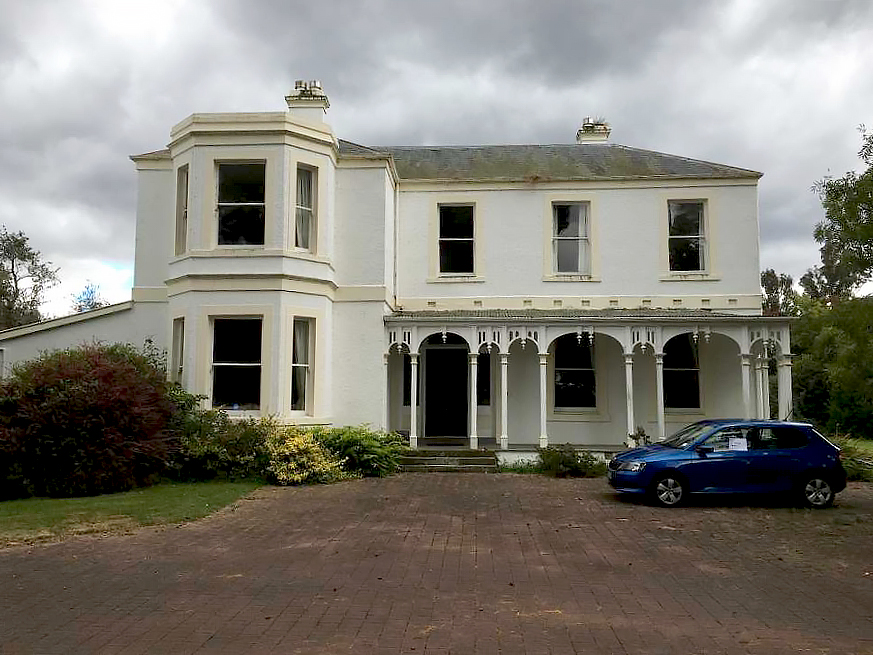
Salisbury is situated at North Taieri on the Taieri Plain. Access to the house is by a long tree-lined paved drive. To the west of the house stand the stable and woolshed (these are not included in the registration). The house itself is surrounded by a garden, including a number of mature trees. The house consists of two main phases of construction: a small cottage built in 1863, which is incorporated into the body of the later two storey house constructed in 1873. Starting with the main section, this was designed by Robert Arthur Lawson and built in 1873. The main south elevation has a double-storey bay window at the western end. On the lower storey there is a verandah that extends from the bay window to the south-east corner of the elevation. Slender columns support the verandah; the spacing of these columns echoes that of the main entrance and windows. The main door, located in the middle of the lower storey, features lead light panels on either side. The northern elevation (or back) features the 1863 portion of the house with an enclosed verandah. The 1863 portion is a simple three-room single storey cottage. It has a corrugated iron/slate hipped-roof and double hung sash windows. The 1870s structure has a hipped roof finished with slate. The windows are double-hung sash. The building's foundations are formed from large rocks quarried from the hillsides of the estate. The eighteen inch (c.45cm) exterior walls are brick. The interior walls consist of clay bricks, three bricks thick, which were made and burnt on the Salisbury Estate property. The interior was not viewed for this database entry. Earlier information indicated the house consisted of eight rooms on the first floor: the formal dining room, the family room, the kitchen, a bathroom, study and additional living areas. The first floor had six bedrooms and a bathroom.
Salisbury is situated at North Taieri on the Taieri Plain. Access to the house is by a long tree-lined paved drive. To the west of the house stand the stable and woolshed (these are not included in the registration). The house itself is surrounded by a garden, including a number of mature trees. The house consists of two main phases of construction: a small cottage built in 1863, which is incorporated into the body of the later two storey house constructed in 1873. Starting with the main section, this was designed by Robert Arthur Lawson and built in 1873. The main south elevation has a double-storey bay window at the western end. On the lower storey there is a verandah that extends from the bay window to the south-east corner of the elevation. Slender columns support the verandah; the spacing of these columns echoes that of the main entrance and windows. The main door, located in the middle of the lower storey, features lead light panels on either side. The northern elevation (or back) features the 1863 portion of the house with an enclosed verandah. The 1863 portion is a simple three-room single storey cottage. It has a corrugated iron/slate hipped-roof and double hung sash windows. The 1870s structure has a hipped roof finished with slate. The windows are double-hung sash. The building's foundations are formed from large rocks quarried from the hillsides of the estate. The eighteen inch (c.45cm) exterior walls are brick. The interior walls consist of clay bricks, three bricks thick, which were made and burnt on the Salisbury Estate property. The interior was not viewed for this database entry. Earlier information indicated the house consisted of eight rooms on the first floor: the formal dining room, the family room, the kitchen, a bathroom, study and additional living areas. The first floor had six bedrooms and a bathroom.
Historical and Associated Iwi / Hapū / Whānau
Public NZAA Number
I44/1067
Completion Date
6th March 2024
Report Written By
Alison Breese
Information Sources
Davis, 1973
G.F. Davis, 'Old Identities and New Iniquities: The Taieri Plain in Otago Province 1770-1870', MA Thesis, University of Otago, 1973
Dictionary of New Zealand Biography
Dictionary of New Zealand Biography
Lemon, 1970
Daphne Lemon, Taieri Buildings: with drawings by Audrey Bascand, McIndoe Print, Dunedin, 1970
Otago Daily Times
Otago Daily Times, 1 Jun 1915, p.10.
Reid, 1939
Reid, E. N. and Alfred Eccles, 1939 Donald Reid: pioneer, statesman, merchant, 1833-1919, Wellington, New Zealand
Reid, 1939
Reid, E. N. and Alfred Eccles, 1939 Donald Reid: pioneer, statesman, merchant, 1833-1919, Wellington, New Zealand
Shaw, 1949
Margaret Shaw and Edgar D. Farrant, The Taieri Plain: Tales of the Years that are Gone, Otago Centennial Historical Publications, Dunedin, 1949
Kirk, 1985
Kirk W.R., Pulse of the Plain – A History of Mosgiel, Mosgiel Borough Council, Dunedin, 1985.
Angus, John H., 1993
Angus, John H., 'Reid, Donald', Dictionary of New Zealand Biography, first published in 1993. Te Ara - the Encyclopedia of New Zealand, https://teara.govt.nz/en/biographies/2r13/reid-donald (accessed 8 February 2024).
Eccles, 1949
Eccles, Alfred., Donald Reid, Statesman – A Sketch of His Political Life and Views, 1949.
Heritage New Zealand Pouhere Taonga Property File
12013-948
Other Information
A fully referenced copy of the upgrade summary report is available from the Southern Area Office of Heritage New Zealand Pouhere Taonga Please note that entry on the New Zealand Heritage List/Rārangi Kōrero identifies only the heritage values of the property concerned, and should not be construed as advice on the state of the property, or as a comment of its soundness or safety, including in regard to earthquake risk, safety in the event of fire, or insanitary conditions.
Historical and Associated Iwi / Hapū / Whānau
Public NZAA Number
I44/1067
Completion Date
6th March 2024
Report Written By
Alison Breese
Information Sources
Davis, 1973
G.F. Davis, 'Old Identities and New Iniquities: The Taieri Plain in Otago Province 1770-1870', MA Thesis, University of Otago, 1973
Dictionary of New Zealand Biography
Dictionary of New Zealand Biography
Lemon, 1970
Daphne Lemon, Taieri Buildings: with drawings by Audrey Bascand, McIndoe Print, Dunedin, 1970
Otago Daily Times
Otago Daily Times, 1 Jun 1915, p.10.
Reid, 1939
Reid, E. N. and Alfred Eccles, 1939 Donald Reid: pioneer, statesman, merchant, 1833-1919, Wellington, New Zealand
Reid, 1939
Reid, E. N. and Alfred Eccles, 1939 Donald Reid: pioneer, statesman, merchant, 1833-1919, Wellington, New Zealand
Shaw, 1949
Margaret Shaw and Edgar D. Farrant, The Taieri Plain: Tales of the Years that are Gone, Otago Centennial Historical Publications, Dunedin, 1949
Kirk, 1985
Kirk W.R., Pulse of the Plain – A History of Mosgiel, Mosgiel Borough Council, Dunedin, 1985.
Angus, John H., 1993
Angus, John H., 'Reid, Donald', Dictionary of New Zealand Biography, first published in 1993. Te Ara - the Encyclopedia of New Zealand, https://teara.govt.nz/en/biographies/2r13/reid-donald (accessed 8 February 2024).
Eccles, 1949
Eccles, Alfred., Donald Reid, Statesman – A Sketch of His Political Life and Views, 1949.
Heritage New Zealand Pouhere Taonga Property File
12013-948
Other Information
A fully referenced copy of the upgrade summary report is available from the Southern Area Office of Heritage New Zealand Pouhere Taonga Please note that entry on the New Zealand Heritage List/Rārangi Kōrero identifies only the heritage values of the property concerned, and should not be construed as advice on the state of the property, or as a comment of its soundness or safety, including in regard to earthquake risk, safety in the event of fire, or insanitary conditions.
Current Usages
Uses: Accommodation
Specific Usage: House
Former Usages
General Usage: Accommodation
Specific Usage: House
Current Usages
Uses: Accommodation
Specific Usage: House
Former Usages
General Usage: Accommodation
Specific Usage: House
Sign up to hear more
Get the latest heritage news, features and events delivered
straight to your inbox.
