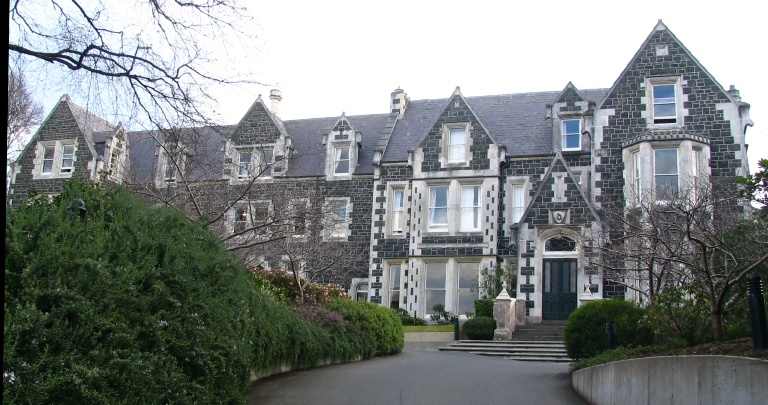
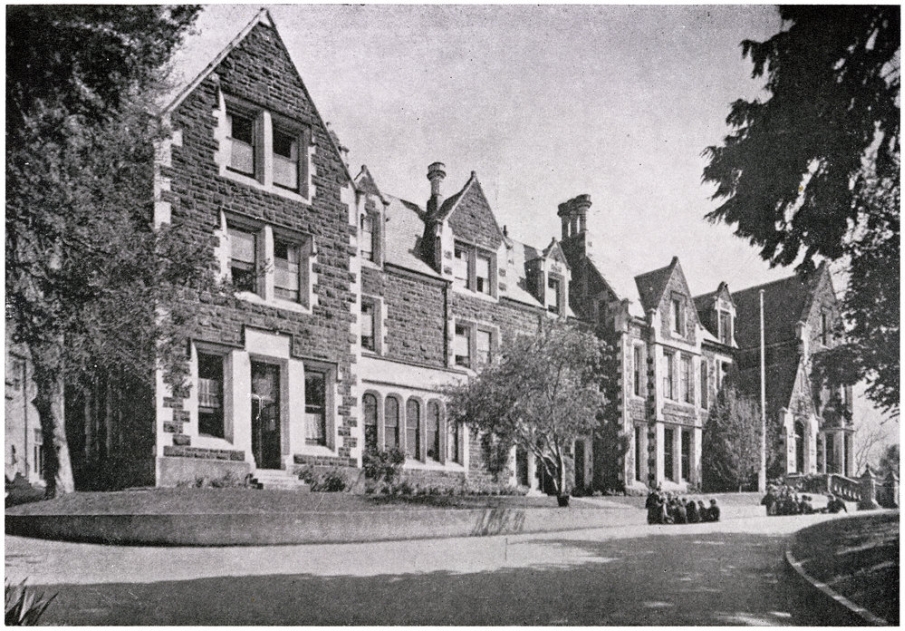
Although partly masked from the road by more recent buildings, Bishopscourt holds an imposing presence on Highgate which runs along the crest of Dunedin’s westerly hills beyond the town belt. It was commissioned in 1871 by newly ordained Bishop Samuel Tarratt Nevill (1837-1921) as his residence. The bluestone stone house was designed by Mason and Wales and has architectural and historical significance.
While on holiday in New Zealand in September 1870, Nevill and his wife visited Dunedin where he was offered the role of Bishop of the newly created synod. He accepted and was consecrated on 4th June that year, following which he swiftly identified a building site on District Road (renamed Highgate) and funded the construction himself.
Nevill commissioned Mason and Williams to design his residence for £3,087 ($456,777) and they called for tenders in July 1871. The successful contractor was David Hunter (1850?-1874). It was reported the residence would be finished in two or three months despite construction not beginning until September. The Otago Witness described its style as Tudor,“a style in keeping with buildings of this class”, with bluestone quarried “on the ground”, laid in course and with quoining, dressings and facings of Kakanui stone. It was also described as comprising 22 rooms. The two storey house with heavy use of quoining, steep gable-ended slated roofs with projecting bay windows, an octagonal turret and towering chimneys was certainly imposing. Stacpoole records the original plaster and Papier-mâché ceilings, walnut lined walls and the elaborate Minton tiled hall, and Galer notes the Nevill’s family crest in the tiling. The house was completed in 1872 and was grander that the diocese had envisaged; Neville’s reasoning was to provide a dormitory for students training for the priesthood. By December two theological students were in residence in the upper rooms.
After Bishop Nevill sold the residence in 1878, it was occupied by a series of businessmen and a landowner through until 1913. The house then had a significant change of purpose. The Rev. Alexander Whyte (1864-1919) was behind the vision for a Presbyterian girls' school in Dunedin. So it followed that in 1913 that Dunedin Presbytery approved the proposal to found Columba College. The following year the house was sold to the Presbyterian Church and Mason and Wales were advertising for tenders for the additions and alterations to Bishopscourt for the construction of the school. The school was opened in 1915.
In 1917 Mason and Wales were engaged to design an addition to Bishopscourt costing £1,385 ($184,612). The addition was in the same style but utilised brick and grey Caversham sandstone. It was constructed by Fletcher Bros and more than doubled the size of the building when complete. Extensive restoration work in 1998 focused on repairing chimney pots, quoin stone, hood moulds, door lintels, corbels, mullions and transoms, and dormers. The hall and front rooms still have their original fittings but the interior has been extensively modified to provide accommodation for Columba College. The school will forever be linked to Bishop Nevill through their adoption of the motto, “Gratia et Disciplina Bona” (Grace and Good Discipline) inscribed in the Staffordshire pottery floor tiles in the vestibule and front hall of Bishopscourt.
While on holiday in New Zealand in September 1870, Nevill and his wife visited Dunedin where he was offered the role of Bishop of the newly created synod. He accepted and was consecrated on 4th June that year, following which he swiftly identified a building site on District Road (renamed Highgate) and funded the construction himself.
Nevill commissioned Mason and Williams to design his residence for £3,087 ($456,777) and they called for tenders in July 1871. The successful contractor was David Hunter (1850?-1874). It was reported the residence would be finished in two or three months despite construction not beginning until September. The Otago Witness described its style as Tudor,“a style in keeping with buildings of this class”, with bluestone quarried “on the ground”, laid in course and with quoining, dressings and facings of Kakanui stone. It was also described as comprising 22 rooms. The two storey house with heavy use of quoining, steep gable-ended slated roofs with projecting bay windows, an octagonal turret and towering chimneys was certainly imposing. Stacpoole records the original plaster and Papier-mâché ceilings, walnut lined walls and the elaborate Minton tiled hall, and Galer notes the Nevill’s family crest in the tiling. The house was completed in 1872 and was grander that the diocese had envisaged; Neville’s reasoning was to provide a dormitory for students training for the priesthood. By December two theological students were in residence in the upper rooms.
After Bishop Nevill sold the residence in 1878, it was occupied by a series of businessmen and a landowner through until 1913. The house then had a significant change of purpose. The Rev. Alexander Whyte (1864-1919) was behind the vision for a Presbyterian girls' school in Dunedin. So it followed that in 1913 that Dunedin Presbytery approved the proposal to found Columba College. The following year the house was sold to the Presbyterian Church and Mason and Wales were advertising for tenders for the additions and alterations to Bishopscourt for the construction of the school. The school was opened in 1915.
In 1917 Mason and Wales were engaged to design an addition to Bishopscourt costing £1,385 ($184,612). The addition was in the same style but utilised brick and grey Caversham sandstone. It was constructed by Fletcher Bros and more than doubled the size of the building when complete. Extensive restoration work in 1998 focused on repairing chimney pots, quoin stone, hood moulds, door lintels, corbels, mullions and transoms, and dormers. The hall and front rooms still have their original fittings but the interior has been extensively modified to provide accommodation for Columba College. The school will forever be linked to Bishop Nevill through their adoption of the motto, “Gratia et Disciplina Bona” (Grace and Good Discipline) inscribed in the Staffordshire pottery floor tiles in the vestibule and front hall of Bishopscourt.