

James Fulton’s main residence was ‘Ravenscliffe’, his farm at West Taieri, but he and other members of the well-connected Fulton family needed to travel to Dunedin for business and social occasions. James, his brothers Robert and Francis, and their mother formed a tight family network centred on West Taieri, with Lisburn House as a city base. Francis Fulton seems to have lived at Lisburn House, as he worked in the city.
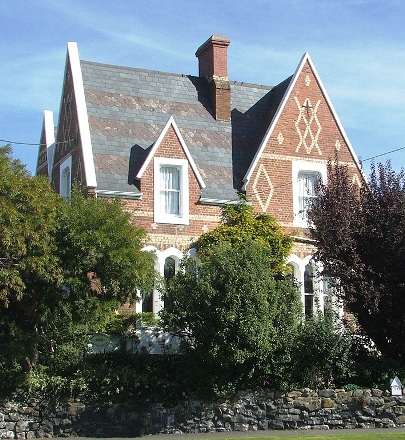
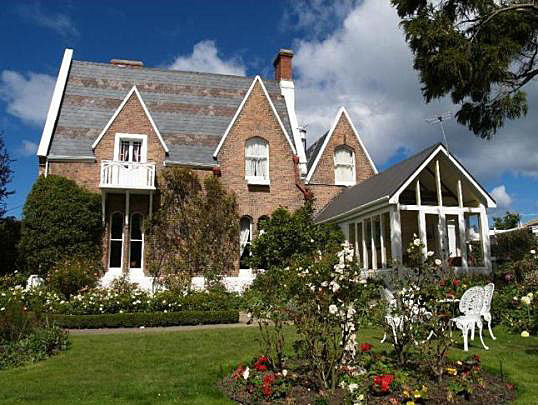
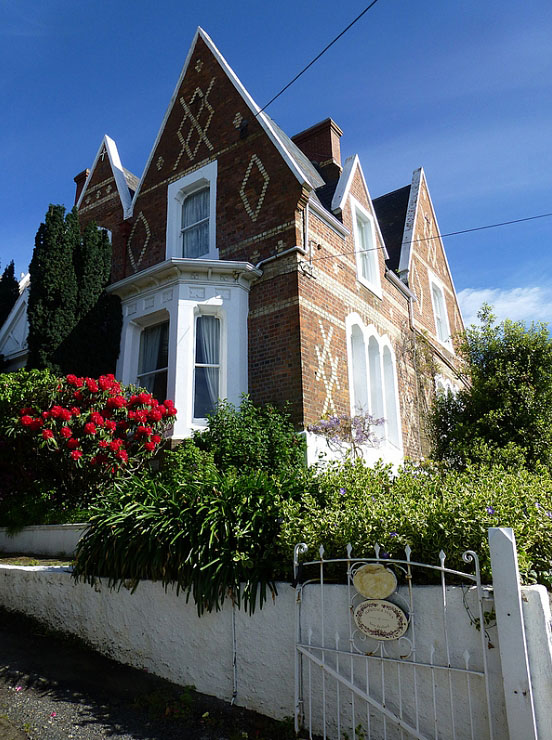
Lisburn House was named for the Fulton home near Belfast in Ireland. The one and a half storey house is brick with a slate roof. Polychromatic brickwork has been used to make patterns on the exterior walls and it has a number of steep gables. Inside, the entrance hall has marble floors with a winding staircase and the original oval fireplace. Architect and historian John Stacpoole describes Lisburn House as a ‘finely proportioned house with gabled roofs and restrained decorative patterns in its mellow brick walls.’
Lisburn House seems to have been let from around the 1880s. After James’ death in 1891, and Francis’ departure for Napier in 1892, the house was let again. The Fultons sold the property in 1903 to Agnes Story, and she and her husband George lived there until his death in 1930. The house was tenanted again in the 1930s. After Agnes’ death in 1944, the land around Lisburn House was subdivided for residential development on newly formed Lisburn Avenue. Although the house lost its generous garden, its striking design means it remains a landmark in Caversham, clearly visible from the Southern Motorway.
Lisburn House remained a private residence for much of the twentieth century. Since the 1990s, it has provided bed and breakfast accommodation. In 2000, Lisburn House became home to a boutique restaurant and luxury bed and breakfast, and it remains so in 2014.
List Entry Information
Status
Listed
List Entry Status
Historic Place Category 1
Access
Private/No Public Access
List Number
2192
Date Entered
27th July 1988
Date of Effect
27th July 1988
City/District Council
Dunedin City
Region
Otago Region
Extent of List Entry
Extent includes the land described as Pt Lot 9 and Lot 10 DP 6344 (RT OT15C/691), Otago Land District and the building known as Lisburn House, thereon.
Legal description
Pt Lot 9 and Lot 10 DP 6344 (RT OT15C/691), Otago Land District
Status
Listed
List Entry Status
Historic Place Category 1
Access
Private/No Public Access
List Number
2192
Date Entered
27th July 1988
Date of Effect
27th July 1988
City/District Council
Dunedin City
Region
Otago Region
Extent of List Entry
Extent includes the land described as Pt Lot 9 and Lot 10 DP 6344 (RT OT15C/691), Otago Land District and the building known as Lisburn House, thereon.
Legal description
Pt Lot 9 and Lot 10 DP 6344 (RT OT15C/691), Otago Land District
Why is this place significant?
Historic Significance
Historical Significance or Value The Fulton family who built the house were early settlers near Outram. James and Robert Fulton were brothers who settled near Woodside in 1849 and were later joined by their brother Francis and other members of the family. Lisburn was built as a town house for the family and Francis moved in to live in it in 1865. It was also used by other members of the family when visiting Dunedin.
Physical Significance
Architectural Significance: Lisburn House is one of the finest townhouses of the 1860s in New Zealand. Most of Clayton's buildings in Dunedin have been destroyed and this is a fine example of his domestic designing. Townscape/Landmark Significance: An impressive sight among the surrounding cottages and bungalows and a minor landmark in the Caversham suburb.
Why is this place significant?
Historic Significance
Historical Significance or Value The Fulton family who built the house were early settlers near Outram. James and Robert Fulton were brothers who settled near Woodside in 1849 and were later joined by their brother Francis and other members of the family. Lisburn was built as a town house for the family and Francis moved in to live in it in 1865. It was also used by other members of the family when visiting Dunedin.
Physical Significance
Architectural Significance: Lisburn House is one of the finest townhouses of the 1860s in New Zealand. Most of Clayton's buildings in Dunedin have been destroyed and this is a fine example of his domestic designing. Townscape/Landmark Significance: An impressive sight among the surrounding cottages and bungalows and a minor landmark in the Caversham suburb.
Construction Professional
Name
Clayton, William Henry
Type
Architect
Biography
Born in Tasmania, Clayton (1823-1877) travelled to Europe with his family in 1842. He studied architecture in Brussells and was then articled to Sir John Rennie, engineer to the Admiralty, in London. He returned to Tasmania in 1848 and worked in private practice until he was appointed Government Surveyor in 1852. He resumed private practice in 1855 and was involved with surveying in the Launceston area. In 1857 he was elected an alderman on the Launceston Municipal Council. By the time Clayton immigrated to Dunedin in 1863 he had been responsible for the design of many buildings including churches, banks, a mechanics' institute, a theatre, steam and water mills, breweries, bridges, mansions and villas, in addition to being a land surveyor and road engineer. In 1864 he entered partnership with William Mason. Mason and Clayton were responsible for some important buildings in Dunedin including All Saints Church (1865) and The Exchange (former Post Office) (1865) as well as the Colonial Museum, Wellington (1865). These were two of the most prominent architects of their day in New Zealand. In 1869 Clayton became the first and only Colonial Architect and was responsible for the design of Post and Telegraph offices, courthouses, customhouses, Government department offices and ministerial residences. His acknowledged masterpiece is Government Buildings, Wellington (1876) a stone-simulated wooden building and the largest timber framed building in the Southern Hemisphere. Clayton was a prolific and highly accomplished architect both within the Public Service and in private practice, in New Zealand and Australia. See https://teara.govt.nz/en/biographies/2c20/clayton-william-henry
Name
Mason and Clayton
Type
Architectural Partnership
Biography
In 1863 William Mason took W H Clayton into partnership. Clayton had had 15 years experience, mostly in Tasmania. He was a Tasmanian by birth who had trained in Brussels and London. He stayed in Dunedin for only six years and then moved to Wellington as Colonial Architect. Buildings designed by Mason and Clayton while the latter was in Dunedin included All Saints Church, Edinburgh House, the Bank of New South Wales on Princes Street and the old Provincial Chambers on the present site of the Chief Post Office. Of these only All Saints Church remains. Clayton is also probably the architect of Lisburn House, a polychromatic brick building similar to All Saints.
Construction Details
Start Year
1865
Type
Original Construction
Start Year
1949
Type
Addition
Description
Garage erected
Construction Materials
The house is built of bricks imported from Ireland with a slate roof. Polychrome brickwork had been used to produce simple patterns on a large wall surface. Rows of fish tail slates alternate with rows of ordinary slates on the roof.
Notable Features
The decorative polychrome brickwork.
Construction Professional
Name
Clayton, William Henry
Type
Architect
Biography
Born in Tasmania, Clayton (1823-1877) travelled to Europe with his family in 1842. He studied architecture in Brussells and was then articled to Sir John Rennie, engineer to the Admiralty, in London. He returned to Tasmania in 1848 and worked in private practice until he was appointed Government Surveyor in 1852. He resumed private practice in 1855 and was involved with surveying in the Launceston area. In 1857 he was elected an alderman on the Launceston Municipal Council. By the time Clayton immigrated to Dunedin in 1863 he had been responsible for the design of many buildings including churches, banks, a mechanics' institute, a theatre, steam and water mills, breweries, bridges, mansions and villas, in addition to being a land surveyor and road engineer. In 1864 he entered partnership with William Mason. Mason and Clayton were responsible for some important buildings in Dunedin including All Saints Church (1865) and The Exchange (former Post Office) (1865) as well as the Colonial Museum, Wellington (1865). These were two of the most prominent architects of their day in New Zealand. In 1869 Clayton became the first and only Colonial Architect and was responsible for the design of Post and Telegraph offices, courthouses, customhouses, Government department offices and ministerial residences. His acknowledged masterpiece is Government Buildings, Wellington (1876) a stone-simulated wooden building and the largest timber framed building in the Southern Hemisphere. Clayton was a prolific and highly accomplished architect both within the Public Service and in private practice, in New Zealand and Australia. See https://teara.govt.nz/en/biographies/2c20/clayton-william-henry
Name
Mason and Clayton
Type
Architectural Partnership
Biography
In 1863 William Mason took W H Clayton into partnership. Clayton had had 15 years experience, mostly in Tasmania. He was a Tasmanian by birth who had trained in Brussels and London. He stayed in Dunedin for only six years and then moved to Wellington as Colonial Architect. Buildings designed by Mason and Clayton while the latter was in Dunedin included All Saints Church, Edinburgh House, the Bank of New South Wales on Princes Street and the old Provincial Chambers on the present site of the Chief Post Office. Of these only All Saints Church remains. Clayton is also probably the architect of Lisburn House, a polychromatic brick building similar to All Saints.
Construction Details
Start Year
1865
Type
Original Construction
Start Year
1949
Type
Addition
Description
Garage erected
Construction Materials
The house is built of bricks imported from Ireland with a slate roof. Polychrome brickwork had been used to produce simple patterns on a large wall surface. Rows of fish tail slates alternate with rows of ordinary slates on the roof.
Notable Features
The decorative polychrome brickwork.
Lisburn House, built in the wake of the wave of wealth and development that swept through Otago with the gold rushes, reflects the prosperity of Dunedin in the 1860s. With the money came architects who were in a position to design the commercial buildings and private residences for those who made their fortunes, or who had consolidated already existing wealth. Architects – including William Mason and William Clayton – moved south, set up practices in Dunedin, and designed buildings appropriate for this now wealthy Victorian city. One such wealthy individual was James Fulton. Fulton was issued title to land in Caversham in 1887, but had occupied the eight-acre suburban section well before this date. Fulton’s main residence was ‘Ravenscliffe’, his farm at West Taieri. The Fulton family was well off and well-connected. Fulton and his brother Robert arrived in Port Chalmers aboard the Ajax in 1849. James Fulton married Catherine Valpy, daughter of William Henry Valpy, one of New Zealand’s wealthiest men. James’ mother and younger brother Francis came to Dunedin in 1852. The Fulton family formed a tight network centred around West Taieri, with Lisburn House as a city base. Architectural partnership Mason and Clayton advertised for tenders for a ‘Gentleman’s Residence (of brick) at Caversham’ in August 1864. This tender notice does not identify the client for this project, but fits the commonly reported construction dates for Lisburn House of 1864-1865. The Otago Daily Times also has a Mason and Clayton tender for stabling at Caversham in September 1864 – the stable (now demolished) was a notable outbuilding at Lisburn House. There are also advertisements for plastering, and for fittings for ‘Mr Fulton’s house’ in November 1864. It seems that the house was ready to be lived in by December 1865 when Francis Fulton’s man was ‘away to town with bags of oats, two bedsteads, mattrass [sic], pillow, wash hand stand table, chest of drawers, blankets & c.’ The house became known as Lisburn House, named for the Fulton home near Belfast in Ireland. The one and a half storey house is brick with a slate roof. Polychromatic brickwork has been used to make patterns on the walls. It has a number of steep gables and its distinctive design makes it a landmark in Caversham. Inside, the entrance hall has marble floors with a winding staircase and the original oval fireplace. Architect and historian John Stacpoole describes Lisburn House as a ‘finely proportioned house with gabled roofs and restrained decorative patterns in its mellow brick walls.’ Mason and Clayton had used brick for other significant buildings including All Saints Church (1864) – notable for its decorative brick work, Edinburgh House, and the Provincial Council Chambers (both 1865, the council chambers have since been demolished). Lisburn House, like All Saints, is notable for its polychromatic brick decoration, similar to Clayton’s design for All Saints. Although the land was owned by James, it was Francis Fulton who lived in Lisburn House. Francis Fulton farmed at West Taieri before moving into Dunedin where he started a commission agency business on his own account, and later in partnership with James Webb. After that partnership was dissolved, he went out on his own again, and acted as local manager for the Land and Loan Company of New Zealand. He moved to Napier in about 1892. The Fulton family had let Lisburn House by the late 1880s, an ‘E.Pettit’ is reported as allowing the grounds at Lisburn to be used for a fundraising garden party for nearby St Peter’s Anglican Church, in 1888. James Fulton died in 1891. Soon after Francis left in 1892, Lisburn House was advertised for let. The advertisement described the house (‘formerly the residence of Mr Francis Fulton’) as having ‘11 lofty rooms, bathroom, gas, tennis lawn, orchard, flower garden, stables.’ The ‘To Let’ advertisements appear in the paper throughout 1892 and 1893. It is likely that the property remained tenanted, as in 1901, Lisburn House was again advertised to let with ‘gas and water laid on, high-pressure boiler etc; 10 rooms.’ In 1903, the Fulton family sold Lisburn House to Agnes Boyd Story, wife of Dunedin merchant George Robert Story. George Story died at Lisburn House (104 South Road, Caversham) in December 1930. In 1931, a portion of the land facing South Road was subdivided into residential sections. The subdivision plan shows Lisburn House and its associated outbuildings – the stable, garage and glasshouse, as well as other unidentified sheds. After George’s death, Mrs Maisie Thompson (nee Denford) rented the house until 1944. Agnes Story (who had built another residence further up the hill in 1929), later shifted to Australia, where she died in 1944. Soon after Agnes’ death, the land around Lisburn House was subdivided, creating Lisburn Avenue and its close cluster of residences. Lisburn House remained a private residence for much of the twentieth century. Since the 1990s, Lisburn House has provided bed and breakfast accommodation. In 2000, Lisburn House became home to a boutique restaurant and luxury bed and breakfast, and it remains so in 2014.
Lisburn House, built in the wake of the wave of wealth and development that swept through Otago with the gold rushes, reflects the prosperity of Dunedin in the 1860s. With the money came architects who were in a position to design the commercial buildings and private residences for those who made their fortunes, or who had consolidated already existing wealth. Architects – including William Mason and William Clayton – moved south, set up practices in Dunedin, and designed buildings appropriate for this now wealthy Victorian city. One such wealthy individual was James Fulton. Fulton was issued title to land in Caversham in 1887, but had occupied the eight-acre suburban section well before this date. Fulton’s main residence was ‘Ravenscliffe’, his farm at West Taieri. The Fulton family was well off and well-connected. Fulton and his brother Robert arrived in Port Chalmers aboard the Ajax in 1849. James Fulton married Catherine Valpy, daughter of William Henry Valpy, one of New Zealand’s wealthiest men. James’ mother and younger brother Francis came to Dunedin in 1852. The Fulton family formed a tight network centred around West Taieri, with Lisburn House as a city base. Architectural partnership Mason and Clayton advertised for tenders for a ‘Gentleman’s Residence (of brick) at Caversham’ in August 1864. This tender notice does not identify the client for this project, but fits the commonly reported construction dates for Lisburn House of 1864-1865. The Otago Daily Times also has a Mason and Clayton tender for stabling at Caversham in September 1864 – the stable (now demolished) was a notable outbuilding at Lisburn House. There are also advertisements for plastering, and for fittings for ‘Mr Fulton’s house’ in November 1864. It seems that the house was ready to be lived in by December 1865 when Francis Fulton’s man was ‘away to town with bags of oats, two bedsteads, mattrass [sic], pillow, wash hand stand table, chest of drawers, blankets & c.’ The house became known as Lisburn House, named for the Fulton home near Belfast in Ireland. The one and a half storey house is brick with a slate roof. Polychromatic brickwork has been used to make patterns on the walls. It has a number of steep gables and its distinctive design makes it a landmark in Caversham. Inside, the entrance hall has marble floors with a winding staircase and the original oval fireplace. Architect and historian John Stacpoole describes Lisburn House as a ‘finely proportioned house with gabled roofs and restrained decorative patterns in its mellow brick walls.’ Mason and Clayton had used brick for other significant buildings including All Saints Church (1864) – notable for its decorative brick work, Edinburgh House, and the Provincial Council Chambers (both 1865, the council chambers have since been demolished). Lisburn House, like All Saints, is notable for its polychromatic brick decoration, similar to Clayton’s design for All Saints. Although the land was owned by James, it was Francis Fulton who lived in Lisburn House. Francis Fulton farmed at West Taieri before moving into Dunedin where he started a commission agency business on his own account, and later in partnership with James Webb. After that partnership was dissolved, he went out on his own again, and acted as local manager for the Land and Loan Company of New Zealand. He moved to Napier in about 1892. The Fulton family had let Lisburn House by the late 1880s, an ‘E.Pettit’ is reported as allowing the grounds at Lisburn to be used for a fundraising garden party for nearby St Peter’s Anglican Church, in 1888. James Fulton died in 1891. Soon after Francis left in 1892, Lisburn House was advertised for let. The advertisement described the house (‘formerly the residence of Mr Francis Fulton’) as having ‘11 lofty rooms, bathroom, gas, tennis lawn, orchard, flower garden, stables.’ The ‘To Let’ advertisements appear in the paper throughout 1892 and 1893. It is likely that the property remained tenanted, as in 1901, Lisburn House was again advertised to let with ‘gas and water laid on, high-pressure boiler etc; 10 rooms.’ In 1903, the Fulton family sold Lisburn House to Agnes Boyd Story, wife of Dunedin merchant George Robert Story. George Story died at Lisburn House (104 South Road, Caversham) in December 1930. In 1931, a portion of the land facing South Road was subdivided into residential sections. The subdivision plan shows Lisburn House and its associated outbuildings – the stable, garage and glasshouse, as well as other unidentified sheds. After George’s death, Mrs Maisie Thompson (nee Denford) rented the house until 1944. Agnes Story (who had built another residence further up the hill in 1929), later shifted to Australia, where she died in 1944. Soon after Agnes’ death, the land around Lisburn House was subdivided, creating Lisburn Avenue and its close cluster of residences. Lisburn House remained a private residence for much of the twentieth century. Since the 1990s, Lisburn House has provided bed and breakfast accommodation. In 2000, Lisburn House became home to a boutique restaurant and luxury bed and breakfast, and it remains so in 2014.
Architectural Description (Style): The house is one and a half storied but the high peaked gables at about 60 degrees give it the height of a two-storied house. The high peaks and multiple gables give it a gothic appearance. Modifications: The exterior is unaltered except that at an early stage an extra dormer window was added to the upper storey on the east side. Inside two fireplace surrounds were removed, but similar surrounds have been replaces by recent owners. Otherwise the interior is relatively unmodified.
Architectural Description (Style): The house is one and a half storied but the high peaked gables at about 60 degrees give it the height of a two-storied house. The high peaks and multiple gables give it a gothic appearance. Modifications: The exterior is unaltered except that at an early stage an extra dormer window was added to the upper storey on the east side. Inside two fireplace surrounds were removed, but similar surrounds have been replaces by recent owners. Otherwise the interior is relatively unmodified.
Historical and Associated Iwi / Hapū / Whānau
Public NZAA Number
I44/1065
Completion Date
17th October 2014
Report Written By
Heather Bauchop
Information Sources
Galer, 1981
L. Galer, Houses and Homes, Allied Press, Dunedin, 1981
Galer, L., 1995
Lois Galer, Houses of Dunedin: An illustrated collection of the city's historic homes, Hyndman Publishing, Dunedin, 1995
Shaw, 1949
Margaret Shaw and Edgar D. Farrant, The Taieri Plain: Tales of the Years that are Gone, Otago Centennial Historical Publications, Dunedin, 1949
Stacpoole, 1976
John Stacpoole, Colonial Architecture in New Zealand, Wellington, 1976
Thomson, 1998
Jane Thomson, (ed)., Southern People: A Dictionary of Otago Southland Biography, Dunedin: Longacre Press/Dunedin City Council, 1998.
Porter, 1983
Frances Porter (ed), Historic Buildings of Dunedin, South Island, Methuen, Auckland, 1983.
Other Information
This historic place was registered under the Historic Places Act 1980. This report includes the text from the original Building Classification Committee report considered by the NZHPT Board at the time of registration. A fully referenced upgrade report is available on request fromthe Otago/Southland Area Office of Heritage New Zealand Please note that entry on the New Zealand Heritage List/Rarangi Korero identifies only the heritage values of the property concerned, and should not be construed as advice on the state of the property, or as a comment of its soundness or safety, including in regard to earthquake risk, safety in the event of fire, or insanitary conditions.
Historical and Associated Iwi / Hapū / Whānau
Public NZAA Number
I44/1065
Completion Date
17th October 2014
Report Written By
Heather Bauchop
Information Sources
Galer, 1981
L. Galer, Houses and Homes, Allied Press, Dunedin, 1981
Galer, L., 1995
Lois Galer, Houses of Dunedin: An illustrated collection of the city's historic homes, Hyndman Publishing, Dunedin, 1995
Shaw, 1949
Margaret Shaw and Edgar D. Farrant, The Taieri Plain: Tales of the Years that are Gone, Otago Centennial Historical Publications, Dunedin, 1949
Stacpoole, 1976
John Stacpoole, Colonial Architecture in New Zealand, Wellington, 1976
Thomson, 1998
Jane Thomson, (ed)., Southern People: A Dictionary of Otago Southland Biography, Dunedin: Longacre Press/Dunedin City Council, 1998.
Porter, 1983
Frances Porter (ed), Historic Buildings of Dunedin, South Island, Methuen, Auckland, 1983.
Other Information
This historic place was registered under the Historic Places Act 1980. This report includes the text from the original Building Classification Committee report considered by the NZHPT Board at the time of registration. A fully referenced upgrade report is available on request fromthe Otago/Southland Area Office of Heritage New Zealand Please note that entry on the New Zealand Heritage List/Rarangi Korero identifies only the heritage values of the property concerned, and should not be construed as advice on the state of the property, or as a comment of its soundness or safety, including in regard to earthquake risk, safety in the event of fire, or insanitary conditions.
Current Usages
Uses: Accommodation
Specific Usage: Boarding/ Guest House
Uses: Accommodation
Specific Usage: House
Uses: Trade
Specific Usage: Restaurant/cafe/tearoom
Web Links
description:
url: http://www.lisburnhouse.co.nz/www.lisburnhouse.co.nz/home.html
Current Usages
Uses: Accommodation
Specific Usage: Boarding/ Guest House
Uses: Accommodation
Specific Usage: House
Uses: Trade
Specific Usage: Restaurant/cafe/tearoom
Web Links
description:
url: http://www.lisburnhouse.co.nz/www.lisburnhouse.co.nz/home.html
Location
Sign up to hear more
Get the latest heritage news, features and events delivered
straight to your inbox.
