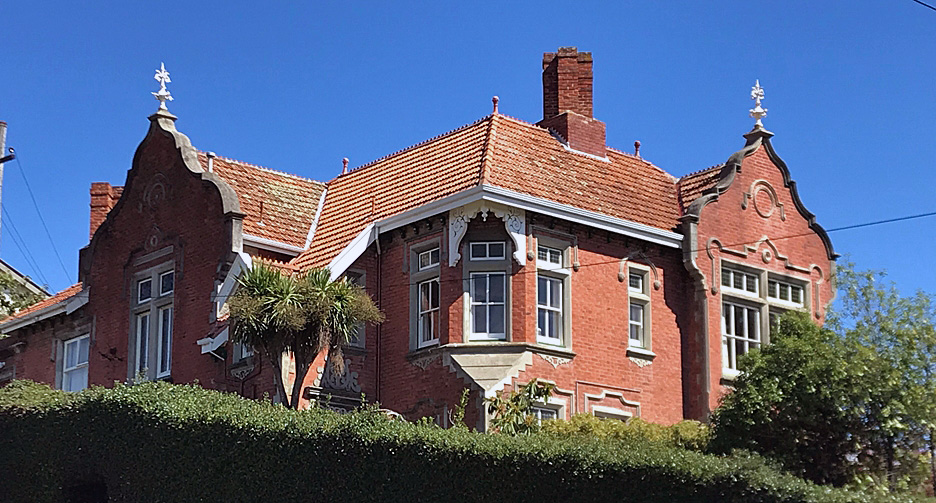
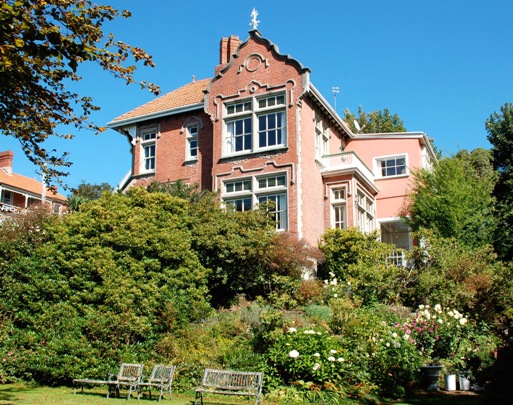
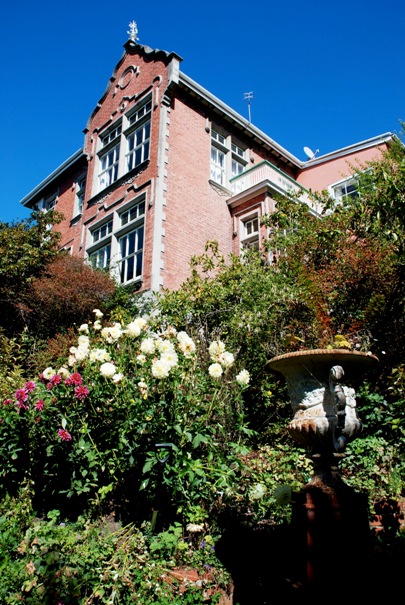
Moata, an ornamental red brick two–storied house at 434 High Street in Dunedin, was built in 1900 for local businessman Leslie Wolford Harris (1873-1950). It is historically significant as the home of Harris, part of the Bing Harris business empire, and because of its unusual Flemish facades which are prominent in the streetscape of High Street, a thoroughfare that is a continual reminder of the most fashionable place to reside in 19th century Dunedin.
In 1900 Harris bought a large block of land in High Street. Architect James Louis Salmond (1868-1950) designed the house and in April 1900, advertised for tenders for the purchase and removal of the existing house on the site. The following month Salmond advertised for tenders to build the Harris home. Crawford & Watson were the successful tenderers. The house was finished at a cost of £2,500 and the family were in residence by 1901. Leslie was involved in the long-lived family business, Bing, Harris and Co. His father, Woolf Harris (1834-1926), was one of only five Jewish businessmen living in Dunedin prior to the discovery of gold in 1861.
Constructed of tuck-pointed red brick with decorative plaster, with a marseilles tiled roof, the street facing elevations of Moata feature two Flemish gables topped by decorative ironwork. The first-floor corner has been cut back at a 45-degree angle to the hipped roof which overhangs it. This portion of roof is supported by heavy decorative eaves, profiled with a tear-drop moulding at the corner. Architectural commentator Hardwicke Knight described the house as comparable to ‘Olveston’ in expressing the ‘influence of the fashionable residential architecture in England at the turn of the century’. The windows are simply treated with occasional lead-lighting or stained-glass work. Knight makes particular note of the picturesque stairwell window, characteristic of the art nouveau period. Depicting long stemmed flowers with unfolded buds, this window was designed to allow light in through a restrained colour palette. The effect would have created a light and airy transition between floors in the house by way of the sweeping staircase accessed from the large foyer. Original fixtures and fittings included a black and white marble-tiled floor in the foyer, highly decorative zinc and plaster moulded ceilings and leaded doors. The Harris family were an influential and generous family who often entertained; their home was part of the thriving social scene of Dunedin’s elite. Parties were a regular event, sometimes involving bridge tournaments. During the Harris residency the house was known as ‘Delmonte’.
In 1913 the family left for London and Delmonte was rented to Sir Henry Lindo Ferguson, an early Dean of the Otago Medical School. In 1920 the Harris family sold to James Milne (1868-1956), a partner in Milne and Bremner Ltd, wholesale wine, spirit and grocery merchants. It was the Milnes who bestowed the name ‘Moata’, meaning morning sun. In 1922, Milne contracted Mason and Wales to design a garage which was influenced by the Flemish style of the gable ends of the house. The Milnes remained at Moata until their deaths in 1956. Since then the house has passed through various hands, including local architect Kingston Knight Sedgefield. A 1957 a roughcast addition to the house was constructed by Thompson & Ogg and contained a sunroom on the ground floor with a bedroom above. The former servants’ wing was converted into a self-contained flat, and the side porch was extended and glassed in. in 2019 Moata remains an outstanding part of the High Street streetscape.
In 1900 Harris bought a large block of land in High Street. Architect James Louis Salmond (1868-1950) designed the house and in April 1900, advertised for tenders for the purchase and removal of the existing house on the site. The following month Salmond advertised for tenders to build the Harris home. Crawford & Watson were the successful tenderers. The house was finished at a cost of £2,500 and the family were in residence by 1901. Leslie was involved in the long-lived family business, Bing, Harris and Co. His father, Woolf Harris (1834-1926), was one of only five Jewish businessmen living in Dunedin prior to the discovery of gold in 1861.
Constructed of tuck-pointed red brick with decorative plaster, with a marseilles tiled roof, the street facing elevations of Moata feature two Flemish gables topped by decorative ironwork. The first-floor corner has been cut back at a 45-degree angle to the hipped roof which overhangs it. This portion of roof is supported by heavy decorative eaves, profiled with a tear-drop moulding at the corner. Architectural commentator Hardwicke Knight described the house as comparable to ‘Olveston’ in expressing the ‘influence of the fashionable residential architecture in England at the turn of the century’. The windows are simply treated with occasional lead-lighting or stained-glass work. Knight makes particular note of the picturesque stairwell window, characteristic of the art nouveau period. Depicting long stemmed flowers with unfolded buds, this window was designed to allow light in through a restrained colour palette. The effect would have created a light and airy transition between floors in the house by way of the sweeping staircase accessed from the large foyer. Original fixtures and fittings included a black and white marble-tiled floor in the foyer, highly decorative zinc and plaster moulded ceilings and leaded doors. The Harris family were an influential and generous family who often entertained; their home was part of the thriving social scene of Dunedin’s elite. Parties were a regular event, sometimes involving bridge tournaments. During the Harris residency the house was known as ‘Delmonte’.
In 1913 the family left for London and Delmonte was rented to Sir Henry Lindo Ferguson, an early Dean of the Otago Medical School. In 1920 the Harris family sold to James Milne (1868-1956), a partner in Milne and Bremner Ltd, wholesale wine, spirit and grocery merchants. It was the Milnes who bestowed the name ‘Moata’, meaning morning sun. In 1922, Milne contracted Mason and Wales to design a garage which was influenced by the Flemish style of the gable ends of the house. The Milnes remained at Moata until their deaths in 1956. Since then the house has passed through various hands, including local architect Kingston Knight Sedgefield. A 1957 a roughcast addition to the house was constructed by Thompson & Ogg and contained a sunroom on the ground floor with a bedroom above. The former servants’ wing was converted into a self-contained flat, and the side porch was extended and glassed in. in 2019 Moata remains an outstanding part of the High Street streetscape.