

The area around the Octagon was traditionally known to Kai Tahu as Otēpoti. The hapū Kai Te Pahi, Kāti Moki, and Kāti Taoka still maintain their presence and responsibility as kaitiaki in this region. In 1848 the First Church Settlement arrived in Dunedin led by Captain William Cargill and Rev. Thomas Burns (Burns’ nephew). Robert Burns (1759-1796) wrote his verses in the Scots dialect and came to epitomise Scot’s nationalism; statues of Burns are common wherever Scots have emigrated. The inspiration for Dunedin’s Burns statue were fuelled after a call for local subscriptions to support a monument in Kilmarnock. James Gordon Stuart Grant (1832-1902) was the brains behind the Dunedin campaign.
The local statue was mooted at a meeting of the Ayrshire Association in 1881. A public meeting held in the Athenaeum followed, and the Robert Burns Statue Committee was established and charged with raising funds. In April 1883 the committee authorised Sir John Steell, renowned Scottish sculptor, to proceed with the commission based on his London sculpture; it was completed that year. In March 1887 the foundation stone was laid amongst great fanfare, a procession and a crowd over 7000 people. A rare mystical Masonic ceremony was performed, and the stone was laid over a collection of coins and papers, the list of subscribers, and a document signed by members of the Burns Statue Committee.
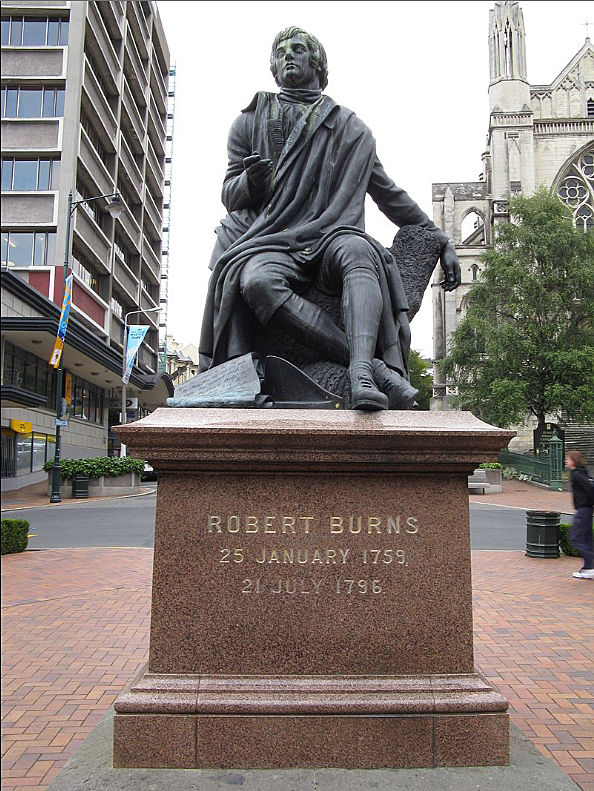
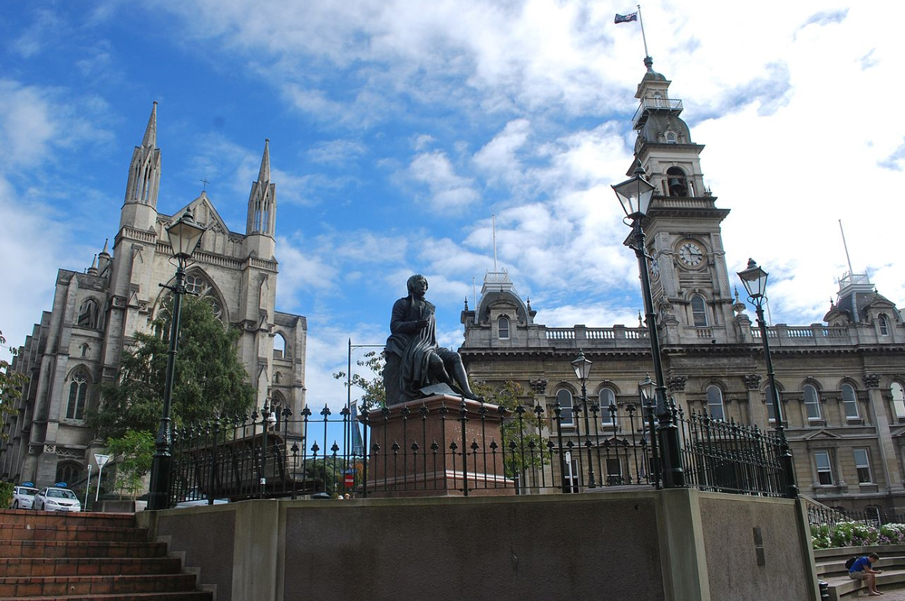
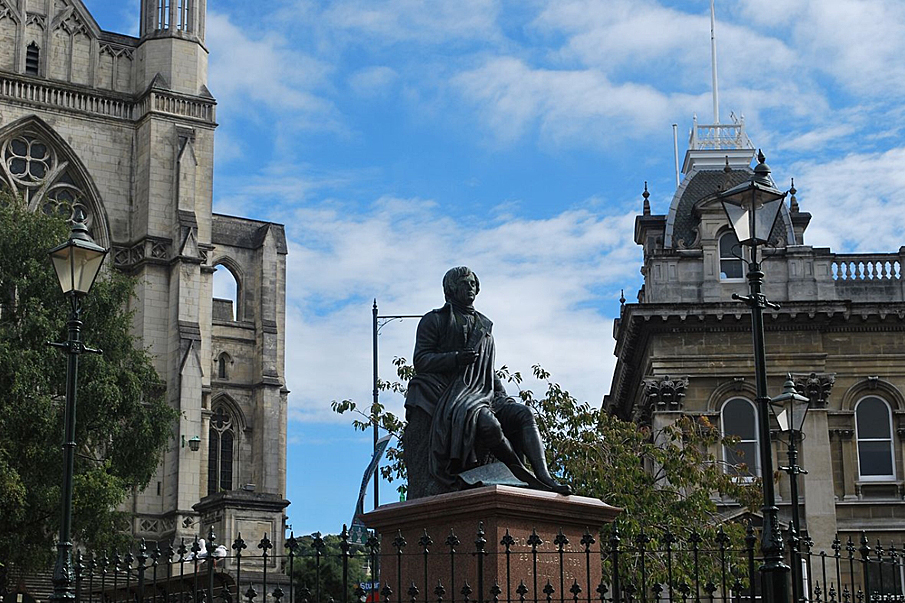
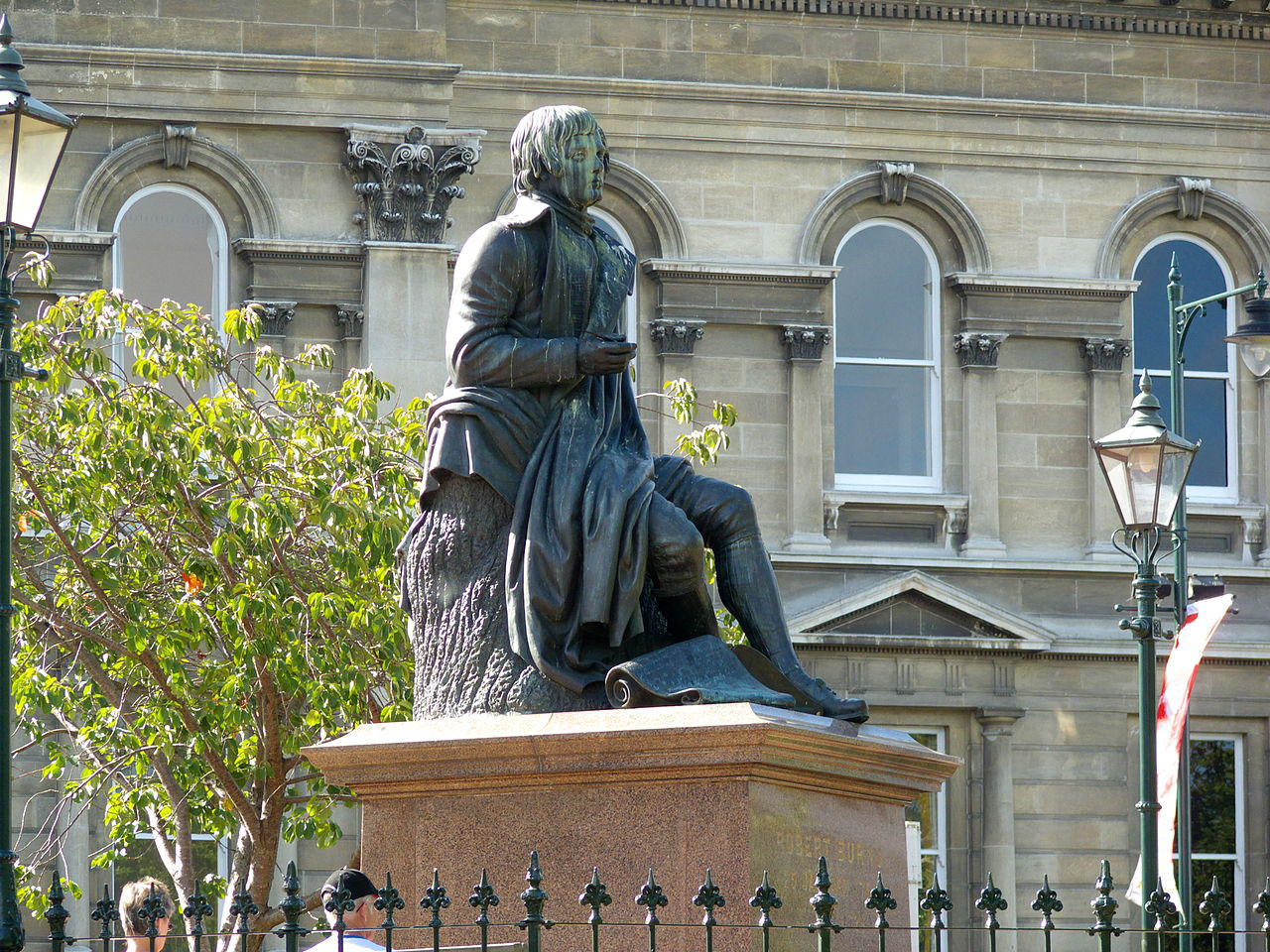
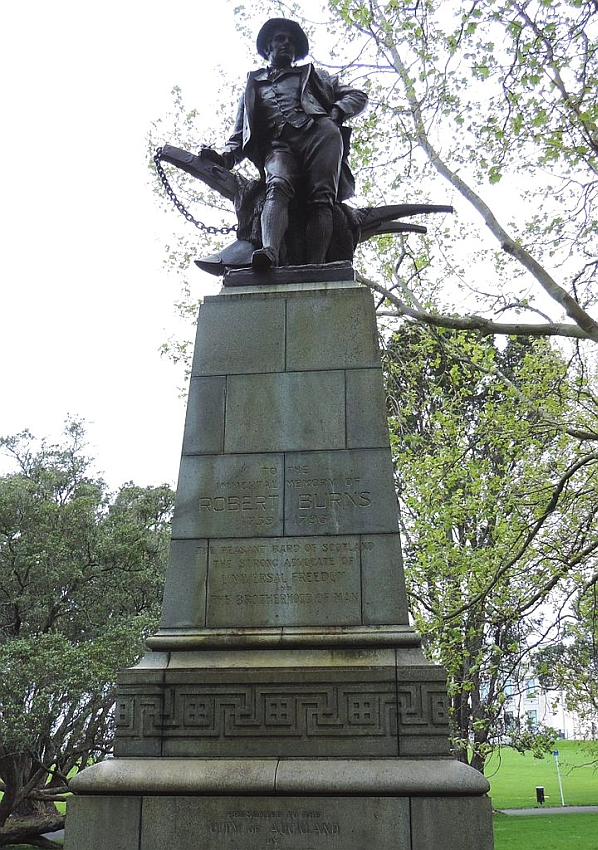
Sir John Steell of Edinburgh cast the statue using the lost wax method, and Mr George Munro, a local contractor, built the base. Sir John Steell was a notable sculptor of the period and cast several similar statues of Burns in New York, Dundee and London. The statue was unveiled the following month, again with great pomp, and witnessed by a crowd of over 6000 people. Miss Burns, great grandniece of Robert Burns, unveiled the statue and Premier Sir George Grey (1812-1898) followed with an address. The statue stands 9 ft high (2.7 m), the base made of Peterhead granite is 9 ft 3 in (2.8 m) by 8 ft 3 in (2.5 m) by 9 ft (2.7 m) high. The sub-base is Port Chalmers bluestone which protrudes 2 ft (0.6 m) above the ground. There is an inscription in gold lettering on the east elevation of the base. Typically realistic and noble, as favoured in the Victorian period, Burns is shown seated, ankles crossed, on the forked stump of an elm beside a plough-shoe and an open scroll displaying the poem, To Mary in Heaven. . He is dressed in coat, breeches and hose and is draped in his plaid. His left arm rests on a stump while his right hand holds a quill. Burns’ head is turned to his right, and he appears to gaze thoughtfully into the distance, mid composition.
The statue has seen many changes in its surroundings. Notably, Alexander McMillan, patron of the Dunedin Burns Club (established in 1861), funded a terrace around the statue in 1967 which rebuilt in 1989. This reduced the height of the sub-base. An extensive conservation project in 2000 saw $19,000 spent on cleaning and repairing the statue. This drew a crowd of over 500 people when it was unveiled. Burns’ legacy is tied to the beginnings of the Dunedin settlement; the first Burns supper was held in January 1855, a tradition still maintained. He was also the inspiration for the University of Otago’s Burns Fellowship. Today the statue remains a strong symbol in Dunedin, at times the subject of protest, but always a focus around UNESCO City of Literature events. Burns is surrounded by plaques dedicated to literary luminaries with ties to Dunedin. Of the more than 50 statues to Burns around the world, Dunedin’s is one of the few commanding such a focal point in the heart of its city. At time of writing, a poem by David Eggleton (1952-) current Poet Laureate, is stencilled in spray paint on the road behind the statue,
‘For Robbie Burns
in bronze plucks a quill
from a passing gull,
and writes on air words
in praise of Octagon
hip-hop.’
List Entry Information
Status
Listed
List Entry Status
Historic Place Category 1
Access
Able to Visit
List Number
2208
Date Entered
27th July 1988
Date of Effect
27th July 1988
City/District Council
Dunedin City
Region
Otago Region
Extent of List Entry
Extent includes part of the land described as Sec 1 Reserve No 2 Town of Dunedin (RT OTB1/144, NZ Gazette 1987, p. 291), Otago Land District and the structure known as the Robert Burns statue, thereon.
Legal description
Sec 1 Reserve No 2 Town of Dunedin (RT OTB1/144, NZ Gazette 1987, p. 291), Otago Land District.
Status
Listed
List Entry Status
Historic Place Category 1
Access
Able to Visit
List Number
2208
Date Entered
27th July 1988
Date of Effect
27th July 1988
City/District Council
Dunedin City
Region
Otago Region
Extent of List Entry
Extent includes part of the land described as Sec 1 Reserve No 2 Town of Dunedin (RT OTB1/144, NZ Gazette 1987, p. 291), Otago Land District and the structure known as the Robert Burns statue, thereon.
Legal description
Sec 1 Reserve No 2 Town of Dunedin (RT OTB1/144, NZ Gazette 1987, p. 291), Otago Land District.
Why is this place significant?
Historic Significance
Historical Significance or Value Robert Burns (1759 - 1796) wrote his verses in the Scots dialect and came to epitomise the nationalism of the Scots, particularly abroad. The Reverend Thomas Burns, a leading figure in the founding of Otago, was a nephew of the poet, but the impetus of funding the statue came from the local Burns Club as a gesture of national pride. Statues of Burns are internationally common, wherever Scots have emigrated. In Dunedin a Burns supper was held in 1855 and has continued as an annual event on the anniversary of the poet's birthday. During the process of fund-raising in Dunedin in the 1870s there were some protests because of the poet's reputation for having written bawdy verses, but local Burn's supporters prevailed. After some discussion about whether or not to place the statue in front of the railway station, a site in the Octagon was granted by the city and the statue was presented to the Mayor and Corporation of Dunedin on 24 May 1887.
Physical Significance
Architectural Significance: Of the four statues made of Robert Burns, the first is in Central Park, New York; the second in Dundee, Scotland; and the third on the Thames Embankment, London. The Dunedin statue is the fourth of the group that Steel produced and most closely resembles the London statue. Townscape/Landmark Significance: It is a major landmark in the upper part of the Octagon and forms a background to many speakers who address people in the Octagon from the edge of the McMillan terrace.
Why is this place significant?
Historic Significance
Historical Significance or Value Robert Burns (1759 - 1796) wrote his verses in the Scots dialect and came to epitomise the nationalism of the Scots, particularly abroad. The Reverend Thomas Burns, a leading figure in the founding of Otago, was a nephew of the poet, but the impetus of funding the statue came from the local Burns Club as a gesture of national pride. Statues of Burns are internationally common, wherever Scots have emigrated. In Dunedin a Burns supper was held in 1855 and has continued as an annual event on the anniversary of the poet's birthday. During the process of fund-raising in Dunedin in the 1870s there were some protests because of the poet's reputation for having written bawdy verses, but local Burn's supporters prevailed. After some discussion about whether or not to place the statue in front of the railway station, a site in the Octagon was granted by the city and the statue was presented to the Mayor and Corporation of Dunedin on 24 May 1887.
Physical Significance
Architectural Significance: Of the four statues made of Robert Burns, the first is in Central Park, New York; the second in Dundee, Scotland; and the third on the Thames Embankment, London. The Dunedin statue is the fourth of the group that Steel produced and most closely resembles the London statue. Townscape/Landmark Significance: It is a major landmark in the upper part of the Octagon and forms a background to many speakers who address people in the Octagon from the edge of the McMillan terrace.
Construction Professional
Name
Munro, George
Type
Sculptor
Biography
Born in Perthshire, Scotland, Munro emigrated to New Zealand with his wife Mary and two children on the Silistra in 1862. Munro was a sculptor and was a monumental mason with a large business on Moray Place in Dunedin, opposite First Church. A member of the Caversham Borough Council, he was elected to the Dunedin City Council in 1883 and was an enthusiastic sportsman. Munro’s work includes the ornate stone façade of Wains Hotel (List No. 2236) and the Peterhead granite base on which the Robert Burns Statue sits. Work from Munro’s premises can be seen from “the Bluff to the Bay of Islands”.
Name
Sir John Robert Steell, RSA (1804-1891)
Type
Sculptor
Biography
Born in Aberdeen but raised in Edinburgh, Steell was the most respected sculptor of his generation and developed an international reputation modelling many of the leading figures of Scottish history and culture. Steell studied at the Trustee’s Academy and after completing his apprenticeship in 1827 he went into business with his father, also an artist. He completed further study at the Edinburgh Life Academy, studied in Rome, and began to take on commissions. He was in great demand and able to deliver the popular neo-classical style while staying abreast of metropolitan trends. Steell was designated Sculptor in Ordinary to Her Majesty for Scotland by Queen Victoria in 1838. “He was a brilliant portraitist, whose attention to detail and use of contemporary dress make him a major precursor of later 19th-century realism.” Steell was responsible for several monuments to Burns including those in Central Park, New York (1871), Dundee (1880), the Embankment in London (1884) and a bust of Burns in Westminster Abbey, London (1885) and Dunedin (1887).
Construction Details
Start Year
1887
Type
Original Construction
Start Year
1883
Type
Designed
Start Year
1967
Type
Addition
Description
McMillan Terrace added and plaque installed
Start Year
1989
Type
Refurbishment/renovation
Description
McMillan terrace replaced and plaque installed
Start Year
2000
Type
Restoration
Description
conservation project cleaning, repairs, quill replaced
Start Year
2008
Type
Addition
Description
Plaque commemorating 50th anniversary of Burns Fellowship
Start Year
2011
Type
Addition
Description
Plaque added by the Dunedin Burns Club
Construction Materials
The plinth is Port Chalmers breccia, about 50cm high, supporting a pedestal of polished brown Peterhead granite, 2.75 metres high. The statue is well weathered bronze. Burns is shown seated on a tree stump with his left arm resting on another convenient stump and his right hand holding a pencil. He is gazing into the distance as if composing and there is an open scroll by his right foot, which is partly tucked back under him. He has a plaid over one shoulder and across his knees. A small stone terrace below the statue was added recently, provided by Alex McMillan, patron of the Dunedin Burns Club.
Notable Features
Its landmark quality and association with the pedestrian centre of Dunedin.
Construction Professional
Name
Munro, George
Type
Sculptor
Biography
Born in Perthshire, Scotland, Munro emigrated to New Zealand with his wife Mary and two children on the Silistra in 1862. Munro was a sculptor and was a monumental mason with a large business on Moray Place in Dunedin, opposite First Church. A member of the Caversham Borough Council, he was elected to the Dunedin City Council in 1883 and was an enthusiastic sportsman. Munro’s work includes the ornate stone façade of Wains Hotel (List No. 2236) and the Peterhead granite base on which the Robert Burns Statue sits. Work from Munro’s premises can be seen from “the Bluff to the Bay of Islands”.
Name
Sir John Robert Steell, RSA (1804-1891)
Type
Sculptor
Biography
Born in Aberdeen but raised in Edinburgh, Steell was the most respected sculptor of his generation and developed an international reputation modelling many of the leading figures of Scottish history and culture. Steell studied at the Trustee’s Academy and after completing his apprenticeship in 1827 he went into business with his father, also an artist. He completed further study at the Edinburgh Life Academy, studied in Rome, and began to take on commissions. He was in great demand and able to deliver the popular neo-classical style while staying abreast of metropolitan trends. Steell was designated Sculptor in Ordinary to Her Majesty for Scotland by Queen Victoria in 1838. “He was a brilliant portraitist, whose attention to detail and use of contemporary dress make him a major precursor of later 19th-century realism.” Steell was responsible for several monuments to Burns including those in Central Park, New York (1871), Dundee (1880), the Embankment in London (1884) and a bust of Burns in Westminster Abbey, London (1885) and Dunedin (1887).
Construction Details
Start Year
1887
Type
Original Construction
Start Year
1883
Type
Designed
Start Year
1967
Type
Addition
Description
McMillan Terrace added and plaque installed
Start Year
1989
Type
Refurbishment/renovation
Description
McMillan terrace replaced and plaque installed
Start Year
2000
Type
Restoration
Description
conservation project cleaning, repairs, quill replaced
Start Year
2008
Type
Addition
Description
Plaque commemorating 50th anniversary of Burns Fellowship
Start Year
2011
Type
Addition
Description
Plaque added by the Dunedin Burns Club
Construction Materials
The plinth is Port Chalmers breccia, about 50cm high, supporting a pedestal of polished brown Peterhead granite, 2.75 metres high. The statue is well weathered bronze. Burns is shown seated on a tree stump with his left arm resting on another convenient stump and his right hand holding a pencil. He is gazing into the distance as if composing and there is an open scroll by his right foot, which is partly tucked back under him. He has a plaid over one shoulder and across his knees. A small stone terrace below the statue was added recently, provided by Alex McMillan, patron of the Dunedin Burns Club.
Notable Features
Its landmark quality and association with the pedestrian centre of Dunedin.
Architect/Engineer/Designer: Sir John Steel of Edinburgh cast the statue, and Mr Munro, a local contractor, built the base. Significance of Architect/Engineer/ Designer: Sir John Steel was a notable sculptor of the period and cast four almost identical statues of Burns with slight changes to the modelling of the head, legs and right hand. ARCHTECTURAL Description (Style): The style is typically realistic and noble as favoured in the Victorian period and is akin to the style of the two statues in Queens Gardens. Burns is however sitting in a more relaxed position.
Architect/Engineer/Designer: Sir John Steel of Edinburgh cast the statue, and Mr Munro, a local contractor, built the base. Significance of Architect/Engineer/ Designer: Sir John Steel was a notable sculptor of the period and cast four almost identical statues of Burns with slight changes to the modelling of the head, legs and right hand. ARCHTECTURAL Description (Style): The style is typically realistic and noble as favoured in the Victorian period and is akin to the style of the two statues in Queens Gardens. Burns is however sitting in a more relaxed position.
Historical and Associated Iwi / Hapū / Whānau
Completion Date
28th June 2021
Report Written By
Sarah Gallagher
Information Sources
Otago Daily Times
Otago Daily Times, 1 Jun 1915, p.10.
Stocker, 1999
Mark Stocker, '"This beautiful statue of thee, Immortal Bard of Ayr': Sir John Steell's statue of Robert Burns in Dunedin", Bulletin of New Zealand Art History, 1999.
Lieuallen, 2002
Rocco Lieuallen, A Sculptor for Scotland: The life and Work of Sir John Steell, RSA 1804-1891, PhD History of Art, The University of Edinburgh, 2002 http://hdl.handle.net/1842/4048 accessed 25 June 2021.
Gordon, 2009
Donald Gordon, Robbie: The Story of Dunedin’s Burns Statue, Avon Publishers, Dunedin, 2009.
Other Information
A fully referenced upgrade report is available on request from the Otago/Southland Area Office of Heritage New Zealand. This historic place was registered under the Historic Places Act 1980. This report includes the text from the original Building Classification Committee report considered by the NZHPT Board at the time of registration. Please note that entry on the New Zealand Heritage List/Rarangi Korero identifies only the heritage values of the property concerned, and should not be construed as advice on the state of the property, or as a comment of its soundness or safety, including in regard to earthquake risk, safety in the event of fire, or insanitary conditions.
Historical and Associated Iwi / Hapū / Whānau
Completion Date
28th June 2021
Report Written By
Sarah Gallagher
Information Sources
Otago Daily Times
Otago Daily Times, 1 Jun 1915, p.10.
Stocker, 1999
Mark Stocker, '"This beautiful statue of thee, Immortal Bard of Ayr': Sir John Steell's statue of Robert Burns in Dunedin", Bulletin of New Zealand Art History, 1999.
Lieuallen, 2002
Rocco Lieuallen, A Sculptor for Scotland: The life and Work of Sir John Steell, RSA 1804-1891, PhD History of Art, The University of Edinburgh, 2002 http://hdl.handle.net/1842/4048 accessed 25 June 2021.
Gordon, 2009
Donald Gordon, Robbie: The Story of Dunedin’s Burns Statue, Avon Publishers, Dunedin, 2009.
Other Information
A fully referenced upgrade report is available on request from the Otago/Southland Area Office of Heritage New Zealand. This historic place was registered under the Historic Places Act 1980. This report includes the text from the original Building Classification Committee report considered by the NZHPT Board at the time of registration. Please note that entry on the New Zealand Heritage List/Rarangi Korero identifies only the heritage values of the property concerned, and should not be construed as advice on the state of the property, or as a comment of its soundness or safety, including in regard to earthquake risk, safety in the event of fire, or insanitary conditions.
Current Usages
Uses: Civic Facilities
Specific Usage: Statue/public art
Uses: Commemoration
Specific Usage: Memorial - Particular person or group
Former Usages
General Usage: Civic Facilities
Specific Usage: Statue/public art
General Usage: Commemoration
Specific Usage: Memorial - Particular person or group
Web Links
description: 24 May 2009 ODT. Writer uncovers how Robbie got to the Octagon
url: https://www.odt.co.nz/lifestyle/magazine/writer-uncovers-how-robbie-got-octagon
Current Usages
Uses: Civic Facilities
Specific Usage: Statue/public art
Uses: Commemoration
Specific Usage: Memorial - Particular person or group
Former Usages
General Usage: Civic Facilities
Specific Usage: Statue/public art
General Usage: Commemoration
Specific Usage: Memorial - Particular person or group
Web Links
description: 24 May 2009 ODT. Writer uncovers how Robbie got to the Octagon
url: https://www.odt.co.nz/lifestyle/magazine/writer-uncovers-how-robbie-got-octagon
Sign up to hear more
Get the latest heritage news, features and events delivered
straight to your inbox.
