

List Entry Information
Status
Listed
List Entry Status
Historic Place Category 1
Access
Private/No Public Access
List Number
2212
Date Entered
27th July 1988
Date of Effect
27th July 1988
City/District Council
Dunedin City
Region
Otago Region
Extent of List Entry
Extent includes the land described as Pt Sec 20 and Sec 21 Blk VI Town of Dunedin (RT 456195), Otago Land District, and the building known as the St Matthew's Church (Anglican) thereon, and its fittings and fixtures.
Legal description
Pt Sec 20 and Sec 21 Blk VI Town of Dunedin (RT 456195), Otago Land District
Status
Listed
List Entry Status
Historic Place Category 1
Access
Private/No Public Access
List Number
2212
Date Entered
27th July 1988
Date of Effect
27th July 1988
City/District Council
Dunedin City
Region
Otago Region
Extent of List Entry
Extent includes the land described as Pt Sec 20 and Sec 21 Blk VI Town of Dunedin (RT 456195), Otago Land District, and the building known as the St Matthew's Church (Anglican) thereon, and its fittings and fixtures.
Legal description
Pt Sec 20 and Sec 21 Blk VI Town of Dunedin (RT 456195), Otago Land District
Why is this place significant?
Historic Significance
Historical Significance or Value By 1872 the population of the southern part of the city and towards Mornington had increased to a point where there were sufficient numbers to support a church to the south of St Pauls. Bishop Nevill convened a meeting on Christmas Eve 1872 at which it was decided to build a new church near the Market Reserve. Bishop Nevill chose a site higher up the hill on Stafford Street and the foundation stone was laid with full masonic honours 11 July 1873. The contractor, James Gore, built scaffolding to accommodate the spectators and a plan of the church was drawn in sand. The church debt was not paid off until 1901 and it was not consecrated until 1924. Around 1905 there was agitation to have the church declared the Cathedral since old St Pauls had lost its spire and looked insignificant by comparison. St Matthews was at the time the largest and noblest Anglican church in the city. The parish declined the suggestion and eventually the present St Pauls was built.
Physical Significance
Architectural Significance: This is one of the most successful of Mason's ecclesiastical commissions, built just prior to retirement. It accords closely with accepted practice in England and the United States at the time, following reaction against French and Italian models. Mason subscribed to the journal 'Building News' where he would have seen drawings of English designs for such parish churches. Townscape/Landmark Significance: The church has become hemmed in by buildings such as the four storied Sew Hoy building next door, and so is less prominent that it was. It still remains an important building in the increasingly commercial area between Stafford and High Street.
Why is this place significant?
Historic Significance
Historical Significance or Value By 1872 the population of the southern part of the city and towards Mornington had increased to a point where there were sufficient numbers to support a church to the south of St Pauls. Bishop Nevill convened a meeting on Christmas Eve 1872 at which it was decided to build a new church near the Market Reserve. Bishop Nevill chose a site higher up the hill on Stafford Street and the foundation stone was laid with full masonic honours 11 July 1873. The contractor, James Gore, built scaffolding to accommodate the spectators and a plan of the church was drawn in sand. The church debt was not paid off until 1901 and it was not consecrated until 1924. Around 1905 there was agitation to have the church declared the Cathedral since old St Pauls had lost its spire and looked insignificant by comparison. St Matthews was at the time the largest and noblest Anglican church in the city. The parish declined the suggestion and eventually the present St Pauls was built.
Physical Significance
Architectural Significance: This is one of the most successful of Mason's ecclesiastical commissions, built just prior to retirement. It accords closely with accepted practice in England and the United States at the time, following reaction against French and Italian models. Mason subscribed to the journal 'Building News' where he would have seen drawings of English designs for such parish churches. Townscape/Landmark Significance: The church has become hemmed in by buildings such as the four storied Sew Hoy building next door, and so is less prominent that it was. It still remains an important building in the increasingly commercial area between Stafford and High Street.
Construction Professional
Name
Mason, William
Type
Architect
Biography
William Mason was born at Suffolk, England, in 1810. He attended a private school in Ipswich and was then articled to his father. He moved to London to study architecture under Thomas Telford and Peter Nicholson and was later employed by Edward Blore, special architect to William IV and to Queen Victoria. In 1838 he moved to New South Wales with wife Sarah and young son, working with colonial architect Mortimer Lewis. Mason was offered the position of superintendent of public works under Felton Mathew by William Hobson, Governor of New Zealand. Mason arrived at the Bay of Islands on 17 March 1840. He was a member of the founding party which arrived at the site of Auckland on 16 September 1840. In July 1841 Mason resigned his position and entered a three-year partnership with Thomas Paton and became involved in farming and local politics as well as architecture. Mason had been in New Zealand for 20 years when he first set up as an architect in the gold mining boom town of Dunedin in 1862, employed to design the southern offices for the recently formed Bank of New Zealand in Dunedin. He set up practice with David Ross, and later with W. H. Clayton. In this period, he designed the Colonial Bank, the 1864 exhibition building which became part of the Dunedin Hospital, the combined post office and courthouse, and Edinburgh House. Mason was elected the first mayor of Dunedin and served two terms. Mason had retired briefly in the late 1860s but returned to work entering into partnership with N. Y. A. Wales in 1871. During this time he designed Bishopscourt and the extension to All Saints Church. In 1876 Mason and his second wife retired to live at Queenstown. After building at Paradise and farming for a few years, a period of ill health drove him back to Dunedin where he died at the Grand Hotel on 22 June 1897.
Construction Details
Start Year
1874
Type
Original Construction
Construction Materials
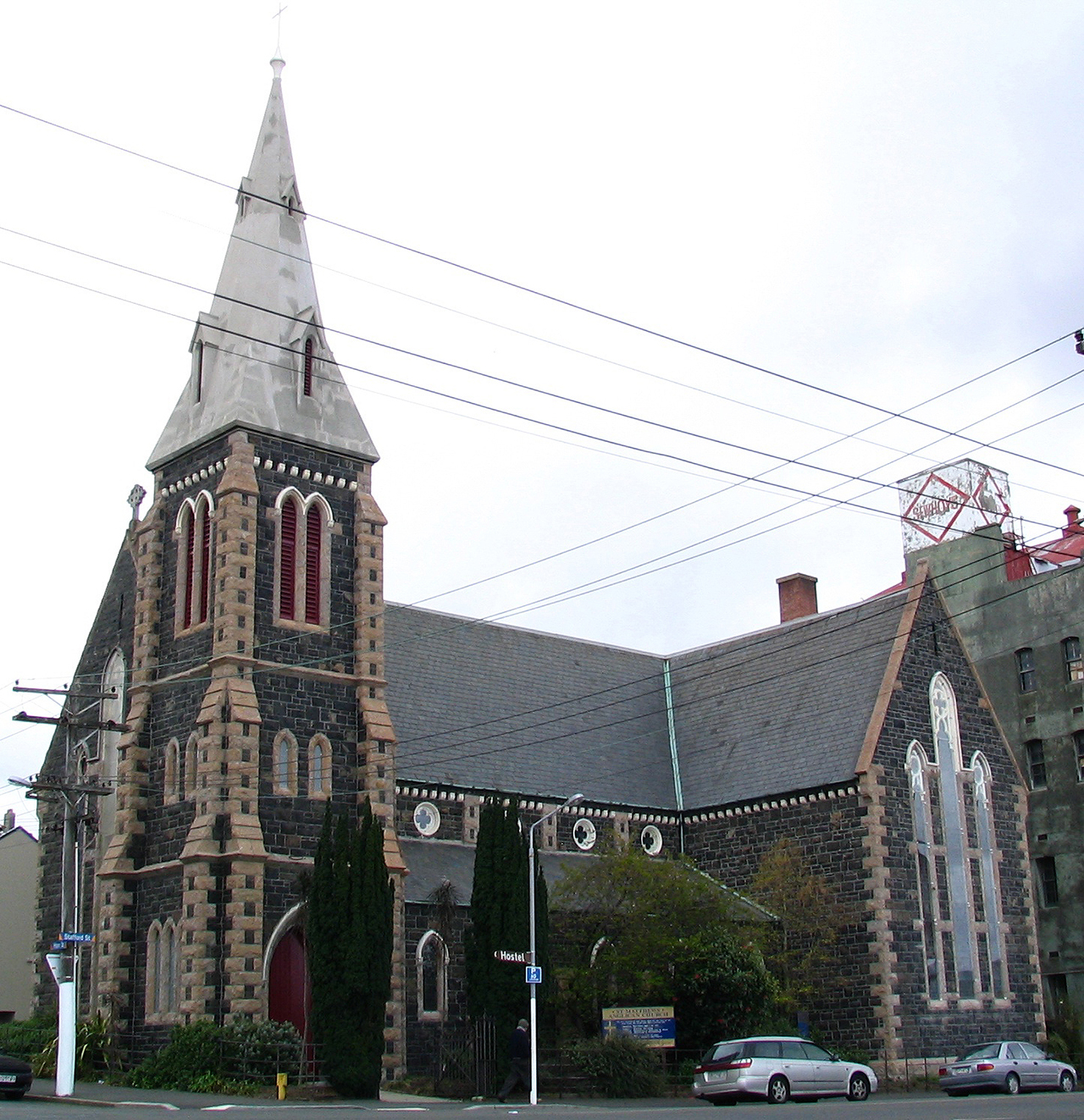
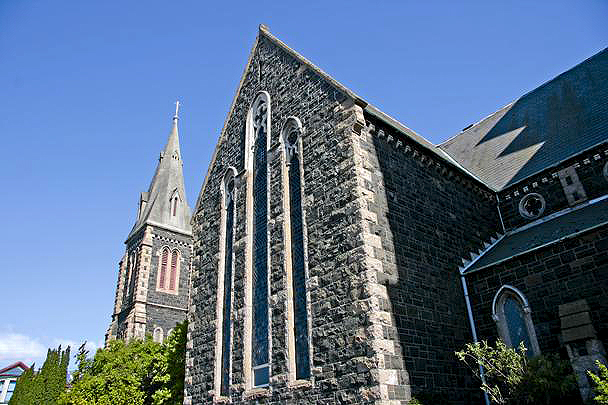
The walls are dark Leith Valley andesite with the corner quoins and door and window frames in a light brown, rough finished Port Chalmers breccia. The roof is slate. There are label moulds of Oamaru stone over doors and windows. The church is cruciform in plan with a well proportioned spire and tower at the south-west corner of the nave over the main entrance porch. Internally the nave has octagonal columns rising to pointed arches, a timber roof with simply decorated braces, single lancet windows on the aisles and triple lancets, the middle one taller than its neighbours, lighting the end of each transept and the west end. The clerestory above the aisles is lit by quatrefoil windows in circular openings. The interior woodwork is Kauri and Rimu.
Notable Features
Its well proportioned gables and spire and its unmodified nature.
Construction Professional
Name
Mason, William
Type
Architect
Biography
William Mason was born at Suffolk, England, in 1810. He attended a private school in Ipswich and was then articled to his father. He moved to London to study architecture under Thomas Telford and Peter Nicholson and was later employed by Edward Blore, special architect to William IV and to Queen Victoria. In 1838 he moved to New South Wales with wife Sarah and young son, working with colonial architect Mortimer Lewis. Mason was offered the position of superintendent of public works under Felton Mathew by William Hobson, Governor of New Zealand. Mason arrived at the Bay of Islands on 17 March 1840. He was a member of the founding party which arrived at the site of Auckland on 16 September 1840. In July 1841 Mason resigned his position and entered a three-year partnership with Thomas Paton and became involved in farming and local politics as well as architecture. Mason had been in New Zealand for 20 years when he first set up as an architect in the gold mining boom town of Dunedin in 1862, employed to design the southern offices for the recently formed Bank of New Zealand in Dunedin. He set up practice with David Ross, and later with W. H. Clayton. In this period, he designed the Colonial Bank, the 1864 exhibition building which became part of the Dunedin Hospital, the combined post office and courthouse, and Edinburgh House. Mason was elected the first mayor of Dunedin and served two terms. Mason had retired briefly in the late 1860s but returned to work entering into partnership with N. Y. A. Wales in 1871. During this time he designed Bishopscourt and the extension to All Saints Church. In 1876 Mason and his second wife retired to live at Queenstown. After building at Paradise and farming for a few years, a period of ill health drove him back to Dunedin where he died at the Grand Hotel on 22 June 1897.
Construction Details
Start Year
1874
Type
Original Construction
Construction Materials
The walls are dark Leith Valley andesite with the corner quoins and door and window frames in a light brown, rough finished Port Chalmers breccia. The roof is slate. There are label moulds of Oamaru stone over doors and windows. The church is cruciform in plan with a well proportioned spire and tower at the south-west corner of the nave over the main entrance porch. Internally the nave has octagonal columns rising to pointed arches, a timber roof with simply decorated braces, single lancet windows on the aisles and triple lancets, the middle one taller than its neighbours, lighting the end of each transept and the west end. The clerestory above the aisles is lit by quatrefoil windows in circular openings. The interior woodwork is Kauri and Rimu.
Notable Features
Its well proportioned gables and spire and its unmodified nature.
Architectural Description (Style): This adapted Gothic church is rather sombre in appearance because of the dark colours of the stone. Brown breccia was used where other buildings used white Oamaru stone but the rough finish of the breccia shows off its qualities much more effectively than in sawn blocks. The great end gables and the spire are simply finished and not lavished with extra pinnacles, though the plan is more elaborate than two previous Anglican churches of All Saints and old St Pauls. The tower is neatly buttressed and the spire rises smoothly with only dormer gables and no extra pinnacles or decorations. Modifications: The church was built in its entirety at once. The only addition to the structure is a small brick Sunday School room added right out of sight on the north east corner. Interior modifications have been minor, consisting of such things as the addition of oak chairs and reading desks, an oak table and the screens separating the transepts from the nave. The altar has been brought forward to accord with modern thinking of worship.
Architectural Description (Style): This adapted Gothic church is rather sombre in appearance because of the dark colours of the stone. Brown breccia was used where other buildings used white Oamaru stone but the rough finish of the breccia shows off its qualities much more effectively than in sawn blocks. The great end gables and the spire are simply finished and not lavished with extra pinnacles, though the plan is more elaborate than two previous Anglican churches of All Saints and old St Pauls. The tower is neatly buttressed and the spire rises smoothly with only dormer gables and no extra pinnacles or decorations. Modifications: The church was built in its entirety at once. The only addition to the structure is a small brick Sunday School room added right out of sight on the north east corner. Interior modifications have been minor, consisting of such things as the addition of oak chairs and reading desks, an oak table and the screens separating the transepts from the nave. The altar has been brought forward to accord with modern thinking of worship.
Historical and Associated Iwi / Hapū / Whānau
Information Sources
Porter, 1983
Frances Porter (ed), Historic Buildings of Dunedin, South Island, Methuen, Auckland, 1983.
Other Information
This historic place was registered under the Historic Places Act 1980. This report includes the text from the original Building Classification Committee report considered by the NZHPT Board at the time of registration. Please note that entry on the New Zealand Heritage List/Rarangi Korero identifies only the heritage values of the property concerned, and should not be construed as advice on the state of the property, or as a comment of its soundness or safety, including in regard to earthquake risk, safety in the event of fire, or insanitary conditions.
Historical and Associated Iwi / Hapū / Whānau
Information Sources
Porter, 1983
Frances Porter (ed), Historic Buildings of Dunedin, South Island, Methuen, Auckland, 1983.
Other Information
This historic place was registered under the Historic Places Act 1980. This report includes the text from the original Building Classification Committee report considered by the NZHPT Board at the time of registration. Please note that entry on the New Zealand Heritage List/Rarangi Korero identifies only the heritage values of the property concerned, and should not be construed as advice on the state of the property, or as a comment of its soundness or safety, including in regard to earthquake risk, safety in the event of fire, or insanitary conditions.
Current Usages
Uses: Religion
Specific Usage: Church
Former Usages
General Usage: Religion
Specific Usage: Church
Current Usages
Uses: Religion
Specific Usage: Church
Former Usages
General Usage: Religion
Specific Usage: Church
