

David Miller purchased land on North Road in March 1881, so it is likely that the house was built after this date. Conal McCarthy writes that David Miller was a stone mason, who also ran a contracting firm, as well as a monumental masonry business with partner Alexander Smillie. Miller worked on St Paul’s Presbyterian Church, and with Smillie, completed the Oamaru harbour breakwater. Miller and Smillie also completed the stone work for George Sumpter’s Exchange Chambers, which were designed by Thomas Forrester.
David Miller died in 1888. David’s widow Elizabeth lived in the house until her death in 1935. In 1937, it was bought by builder Thomas Beatty. The North Otago Museum records that the proprietors of the Oamaru Woollen Mill, which was located close by, bought the property in 1955, converting the downstairs into flats, and using the upstairs as a board room. Later owners converted it into three flats, before it was restored to a single residence after 1989. Still later, the house has provided bed and breakfast accommodation.
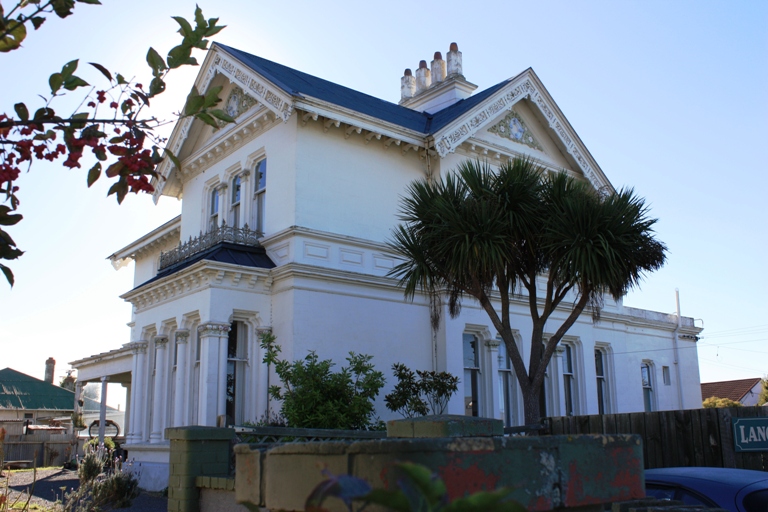
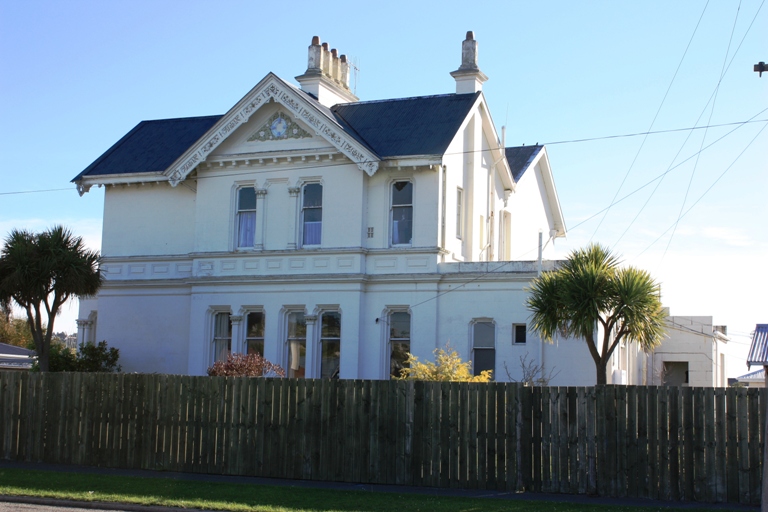
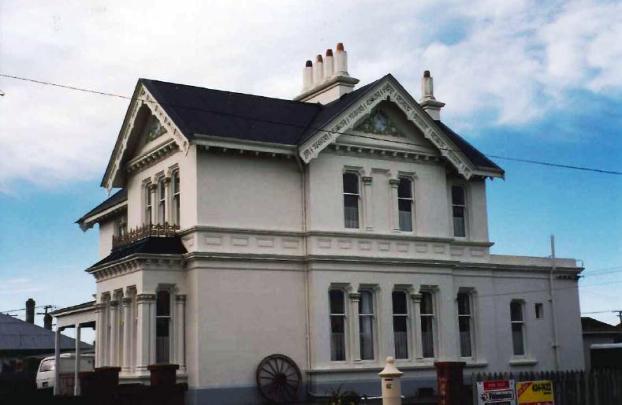
Miller’s House was one of Forrester and Lemon’s important residential projects. It was built after the practice designed residences for George Sumpter (one of the practice’s most important clients, and one of Oamaru’s major figures) and Dr J.W. Wait, the superintendent of Oamaru Hospital, and at the same time as J.C. Gilchrist’s Brookfield homestead. Miller may have been involved in the design of his home – the house is notable for its carved stonework, particularly around the pilasters flanking the windows. Other notable features include the ‘distinctive arched motif’ on the windows, the pierced bargeboards and the triangular plaster panels at the apex of the gables. These ornate treatments, McCarthy writes, reflect Oamaru’s ‘increased prosperity.’ Miller’s house is similar in style to British Italianate villas of the time, with its gabled roofs, cornices, and projecting gables. Large residences such as this are significant because they ‘reveal the private side of the community the public face of which the architects made manifest in their commercial and civic buildings’, and also provide evidence of the practice’s contacts with wealthy businessmen, civic notables, merchants and other significant figures.
In 2015, the Miller House remains a private residence.
List Entry Information
Status
Listed
List Entry Status
Historic Place Category 2
Access
Private/No Public Access
List Number
2282
Date Entered
2nd July 1982
Date of Effect
2nd July 1982
City/District Council
Waitaki District
Region
Otago Region
Extent of List Entry
Extent includes the land described as Lot 10 DP 4993 (RT OT286/132), Otago Land District, and the building known as Miller House (Former) thereon.
Legal description
Lot 10 DP 4993 (RT OT286/132), Otago Land District
Status
Listed
List Entry Status
Historic Place Category 2
Access
Private/No Public Access
List Number
2282
Date Entered
2nd July 1982
Date of Effect
2nd July 1982
City/District Council
Waitaki District
Region
Otago Region
Extent of List Entry
Extent includes the land described as Lot 10 DP 4993 (RT OT286/132), Otago Land District, and the building known as Miller House (Former) thereon.
Legal description
Lot 10 DP 4993 (RT OT286/132), Otago Land District
Construction Professional
Name
David Miller
Type
Stonemason
Biography
No biography is currently available for this construction professional
Name
Forrester & Lemon
Type
Architectural Partnership
Biography
The architectural partnership of Forrester and Lemon was established in Oamaru in 1872. Thomas Forrester (1838-1907) was born in Glasgow and educated at the Glasgow School of Art. Emigrating to New Zealand in 1861 he settled in Dunedin and worked under William Mason (1810-97) and William Henry Clayton (1823-77) and later Robert Arthur Lawson (1833-1902). In 1865 he superintended the Dunedin Exhibition and from 1870 he became involved with the supervision of harbour works. Some time after 1885 he became Engineer to the Oamaru Harbour Board and in this capacity designed the repairs to the breakwater following storm damage in 1886 and later the Holmes Wharf. On his death in 1907 he was still in the employ of the Harbour Board. John Lemon (1828-1890) was born in Jamaica and travelled to England before emigrating to New Zealand in 1849. He settled in Oamaru in 1860 and with his brother Charles established a timber merchant's business. By 1869 he was in partnership with his father-in-law, George Sumpter calling themselves "Timber and General Merchants, Land and Commission Agents". This partnership was dissolved in 1872 and Lemon entered into partnership with Forrester. Lemon had no architectural experience at all, but had a wide circle of business contacts and was an efficient administrator. Buildings designed by the partnership of Forrester and Lemon include St Paul's Church (1875-76), the Harbour Board Offices (1876), Queen's (later Brydone) Hotel (1881), Waitaki Boys' High School (1883), The Courthouse (1883) and the Post Office (1883-84), all in Oamaru. Forrester and Lemon contributed greatly to Oamaru's nineteenth century character. On Lemon's death in 1890 the practice was taken over by Forrester's son, John Megget Forrester (1865-1965).
Construction Details
Start Year
1881
startYearCirca
Type
Original Construction
Construction Professional
Name
David Miller
Type
Stonemason
Biography
No biography is currently available for this construction professional
Name
Forrester & Lemon
Type
Architectural Partnership
Biography
The architectural partnership of Forrester and Lemon was established in Oamaru in 1872. Thomas Forrester (1838-1907) was born in Glasgow and educated at the Glasgow School of Art. Emigrating to New Zealand in 1861 he settled in Dunedin and worked under William Mason (1810-97) and William Henry Clayton (1823-77) and later Robert Arthur Lawson (1833-1902). In 1865 he superintended the Dunedin Exhibition and from 1870 he became involved with the supervision of harbour works. Some time after 1885 he became Engineer to the Oamaru Harbour Board and in this capacity designed the repairs to the breakwater following storm damage in 1886 and later the Holmes Wharf. On his death in 1907 he was still in the employ of the Harbour Board. John Lemon (1828-1890) was born in Jamaica and travelled to England before emigrating to New Zealand in 1849. He settled in Oamaru in 1860 and with his brother Charles established a timber merchant's business. By 1869 he was in partnership with his father-in-law, George Sumpter calling themselves "Timber and General Merchants, Land and Commission Agents". This partnership was dissolved in 1872 and Lemon entered into partnership with Forrester. Lemon had no architectural experience at all, but had a wide circle of business contacts and was an efficient administrator. Buildings designed by the partnership of Forrester and Lemon include St Paul's Church (1875-76), the Harbour Board Offices (1876), Queen's (later Brydone) Hotel (1881), Waitaki Boys' High School (1883), The Courthouse (1883) and the Post Office (1883-84), all in Oamaru. Forrester and Lemon contributed greatly to Oamaru's nineteenth century character. On Lemon's death in 1890 the practice was taken over by Forrester's son, John Megget Forrester (1865-1965).
Construction Details
Start Year
1881
startYearCirca
Type
Original Construction
Historical and Associated Iwi / Hapū / Whānau
Completion Date
2nd December 2015
Report Written By
Heather Bauchop
Information Sources
McCarthy, 2002
Conal McCarthy, Forrester and Lemon of Oamaru, architects, Oamaru, 2002
Other Information
This place was identified as significant under previous legislation with different information requirements. It remains significant under the current legislation. There is opportunity under our legislation and policies to add to this information. Further information about this place may be available from the Otago/Southland Office of Heritage New Zealand Pouhere Taonga. Please note that entry on the New Zealand Heritage List/Rarangi Korero identifies only the heritage values of the property concerned, and should not be construed as advice on the state of the property, or as a comment of its soundness or safety, including in regard to earthquake risk, safety in the event of fire, or insanitary conditions. A fully referenced upgrade report is available on request from the Otago/Southland Office of Heritage New Zealand
Historical and Associated Iwi / Hapū / Whānau
Completion Date
2nd December 2015
Report Written By
Heather Bauchop
Information Sources
McCarthy, 2002
Conal McCarthy, Forrester and Lemon of Oamaru, architects, Oamaru, 2002
Other Information
This place was identified as significant under previous legislation with different information requirements. It remains significant under the current legislation. There is opportunity under our legislation and policies to add to this information. Further information about this place may be available from the Otago/Southland Office of Heritage New Zealand Pouhere Taonga. Please note that entry on the New Zealand Heritage List/Rarangi Korero identifies only the heritage values of the property concerned, and should not be construed as advice on the state of the property, or as a comment of its soundness or safety, including in regard to earthquake risk, safety in the event of fire, or insanitary conditions. A fully referenced upgrade report is available on request from the Otago/Southland Office of Heritage New Zealand
Current Usages
Uses: Accommodation
Specific Usage: House
Former Usages
General Usage: Accommodation
Specific Usage: House
Current Usages
Uses: Accommodation
Specific Usage: House
Former Usages
General Usage: Accommodation
Specific Usage: House
Location
Sign up to hear more
Get the latest heritage news, features and events delivered
straight to your inbox.
