

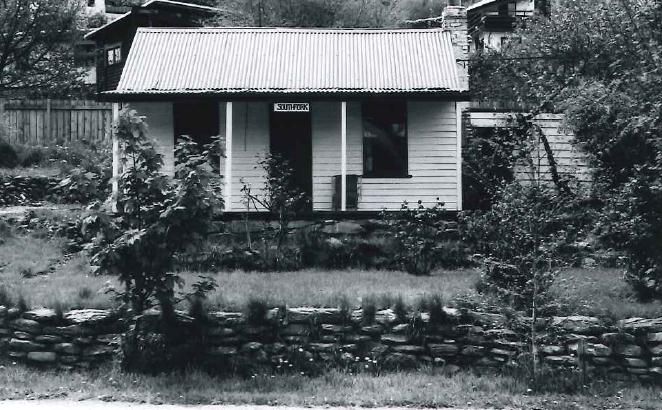
By the early 1870s, Queenstown was settling down from the chaos of early gold mining years. Residents moved from canvas tents or shanties into cottages, such as this diminutive building on land at the edge of the settlement. Queenstown builder John Frederic was the first ratepayer for this land in 1870-1871, and he probably built the cottage with milled beech from James Robertson’s sawmill at the head of the lake. Robertson’s mill supplied most of the timber for Queenstown’s early buildings.
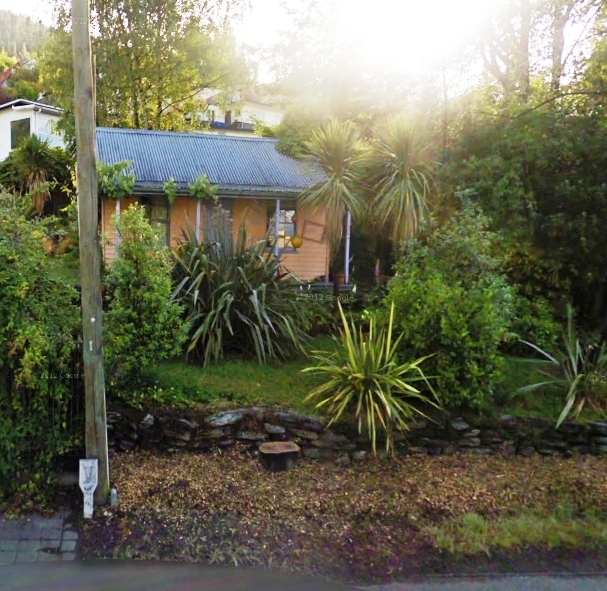
The style and small size of the cottage are typical of the 1860s and 1870s. Architect Jeremy Salmond writes that the ‘little wooden cottage of one or two rooms, with a central door and a window either side of the door, remained the basic unit of house design throughout the nineteenth century.’ The building is a simple single-gabled box cottage with a verandah and an external brick chimney. It has two rooms (one living and one bedroom) and a lean-to bathroom.
An 1874 photograph shows the cottage sitting at the edge of the cluster of commercial buildings and residences that had sprung up at the edge of the lake. The cottage sits within a fenced paddock, the boundaries marked by timber fencing.
Thomas Betts paid the rates on this land from 1872 until 1882, renting out the cottage to Edward Canning during this time. Betts died intestate and his estate was sold.
Widow Margaret Gardiner bought the cottage in 1882. The Gardiner family lived across the road from the cottage, on the corner of Turner Street and Skippers Road (now Gorge Road), where Margaret ran a boarding house. The cottage was perhaps a convenient home close to her business. The cottage remained in the Gardiner family until 1948. On Margaret’s death in 1917, she left the cottage to daughter Agnes Gardiner. On Agnes’ death in 1926, the property was transferred to tourist agent James Walter Gardiner and his wife Minnie. Minnie died in 1947 and Gardiner sold the cottage soon after.
Dr Raymond Kirk bought the cottage in November 1948. Kirk named the property ‘Gratuity Cottage’ as the purchase money came from his post-war gratuity of £375. In 1980, John R. McCormack bought the property. When McCormack owned the tiny cottage, it was ironically nick-named ‘Southfork’. McCormack’s initials matched those of J.R. Ewing, a character in the 1980s television series ‘Dallas’, who lived at a grand ranch called Southfork. For many years, the cottage served as a studio and gallery for McCormack.
In 2014, this small cottage is a surviving example of a settler’s cottage, in the otherwise bustling tourist centre of Queenstown.
List Entry Information
Status
Listed
List Entry Status
Historic Place Category 2
Access
Private/No Public Access
List Number
2339
Date Entered
24th November 1983
Date of Effect
24th November 1983
City/District Council
Queenstown-Lakes District
Region
Otago Region
Extent of List Entry
The extent includes the land described as Lot 1 DP 12476 (RT OT5A/1311), Otago Land District, and the building known as Gratuity Cottage thereon.
Legal description
Lot 1 DP 12476 (RT OT5A/1311), Otago Land District
Status
Listed
List Entry Status
Historic Place Category 2
Access
Private/No Public Access
List Number
2339
Date Entered
24th November 1983
Date of Effect
24th November 1983
City/District Council
Queenstown-Lakes District
Region
Otago Region
Extent of List Entry
The extent includes the land described as Lot 1 DP 12476 (RT OT5A/1311), Otago Land District, and the building known as Gratuity Cottage thereon.
Legal description
Lot 1 DP 12476 (RT OT5A/1311), Otago Land District
Construction Professional
Name
Frederic, John Augustus
Type
Builder
Biography
John Frederic was a builder operating in Queenstown in the early 1870s. Frederic and Co. won the tender for the construction of the Arrowtown Post Office and Telegraph Station in December 1871. He was the subject of bankruptcy proceedings in 1872. Little else is known about him.
Construction Details
Start Year
1871
startYearCirca
Finish Year
1872
finishYearCirca
Type
Original Construction
Construction Professional
Name
Frederic, John Augustus
Type
Builder
Biography
John Frederic was a builder operating in Queenstown in the early 1870s. Frederic and Co. won the tender for the construction of the Arrowtown Post Office and Telegraph Station in December 1871. He was the subject of bankruptcy proceedings in 1872. Little else is known about him.
Construction Details
Start Year
1871
startYearCirca
Finish Year
1872
finishYearCirca
Type
Original Construction
Historical and Associated Iwi / Hapū / Whānau
Public NZAA Number
E41/287
Completion Date
18th March 2014
Report Written By
Heather Bauchop
Other Information
This place was identified as significant under previous legislation with different information requirements. It remains significant under the current legislation. There is opportunity under our legislation and policies to add to this information. Further information about this place may be available from the Otago/Southland Office of Heritage New Zealand Pouhere Taonga. A fully referenced upgrade report is available on request from the Otago/Southland Area Office of Heritage New Zealand. Please note that entry on the New Zealand Heritage List/Rarangi Korero identifies only the heritage values of the property concerned, and should not be construed as advice on the state of the property, or as a comment of its soundness or safety, including in regard to earthquake risk, safety in the event of fire, or insanitary conditions.
Historical and Associated Iwi / Hapū / Whānau
Public NZAA Number
E41/287
Completion Date
18th March 2014
Report Written By
Heather Bauchop
Other Information
This place was identified as significant under previous legislation with different information requirements. It remains significant under the current legislation. There is opportunity under our legislation and policies to add to this information. Further information about this place may be available from the Otago/Southland Office of Heritage New Zealand Pouhere Taonga. A fully referenced upgrade report is available on request from the Otago/Southland Area Office of Heritage New Zealand. Please note that entry on the New Zealand Heritage List/Rarangi Korero identifies only the heritage values of the property concerned, and should not be construed as advice on the state of the property, or as a comment of its soundness or safety, including in regard to earthquake risk, safety in the event of fire, or insanitary conditions.
Current Usages
Uses: Accommodation
Specific Usage: House
Current Usages
Uses: Accommodation
Specific Usage: House
Location
Sign up to hear more
Get the latest heritage news, features and events delivered
straight to your inbox.
