DonateMembershipVisit Heritage
  • Tūrangawaewae
    Places
  • Tira Māori
    Māori Heritage
  • Poutairangahia
    Archaeology
  • Rauemi
    Resources
  • Mō Tātou
    About Us
  • New Zealand Heritage List
  • Nominate and submit
  • Explore the List
  • National Historic Landmarks
  • Plaques
  • Rainbow List Project
  • Lost heritage
  • Visit Heritage
  • Our properties
  • Turnbull House Project
  • Collections
  • Shop
  • Tohu Whenua
  • Tira Māori
  • Conserving Māori heritage
  • Marae built heritage
  • Māori heritage on the List
  • Hinemihi—Te Hokinga Mai
  • What is archaeology?
  • Is there a site on my property?
  • What are my legal requirements?
  • Affecting an archaeological site
  • Declaring an archaeological site
  • Archaeology FAQs
  • Archaeology Digital Library
  • Archaeology guidelines and templates
  • Resources
  • Funding
  • Publications
  • Sustainable management guides
  • Disaster recovery
  • Podcasts & digital resources
  • Education Hub
  • Conservation plans
  • About
  • Board
  • Māori Heritage Council
  • Senior Staff
  • Offices
  • Contact us
  • Careers
  • Covenants
  • Fast-track
  • Corporate documents
  • Currently consulting on
  • Our submissions
  • News
  • Covid-19 response
Quick links
Rārangi Kōrero | The List
Explore the List
National Historic Landmarks
Ngā Manawhenua o Aotearoa me ōna Kōrero Tūturu
Quick links
Tapuwae
A Vision for Places of Māori Heritage
Funding for Māori Heritage
Resources
Quick links
Archaeological Authority Portal
Applying for an archaeological authority
Archaeology FAQs
Browse the most frequently asked questions about archaeological authorities and the archaeological process.
Quick links
Quick links
News
News Keep up to date with Heritage New Zealand Pouhere Taonga
Membership
Membership Find out more and sign up today
DonateMembershipVisit Heritage
  • Tūrangawaewae
    Places
  • Tira Māori
    Māori Heritage
  • Poutairangahia
    Archaeology
  • Rauemi
    Resources
  • Mō Tātou
    About Us
  • New Zealand Heritage List
  • Nominate and submit
  • Explore the List
  • National Historic Landmarks
  • Plaques
  • Rainbow List Project
  • Lost heritage
  • Visit Heritage
  • Our properties
  • Turnbull House Project
  • Collections
  • Shop
  • Tohu Whenua
  • Tira Māori
  • Conserving Māori heritage
  • Marae built heritage
  • Māori heritage on the List
  • Hinemihi—Te Hokinga Mai
  • What is archaeology?
  • Is there a site on my property?
  • What are my legal requirements?
  • Affecting an archaeological site
  • Declaring an archaeological site
  • Archaeology FAQs
  • Archaeology Digital Library
  • Archaeology guidelines and templates
  • Resources
  • Funding
  • Publications
  • Sustainable management guides
  • Disaster recovery
  • Podcasts & digital resources
  • Education Hub
  • Conservation plans
  • About
  • Board
  • Māori Heritage Council
  • Senior Staff
  • Offices
  • Contact us
  • Careers
  • Covenants
  • Fast-track
  • Corporate documents
  • Currently consulting on
  • Our submissions
  • News
  • Covid-19 response
Quick links
Rārangi Kōrero | The List
Explore the List
National Historic Landmarks
Ngā Manawhenua o Aotearoa me ōna Kōrero Tūturu
Quick links
Tapuwae
A Vision for Places of Māori Heritage
Funding for Māori Heritage
Resources
Quick links
Archaeological Authority Portal
Applying for an archaeological authority
Archaeology FAQs
Browse the most frequently asked questions about archaeological authorities and the archaeological process.
Quick links
Quick links
News
News Keep up to date with Heritage New Zealand Pouhere Taonga
Membership
Membership Find out more and sign up today
  • Places
  • Nominate and submit
  • National Historic Landmarks
  • Places
  • Nominate and submit
  • National Historic Landmarks
  • Tira Māori
  • Conserving Māori heritage
  • Marae built heritage
  • Tira Māori
  • Conserving Māori heritage
  • Marae built heritage
  • Archaeological authorities
  • Archaeology Digital Library
  • Archaeological authorities
  • Archaeology Digital Library
  • All resources
  • Publications
  • Funding
  • All resources
  • Publications
  • Funding
  • FAQs
  • FAQs
Follow us on:
Places
  • Places
  • Nominate and submit
  • National Historic Landmarks
Tira Māori
  • Tira Māori
  • Conserving Māori heritage
  • Marae built heritage
Archaeology
  • Archaeological authorities
  • Archaeology Digital Library
Resources
  • All resources
  • Publications
  • Funding
FAQs
  • FAQs
Follow us on
HomePrivacyTerms and conditionsAbout this site
© Heritage New Zealand Pouhere Taonga 2026.
 
Opawa River Bridge

Grove Road; State Highway 1, BLENHEIM

Public

Historic Place Category 1

List No. 241

Quick links:
List GalleryLocationDetails
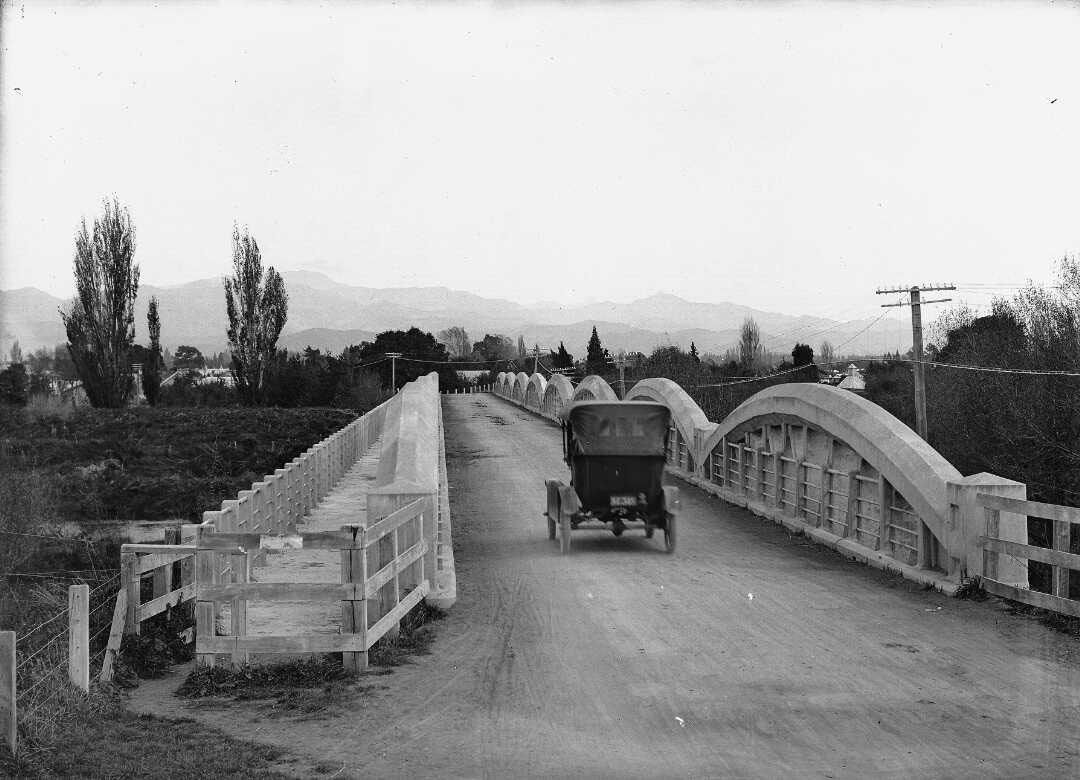
The first bridge over the Ōpaoa River at this point was built in 1869. It collapsed in 1878 and from then traffic was taken across the river by the nearby narrow railway bridge, by punt, or by fording when water levels were low enough. Planning for a new road bridge had commenced by 1913. Construction proper began in 1915 but because of the War, the bridge was not completed until the end of 1917. It then provided the much needed road link between Blenheim and the settlements to the north.
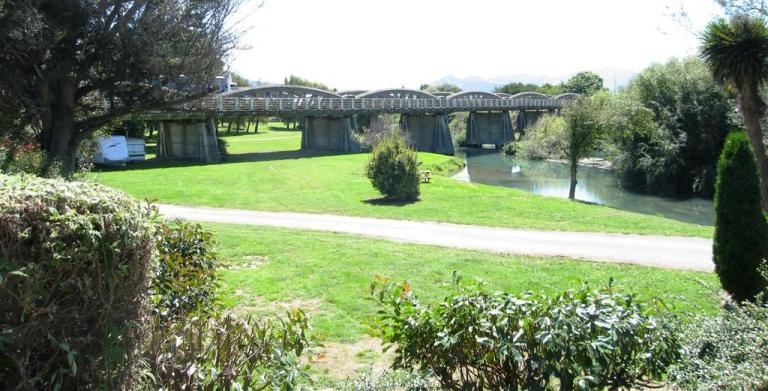
Opawa River Bridge, Blenheim. CC BY-SA 4.0 Image courtesy of commons.wikimedia.org | Lcmortensen | 04/04/2021 | Lcmortensen - Wikimedia Commons
Opawa River Bridge, Blenheim. c.1920s Car travelling across the bridge. Photographs of New Zealand. Ref: 1/2-045797-G Permission of the must be obtained before reuse of this image | Sydney Charles Smith | Alexander Turnbull Library, Wellington, New Zealand
Opawa River Bridge, Blenheim. CC BY-SA 4.0 Image courtesy of commons.wikimedia.org | Lcmortensen | 04/04/2021 | Lcmortensen - Wikimedia Commons
Opawa River Bridge, Blenheim. c.1920s Car travelling across the bridge. Photographs of New Zealand. Ref: 1/2-045797-G Permission of the must be obtained before reuse of this image | Sydney Charles Smith | Alexander Turnbull Library, Wellington, New Zealand

List Entry Information

Overview

Status
Listed

List Entry Status
Historic Place Category 1

Access
Able to Visit

List Number
241

Date Entered
28th June 1990

Date of Effect
28th June 1990

City/District Council
Marlborough District

Region
Marlborough Region

Extent of List Entry

Extent includes part of the land described as Legal Road, Marlborough Land District and the structure known as Opawa River Bridge thereon, including its abutments. Refer to the extent map tabled at the Rārangi Kōrero meeting on 8 June 2017.

Legal description

Legal Road, Marlborough Land District

Detailed List Entry
Significance

Historic Significance

Historical Significance or Value The Opawa River bridge was designed at a time of international experimentation in the use of reinforced concrete in such engineering structures, especially by Swiss, French and German engineers. The bowstring arch design in concrete enjoyed a period of popularity in New Zealand through to the 1930s. The bridge is still an important part of the South Island State Highway 1.

Physical Significance

ARCHITECTURAL QUALITY: The Opawa River bridge was one of the first bowstring arch bridges in reinforced concrete to be built in New Zealand. Despite the somewhat heavy nature of its construction, the low bold arches in sequence give it an overall rhythmic architectural elegance, although it does lack the refinement of later bowstring arch bridges in New Zealand, such as the former Fitzherbert Bridge (Palmerston North 1935) and the Fairfield Bridge (Hamilton 1936). TOWNSCAPE/LANDMARK VALUE: The bridge is a well-known structure spanning the Ōpaoa River and is a significant local landmark.

Construction Professional

Name

Holmes, John Dudley and Robert West

Type

Architectural Partnership

Biography

John Dudley Holmes (1886-?) was educated at Wellington College and Canterbury University. He worked for the Railways Department (1902-1908) and the Public Works Department (1909-20). He held various positions, including District Engineer, Tauranga, and Resident Engineer to the Napier Harbour Board. He later engaged in private practice with his father as a consulting engineer. He was a member of the Institution of Engineers. Robert West Holmes(1856-1936) was born and educated in London. He entered the New Zealand Public Works Department in 1872 and rose to the position of Under-Secretary before retiring in 1920.

Construction Details

Start Year

1917

Type

Original Construction

Construction Materials

Trusses and piers of reinforced concrete.

Notable Features

Early use of reinforced concrete in a new form of bridge design.

Physical Description

ARCHITECTURAL DESCRIPTION: The bridge which carries State Highway 1 over the Ōpaoa River at Blenheim, has a total length of 170 metres. It has eight bow-string arch trusses of equal length. Each span has eight vertical hangers and diagonal reinforcing members, supporting the heavier lower chords, which carry the roadway. Heavy posts form the ends of each truss, which are supported on reinforced concrete piers, each having three converging flanges with their upstream faces formed at diagonals to assist water flow. A footpath is cantilevered on the downstream side of the bridge and horizontal iron bars have been placed between the truss hangers to form a barrier between the footpath and the roadway. MODIFICATIONS: No significant modifications have been made.

Reference

Information Sources

Appendices to the Journals of the House of Representatives (AJHR)

Appendices to the Journals of the House of Representatives

Furkert, 1953

Frederick William Furkert, Early New Zealand Engineers, Wellington, 1953

Marlborough Express

Marlborough Express

New Zealand Gazette

New Zealand Gazette

New Zealand Institute of Architects Journal

New Zealand Institute of Architects Journal (NZIA), No.8, Aug 1974

Billington, 1986

D Billington. The Tower and the Bridge, Basic Books Inc, New York, 1983

Who's Who in NZ

Who's Who in New Zealand

Report Written By

This historic place was registered under the Historic Places Act 1980. This report includes the text from the original Building Classification Committee report considered by the NZHPT Board at the time of registration. Won a commendation for the 'Enduring Concrete Award' in 2010 from the NZ Concrete Society The Ōpaoa River Bridge project won the 2021 Engineering NZ Heritage Award. Please note that entry on the New Zealand Heritage List/Rarangi Korero identifies only the heritage values of the property concerned, and should not be construed as advice on the state of the property, or as a comment of its soundness or safety, including in regard to earthquake risk, safety in the event of fire, or insanitary conditions.

Further Information

Current Usages

Uses: Transport

Specific Usage: Bridge/ Viaduct

Former Usages

Themes

Web Links

Overview

Status

Listed

List Entry Status

Historic Place Category 1

Access

Able to Visit

List Number

241

Date Entered

28th June 1990

Date of Effect

28th June 1990

City/District Council

Marlborough District

Region

Marlborough Region

Extent of List Entry

Extent includes part of the land described as Legal Road, Marlborough Land District and the structure known as Opawa River Bridge thereon, including its abutments. Refer to the extent map tabled at the Rārangi Kōrero meeting on 8 June 2017.

Legal description

Legal Road, Marlborough Land District

Status

Listed

List Entry Status

Historic Place Category 1

Access

Able to Visit

List Number

241

Date Entered

28th June 1990

Date of Effect

28th June 1990

City/District Council

Marlborough District

Region

Marlborough Region

Extent of List Entry

Extent includes part of the land described as Legal Road, Marlborough Land District and the structure known as Opawa River Bridge thereon, including its abutments. Refer to the extent map tabled at the Rārangi Kōrero meeting on 8 June 2017.

Legal description

Legal Road, Marlborough Land District

Significance

Why is this place significant?

Historic Significance

Historical Significance or Value The Opawa River bridge was designed at a time of international experimentation in the use of reinforced concrete in such engineering structures, especially by Swiss, French and German engineers. The bowstring arch design in concrete enjoyed a period of popularity in New Zealand through to the 1930s. The bridge is still an important part of the South Island State Highway 1.

Physical Significance

ARCHITECTURAL QUALITY: The Opawa River bridge was one of the first bowstring arch bridges in reinforced concrete to be built in New Zealand. Despite the somewhat heavy nature of its construction, the low bold arches in sequence give it an overall rhythmic architectural elegance, although it does lack the refinement of later bowstring arch bridges in New Zealand, such as the former Fitzherbert Bridge (Palmerston North 1935) and the Fairfield Bridge (Hamilton 1936). TOWNSCAPE/LANDMARK VALUE: The bridge is a well-known structure spanning the Ōpaoa River and is a significant local landmark.

Why is this place significant?

Historic Significance

Historical Significance or Value The Opawa River bridge was designed at a time of international experimentation in the use of reinforced concrete in such engineering structures, especially by Swiss, French and German engineers. The bowstring arch design in concrete enjoyed a period of popularity in New Zealand through to the 1930s. The bridge is still an important part of the South Island State Highway 1.

Physical Significance

ARCHITECTURAL QUALITY: The Opawa River bridge was one of the first bowstring arch bridges in reinforced concrete to be built in New Zealand. Despite the somewhat heavy nature of its construction, the low bold arches in sequence give it an overall rhythmic architectural elegance, although it does lack the refinement of later bowstring arch bridges in New Zealand, such as the former Fitzherbert Bridge (Palmerston North 1935) and the Fairfield Bridge (Hamilton 1936). TOWNSCAPE/LANDMARK VALUE: The bridge is a well-known structure spanning the Ōpaoa River and is a significant local landmark.

Construction Information

Construction Professional

Name

Holmes, John Dudley and Robert West

Type

Architectural Partnership

Biography

John Dudley Holmes (1886-?) was educated at Wellington College and Canterbury University. He worked for the Railways Department (1902-1908) and the Public Works Department (1909-20). He held various positions, including District Engineer, Tauranga, and Resident Engineer to the Napier Harbour Board. He later engaged in private practice with his father as a consulting engineer. He was a member of the Institution of Engineers. Robert West Holmes(1856-1936) was born and educated in London. He entered the New Zealand Public Works Department in 1872 and rose to the position of Under-Secretary before retiring in 1920.

Construction Details

Start Year

1917

Type

Original Construction

Construction Materials

Trusses and piers of reinforced concrete.

Notable Features

Early use of reinforced concrete in a new form of bridge design.

Construction Professional

Name

Holmes, John Dudley and Robert West

Type

Architectural Partnership

Biography

John Dudley Holmes (1886-?) was educated at Wellington College and Canterbury University. He worked for the Railways Department (1902-1908) and the Public Works Department (1909-20). He held various positions, including District Engineer, Tauranga, and Resident Engineer to the Napier Harbour Board. He later engaged in private practice with his father as a consulting engineer. He was a member of the Institution of Engineers. Robert West Holmes(1856-1936) was born and educated in London. He entered the New Zealand Public Works Department in 1872 and rose to the position of Under-Secretary before retiring in 1920.

Construction Details

Start Year

1917

Type

Original Construction

Construction Materials

Trusses and piers of reinforced concrete.

Notable Features

Early use of reinforced concrete in a new form of bridge design.

Physical Description

ARCHITECTURAL DESCRIPTION: The bridge which carries State Highway 1 over the Ōpaoa River at Blenheim, has a total length of 170 metres. It has eight bow-string arch trusses of equal length. Each span has eight vertical hangers and diagonal reinforcing members, supporting the heavier lower chords, which carry the roadway. Heavy posts form the ends of each truss, which are supported on reinforced concrete piers, each having three converging flanges with their upstream faces formed at diagonals to assist water flow. A footpath is cantilevered on the downstream side of the bridge and horizontal iron bars have been placed between the truss hangers to form a barrier between the footpath and the roadway. MODIFICATIONS: No significant modifications have been made.

ARCHITECTURAL DESCRIPTION: The bridge which carries State Highway 1 over the Ōpaoa River at Blenheim, has a total length of 170 metres. It has eight bow-string arch trusses of equal length. Each span has eight vertical hangers and diagonal reinforcing members, supporting the heavier lower chords, which carry the roadway. Heavy posts form the ends of each truss, which are supported on reinforced concrete piers, each having three converging flanges with their upstream faces formed at diagonals to assist water flow. A footpath is cantilevered on the downstream side of the bridge and horizontal iron bars have been placed between the truss hangers to form a barrier between the footpath and the roadway. MODIFICATIONS: No significant modifications have been made.

Reference

Historical and Associated Iwi / Hapū / Whānau

Information Sources

Appendices to the Journals of the House of Representatives (AJHR)

Appendices to the Journals of the House of Representatives

Furkert, 1953

Frederick William Furkert, Early New Zealand Engineers, Wellington, 1953

Marlborough Express

Marlborough Express

New Zealand Gazette

New Zealand Gazette

New Zealand Institute of Architects Journal

New Zealand Institute of Architects Journal (NZIA), No.8, Aug 1974

Billington, 1986

D Billington. The Tower and the Bridge, Basic Books Inc, New York, 1983

Who's Who in NZ

Who's Who in New Zealand

Other Information

This historic place was registered under the Historic Places Act 1980. This report includes the text from the original Building Classification Committee report considered by the NZHPT Board at the time of registration. Won a commendation for the 'Enduring Concrete Award' in 2010 from the NZ Concrete Society The Ōpaoa River Bridge project won the 2021 Engineering NZ Heritage Award. Please note that entry on the New Zealand Heritage List/Rarangi Korero identifies only the heritage values of the property concerned, and should not be construed as advice on the state of the property, or as a comment of its soundness or safety, including in regard to earthquake risk, safety in the event of fire, or insanitary conditions.

Historical and Associated Iwi / Hapū / Whānau

Information Sources

Appendices to the Journals of the House of Representatives (AJHR)

Appendices to the Journals of the House of Representatives

Furkert, 1953

Frederick William Furkert, Early New Zealand Engineers, Wellington, 1953

Marlborough Express

Marlborough Express

New Zealand Gazette

New Zealand Gazette

New Zealand Institute of Architects Journal

New Zealand Institute of Architects Journal (NZIA), No.8, Aug 1974

Billington, 1986

D Billington. The Tower and the Bridge, Basic Books Inc, New York, 1983

Who's Who in NZ

Who's Who in New Zealand

Other Information

This historic place was registered under the Historic Places Act 1980. This report includes the text from the original Building Classification Committee report considered by the NZHPT Board at the time of registration. Won a commendation for the 'Enduring Concrete Award' in 2010 from the NZ Concrete Society The Ōpaoa River Bridge project won the 2021 Engineering NZ Heritage Award. Please note that entry on the New Zealand Heritage List/Rarangi Korero identifies only the heritage values of the property concerned, and should not be construed as advice on the state of the property, or as a comment of its soundness or safety, including in regard to earthquake risk, safety in the event of fire, or insanitary conditions.

Further Information

Current Usages

Uses: Transport

Specific Usage: Bridge/ Viaduct

Current Usages

Uses: Transport

Specific Usage: Bridge/ Viaduct

Location

Loading
Stay up to date with Heritage this month
