

Matheson and Co. were general merchants who operated stores in Invercargill and the wider Southland district. The business was founded in 1863 under the style of Matheson and Cameron. Farquhar and John Matheson conducted the business from 1895. Mackenzie and Wilson tendered for the ‘erection of business premises, offices, etc, in Esk Street, for Messrs Matheson and Co.’ Invercargill builder Malcolm Robertson won the tender.
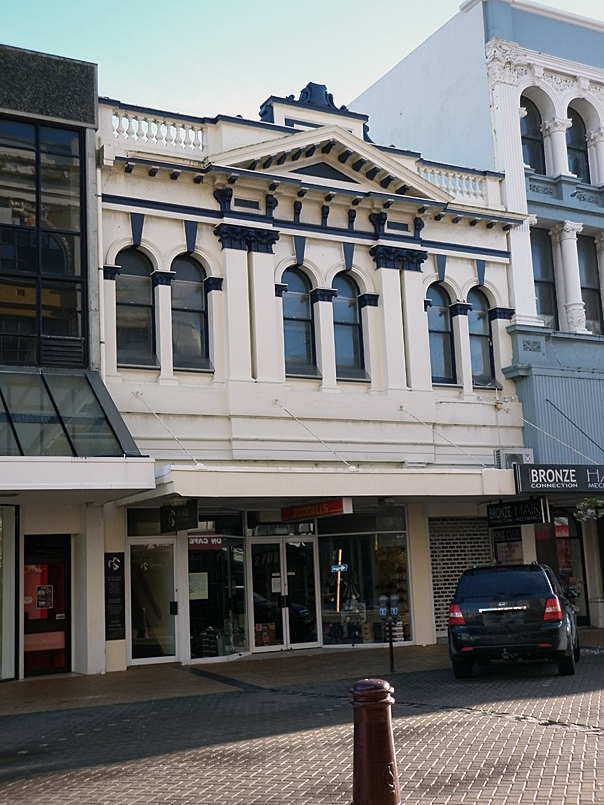
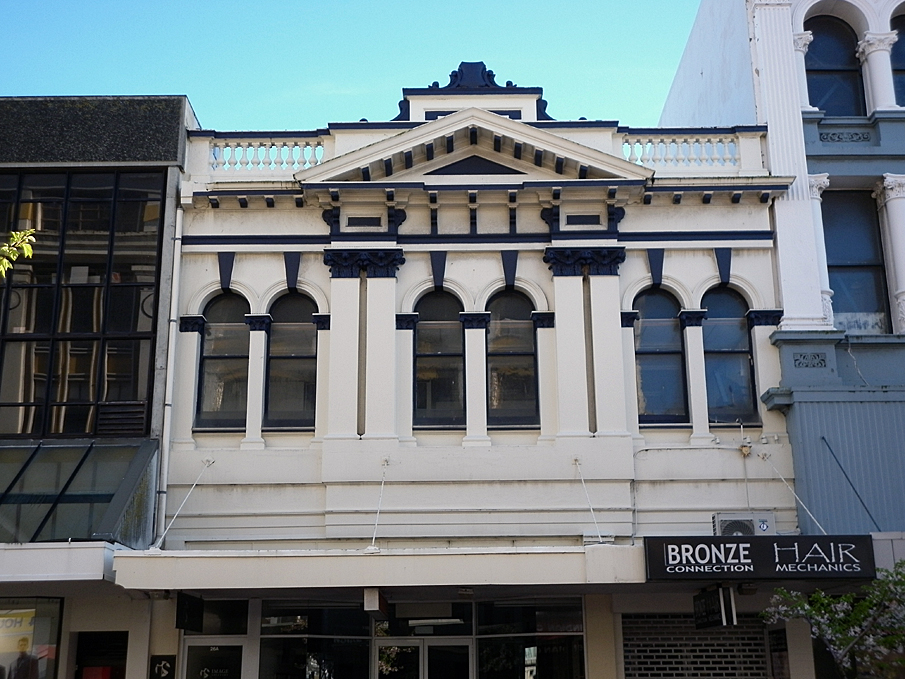
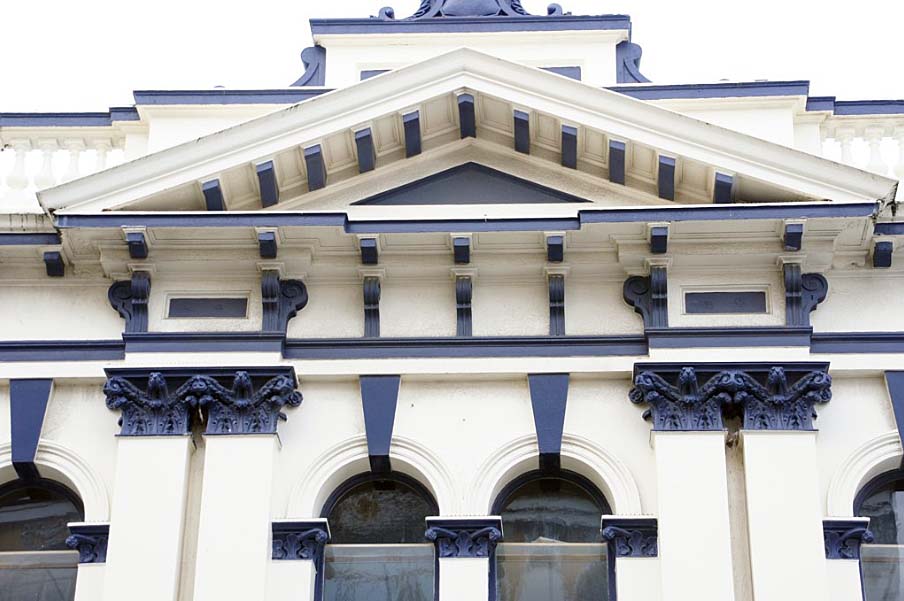
Wilson’s handsome new building replaced what had been a ‘decrepit and unsightly building used as a fish shop.’ It is a two-storey building with Classical Victorian façade. It has three pairs of round-headed windows, divided by engaged pilasters which support a triangular pediment. The building covered 165 by 34 ft [50.1 by10.4 metres], the whole of the available site. The front part of the ground floor was occupied (and designed especially for) hairdressers and tobacconists Messrs Double Bros. The upstairs was offices for architects McKenzie and Wilson, and solicitor C.S. Longuet. The back portion of the building was a ‘spacious store’ for building owners and grocers Messrs Matheson. The opulence of the ground floor salon was such that it merited a detailed description in the Southland Times. A stair led to the generous first floor hall (notable for the use of native timbers). One the left hand side of the landing was McKenzie and Wilson’s suite of offices – with three rooms: a draughting room, an office for Wilson (including a strongroom) and a contractor’s room, in which architectural drawings could be examined. Across the hall was Longuet’s office and private rooms.
The rear of the building housed Messrs Matheson and Co.’s ‘large storeroom.’ The storeroom had a ‘light steel trussed roof’ with a 34 foot [10.4 metre] span. The greater part of the ground floor was covered by a’a staging of a convenient height for the unloading and loading of drays. Beneath the staging is a basement for the accommodation of empty cases of goods, close at hand is a packing room, where stores are prepared for sending out to customers.’ The store was connected to Matheson’s main premises on Dee Street. The Southland Times described how the ‘street frontage of the building is finished with a glass and iron verandah of light and artistic design, similar to that in front of the Dee street shop.’ ‘The building as a whole serves as an indication of the stage of development that the town has reached.’
E.R. Wilson had his offices in the building until the 1930s. For many years it was home to a succession of hairdressers or beauticians. In 1940s the property was purchased by Bruce Woollen and Manufacturing Company and housed their retail premises. Goodall and Sons, footwear specialists were another significant long term owner. Goodall’s was a family footwear business, begun in Winton in 1910, before setting up an Invercargill branch.
In 2017, it remains a significant element in the streetscape.
List Entry Information
Status
Listed
List Entry Status
Historic Place Category 2
Access
Private/No Public Access
List Number
2469
Date Entered
24th November 1983
Date of Effect
24th November 1983
City/District Council
Invercargill City
Region
Southland Region
Extent of List Entry
Extent includes the land described as Lots 1-2 DP 3266 (RT SL147/100), Otago Land District, and Commercial Building, thereon.
Legal description
Lots 1-2 DP 3266 (RT SL147/100), Southland Land District
Status
Listed
List Entry Status
Historic Place Category 2
Access
Private/No Public Access
List Number
2469
Date Entered
24th November 1983
Date of Effect
24th November 1983
City/District Council
Invercargill City
Region
Southland Region
Extent of List Entry
Extent includes the land described as Lots 1-2 DP 3266 (RT SL147/100), Otago Land District, and Commercial Building, thereon.
Legal description
Lots 1-2 DP 3266 (RT SL147/100), Southland Land District
Construction Professional
Name
Malcolm Robertson
Type
Builder
Biography
Malcolm Robertson was a British-born building contractor who moved to New Zealand in 1862. He was involved with domestic and commercial work. Major projects included J.H. Kirk and Co.’s premises on Don Street, Southland Girl’s High School and the commercial building at 26 Esk Street.
Name
Wilson, E R
Type
Architect
Biography
Edmund Wilson was born in Invercargill, the son of Henry Fitz Wilson, a merchant and Dorothy Eleanor Richardson. The Wilson family was prominent in Invercargill: Henry Wilson was chairman of the Hospital Board, the Bluff Harbour Board and the Invercargill Savings Bank. He was a warden and choir member of St John's Church. Edmund Wilson served a seven-year apprenticeship with the local firm of McKenzie and Gilbertson. He may also have served some time with noted Wellington architect Frederick de Jersey Clere. In 1902 he married Elizabeth Alice Mary Dickinson. They had three sons and two daughters. Amongst Wilson's commissions in Invercargill were the Town Hall and Civic Theatre (1906), St Catherine's Girls' College, the fire station, and various retail stores. He designed many churches, both in Southland and elsewhere. These included St John's Anglican Church, Invercargill (1913), St Mary's, Merivale (1927), St Andrew's in Southbridge, Mid-Canterbury, and St Michael's, Kelburn, Wellington (1920). He designed town halls in Otautau and Bluff. Kew Hospital, which came near the end of his career, was among his most important commissions. Edmund Wilson was also a vestryman, lay reader and choir member of St John's. Two of his brothers were Anglican clergymen. Wilson was a President of the New Zealand Institute of Architects. Wilson died on 13 October 1941 and was buried in St John's Cemetery, Waikiwi, Invercargill. His wife, Elizabeth, died in 1955. Wilson's practice was inherited by Baxter Hesselin McDowell, now McDowell Architects, who retain his original plans.
Construction Details
Start Year
1905
Type
Original Construction
Construction Professional
Name
Malcolm Robertson
Type
Builder
Biography
Malcolm Robertson was a British-born building contractor who moved to New Zealand in 1862. He was involved with domestic and commercial work. Major projects included J.H. Kirk and Co.’s premises on Don Street, Southland Girl’s High School and the commercial building at 26 Esk Street.
Name
Wilson, E R
Type
Architect
Biography
Edmund Wilson was born in Invercargill, the son of Henry Fitz Wilson, a merchant and Dorothy Eleanor Richardson. The Wilson family was prominent in Invercargill: Henry Wilson was chairman of the Hospital Board, the Bluff Harbour Board and the Invercargill Savings Bank. He was a warden and choir member of St John's Church. Edmund Wilson served a seven-year apprenticeship with the local firm of McKenzie and Gilbertson. He may also have served some time with noted Wellington architect Frederick de Jersey Clere. In 1902 he married Elizabeth Alice Mary Dickinson. They had three sons and two daughters. Amongst Wilson's commissions in Invercargill were the Town Hall and Civic Theatre (1906), St Catherine's Girls' College, the fire station, and various retail stores. He designed many churches, both in Southland and elsewhere. These included St John's Anglican Church, Invercargill (1913), St Mary's, Merivale (1927), St Andrew's in Southbridge, Mid-Canterbury, and St Michael's, Kelburn, Wellington (1920). He designed town halls in Otautau and Bluff. Kew Hospital, which came near the end of his career, was among his most important commissions. Edmund Wilson was also a vestryman, lay reader and choir member of St John's. Two of his brothers were Anglican clergymen. Wilson was a President of the New Zealand Institute of Architects. Wilson died on 13 October 1941 and was buried in St John's Cemetery, Waikiwi, Invercargill. His wife, Elizabeth, died in 1955. Wilson's practice was inherited by Baxter Hesselin McDowell, now McDowell Architects, who retain his original plans.
Construction Details
Start Year
1905
Type
Original Construction
Historical and Associated Iwi / Hapū / Whānau
Completion Date
19th September 2017
Report Written By
Heather Bauchop
Information Sources
Southland Times
Southland Times
Other Information
This place was identified as significant under previous legislation with different information requirements. It remains significant under the current legislation. There is opportunity under our legislation and policies to add to this information. Further information about this place may be available from the Otago/Southland Office of Heritage New Zealand Pouhere Taonga. Please note that entry on the New Zealand Heritage List/Rarangi Korero identifies only the heritage values of the property concerned, and should not be construed as advice on the state of the property, or as a comment of its soundness or safety, including in regard to earthquake risk, safety in the event of fire, or insanitary conditions. A fully referenced upgrade report is available on request from the Otago/Southland Office of Heritage New Zealand.
Historical and Associated Iwi / Hapū / Whānau
Completion Date
19th September 2017
Report Written By
Heather Bauchop
Information Sources
Southland Times
Southland Times
Other Information
This place was identified as significant under previous legislation with different information requirements. It remains significant under the current legislation. There is opportunity under our legislation and policies to add to this information. Further information about this place may be available from the Otago/Southland Office of Heritage New Zealand Pouhere Taonga. Please note that entry on the New Zealand Heritage List/Rarangi Korero identifies only the heritage values of the property concerned, and should not be construed as advice on the state of the property, or as a comment of its soundness or safety, including in regard to earthquake risk, safety in the event of fire, or insanitary conditions. A fully referenced upgrade report is available on request from the Otago/Southland Office of Heritage New Zealand.
Current Usages
Uses: Trade
Specific Usage: Office building/Offices
Uses: Trade
Specific Usage: Retail & Wholesale - other
Uses: Trade
Specific Usage: Shop
Current Usages
Uses: Trade
Specific Usage: Office building/Offices
Uses: Trade
Specific Usage: Retail & Wholesale - other
Uses: Trade
Specific Usage: Shop
Location
Sign up to hear more
Get the latest heritage news, features and events delivered
straight to your inbox.
