

The YMCA movement that began in London in 1844 was conceived of as a Bible study group for the young men who had flooded into cities looking for work. The association was to provide a safe environment for young men who were away from home. New Zealand’s first YMCA began in Auckland in 1855. The YMCA was established in Invercargill in 1878. In its early years it carried on its activities in premises on Kelvin Street, but membership was limited. In 1906, the YMCA amalgamated with the Bible Class Union. A general secretary was appointed and headquarters moved to Esk Street.
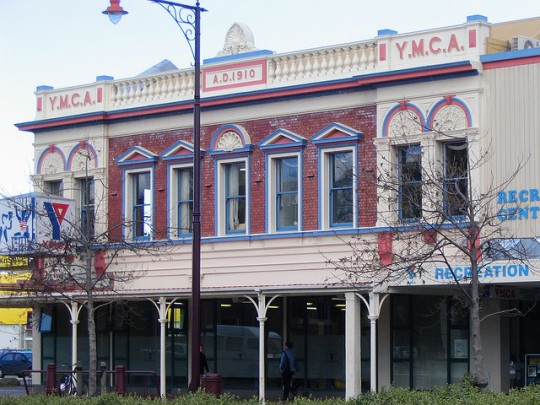
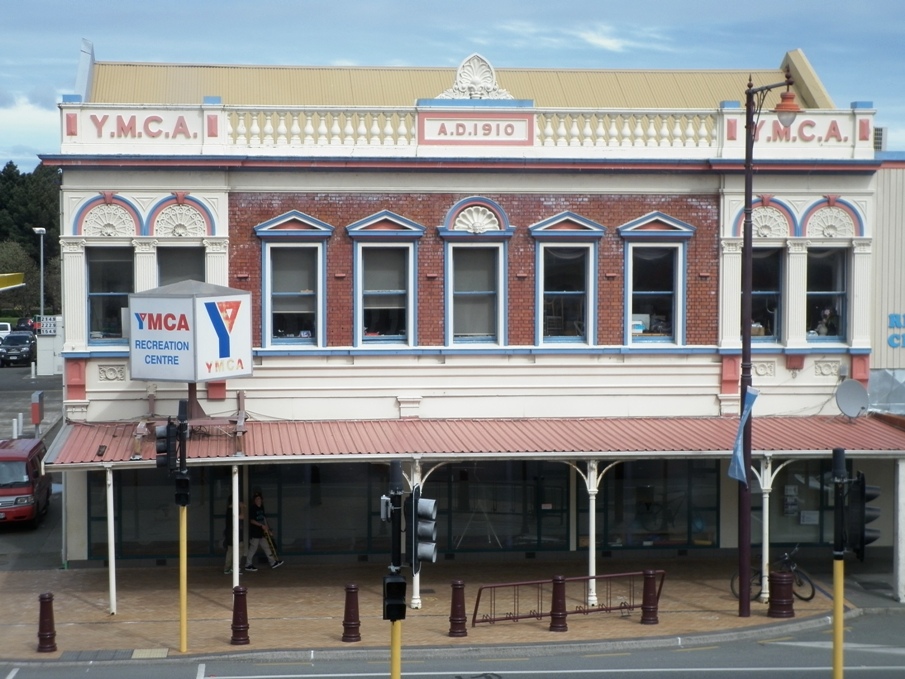
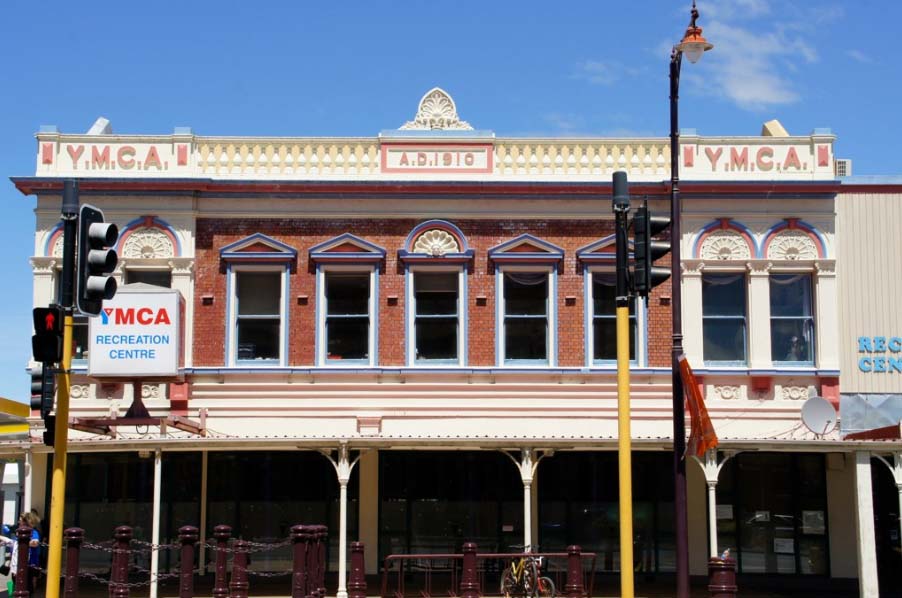
In 1908, the YMCA proposed to the citizens of Invercargill a ‘comprehensive scheme’ having the object providing a ‘modern Home’ for the organisation. Invercargill citizens pledged £3820. The YMCA owned land in Tay street which they sold and leased the current site, opposite the town hall. The Board instructed architect Charles Roberts to prepare sketch plans of a building to cover the whole section, stipulating that there should be several shops on the street front to provide rental income. The plans were adopted in February 1910. Roberts invited tenders in April 1910, and that of Wilson Bros. of £4350 was accepted. The foundation stone was laid on 8 October 1910, and the building formally opened on 16 August 1911.
Secretary J.B. McKinney showed the Southland Times reporter through the new premises. The reporter commented on the harmonious and welcoming nature of the building for young men of all denominations: ‘the main entrance opens out into a spacious reception hall, from the farthest wall of which a big fireplace sends forth a welcome to the incomer. This reception room is to be the rallying place for members. It is to be fitted with comfortable lounges and easy chairs and it is intended to be a free and easy lounge where members may associate in friendly intercourse.’ Four shops and the entrance to the reception room faced Tay street. Off the reception hall were the public and secretary’s offices, and the boys’ department – a partitioned space providing a social room and a meeting room. At the rear of the building were the men’s and boy’s dressing rooms, bathrooms and toilets. Stairs led to the gymnasium. A dark room completed the ground floor.
The first floor was mainly occupied by the gymnasium (55 ft high, 58 ft long and 35 ft broad). A billiard room faced east adjoining a classroom and meeting place for clubs and other institutions that make use of the rooms. Along with the usual service areas, there was also a lecture hall capable of accommodating 150 people, and a social room for senior club members. The remaining apartment was to be used as a board room and as a meeting room for ladies’ committees.
In 1929, the organisation went into recess. In 1938, the local Rotary Club revived the organisation. By the 21st century it had diversified to the extent that it is now ‘more of a community service organisation than one just focused on youth.’ In 2018, the building continues to provide retail space and is the home of the YMCA Recreation Trust/Head Office.
List Entry Information
Status
Listed
List Entry Status
Historic Place Category 2
Access
Private/No Public Access
List Number
2528
Date Entered
24th November 1983
Date of Effect
24th November 1983
City/District Council
Invercargill City
Region
Southland Region
Extent of List Entry
Extent includes the land described as Lot 1 DP 4564 (RT SL179/134), Southland Land District, and the building known as the YMCA Building thereon
Legal description
Lot 1 DP 4564 (RT SL179/134), Southland Land District
Status
Listed
List Entry Status
Historic Place Category 2
Access
Private/No Public Access
List Number
2528
Date Entered
24th November 1983
Date of Effect
24th November 1983
City/District Council
Invercargill City
Region
Southland Region
Extent of List Entry
Extent includes the land described as Lot 1 DP 4564 (RT SL179/134), Southland Land District, and the building known as the YMCA Building thereon
Legal description
Lot 1 DP 4564 (RT SL179/134), Southland Land District
Construction Professional
Name
Wilson Bros.
Type
Builder
Biography
Contractors operating in Invercargill around 1910.
Name
Roberts, Charles. H
Type
Architect
Biography
Roberts (1869-1942) trained as an architect in Dunedin before establishing a practice in Invercargill in 1895. Roberts seems to have been reasonably popular around the turn of the century designing many commercial and residential buildings. However, the Southland Times Building is one of only a small group of buildings attributed to Roberts which remain.
Construction Details
Start Year
1910
Finish Year
1911
Type
Original Construction
Construction Professional
Name
Wilson Bros.
Type
Builder
Biography
Contractors operating in Invercargill around 1910.
Name
Roberts, Charles. H
Type
Architect
Biography
Roberts (1869-1942) trained as an architect in Dunedin before establishing a practice in Invercargill in 1895. Roberts seems to have been reasonably popular around the turn of the century designing many commercial and residential buildings. However, the Southland Times Building is one of only a small group of buildings attributed to Roberts which remain.
Construction Details
Start Year
1910
Finish Year
1911
Type
Original Construction
Historical and Associated Iwi / Hapū / Whānau
Completion Date
22nd January 2018
Report Written By
Heather Bauchop
Information Sources
Southland Times
Southland Times
Te Ara - The Encyclopedia of New Zealand
www.TeAra.govt.nz
http://www.ymcasouth.org.nz/who-we-are/
Other Information
This place was identified as significant under previous legislation with different information requirements. It remains significant under the current legislation. There is opportunity under our legislation and policies to add to this information. Further information about this place may be available from the Otago/Southland Office of Heritage New Zealand Pouhere Taonga. Please note that entry on the New Zealand Heritage List/Rarangi Korero identifies only the heritage values of the property concerned, and should not be construed as advice on the state of the property, or as a comment of its soundness or safety, including in regard to earthquake risk, safety in the event of fire, or insanitary conditions. A fully referenced upgrade report is available on request from the Otago/Southland Area Office of Heritage New Zealand
Historical and Associated Iwi / Hapū / Whānau
Completion Date
22nd January 2018
Report Written By
Heather Bauchop
Information Sources
Southland Times
Southland Times
Te Ara - The Encyclopedia of New Zealand
www.TeAra.govt.nz
http://www.ymcasouth.org.nz/who-we-are/
Other Information
This place was identified as significant under previous legislation with different information requirements. It remains significant under the current legislation. There is opportunity under our legislation and policies to add to this information. Further information about this place may be available from the Otago/Southland Office of Heritage New Zealand Pouhere Taonga. Please note that entry on the New Zealand Heritage List/Rarangi Korero identifies only the heritage values of the property concerned, and should not be construed as advice on the state of the property, or as a comment of its soundness or safety, including in regard to earthquake risk, safety in the event of fire, or insanitary conditions. A fully referenced upgrade report is available on request from the Otago/Southland Area Office of Heritage New Zealand
Former Usages
General Usage: Accommodation
Specific Usage: Backpackers/ Youth Hostel
General Usage: Civic Facilities
Specific Usage: Gymnasium
General Usage: Education
Specific Usage: Education - other
General Usage: Trade
Specific Usage: Shop
Former Usages
General Usage: Accommodation
Specific Usage: Backpackers/ Youth Hostel
General Usage: Civic Facilities
Specific Usage: Gymnasium
General Usage: Education
Specific Usage: Education - other
General Usage: Trade
Specific Usage: Shop
Location
Sign up to hear more
Get the latest heritage news, features and events delivered
straight to your inbox.
