

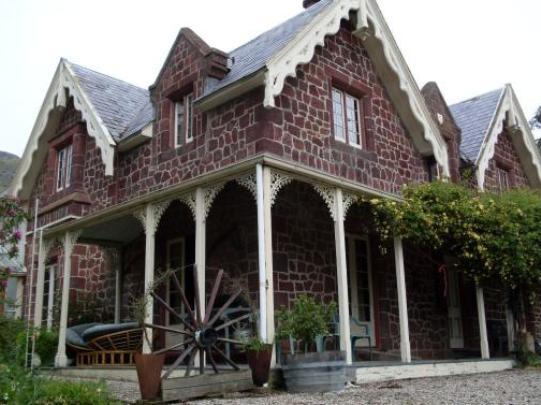
Built in 1853 from locally quarried reddish brown sandstone the picturesque Purau homestead has some significance as the first house to be built of stone in Canterbury.
The Greenwood brothers who were the first European settlers in Lyttelton Harbour when they arrived in 1843 built a large timber house at Purau. They sold their run in 1847 to the Rhodes brothers and six years later Robert Rhodes built the fine two storeyed stone house using slate for the roof. The house has large gables with boldly ornamental bargeboards. The graceful verandahs were added in 1858 to George Mallinson's design with the cast iron 'lace' dating from early in this century. The major ground floor rooms have French doors opening to the verandahs while on the left side a conservatory originally adjoined the dining room. In 1910 when the Luttrell brothers made timber additions to the house the conservatory was moved further to the rear. The interior shows little alteration over the years.
Since 1874 the property has been owned by the Gardiner family who still live in the house. Purau homestead is notable for its architectural significance and the association with three important pioneer families in Canterbury's development.
List Entry Information
Status
Listed
List Entry Status
Historic Place Category 1
Access
Private/No Public Access
List Number
280
Date Entered
27th June 1985
Date of Effect
27th June 1985
City/District Council
Christchurch City
Region
Canterbury Region
Legal description
Lot 3 DP 387552 (RT 350439), Canterbury Land District
Status
Listed
List Entry Status
Historic Place Category 1
Access
Private/No Public Access
List Number
280
Date Entered
27th June 1985
Date of Effect
27th June 1985
City/District Council
Christchurch City
Region
Canterbury Region
Legal description
Lot 3 DP 387552 (RT 350439), Canterbury Land District
Construction Details
Start Year
1854
Type
Original Construction
Construction Details
Start Year
1854
Type
Original Construction
Historical and Associated Iwi / Hapū / Whānau
Other Information
This place was identified as significant under previous legislation with different information requirements. It remains significant under the current legislation. There is opportunity under our legislation and policies to add to this information. Further information about this place may be available from the Southern Regional Office of Heritage New Zealand Pouhere Taonga. Please note that entry on the New Zealand Heritage List/Rarangi Korero identifies only the heritage values of the property concerned, and should not be construed as advice on the state of the property, or as a comment of its soundness or safety, including in regard to earthquake risk, safety in the event of fire, or insanitary conditions. This historic place was registered under the Historic Places Act 1980. The following text is the original citation considered by the NZHPT Board at the time of registration. Information in square brackets indicate modifications made after the paper was considered by the NZHPT Board.
Historical and Associated Iwi / Hapū / Whānau
Other Information
This place was identified as significant under previous legislation with different information requirements. It remains significant under the current legislation. There is opportunity under our legislation and policies to add to this information. Further information about this place may be available from the Southern Regional Office of Heritage New Zealand Pouhere Taonga. Please note that entry on the New Zealand Heritage List/Rarangi Korero identifies only the heritage values of the property concerned, and should not be construed as advice on the state of the property, or as a comment of its soundness or safety, including in regard to earthquake risk, safety in the event of fire, or insanitary conditions. This historic place was registered under the Historic Places Act 1980. The following text is the original citation considered by the NZHPT Board at the time of registration. Information in square brackets indicate modifications made after the paper was considered by the NZHPT Board.
Current Usages
Uses: Accommodation
Specific Usage: House
Former Usages
General Usage: Accommodation
Specific Usage: House
Current Usages
Uses: Accommodation
Specific Usage: House
Former Usages
General Usage: Accommodation
Specific Usage: House
Location
Sign up to hear more
Get the latest heritage news, features and events delivered
straight to your inbox.
