

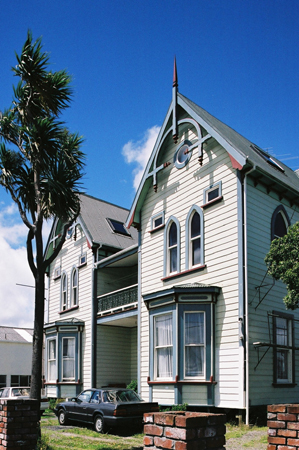
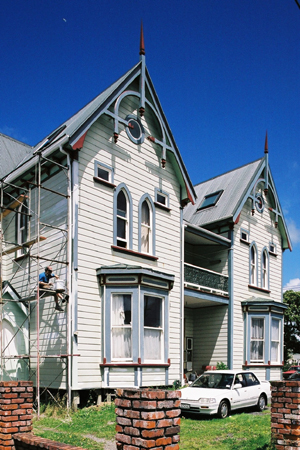
Originally named 'Sunnyside', the building was a two-storey, late Victorian villa with Gothic detailing. It featured gables, topped with large finials, that had an unusual arch and post decorative infill. The main elevation on Sydney Street, was symmetrical, with bay windows in the lower floor of each wing that were originally were surmounted by wrought-iron decoration.
Price and his family remained in the house for less than four years, which may explain the building's colloquial name 'Price's Folly'. In 1904 Price retired, and relocated to Roxburgh Street in Wellington for health reasons. He died the following year.
The house was sold to the Wellington Education Board and was used to accommodate the Petone Technical School until 1908. It then became the Secondary Department of the Petone District High School. In 1915 it housed the infant classes of Petone West School, and by the 1920s the Education Board was leasing the building as a boarding house. The Board sold the house in 1928 to Barnet Goldberg, a manufacturing tailor, and it again became a private residence. It then had a variety of owners, and in 1986 was used for the setting of a New Zealand television drama series. In 1987 the house was damaged by fire and much of the interior was destroyed. The house was repaired and is, once again, a dwelling.
Price's Folly is a well-known landmark in Petone. It is one of only a few domestic buildings of that age and size in Petone. Historically it is associated with Thomas Price, a successful businessman and local identity. Since Price's death the house has had a varied history including school, and boarding house.
List Entry Information
Status
Listed
List Entry Status
Historic Place Category 2
Access
Private/No Public Access
List Number
2886
Date Entered
11th December 2003
Date of Effect
11th December 2003
City/District Council
Hutt City
Region
Wellington Region
Extent of List Entry
Extent includes the land described as Lots 7-8 DP 412 (RT WN WN769/33), Wellington Land District and the building known as Price's Folly thereon in its entirety.
Legal description
Lots 7-8 DP 412 (RT WN WN769/33), Wellington Land District
Status
Listed
List Entry Status
Historic Place Category 2
Access
Private/No Public Access
List Number
2886
Date Entered
11th December 2003
Date of Effect
11th December 2003
City/District Council
Hutt City
Region
Wellington Region
Extent of List Entry
Extent includes the land described as Lots 7-8 DP 412 (RT WN WN769/33), Wellington Land District and the building known as Price's Folly thereon in its entirety.
Legal description
Lots 7-8 DP 412 (RT WN WN769/33), Wellington Land District
Why is this place significant?
Cultural Significance
Price's Folly is of cultural and social significance as a place of learning and, in the mid 1980s, as the setting for a television drama series. It has further social value as a well-known landmark to the Petone community.
Historic Significance
Historical Significance or Value The house has historic significance through its association with the prominent late nineteenth century timber merchant, Thomas Price, and, after the building was sold, with education at all levels in Petone until about 1928.
Physical Significance
Price's Folly is aesthetically and architecturally significant as the largest late Victorian house built and remaining in Petone, the site of the New Zealand Company's first settlement.
Why is this place Category 1 / Category 2?
Detail Of Assessed Criteria
As a place of historical and cultural heritage, Price's Folly is assigned Category l l status under the Historic Places Act 1993. a) Price's Folly is an outstanding example of the type of grand residence that could be constructed by a self-made man in the late nineteenth to early twentieth century. (b) Sawmilling, timber dressing, and the sale of finished wood products were all important parts of late nineteenth century life in New Zealand as most houses were built from locally-milled and dressed timber. Demand was high as towns and cities expanded. Thomas Price had at least three sawmills in the Wairarapa, and set himself up as a significant timber merchant in Petone where there was a major outlet for his produce. His home there was a measure of his success. (c)The place has strong potential for providing knowledge of New Zealand history as a relatively rare example of a very large Carpenter Gothic mansion built as his own home by a successful self-made man. (e) There is a strong community association with this place through its' former use as an educational establishment, and also for its use as a setting in the television drama series 'Open House' in the mid-1980s. There is still considerable public esteem for the place because of its size in relation to the surroundings, because of its survival against considerable odds, and the fact that it is still a living home, although requiring constant maintenance. This esteem was recognised in a Cityscape article in the Evening Post in 1979. (f) The place has potential for public education as it is easily visible from many parts of Petone, as well as being close to several prominent streets. It has already figured in several leaflets detailing the history of Petone for the general public. (g) The design is an unusual combination of high stud, steeply pitched roofs, and a multiplicity of gables on tall, narrow frontages. It is an accomplished design showing wide variety in the use of timber for construction and ornament. (h) Price's Folly is symbolic of what was seen as ostentation by the people of Petone early last century, but it remains a symbol of the lasting quality of Price's work. (j) This building has had a large number of uses in the course of a long history, from residence to different types of educational establishment, to clothing factory, television location, and back to residence. In this respect and also in the quirkiness of the design, it is a rare type of historic place. (k) Price's Folly now borders a light industrial area to the north, but in the other cardinal directions are many single-storey houses, most of which date from before the turn of the previous century or the 1920s. It thus forms a focus for a wider historical and cultural complex at the present time.
Why is this place significant?
Cultural Significance
Price's Folly is of cultural and social significance as a place of learning and, in the mid 1980s, as the setting for a television drama series. It has further social value as a well-known landmark to the Petone community.
Historic Significance
Historical Significance or Value The house has historic significance through its association with the prominent late nineteenth century timber merchant, Thomas Price, and, after the building was sold, with education at all levels in Petone until about 1928.
Physical Significance
Price's Folly is aesthetically and architecturally significant as the largest late Victorian house built and remaining in Petone, the site of the New Zealand Company's first settlement.
Why is this place Category 1 / Category 2?
Detail Of Assessed Criteria
As a place of historical and cultural heritage, Price's Folly is assigned Category l l status under the Historic Places Act 1993. a) Price's Folly is an outstanding example of the type of grand residence that could be constructed by a self-made man in the late nineteenth to early twentieth century. (b) Sawmilling, timber dressing, and the sale of finished wood products were all important parts of late nineteenth century life in New Zealand as most houses were built from locally-milled and dressed timber. Demand was high as towns and cities expanded. Thomas Price had at least three sawmills in the Wairarapa, and set himself up as a significant timber merchant in Petone where there was a major outlet for his produce. His home there was a measure of his success. (c)The place has strong potential for providing knowledge of New Zealand history as a relatively rare example of a very large Carpenter Gothic mansion built as his own home by a successful self-made man. (e) There is a strong community association with this place through its' former use as an educational establishment, and also for its use as a setting in the television drama series 'Open House' in the mid-1980s. There is still considerable public esteem for the place because of its size in relation to the surroundings, because of its survival against considerable odds, and the fact that it is still a living home, although requiring constant maintenance. This esteem was recognised in a Cityscape article in the Evening Post in 1979. (f) The place has potential for public education as it is easily visible from many parts of Petone, as well as being close to several prominent streets. It has already figured in several leaflets detailing the history of Petone for the general public. (g) The design is an unusual combination of high stud, steeply pitched roofs, and a multiplicity of gables on tall, narrow frontages. It is an accomplished design showing wide variety in the use of timber for construction and ornament. (h) Price's Folly is symbolic of what was seen as ostentation by the people of Petone early last century, but it remains a symbol of the lasting quality of Price's work. (j) This building has had a large number of uses in the course of a long history, from residence to different types of educational establishment, to clothing factory, television location, and back to residence. In this respect and also in the quirkiness of the design, it is a rare type of historic place. (k) Price's Folly now borders a light industrial area to the north, but in the other cardinal directions are many single-storey houses, most of which date from before the turn of the previous century or the 1920s. It thus forms a focus for a wider historical and cultural complex at the present time.
Construction Professional
Name
Price, Thomas
Type
Builder
Biography
Price's Folly has been a prominent Petone landmark since it was built at the beginning of the 20th century. The house was built by Thomas Price around 1901 to house his family and become a showcase for his sucessful timber business.
Construction Details
Start Year
1902
Type
Original Construction
Description
Precise date of construction cannot be confirmed but land purchase suggests house was probably built between 1901 to 1902
Type
Modification
Description
Chimneys and decoration removed from the bay windows removed
Start Year
1987
Type
Other
Description
Damaged by fire
Type
Modification
Description
Oriel window added
Start Year
2020
Finish Year
2020
Type
Modification
Description
Removal of main internal staircase by B Guthrie.Unclear if original.
Period
2020
Start Year
2000
startYearCirca
Finish Year
2019
finishYearCirca
Type
Modification
Description
multiple skylights added to all upper level roofs post 2010?
Period
2000
Construction Materials
A two-storey timber building with attics and a corrugated iron roof. The house is constructed around a timber frame, with internal timber linings, now partly replaced following a major fire in 1987.
Construction Professional
Name
Price, Thomas
Type
Builder
Biography
Price's Folly has been a prominent Petone landmark since it was built at the beginning of the 20th century. The house was built by Thomas Price around 1901 to house his family and become a showcase for his sucessful timber business.
Construction Details
Start Year
1902
Type
Original Construction
Description
Precise date of construction cannot be confirmed but land purchase suggests house was probably built between 1901 to 1902
Type
Modification
Description
Chimneys and decoration removed from the bay windows removed
Start Year
1987
Type
Other
Description
Damaged by fire
Type
Modification
Description
Oriel window added
Start Year
2020
Finish Year
2020
Type
Modification
Description
Removal of main internal staircase by B Guthrie.Unclear if original.
Period
2020
Start Year
2000
startYearCirca
Finish Year
2019
finishYearCirca
Type
Modification
Description
multiple skylights added to all upper level roofs post 2010?
Period
2000
Construction Materials
A two-storey timber building with attics and a corrugated iron roof. The house is constructed around a timber frame, with internal timber linings, now partly replaced following a major fire in 1987.
Price's Folly, or Sunnyside as it was first known, was probably built in 1901, shortly after the site on which it rests was purchased by Thomas Price. Thomas Price arrived in Nelson from England on the 'Olympus' in 1842 at four years of age with his parents and five siblings. He married Ann Jane Chattock at Wakefield in 1867, and eleven years later became a storekeeper in Carterton. By 1885, he had become a sawmiller there and over the next seven years he expanded the business, establishing mills at Dalefield and Maungamahoe. In 1890 he set up as a timber merchant and sawmiller in Petone, while maintaining his sawmills in Carterton and Maungamahoe. By 1896, the Petone township had grown to 523 dwellings and an estimated population of just over 2,600. Thomas Price was able to offer dressed and undressed building timber, mouldings, skirtings, architraves, doors and sashes to settlers in the expanding settlement. In 1901 Price purchased land in Sydney Street and shortly afterwards he constructed a grand new house on the premises. Price's new home, built to house his large family, became a showcase for all the products he could offer, as well as a sign of his affluence. The house stands as a leviathan, towering over its surroundings even today where it stands on the border between a residential area of primarily single storey former workers' homes and a light industrial area. It is a great, timber, Gothic mansion of two storeys plus attics, multi-gabled, with steeply pitched iron roofs, bay windows, lancet windows and bulls eye windows. Ornament is chiefly confined to the gable ends, but there is also cast iron fern frond decoration as a balustrade fronting the first floor balcony over the entranceway. Old photos show that there was once more iron lace around the front door. Gone too are the original brick chimneys. The former bulls eye window on the south face gable has been replaced by an oriel window of appropriate design, and the gable decoration above it has been simplified. An external staircase has been added at the rear of the building for first floor access. During his residence at Petone, Price became involved in the community. He donated the spire to St Augustine's Church and became a vestryman there; he was a keen cricketer, having served as President of the Carterton Cricket Club between 1895 and 1896. He was also a Freemason, an Oddfellow and a member of the volunteer militia. Price retired from businee in 1904, and ill-health prompted him to move with his family Roxburgh Street in Wellington. Sunnyside was sold to the Education Board of the District of Wellington in October 1905. The Education Board used the building to house the Petone Technical School until 1908, and then as the secondary department of the Petone High School and, finally, from 1915, for the infant classes of the Petone West School. In 1928, the house was sold to a manufacturing tailor, Barnet Goldberg. Subsequently, the building had many owners, and provided the scene for the television drama 'Open House' over a 27-week period of shooting one day or night per week. It reverted to a dwelling following a major fire on 19 July 1987. Considerable renovation and maintenance work was necessary to repair the fire damage as much of the interior, including the wood-panelled hallway, was destroyed and had to be rebuilt. Why did it become known as Price's Folly? Two theories about the name have common currency today. The first is that, at the time of erection, the locals claimed the foundations were too small and weak for the size of the building, and that it would not last. The second was because he only lived there for a few years before moving to Wellington. Price's Folly remains a significant landmark in Petone, commemorating the building skills of Thomas Price, and the township's educational history.
Price's Folly, or Sunnyside as it was first known, was probably built in 1901, shortly after the site on which it rests was purchased by Thomas Price. Thomas Price arrived in Nelson from England on the 'Olympus' in 1842 at four years of age with his parents and five siblings. He married Ann Jane Chattock at Wakefield in 1867, and eleven years later became a storekeeper in Carterton. By 1885, he had become a sawmiller there and over the next seven years he expanded the business, establishing mills at Dalefield and Maungamahoe. In 1890 he set up as a timber merchant and sawmiller in Petone, while maintaining his sawmills in Carterton and Maungamahoe. By 1896, the Petone township had grown to 523 dwellings and an estimated population of just over 2,600. Thomas Price was able to offer dressed and undressed building timber, mouldings, skirtings, architraves, doors and sashes to settlers in the expanding settlement. In 1901 Price purchased land in Sydney Street and shortly afterwards he constructed a grand new house on the premises. Price's new home, built to house his large family, became a showcase for all the products he could offer, as well as a sign of his affluence. The house stands as a leviathan, towering over its surroundings even today where it stands on the border between a residential area of primarily single storey former workers' homes and a light industrial area. It is a great, timber, Gothic mansion of two storeys plus attics, multi-gabled, with steeply pitched iron roofs, bay windows, lancet windows and bulls eye windows. Ornament is chiefly confined to the gable ends, but there is also cast iron fern frond decoration as a balustrade fronting the first floor balcony over the entranceway. Old photos show that there was once more iron lace around the front door. Gone too are the original brick chimneys. The former bulls eye window on the south face gable has been replaced by an oriel window of appropriate design, and the gable decoration above it has been simplified. An external staircase has been added at the rear of the building for first floor access. During his residence at Petone, Price became involved in the community. He donated the spire to St Augustine's Church and became a vestryman there; he was a keen cricketer, having served as President of the Carterton Cricket Club between 1895 and 1896. He was also a Freemason, an Oddfellow and a member of the volunteer militia. Price retired from businee in 1904, and ill-health prompted him to move with his family Roxburgh Street in Wellington. Sunnyside was sold to the Education Board of the District of Wellington in October 1905. The Education Board used the building to house the Petone Technical School until 1908, and then as the secondary department of the Petone High School and, finally, from 1915, for the infant classes of the Petone West School. In 1928, the house was sold to a manufacturing tailor, Barnet Goldberg. Subsequently, the building had many owners, and provided the scene for the television drama 'Open House' over a 27-week period of shooting one day or night per week. It reverted to a dwelling following a major fire on 19 July 1987. Considerable renovation and maintenance work was necessary to repair the fire damage as much of the interior, including the wood-panelled hallway, was destroyed and had to be rebuilt. Why did it become known as Price's Folly? Two theories about the name have common currency today. The first is that, at the time of erection, the locals claimed the foundations were too small and weak for the size of the building, and that it would not last. The second was because he only lived there for a few years before moving to Wellington. Price's Folly remains a significant landmark in Petone, commemorating the building skills of Thomas Price, and the township's educational history.
A complex, two-storey bay villa with a symmetrical front and two bay windows at ground-level on either side of a recessed front door with a roofed open-fronted balcony above. At first floor level are two pairs of Gothic-style lancet sash windows, with two small, curious rectangular windows above, and to the right and left of each pair. The steeply pitched gables above the windows are decorated with large timber finials supported by bracketed half hoops. In the centre of each gable is a bulls eye window. On the north face of the house is a protruding gable with a single, rectangular bay window beneath at ground level, and a small Gothic porch on one side; decoration is similar to that on the Sydney Street frontage. On the south side of the house (Campbell Terrace), a decorative gable breaks the roof line but with less elaborate decoration than the others. An oriel window has been added at the attic level. The rear of the house is similar to the front, but less complex and now has an external staircase leading to the first floor level. Decorative cast iron in a fern pattern forms a balustrade to the first floor verandah at the front of the house. The total length of the front of the house is approximately 19 metres and the length on the Campbell Terrace side is approximately 17 metres.
A complex, two-storey bay villa with a symmetrical front and two bay windows at ground-level on either side of a recessed front door with a roofed open-fronted balcony above. At first floor level are two pairs of Gothic-style lancet sash windows, with two small, curious rectangular windows above, and to the right and left of each pair. The steeply pitched gables above the windows are decorated with large timber finials supported by bracketed half hoops. In the centre of each gable is a bulls eye window. On the north face of the house is a protruding gable with a single, rectangular bay window beneath at ground level, and a small Gothic porch on one side; decoration is similar to that on the Sydney Street frontage. On the south side of the house (Campbell Terrace), a decorative gable breaks the roof line but with less elaborate decoration than the others. An oriel window has been added at the attic level. The rear of the house is similar to the front, but less complex and now has an external staircase leading to the first floor level. Decorative cast iron in a fern pattern forms a balustrade to the first floor verandah at the front of the house. The total length of the front of the house is approximately 19 metres and the length on the Campbell Terrace side is approximately 17 metres.
Historical and Associated Iwi / Hapū / Whānau
Completion Date
11th December 2003
Report Written By
Helen McCracken / Geoff Mew
Information Sources
Alexander Turnbull Library
Alexander Turnbull Library, Wellington
Butterworth, 1988
Susan Butterworth, 'Petone, A history', Auckland, 1988
Hutt City Council
Hutt City Council
Other Information
A fully referenced Registration Report is available from the NZHPT Central Region office Please note that entry on the New Zealand Heritage List/Rarangi Korero identifies only the heritage values of the property concerned, and should not be construed as advice on the state of the property, or as a comment of its soundness or safety, including in regard to earthquake risk, safety in the event of fire, or insanitary conditions.
Historical and Associated Iwi / Hapū / Whānau
Completion Date
11th December 2003
Report Written By
Helen McCracken / Geoff Mew
Information Sources
Alexander Turnbull Library
Alexander Turnbull Library, Wellington
Butterworth, 1988
Susan Butterworth, 'Petone, A history', Auckland, 1988
Hutt City Council
Hutt City Council
Other Information
A fully referenced Registration Report is available from the NZHPT Central Region office Please note that entry on the New Zealand Heritage List/Rarangi Korero identifies only the heritage values of the property concerned, and should not be construed as advice on the state of the property, or as a comment of its soundness or safety, including in regard to earthquake risk, safety in the event of fire, or insanitary conditions.
Current Usages
Uses: Accommodation
Specific Usage: House
Former Usages
General Usage: Accommodation
Specific Usage: Boarding/ Guest House
General Usage: Education
Specific Usage: School
Current Usages
Uses: Accommodation
Specific Usage: House
Former Usages
General Usage: Accommodation
Specific Usage: Boarding/ Guest House
General Usage: Education
Specific Usage: School
Location
Sign up to hear more
Get the latest heritage news, features and events delivered
straight to your inbox.
