DonateSupporterVisit Heritage
  • Tūrangawaewae
    Places
  • Tira Māori
    Māori Heritage
  • Poutairangahia
    Archaeology
  • Rauemi
    Resources
  • Mō Tātou
    About Us
  • New Zealand Heritage List
  • Nominate and submit
  • Explore the List
  • National Historic Landmarks
  • Plaques
  • Rainbow List Project
  • Lost heritage
  • Visit Heritage
  • Our properties
  • Turnbull House Project
  • Collections
  • Shop
  • Tohu Whenua
  • Tira Māori
  • Conserving Māori heritage
  • Marae built heritage
  • Māori heritage on the List
  • Hinemihi—Te Hokinga Mai
  • What is archaeology?
  • Is there a site on my property?
  • What are my legal requirements?
  • Affecting an archaeological site
  • Declaring an archaeological site
  • Archaeology FAQs
  • Archaeology Digital Library
  • Archaeology guidelines and templates
  • Resources
  • Funding
  • Publications
  • Sustainable management guides
  • Disaster recovery
  • Podcasts & digital resources
  • Education Hub
  • Conservation plans
  • About
  • Board
  • Māori Heritage Council
  • Senior Staff
  • Offices
  • Contact us
  • Careers
  • Covenants
  • Fast-track
  • Corporate documents
  • Currently consulting on
  • Our submissions
  • News
Quick links
Rārangi Kōrero | The List
Explore the List
National Historic Landmarks
Ngā Manawhenua o Aotearoa me ōna Kōrero Tūturu
Quick links
Tapuwae
A Vision for Places of Māori Heritage
Funding for Māori Heritage
Resources
Quick links
Archaeological Authority Portal
Applying for an archaeological authority
Archaeology FAQs
Browse the most frequently asked questions about archaeological authorities and the archaeological process.
Quick links
Quick links
Contact us
Offices
DonateSupporterVisit Heritage
  • Tūrangawaewae
    Places
  • Tira Māori
    Māori Heritage
  • Poutairangahia
    Archaeology
  • Rauemi
    Resources
  • Mō Tātou
    About Us
  • New Zealand Heritage List
  • Nominate and submit
  • Explore the List
  • National Historic Landmarks
  • Plaques
  • Rainbow List Project
  • Lost heritage
  • Visit Heritage
  • Our properties
  • Turnbull House Project
  • Collections
  • Shop
  • Tohu Whenua
  • Tira Māori
  • Conserving Māori heritage
  • Marae built heritage
  • Māori heritage on the List
  • Hinemihi—Te Hokinga Mai
  • What is archaeology?
  • Is there a site on my property?
  • What are my legal requirements?
  • Affecting an archaeological site
  • Declaring an archaeological site
  • Archaeology FAQs
  • Archaeology Digital Library
  • Archaeology guidelines and templates
  • Resources
  • Funding
  • Publications
  • Sustainable management guides
  • Disaster recovery
  • Podcasts & digital resources
  • Education Hub
  • Conservation plans
  • About
  • Board
  • Māori Heritage Council
  • Senior Staff
  • Offices
  • Contact us
  • Careers
  • Covenants
  • Fast-track
  • Corporate documents
  • Currently consulting on
  • Our submissions
  • News
Quick links
Rārangi Kōrero | The List
Explore the List
National Historic Landmarks
Ngā Manawhenua o Aotearoa me ōna Kōrero Tūturu
Quick links
Tapuwae
A Vision for Places of Māori Heritage
Funding for Māori Heritage
Resources
Quick links
Archaeological Authority Portal
Applying for an archaeological authority
Archaeology FAQs
Browse the most frequently asked questions about archaeological authorities and the archaeological process.
Quick links
Quick links
Contact us
Offices
  • Places
  • Nominate and submit
  • National Historic Landmarks
  • Places
  • Nominate and submit
  • National Historic Landmarks
  • Tira Māori
  • Conserving Māori heritage
  • Marae built heritage
  • Tira Māori
  • Conserving Māori heritage
  • Marae built heritage
  • Archaeological authorities
  • Archaeology Digital Library
  • Archaeological authorities
  • Archaeology Digital Library
  • All resources
  • Publications
  • Funding
  • All resources
  • Publications
  • Funding
  • FAQs
  • FAQs
Follow us on:
Places
  • Places
  • Nominate and submit
  • National Historic Landmarks
Tira Māori
  • Tira Māori
  • Conserving Māori heritage
  • Marae built heritage
Archaeology
  • Archaeological authorities
  • Archaeology Digital Library
Resources
  • All resources
  • Publications
  • Funding
FAQs
  • FAQs
Follow us on
HomePrivacyTerms and conditionsAbout this site
© Heritage New Zealand Pouhere Taonga 2026.
 
House

10 Wensley Road, RICHMOND

Private

Historic Place Category 2

List No. 3005

Quick links:
List GalleryLocationDetails
Constructed at 61 Nile Street in the 1920s, Kershaw House is a noteworthy example of the English suburban style and features Art Deco influences. The House is a two-storied, weatherboard home with corrugated iron roofing. It has an elaborate interior, with the main door opening up to reveal an wood-panelled entranceway and staircase. The stairs lead to an Art Deco style stained-glass bay window on the staircase landing. The window features geometric patterns, most notably diamond shapes, which are highlighted by the use of filigree lead. Phillips and Maclean (1983:95) state that although the bevels give the windows a jewel-like quality, the design has a mathematic precision. In its symmetry and repetition, the window reflects the logic and order of a machine-age world. However, there is a flaw in the top corner of the right-hand window as the leadline curves to the left instead of the right as in the other windows. Phillips and Maclean (1983:95) conclude that this was either a deliberate act of rebellion on the part of the artist or a simple mistake.

Little historical information is available about the original owners of Kershaw House. From 1944 or 1945 it was occupied by the prominent Nelson doctor, David Collingwood Low. Low remained there until the early 1980s. His surgery was located along the side of the house in a room marked 'games room' on the plans and his dispensary was situated in what is now the office.

In the 1980s a large area of Nelson central was earmarked for demolition, in preparation for the construction of the new Regional Polytechnic campus. In 1988 the then owner D.G. McLean obtained consent to relocate Kershaw House to 10 Wensley Road. The entire house was successfully relocated in five pieces. Kershaw House was converted in 2003 to a luxury bed and breakfast operation with four en-suite guest
rooms.
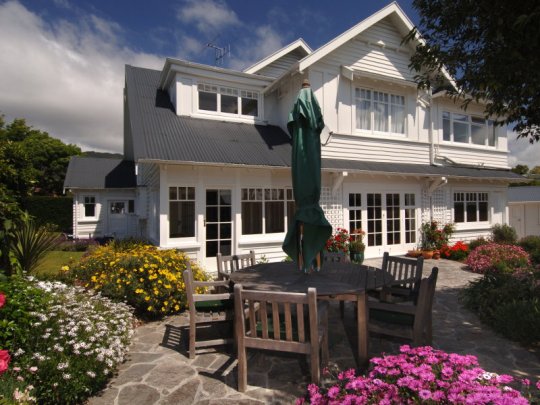
House | Robert McClean | 01/01/2005 | Heritage New Zealand Pouhere Taonga

List Entry Information

Overview

Status
Listed

List Entry Status
Historic Place Category 2

Access
Private/No Public Access

List Number
3005

Date Entered
24th June 2005

Date of Effect
24th June 2005

City/District Council
Tasman District

Region
Tasman Region

Extent of List Entry

Registration includes the buidling, its fixtures and land in certificate of title 6A/1093, Nelson Registry, Section 246 District of Waimea East.

Legal description

Sec 246 District of Waimea East (RT 6A/1093), Nelson Land District

Location Description

Formerly located at 61 Nile Street, Nelson, the house was relocated to 10 Wensley Road, Nelson, in 1988.

Detailed List Entry
Significance

Historic Significance

Historical Significance or Value Kershaw House has historical significance through its association with Doctor David Collingwood Low, an important figure in Nelson medical history.

Physical Significance

Kershaw House is a grand example of residential architecture. It was built during the 1920s and exhibits features of the English suburban style such as bold roof shapes and large 'picture' windows. The most significant aspect of Kershaw House is the Art Deco stained glass bay window on the staircase landing.

Detail Of Assessed Criteria

(b) 'The association of the place with events, persons, or ideas of importance in New Zealand history' Kershaw House is associated with Doctor D.C. Low who lived at the property from 1944/1945 to the early 1980s. Doctor D.C. Low is considered to have been a health leader in the Nelson region; he was responsible for the establishment of the Nelson branch of the St John Ambulance Association in 1931 and held various posts including chairman of the hospital board and president of the New Zealand section of the British Medical Association. Doctor D.C. Low worked as a general practitioner from 1928 to 1977 and his surgery and dispensary were located at Kershaw House. (g) 'The technical accomplishment or value, or design of the place' Kershaw House has an elaborate Art Deco stained glass bay window on the staircase landing which shows considerable craftsmanship.

Construction Details

Start Year

1921

Finish Year

1927

Type

Original Construction

Start Year

1988

Type

Relocation

Description

Relocated from 61 Nile Street to 10 Wensley Road.

Start Year

1994

Type

Modification

Description

Ensuite bathrooms installed.

Construction Materials

The house exterior is clad in weatherboard and there is corrugated iron roofing at both the ground floor and first floor level.

Physical Description

Built in the 1920s, Kershaw House is a fine example of English suburban style. The intricately designed Art Deco stained-glass bay window is the 'showpiece' of the home. On the ground floor there is an extensive wood-panelled entranceway. This entranceway leads to an oak staircase with panels continuing right along the wall to the top of the stairs on the first floor. There are casement windows throughout the house - many of which share the same design of one large pane bordered by two, three, or four small panes along the top. The top floor of Kershaw House has been converted to bed and breakfast accommodation with four en-suite guest rooms.

Reference

Completion Date

15th February 2005

Report Written By

J. Wylie.

Report Written By

A full referenced registration report is available from the NZHPT Central Region Office Please note that entry on the New Zealand Heritage List/Rarangi Korero identifies only the heritage values of the property concerned, and should not be construed as advice on the state of the property, or as a comment of its soundness or safety, including in regard to earthquake risk, safety in the event of fire, or insanitary conditions.

Further Information

Current Usages

Uses: Accommodation

Specific Usage: House

Former Usages

General Usage:: Accommodation

Specific Usage: House

Themes

Web Links

description:

url: http://kershawhouse.co.nz/

Overview

Status

Listed

List Entry Status

Historic Place Category 2

Access

Private/No Public Access

List Number

3005

Date Entered

24th June 2005

Date of Effect

24th June 2005

City/District Council

Tasman District

Region

Tasman Region

Extent of List Entry

Registration includes the buidling, its fixtures and land in certificate of title 6A/1093, Nelson Registry, Section 246 District of Waimea East.

Legal description

Sec 246 District of Waimea East (RT 6A/1093), Nelson Land District

Location Description

Formerly located at 61 Nile Street, Nelson, the house was relocated to 10 Wensley Road, Nelson, in 1988.

Status

Listed

List Entry Status

Historic Place Category 2

Access

Private/No Public Access

List Number

3005

Date Entered

24th June 2005

Date of Effect

24th June 2005

City/District Council

Tasman District

Region

Tasman Region

Extent of List Entry

Registration includes the buidling, its fixtures and land in certificate of title 6A/1093, Nelson Registry, Section 246 District of Waimea East.

Legal description

Sec 246 District of Waimea East (RT 6A/1093), Nelson Land District

Location Description

Formerly located at 61 Nile Street, Nelson, the house was relocated to 10 Wensley Road, Nelson, in 1988.

Significance

Why is this place significant?

Historic Significance

Historical Significance or Value Kershaw House has historical significance through its association with Doctor David Collingwood Low, an important figure in Nelson medical history.

Physical Significance

Kershaw House is a grand example of residential architecture. It was built during the 1920s and exhibits features of the English suburban style such as bold roof shapes and large 'picture' windows. The most significant aspect of Kershaw House is the Art Deco stained glass bay window on the staircase landing.

Why is this place Category 1 / Category 2?

Detail Of Assessed Criteria

(b) 'The association of the place with events, persons, or ideas of importance in New Zealand history' Kershaw House is associated with Doctor D.C. Low who lived at the property from 1944/1945 to the early 1980s. Doctor D.C. Low is considered to have been a health leader in the Nelson region; he was responsible for the establishment of the Nelson branch of the St John Ambulance Association in 1931 and held various posts including chairman of the hospital board and president of the New Zealand section of the British Medical Association. Doctor D.C. Low worked as a general practitioner from 1928 to 1977 and his surgery and dispensary were located at Kershaw House. (g) 'The technical accomplishment or value, or design of the place' Kershaw House has an elaborate Art Deco stained glass bay window on the staircase landing which shows considerable craftsmanship.

Why is this place significant?

Historic Significance

Historical Significance or Value Kershaw House has historical significance through its association with Doctor David Collingwood Low, an important figure in Nelson medical history.

Physical Significance

Kershaw House is a grand example of residential architecture. It was built during the 1920s and exhibits features of the English suburban style such as bold roof shapes and large 'picture' windows. The most significant aspect of Kershaw House is the Art Deco stained glass bay window on the staircase landing.

Why is this place Category 1 / Category 2?

Detail Of Assessed Criteria

(b) 'The association of the place with events, persons, or ideas of importance in New Zealand history' Kershaw House is associated with Doctor D.C. Low who lived at the property from 1944/1945 to the early 1980s. Doctor D.C. Low is considered to have been a health leader in the Nelson region; he was responsible for the establishment of the Nelson branch of the St John Ambulance Association in 1931 and held various posts including chairman of the hospital board and president of the New Zealand section of the British Medical Association. Doctor D.C. Low worked as a general practitioner from 1928 to 1977 and his surgery and dispensary were located at Kershaw House. (g) 'The technical accomplishment or value, or design of the place' Kershaw House has an elaborate Art Deco stained glass bay window on the staircase landing which shows considerable craftsmanship.

Construction Information

Construction Details

Start Year

1921

Finish Year

1927

Type

Original Construction

Start Year

1988

Type

Relocation

Description

Relocated from 61 Nile Street to 10 Wensley Road.

Start Year

1994

Type

Modification

Description

Ensuite bathrooms installed.

Construction Materials

The house exterior is clad in weatherboard and there is corrugated iron roofing at both the ground floor and first floor level.

Construction Details

Start Year

1921

Finish Year

1927

Type

Original Construction

Start Year

1988

Type

Relocation

Description

Relocated from 61 Nile Street to 10 Wensley Road.

Start Year

1994

Type

Modification

Description

Ensuite bathrooms installed.

Construction Materials

The house exterior is clad in weatherboard and there is corrugated iron roofing at both the ground floor and first floor level.

Physical Description

Built in the 1920s, Kershaw House is a fine example of English suburban style. The intricately designed Art Deco stained-glass bay window is the 'showpiece' of the home. On the ground floor there is an extensive wood-panelled entranceway. This entranceway leads to an oak staircase with panels continuing right along the wall to the top of the stairs on the first floor. There are casement windows throughout the house - many of which share the same design of one large pane bordered by two, three, or four small panes along the top. The top floor of Kershaw House has been converted to bed and breakfast accommodation with four en-suite guest rooms.

Built in the 1920s, Kershaw House is a fine example of English suburban style. The intricately designed Art Deco stained-glass bay window is the 'showpiece' of the home. On the ground floor there is an extensive wood-panelled entranceway. This entranceway leads to an oak staircase with panels continuing right along the wall to the top of the stairs on the first floor. There are casement windows throughout the house - many of which share the same design of one large pane bordered by two, three, or four small panes along the top. The top floor of Kershaw House has been converted to bed and breakfast accommodation with four en-suite guest rooms.

Reference

Historical and Associated Iwi / Hapū / Whānau

Completion Date

15th February 2005

Report Written By

J. Wylie.

Other Information

A full referenced registration report is available from the NZHPT Central Region Office Please note that entry on the New Zealand Heritage List/Rarangi Korero identifies only the heritage values of the property concerned, and should not be construed as advice on the state of the property, or as a comment of its soundness or safety, including in regard to earthquake risk, safety in the event of fire, or insanitary conditions.

Historical and Associated Iwi / Hapū / Whānau

Completion Date

15th February 2005

Report Written By

J. Wylie.

Other Information

A full referenced registration report is available from the NZHPT Central Region Office Please note that entry on the New Zealand Heritage List/Rarangi Korero identifies only the heritage values of the property concerned, and should not be construed as advice on the state of the property, or as a comment of its soundness or safety, including in regard to earthquake risk, safety in the event of fire, or insanitary conditions.

Further Information

Current Usages

Uses: Accommodation

Specific Usage: House

Former Usages

General Usage: Accommodation

Specific Usage: House

Web Links

description:

url: http://kershawhouse.co.nz/

Current Usages

Uses: Accommodation

Specific Usage: House

Former Usages

General Usage: Accommodation

Specific Usage: House

Web Links

description:

url: http://kershawhouse.co.nz/

Location

Loading
Sign up to hear more

Get the latest heritage news, features and events delivered
straight to your inbox.

Subscribe