

In the 1960s declining attendance at churches in Winchester led to the decision to unify the Presbyterian and Anglican parishes, with activity centred on the Presbyterian Church Hall. In 1971 the Anglican Parish offered their now redundant building as a gift to the Waihi Preparatory School, covering the cost of moving it to its new location, repairing and painting it. In June 1972 the church was shifted the few kilometres north to the grounds of the school, where it was formally reopened the following September. This enabled it to serve not only the parish, but also as chapel for the Anglican boys preparatory school.
The Waihi Boys' Preparatory School was established in 1907 by Joseph Robinson Orford, an English born teacher who had lived in New Zealand for some years, and who felt that the South Island needed a boys' preparatory school. He bought a 15 acre paddock of stony broom and gorse covered land just north of Winchester and built a large house to serve as his family home, with boarding accommodation and school rooms included. It opened in September 1907 with just three pupils, the numbers increasing as each year passed, but about 80 has been the ceiling. There were close links with St John's Anglican Church from the earliest days of the school with Orford conducting many of the services as the vicar from Temuka was only scheduled here once a month.
When Orford died in 1924 a memorial plaque was placed in the nave of the church, and the Waihi Old Boys Association commemorated him by providing the stained glass window, installed in the chancel in 1930. Designed and executed by Veronica Whall it is an unusual example of her superb craftsmanship in her use of soft pastel colourings rather than the more frequently seen rich, vibrant colour hues. Renowned in Canterbury for the quality of the windows she designed for churches in the province, the English artist has depicted "The Christ-Child Blessing in Majesty with Emblems of Faith and Hope." Painted around the enclosing arch are the words "Give unto the Lord the glory due unto his name. Worship the Lord in the beauty of holiness." As well as the memorial to Orford there is also a brass tablet commemorating local flour miller D. Inwood, benefactor of the church's original site.
In the 1960s the school's connection with the church lessened as State Highway 1 had become so busy it was hazardous for the boys to walk to church, and services were conducted in the school's music room. The donation of St John's Church overcame the school's need for a chapel of its own, while ensuring the heritage building's retention and continued use in its home town.
Thomas Cane (1830-1905) was born in Brighton, England, and worked for Sir George Gilbert Scott before emigrating to Canterbury in 1874. Cane initially succeeded Benjamin Mountfort as Provincial Architect in 1875, but became Education Board Architect following the abolition of the provinces in 1876. Buildings designed by Cane include the Lyttelton Time Ball Station (1876), the original Christchurch Girls' High School (1876), and the School Master's House, Timaru (1878).
List Entry Information
Status
Listed
List Entry Status
Historic Place Category 2
Access
Private/No Public Access
List Number
3164
Date Entered
25th June 2004
Date of Effect
25th June 2004
City/District Council
Timaru District
Region
Canterbury Region
Extent of List Entry
Registration Includes: The Church, its fittings and fixtures, and land on RT CB26B/127.
Legal description
Lot 1 DP 46763 (RT CB26B/127)
Status
Listed
List Entry Status
Historic Place Category 2
Access
Private/No Public Access
List Number
3164
Date Entered
25th June 2004
Date of Effect
25th June 2004
City/District Council
Timaru District
Region
Canterbury Region
Extent of List Entry
Registration Includes: The Church, its fittings and fixtures, and land on RT CB26B/127.
Legal description
Lot 1 DP 46763 (RT CB26B/127)
Why is this place significant?
Historic Significance
Historical Significance or Value Its historical, social and spiritual significance relate to its position as the centre of Anglican worship in Winchester for 125 years and as a key component of the school complex since 1972.
Physical Significance
St John's Anglican Church has aesthetic significance as a simple Gothic building in its present semi-rural setting, with a fine interior featuring a splendid stained glass window in the sanctuary. It has architectural value as an example of the work of significant Canterbury architect Thomas Cane.
Why is this place Category 1 / Category 2?
Detail Of Assessed Criteria
St John's Anglican Church, Waihi School, can be assigned Category Two status because of the high degree of community esteem for the church, an esteem which saw it moved and restored on a new site in order that it could remain a place of worship. The interior is dominated by the fine sanctuary window designed and executed by Veronica Whall, an esteemed English stained glass craftswoman who was responsible for a number of notable windows in South Canterbury church. The church also has an important commemorative function, particularly as a memorial to J. R. Orford, founder of the Waihi School. This commemorative function has been strengthened since the relocation of the church to the school grounds.
Why is this place significant?
Historic Significance
Historical Significance or Value Its historical, social and spiritual significance relate to its position as the centre of Anglican worship in Winchester for 125 years and as a key component of the school complex since 1972.
Physical Significance
St John's Anglican Church has aesthetic significance as a simple Gothic building in its present semi-rural setting, with a fine interior featuring a splendid stained glass window in the sanctuary. It has architectural value as an example of the work of significant Canterbury architect Thomas Cane.
Why is this place Category 1 / Category 2?
Detail Of Assessed Criteria
St John's Anglican Church, Waihi School, can be assigned Category Two status because of the high degree of community esteem for the church, an esteem which saw it moved and restored on a new site in order that it could remain a place of worship. The interior is dominated by the fine sanctuary window designed and executed by Veronica Whall, an esteemed English stained glass craftswoman who was responsible for a number of notable windows in South Canterbury church. The church also has an important commemorative function, particularly as a memorial to J. R. Orford, founder of the Waihi School. This commemorative function has been strengthened since the relocation of the church to the school grounds.
Construction Professional
Name
Cane, Thomas Walter
Type
Architect
Biography
Thomas Cane (1830-1905) was born in Brighton, Sussex. For many years he worked for Sir Gilbert Scott, the celebrated architect of London. Cane came to Lyttelton in 1874 and succeeded Benjamin Woolfield Mountfort (1825-1898) as Provincial Architect for Canterbury. He held this position until the abolition of the provinces in 1876, making his name as a Christchurch architect. Cane was responsible for Corfe House at Christ's College and for Christchurch Girls' High School which became the School of Art, and later an extension of the University of Canterbury Library. Cane also achieved recognition as a landscape artist.
Name
Clinch & Lloyd
Type
Builder
Biography
No biography is currently available for this construction professional
Name
Waters
Type
Builder
Biography
No biography is currently available for this construction professional
Construction Details
Start Year
1879
Type
Original Construction
Start Year
1890
Type
Addition
Description
Addition of chancel, porch and vestry.
Start Year
1972
Type
Relocation
Description
Relocation from Winchester township to Waihi Preparatory School grounds.
Construction Materials
Timber with a corrugated iron roof.
Construction Professional
Name
Cane, Thomas Walter
Type
Architect
Biography
Thomas Cane (1830-1905) was born in Brighton, Sussex. For many years he worked for Sir Gilbert Scott, the celebrated architect of London. Cane came to Lyttelton in 1874 and succeeded Benjamin Woolfield Mountfort (1825-1898) as Provincial Architect for Canterbury. He held this position until the abolition of the provinces in 1876, making his name as a Christchurch architect. Cane was responsible for Corfe House at Christ's College and for Christchurch Girls' High School which became the School of Art, and later an extension of the University of Canterbury Library. Cane also achieved recognition as a landscape artist.
Name
Clinch & Lloyd
Type
Builder
Biography
No biography is currently available for this construction professional
Name
Waters
Type
Builder
Biography
No biography is currently available for this construction professional
Construction Details
Start Year
1879
Type
Original Construction
Start Year
1890
Type
Addition
Description
Addition of chancel, porch and vestry.
Start Year
1972
Type
Relocation
Description
Relocation from Winchester township to Waihi Preparatory School grounds.
Construction Materials
Timber with a corrugated iron roof.
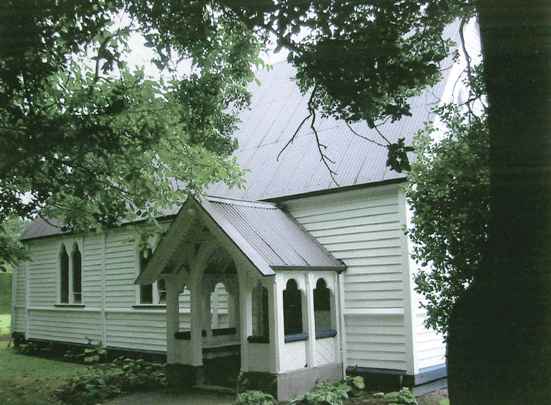
The church is a small weatherboard neo-gothic church, in the early English style. . The nave is covered by a simple pitched roof with the interior's open ceiling featuring timber ribs. It is orientated on its new site with the separately roofed chancel and vestry at its eastern end and the decorative projecting porch facing the school to the north. Paired lancet windows with plain glazing light the nave and two large paired lancets are sited at the west end. In the chancel framed within an arch is a stained glass depiction of The Christ Child blessing in Majesty with Emblems of Faith and Hope. This is set in three tall lancets surmounted by a circular window.
The church is a small weatherboard neo-gothic church, in the early English style. . The nave is covered by a simple pitched roof with the interior's open ceiling featuring timber ribs. It is orientated on its new site with the separately roofed chancel and vestry at its eastern end and the decorative projecting porch facing the school to the north. Paired lancet windows with plain glazing light the nave and two large paired lancets are sited at the west end. In the chancel framed within an arch is a stained glass depiction of The Christ Child blessing in Majesty with Emblems of Faith and Hope. This is set in three tall lancets surmounted by a circular window.
Historical and Associated Iwi / Hapū / Whānau
Completion Date
2nd September 2004
Report Written By
Pam Wilson
Information Sources
Ciaran, 1998
Fiona Ciaran, Stained Glass Windows of Canterbury, New Zealand. A Catalogue Raisonne, Dunedin, 1998
Collins, 1982
J. Collins, History of Waihi School, 1907-1982 Winchester: Waihi School Association,1982.
Wilson, 1991 (2)
J. Wilson, South Canterbury historical guide : including the towns of Timaru, Temuka, Geraldine, Pleasant Point, Fairlie and Waimate, their surrounding country districts, and the Mackenzie Country, Timaru, 1991.
Hopkins, 1978
H Hopkins, Centennial History of the Parish of Temuka and Winchester1878-1978 Temuka: Temuka Parish Centennial Committee, 1978.
New Zealand Historic Places Trust (NZHPT)
New Zealand Historic Places Trust
Teal, 1954
J Teal, 'Booklet published for the seventy-fifth jubilee of St Johns'. 1954.
Other Information
A fully referenced version of this report is available from the NZHPT Southern Region Office. Please note that entry on the New Zealand Heritage List/Rarangi Korero identifies only the heritage values of the property concerned, and should not be construed as advice on the state of the property, or as a comment of its soundness or safety, including in regard to earthquake risk, safety in the event of fire, or insanitary conditions.
Historical and Associated Iwi / Hapū / Whānau
Completion Date
2nd September 2004
Report Written By
Pam Wilson
Information Sources
Ciaran, 1998
Fiona Ciaran, Stained Glass Windows of Canterbury, New Zealand. A Catalogue Raisonne, Dunedin, 1998
Collins, 1982
J. Collins, History of Waihi School, 1907-1982 Winchester: Waihi School Association,1982.
Wilson, 1991 (2)
J. Wilson, South Canterbury historical guide : including the towns of Timaru, Temuka, Geraldine, Pleasant Point, Fairlie and Waimate, their surrounding country districts, and the Mackenzie Country, Timaru, 1991.
Hopkins, 1978
H Hopkins, Centennial History of the Parish of Temuka and Winchester1878-1978 Temuka: Temuka Parish Centennial Committee, 1978.
New Zealand Historic Places Trust (NZHPT)
New Zealand Historic Places Trust
Teal, 1954
J Teal, 'Booklet published for the seventy-fifth jubilee of St Johns'. 1954.
Other Information
A fully referenced version of this report is available from the NZHPT Southern Region Office. Please note that entry on the New Zealand Heritage List/Rarangi Korero identifies only the heritage values of the property concerned, and should not be construed as advice on the state of the property, or as a comment of its soundness or safety, including in regard to earthquake risk, safety in the event of fire, or insanitary conditions.
Current Usages
Uses: Religion
Specific Usage: Chapel
Former Usages
General Usage: Religion
Specific Usage: Church
Current Usages
Uses: Religion
Specific Usage: Chapel
Former Usages
General Usage: Religion
Specific Usage: Church
Location
Sign up to hear more
Get the latest heritage news, features and events delivered
straight to your inbox.
