

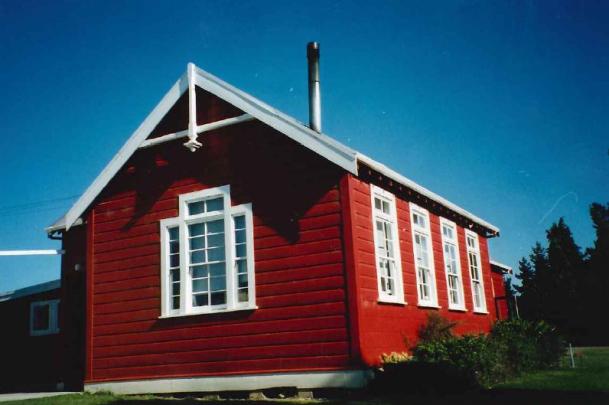
Waianakarua is a rural district in North Otago and the name of a settlement that grew up around this farming and forestry area. With settlement came the need for services such as schools. Initially children walked several kilometres to the towns of Hampden or Herbert. Education was a priority for central government and local communities reflected in the passing of The Education Act 1877 that provided for free, secular and compulsory education for all children aged between seven and thirteen. This Act established state schools for New Zealand children and the administrative structure for education. The Department of Education was responsible for distributing grant funding to education boards. Twelve education boards (made up of nine members elected by school committees) defined school districts within their areas, and established and maintained schools within their districts. School committees were elected by a ballot of local householders, and had management of educational matters in their area.
As the population in Otago became more settled so the Otago Education Board had a building programme for schools. The building programme was based around standard designs with variations according to local circumstances where necessary designed by John Somerville, the Otago Education Board architect from 1878-1901. The form of the buildings reflected the teaching methods, where children were ‘often taught in relays in order to accommodate as many as possible in the small space available.’ Local support for establishing a school came from James Findlay and other prominent men in the community. In February 1883, P.G. Pryde, the secretary of the Otago Education Board, advertised for tenders for the erection of school buildings in the new school districts of Totara and Waianakarua. The school was built by J.E. Jago of Mosgiel for £950. The building had tiered seating on long forms arranged the length of the classroom.
In 1895 the Otago Education Board advertised for additions to the school. The addition was built by J. Menzies of Maheno. The Cyclopedia of Otago and Southland entry for the school records that it was conducted in a wooden building of two rooms with room for 110 students. The school was set on a glebe of ten acres which included a playground and the headmaster’s residence.
The history of the building reflects the changes around Waianakarua. The school roll dropped in the early years of the twentieth century and as a result one of the school rooms was removed to Five Forks School. According to historian C.W.S. Moore, this was probably the 1883 building. Toilets were added around 1958.
In the 1970s, an addition was made to the back of the school and it was further extended in 1994. In 1998 falling rolls led to the closure of the school. In 2016, the school is a private residence.
List Entry Information
Status
Listed
List Entry Status
Historic Place Category 2
Access
Private/No Public Access
List Number
3253
Date Entered
7th April 1983
Date of Effect
7th April 1983
City/District Council
Waitaki District
Region
Otago Region
Extent of List Entry
Extent includes part of the land described as Lot 1 DP 8711 (RT OT18C/1024), Otago Land District, and the building known as Waianakarua School (Former) thereon. Refer to the extent map tabled at the Rārangi Kōrero Committee meeting on 6 September 2017.
Legal description
Lot 1 DP 8711 (RT OT18C/1024), Otago Land District
Status
Listed
List Entry Status
Historic Place Category 2
Access
Private/No Public Access
List Number
3253
Date Entered
7th April 1983
Date of Effect
7th April 1983
City/District Council
Waitaki District
Region
Otago Region
Extent of List Entry
Extent includes part of the land described as Lot 1 DP 8711 (RT OT18C/1024), Otago Land District, and the building known as Waianakarua School (Former) thereon. Refer to the extent map tabled at the Rārangi Kōrero Committee meeting on 6 September 2017.
Legal description
Lot 1 DP 8711 (RT OT18C/1024), Otago Land District
Construction Professional
Name
J.E. Jago
Type
Builder
Biography
Builder of the original 1883 block of the Waianakarua School
Name
Somerville, John (1834-1905)
Type
Architect
Biography
John Somerville was born in Peebles and later served an apprenticeship in carpentry. He came to Otago aboard the Robert Henderson in 1858 and commenced trade as a builder. His early work included the building of the Knox Church manse (later relocated to Forbury Road), and P.C. Neill’s residence in the North East Valley. In 1868 he became inspector of works for the Provincial Government, a position he held until his appointment in 1877 to be architect to the Otago Education Board. He held this position until 1901. He planned and supervised the erection of most of the schools in Otago and designed all Dunedin’s schools of this period. Somerville died in 1905. Source: List Entry Report for Arthur Street School Infant Department (Former), List No. Heather Bauchop, 9717, 4 September 2017.
Name
John Menzies
Type
Builder
Biography
No biography is currently available for this construction professional
Construction Details
Start Year
1895
startYearCirca
Type
Original Construction
Start Year
1883
Type
Other
Description
Construction of original school block
Start Year
1918
Type
Relocation
Description
1883 Block removed to Five Forks
Start Year
1958
Type
Addition
Description
Toilet addition
Type
Addition
Description
Addition to rear of school
Period
1970s
Start Year
1998
Type
Other
Description
School closed
Construction Professional
Name
J.E. Jago
Type
Builder
Biography
Builder of the original 1883 block of the Waianakarua School
Name
Somerville, John (1834-1905)
Type
Architect
Biography
John Somerville was born in Peebles and later served an apprenticeship in carpentry. He came to Otago aboard the Robert Henderson in 1858 and commenced trade as a builder. His early work included the building of the Knox Church manse (later relocated to Forbury Road), and P.C. Neill’s residence in the North East Valley. In 1868 he became inspector of works for the Provincial Government, a position he held until his appointment in 1877 to be architect to the Otago Education Board. He held this position until 1901. He planned and supervised the erection of most of the schools in Otago and designed all Dunedin’s schools of this period. Somerville died in 1905. Source: List Entry Report for Arthur Street School Infant Department (Former), List No. Heather Bauchop, 9717, 4 September 2017.
Name
John Menzies
Type
Builder
Biography
No biography is currently available for this construction professional
Construction Details
Start Year
1895
startYearCirca
Type
Original Construction
Start Year
1883
Type
Other
Description
Construction of original school block
Start Year
1918
Type
Relocation
Description
1883 Block removed to Five Forks
Start Year
1958
Type
Addition
Description
Toilet addition
Type
Addition
Description
Addition to rear of school
Period
1970s
Start Year
1998
Type
Other
Description
School closed
Historical and Associated Iwi / Hapū / Whānau
Completion Date
7th August 2017
Report Written By
Heather Bauchop
Information Sources
Moore, 1983
C.W.S. Moore, Waianakarua: land of promise 1883-1983, Waianakarua School and District Centennial Committee, Waianakarua, 1983
Other Information
This place was identified as significant under previous legislation with different information requirements. It remains significant under the current legislation. There is opportunity under our legislation and policies to add to this information. Further information about this place may be available from the Otago/Southland Office of Heritage New Zealand Pouhere Taonga. Please note that entry on the New Zealand Heritage List/Rarangi Korero identifies only the heritage values of the property concerned, and should not be construed as advice on the state of the property, or as a comment of its soundness or safety, including in regard to earthquake risk, safety in the event of fire, or insanitary conditions. A fully referenced upgrade report is available on request from the Otago/Soutland Area Office of Heritage New Zealand.
Historical and Associated Iwi / Hapū / Whānau
Completion Date
7th August 2017
Report Written By
Heather Bauchop
Information Sources
Moore, 1983
C.W.S. Moore, Waianakarua: land of promise 1883-1983, Waianakarua School and District Centennial Committee, Waianakarua, 1983
Other Information
This place was identified as significant under previous legislation with different information requirements. It remains significant under the current legislation. There is opportunity under our legislation and policies to add to this information. Further information about this place may be available from the Otago/Southland Office of Heritage New Zealand Pouhere Taonga. Please note that entry on the New Zealand Heritage List/Rarangi Korero identifies only the heritage values of the property concerned, and should not be construed as advice on the state of the property, or as a comment of its soundness or safety, including in regard to earthquake risk, safety in the event of fire, or insanitary conditions. A fully referenced upgrade report is available on request from the Otago/Soutland Area Office of Heritage New Zealand.
Current Usages
Uses: Accommodation
Specific Usage: House
Former Usages
General Usage: Education
Specific Usage: School
Current Usages
Uses: Accommodation
Specific Usage: House
Former Usages
General Usage: Education
Specific Usage: School
Location
Sign up to hear more
Get the latest heritage news, features and events delivered
straight to your inbox.
