

Land records show that in 1866 this land was part of James Dalgleish’s freehold on the Papakaio Plain where he owned some 600 acres in Block III. His wife Mary’s obituary reveals some of the family history: James and Mary Dalgleish came to New Zealand around 1858 with their three children john, Archie and Ann. After working at several pastoral stations – including Ben Lomond – they settled in the Papakaio district.
In 1866 Dalgleish advertised land for sale or let at Papakaio – 630 acres of ‘good agricultural land’ with ‘a house with five rooms, good Well of Water, Stockyard, and 7 acre Paddock.’ He described the house as ‘well-adapted for an Accommodation House, being 14 miles from Oamaru.’ James Dalgleish died in February 1873 following a drunken fall from a horse, leaving his wife Mary a life interest in the property. The Dalgleish family were active in the community – Mrs Dalgleish’s ‘barn’ was used for a soiree to raise funds for the Papakaio Church, while the paddock was used for sports events.
In 1895, Mary Dalgleish appears to have occupied the land along with Hawthorne Stewart and Thomas McClurg. Title to this block of land on which the building stands was issued to Mary Dalgleish (described as a ‘Papakaio widow’) as freehold ‘for her life.’ Section 29 may have been occupied by Stewart, as in 1895 the title to this section (and four others) was issued to Stewart, described as an Otiake farmer.
Hawthorne Stewart had lived in the Waitaki district since the 1870s. He sold his Otiake property in December 1895. He is reported as purchasing the Papakaio property of Thomas McClurg in January 1896 for £12 an acre. This may have been a transaction closer to home than that as Mary Dalgleish was Stewart’s mother-in-law (married to her daughter Ann). Stewart sold the property around 1899 and moved to Otipua Station near Timaru. William Gardiner bought the property.
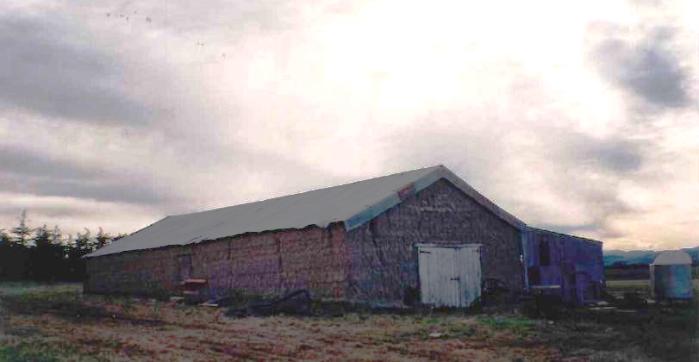
A 1969 newspaper article describes the building as ‘cob’ and notes that it was used as a hay barn and implement store. The owner at the time thought that the clay from which the building was constructed came from a spot some 200 metres away, and that the doors and the iron were original. Baden Gardiner, an earlier owner, recalled that during World War one the building was used as a dance hall.
Architect and historian Geoffrey Thornton writes that this structure was built as a granary in 1868. It was a gable-roofed structure, originally roofed in corrugated iron with a wooden floor. At a later stage a corrugated iron lean-to was added to one side. When Heritage New Zealand archaeologist Matthew Schmidt and building conservator Jonathan Howard visited the site they were able to provide more detail about the structure. Much of the structural timber was circular sawn Rimu but there was evidence that a little of timber may have been pit sawn. The corrugated iron was Walkers, G (Anchor symbol) O, Gospel Oak, Tinned which was first advertised in New Zealand in this form in 1861. It appears that the roof covering was the original. The roof was damaged in 2011. No windows or doors survive. The majority of the floor was earth, but the section of timber was Oregon and Rimu with cut nails. The walls are constructed of rammed earth rather than sod and about 480mm thick. In 2016, the now roofless structure remains part of a working farm.
List Entry Information
Status
Listed
List Entry Status
Historic Place Category 2
Access
Private/No Public Access
List Number
3254
Date Entered
7th April 1983
Date of Effect
7th April 1983
City/District Council
Waitaki District
Region
Otago Region
Extent of List Entry
Extent includes part of the land described as Sec 29 Blk III Papakaio SD (RT OT15B/426) and Legal Road, Otago Land District, and the building known as the Barn (Former) thereon, as shown in the extent map tabled at the Rarangi Korero Committee meeting on 9 March 2017.
Legal description
Sec 29 Blk III Papakaio SD (RT OT15B/426) and Legal Road, Otago Land District.
Status
Listed
List Entry Status
Historic Place Category 2
Access
Private/No Public Access
List Number
3254
Date Entered
7th April 1983
Date of Effect
7th April 1983
City/District Council
Waitaki District
Region
Otago Region
Extent of List Entry
Extent includes part of the land described as Sec 29 Blk III Papakaio SD (RT OT15B/426) and Legal Road, Otago Land District, and the building known as the Barn (Former) thereon, as shown in the extent map tabled at the Rarangi Korero Committee meeting on 9 March 2017.
Legal description
Sec 29 Blk III Papakaio SD (RT OT15B/426) and Legal Road, Otago Land District.
Construction Details
Start Year
2011
Type
Modification
Description
Roof lost in storm.
Start Year
1868
Type
Original Construction
Construction Details
Start Year
2011
Type
Modification
Description
Roof lost in storm.
Start Year
1868
Type
Original Construction
Historical and Associated Iwi / Hapū / Whānau
Completion Date
19th December 2017
Report Written By
Heather Bauchop
Information Sources
Thornton, 1986
Geoffrey Thornton, The New Zealand Heritage of Farm Buildings, Auckland, 1986
Other Information
This place was identified as significant under previous legislation with different information requirements. It remains significant under the current legislation. There is opportunity under our legislation and policies to add to this information. Further information about this place may be available from the Otago/Southland Office of Heritage New Zealand Pouhere Taonga. Please note that entry on the New Zealand Heritage List/Rarangi Korero identifies only the heritage values of the property concerned, and should not be construed as advice on the state of the property, or as a comment of its soundness or safety, including in regard to earthquake risk, safety in the event of fire, or insanitary conditions. A fully referenced upgrade report is available on request from the Otago/Southland Area Office of Heritage New Zealand.
Historical and Associated Iwi / Hapū / Whānau
Completion Date
19th December 2017
Report Written By
Heather Bauchop
Information Sources
Thornton, 1986
Geoffrey Thornton, The New Zealand Heritage of Farm Buildings, Auckland, 1986
Other Information
This place was identified as significant under previous legislation with different information requirements. It remains significant under the current legislation. There is opportunity under our legislation and policies to add to this information. Further information about this place may be available from the Otago/Southland Office of Heritage New Zealand Pouhere Taonga. Please note that entry on the New Zealand Heritage List/Rarangi Korero identifies only the heritage values of the property concerned, and should not be construed as advice on the state of the property, or as a comment of its soundness or safety, including in regard to earthquake risk, safety in the event of fire, or insanitary conditions. A fully referenced upgrade report is available on request from the Otago/Southland Area Office of Heritage New Zealand.
Current Usages
Uses: Ruin
Specific Usage: Misc Archaeological
Former Usages
General Usage: Agriculture
Specific Usage: Barn
General Usage: Agriculture
Specific Usage: Granary/Grain Shed
General Usage: Agriculture
Specific Usage: Shed
Current Usages
Uses: Ruin
Specific Usage: Misc Archaeological
Former Usages
General Usage: Agriculture
Specific Usage: Barn
General Usage: Agriculture
Specific Usage: Granary/Grain Shed
General Usage: Agriculture
Specific Usage: Shed
Location
Sign up to hear more
Get the latest heritage news, features and events delivered
straight to your inbox.
