

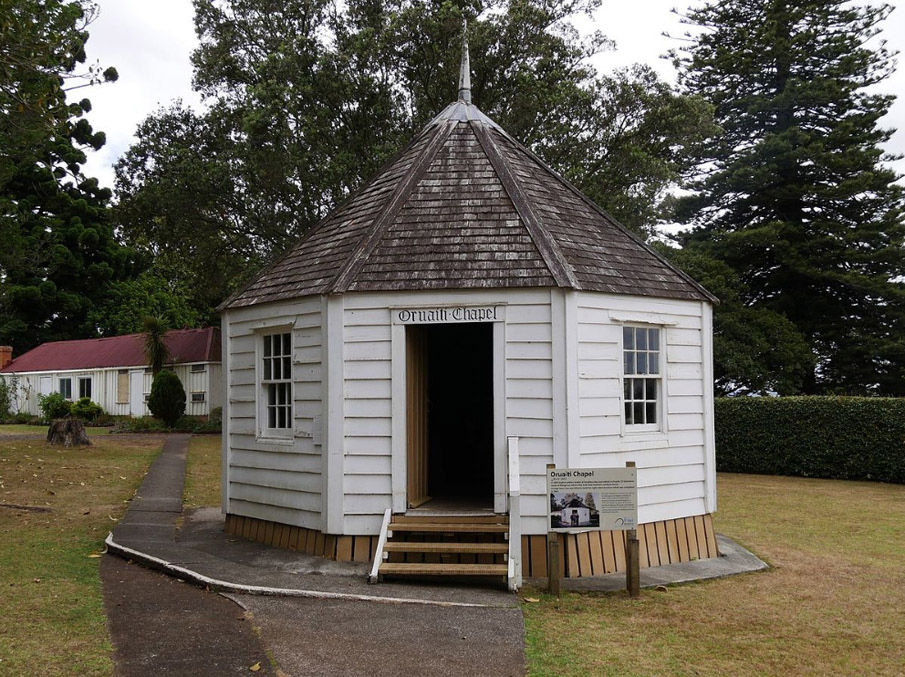
After completing rough dwellings for themselves and their families a group of early settlers led by Mr Thomas Ball erected a chapel for worship at Oruaiti, near Mangonui Harbour. The materials were gifted to the church, the kauri timber being from bush on Ball's land and lead for flashings and a piece of heart oak for the door lock were given to the chapel by pioneers who had personally brought out such materials for their own homes. The chapel was non-denominational and services were held each Sunday by one of the settlers. If there was a visiting clergyman in the area, either Anglican or Methodist, he would administer the sacraments.
In 1870 a library was established in the church, with many of the books supplied by Sir Maurice O'Rorke, Speaker of the Auckland Provincial Council and a Member of the House of Representatives. In 1892 the property changed owners, the Ball family selling to the Foster family. After a period of disuse the chapel was put on skids and moved by bullocks closer to the roadside so as to be accessible to the other families. On 22 May 1936 the chapel and the land it sat on were deeded to the Methodist Church by the Foster family. In 1946 the chapel was moved over 80 miles to 149 Kamo Road, Whangarei and on 13 April 1946 it was reopened and rededicated as the Leigh Memorial Church, in honour of Samuel Leigh, the founder of Methodism in New Zealand. The Chapel was just one of the Methodist buildings on the site and was used for weddings and baptisms, as well as a Sunday school.
When the site was to be redeveloped the Chapel's future was questioned. Three options included incorporating it into the new building, returning it to Oruaiti, and presenting it to the newly established Northland Regional Museum. The latter alternative was chosen and in 1975 it was relocated to the present site and renamed Oruaiti Chapel.
List Entry Information
Status
Listed
List Entry Status
Historic Place Category 2
Access
Able to Visit
List Number
3291
Date Entered
22nd August 1991
Date of Effect
22nd August 1991
City/District Council
Whangārei District
Region
Northland Region
Legal description
Pt Lot 3 DP 13587 (RT NA64D/903), North Auckland Land District
Status
Listed
List Entry Status
Historic Place Category 2
Access
Able to Visit
List Number
3291
Date Entered
22nd August 1991
Date of Effect
22nd August 1991
City/District Council
Whangārei District
Region
Northland Region
Legal description
Pt Lot 3 DP 13587 (RT NA64D/903), North Auckland Land District
Why is this place significant?
Historic Significance
Historical Significance or Value Although moved from its original site, Oruaiti Chapel has historical roots in the colonial settlement at Oruaiti. It was relocated on the same property in 1933 and removed in 1946, reflecting the versatility of its small size.
Physical Significance
ARCHITECTURAL QUALITY: The chapel is a pioneer building said to be the smallest church in New Zealand and possibly the world. TOWNSCAPE/LANDMARK VALUE: It is an important visual element of the museum complex.
Why is this place significant?
Historic Significance
Historical Significance or Value Although moved from its original site, Oruaiti Chapel has historical roots in the colonial settlement at Oruaiti. It was relocated on the same property in 1933 and removed in 1946, reflecting the versatility of its small size.
Physical Significance
ARCHITECTURAL QUALITY: The chapel is a pioneer building said to be the smallest church in New Zealand and possibly the world. TOWNSCAPE/LANDMARK VALUE: It is an important visual element of the museum complex.
Construction Details
Start Year
1861
Type
Original Construction
Start Year
1886
Type
Modification
Description
Original thatched roof replaced with wooden shingles
Start Year
1919
Type
Modification
Description
Roof reshingled with kauri.
Start Year
1933
Type
Relocation
Description
Chapel placed on skids and transported to the roadside by a bullock team (remained on original property).
Start Year
1946
Type
Relocation
Description
Chapel moved to 149 Kamo Road, Whangarei.
Type
Modification
Description
Installation of an electric light and power point (now removed). Part of the walls renewed. Seats around wall of chapel removed.
Period
post 1946
Start Year
1975
Type
Relocation
Description
Chapel moved to the Northland Regional Museum, Maunu.
Construction Materials
The church is timber framed originally on wooden piles. The studs and ceiling joists are morticed and tenoned as are the bearers. The walls have plain weatherboards with two butt jointed boards at the angles. A similar method is used on the roof where two separate roof planes meet. The roof, originally thatched with rushes, is now clad with kauri shingles laid on butt jointed sarking. All flashings are lead.
Notable Features
Unusual octagonal shape. Very small size.
Construction Details
Start Year
1861
Type
Original Construction
Start Year
1886
Type
Modification
Description
Original thatched roof replaced with wooden shingles
Start Year
1919
Type
Modification
Description
Roof reshingled with kauri.
Start Year
1933
Type
Relocation
Description
Chapel placed on skids and transported to the roadside by a bullock team (remained on original property).
Start Year
1946
Type
Relocation
Description
Chapel moved to 149 Kamo Road, Whangarei.
Type
Modification
Description
Installation of an electric light and power point (now removed). Part of the walls renewed. Seats around wall of chapel removed.
Period
post 1946
Start Year
1975
Type
Relocation
Description
Chapel moved to the Northland Regional Museum, Maunu.
Construction Materials
The church is timber framed originally on wooden piles. The studs and ceiling joists are morticed and tenoned as are the bearers. The walls have plain weatherboards with two butt jointed boards at the angles. A similar method is used on the roof where two separate roof planes meet. The roof, originally thatched with rushes, is now clad with kauri shingles laid on butt jointed sarking. All flashings are lead.
Notable Features
Unusual octagonal shape. Very small size.
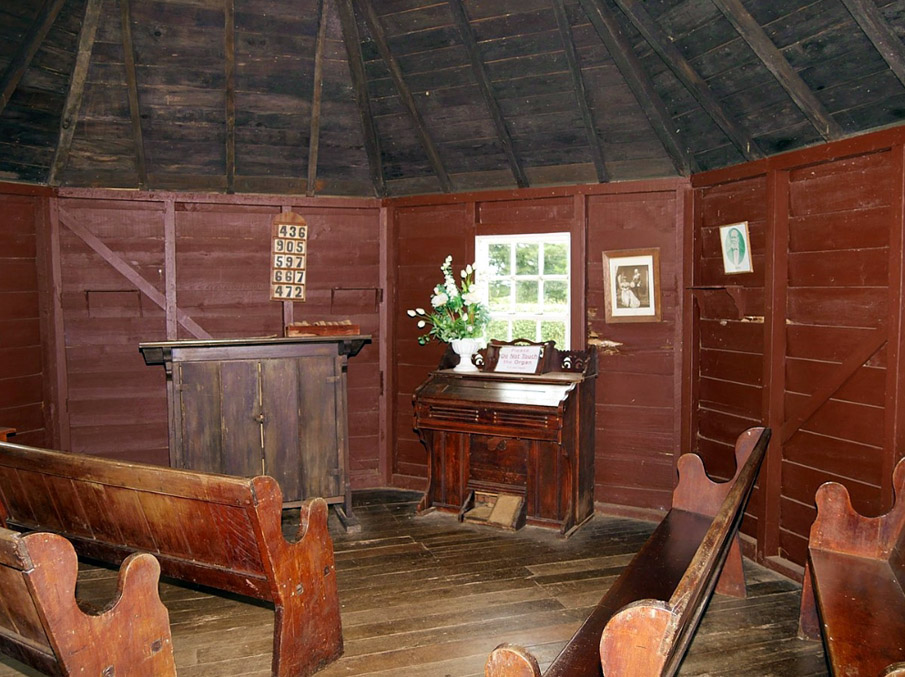
ARCHITECT/ENGINEER/DESIGNER: Mr T Ball and fellow settlers An early pioneer with no architectural/building training. ARCHITECTURAL DESCRIPTION: The 5.48 metre octagonal chapel is a single unlined space. The fenestration is limited to four double-hung sash windows with twelve panes, a common window of the period. The door is simply ledged and braced. The building has no applied decoration, except for the wooden finial at the apex of the eight-sided roof. MODIFICATIONS: Structural:- 1886 - Original thatched roof replaced with wooden shingles. 1919 - Roof reshingled with kauri. 1933 - Chapel placed on skids and transported to the roadside by a bullock team (remained on original property). 1946 - Chapel moved to 149 Kamo Road, Whangarei. Post 1946 - Installation of an electric light and power point (now removed). - Parts of the wall renewed. - Seats around wall of chapel removed. 1975 - Chapel moved to the Northland Regional Museum, Maunu.
ARCHITECT/ENGINEER/DESIGNER: Mr T Ball and fellow settlers An early pioneer with no architectural/building training. ARCHITECTURAL DESCRIPTION: The 5.48 metre octagonal chapel is a single unlined space. The fenestration is limited to four double-hung sash windows with twelve panes, a common window of the period. The door is simply ledged and braced. The building has no applied decoration, except for the wooden finial at the apex of the eight-sided roof. MODIFICATIONS: Structural:- 1886 - Original thatched roof replaced with wooden shingles. 1919 - Roof reshingled with kauri. 1933 - Chapel placed on skids and transported to the roadside by a bullock team (remained on original property). 1946 - Chapel moved to 149 Kamo Road, Whangarei. Post 1946 - Installation of an electric light and power point (now removed). - Parts of the wall renewed. - Seats around wall of chapel removed. 1975 - Chapel moved to the Northland Regional Museum, Maunu.
Historical and Associated Iwi / Hapū / Whānau
Information Sources
Keene, 1978
Keene, Florence, Legacies in Kauri: Old Homes and Churches of the North, Whangarei, 1978
Northern Advocate
Northern Advocate
Salmond, 1986
Jeremy Salmond, Old New Zealand Houses 1800-1940, Auckland, 1986, Reed Methuen
Northland Magazine
Northland Magazine
Other Information
This historic place was registered under the Historic Places Act 1980. This report includes the text from the original Building Classification Committee report considered by the NZHPT Board at the time of registration. Please note that entry on the New Zealand Heritage List/Rarangi Korero identifies only the heritage values of the property concerned, and should not be construed as advice on the state of the property, or as a comment of its soundness or safety, including in regard to earthquake risk, safety in the event of fire, or insanitary conditions.
Historical and Associated Iwi / Hapū / Whānau
Information Sources
Keene, 1978
Keene, Florence, Legacies in Kauri: Old Homes and Churches of the North, Whangarei, 1978
Northern Advocate
Northern Advocate
Salmond, 1986
Jeremy Salmond, Old New Zealand Houses 1800-1940, Auckland, 1986, Reed Methuen
Northland Magazine
Northland Magazine
Other Information
This historic place was registered under the Historic Places Act 1980. This report includes the text from the original Building Classification Committee report considered by the NZHPT Board at the time of registration. Please note that entry on the New Zealand Heritage List/Rarangi Korero identifies only the heritage values of the property concerned, and should not be construed as advice on the state of the property, or as a comment of its soundness or safety, including in regard to earthquake risk, safety in the event of fire, or insanitary conditions.
Former Usages
General Usage: Religion
Specific Usage: Chapel
Former Usages
General Usage: Religion
Specific Usage: Chapel
Location
Sign up to hear more
Get the latest heritage news, features and events delivered
straight to your inbox.
