

List Entry Information
Status
Listed
List Entry Status
Historic Place Category 1
Access
Able to Visit
List Number
3376
Date Entered
27th July 1988
Date of Effect
27th July 1988
City/District Council
Dunedin City
Region
Otago Region
Legal description
Lot 1 DP 23576
Status
Listed
List Entry Status
Historic Place Category 1
Access
Able to Visit
List Number
3376
Date Entered
27th July 1988
Date of Effect
27th July 1988
City/District Council
Dunedin City
Region
Otago Region
Legal description
Lot 1 DP 23576
Why is this place significant?
Historic Significance
Historical Significance or Value Vogel's national railway system increased its mileage almost exponentially from 1870 to 1910 and had added another 500 miles by 1930. Around 1950-53 the mileage of railway lines reached its peak and has since declined. Passenger services on the trains flourished until about 1944 when they declined with the coal shortages after the war. Even though people went willingly by train where there were trains the buses were needed for ancillary routes, especially in Otago where for political reasons the main route into Central Otago ran through sparsely populated country. As roads improved and buses became more powerful during the 1930s, there was a need for a place to garage the buses and provide cover for increasing freight and passengers. Though the building must have seemed large at the time, it is now rather cramped for moving the passengers and freight which now go by road. The first bus service in the country was set up in 1970 to carry passengers from the Culverden railway terminal to Hanmer Springs. The Road Services Branch was formally set up in 1926 when several competitive bus services were purchased. By the 1960s the Railways Department was the largest operator of road vehicles in the country with more than a thousand vehicles on the road.
Physical Significance
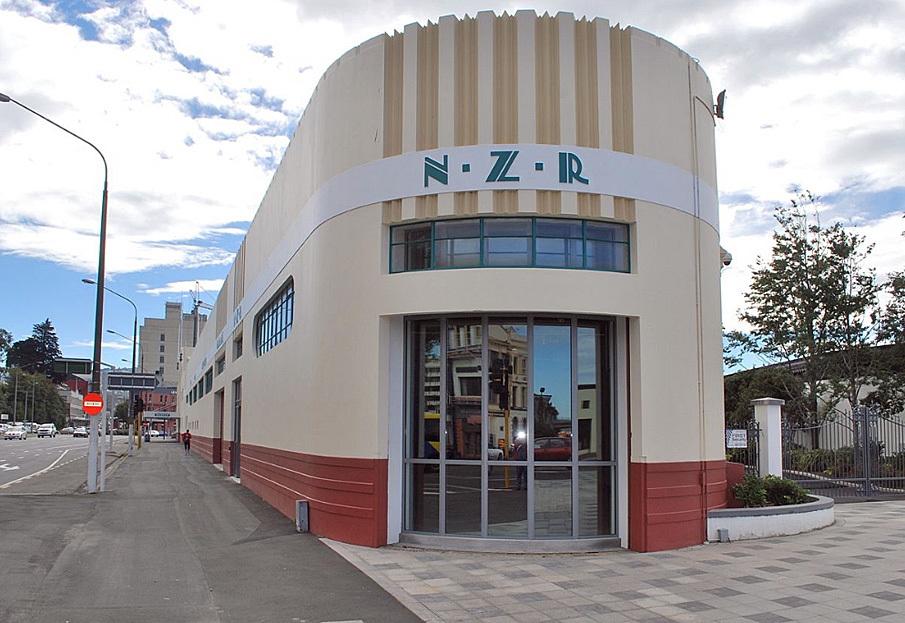
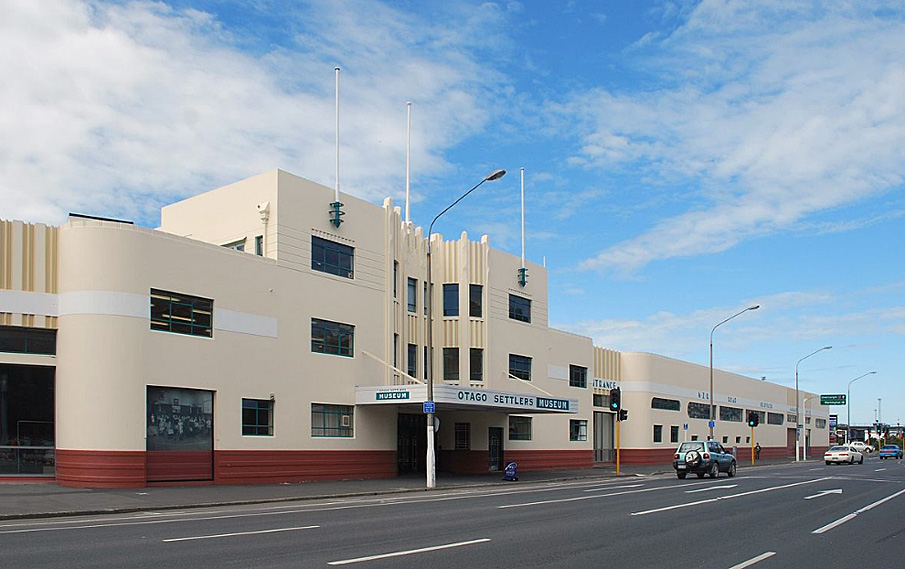
Architectural Significance: The Bus Services building was constructed at a time when few large buildings were being erected in Dunedin and is the most important Art Deco building of its period. (The other large building of the 1930s is the Chief Post Office, 1935). The long front parapet hiding the low pitched roof, the crisp lines, smoothly plastered surfaces and the rounded corners are characteristic of this style. The interior of the concourse is a particularly fine example of an Art Deco public interior. Township/Landmark Significance: It is a major 'modern' building in the Queens Gardens area.
Why is this place significant?
Historic Significance
Historical Significance or Value Vogel's national railway system increased its mileage almost exponentially from 1870 to 1910 and had added another 500 miles by 1930. Around 1950-53 the mileage of railway lines reached its peak and has since declined. Passenger services on the trains flourished until about 1944 when they declined with the coal shortages after the war. Even though people went willingly by train where there were trains the buses were needed for ancillary routes, especially in Otago where for political reasons the main route into Central Otago ran through sparsely populated country. As roads improved and buses became more powerful during the 1930s, there was a need for a place to garage the buses and provide cover for increasing freight and passengers. Though the building must have seemed large at the time, it is now rather cramped for moving the passengers and freight which now go by road. The first bus service in the country was set up in 1970 to carry passengers from the Culverden railway terminal to Hanmer Springs. The Road Services Branch was formally set up in 1926 when several competitive bus services were purchased. By the 1960s the Railways Department was the largest operator of road vehicles in the country with more than a thousand vehicles on the road.
Physical Significance
Architectural Significance: The Bus Services building was constructed at a time when few large buildings were being erected in Dunedin and is the most important Art Deco building of its period. (The other large building of the 1930s is the Chief Post Office, 1935). The long front parapet hiding the low pitched roof, the crisp lines, smoothly plastered surfaces and the rounded corners are characteristic of this style. The interior of the concourse is a particularly fine example of an Art Deco public interior. Township/Landmark Significance: It is a major 'modern' building in the Queens Gardens area.
Construction Professional
Name
Miller, Eric S C
Type
Architect
Biography
Eric Miller was educated at Otago Boys High School and served an apprenticeship with Salmond and Vane. After serving in the engineers in France in World War I, he trained in London on a scholarship, along with James White whom he had known as a child when living in Dunedin. After London he went to stay with an aunt in San Francisco where he helped with rebuilding that city after its great earthquake. Returning to Dunedin about 1925-25, he was associated with the New Zealand and South Seas Exhibition at Logan Park where he worked with Edmund Anscombe, a distant relative. He and Jim White formed a partnership in 1927 and took over Anscombe's office when the latter moved to Wellington. Miller and then White followed Anscombe as the University architect. They designed the Willi Fels wing of the Otago Museum (1929), the Otakou Maori church and hall (1941) and the Hercus block of the Medical School (1948), all of which tend to be associated with Miller's name, rather than White's. Miller also won a competition for the Oamaru war memorial (1926). Miller was a skilled mountaineer and one of the foundation members of the Otago Alpine Club. In 1939 he published his diary of life in the trenches in 1917, illustrated with numerous pen and ink sketches made during active service. He was a Fellow of both the New Zeeland and Royal British Institute of Architects.
Construction Details
Start Year
1939
Type
Original Construction
Construction Materials
The building covers three-quarters of an acre (about 3125 square meters) and includes about 110 metres of two metre wide passenger platforms. The walls are reinforced concrete, with welded steel roof trusses of spans up to 35 metres long so that the interior of the building is relatively free of columns to allow for movement of passengers and vehicles. The roof is an industrial sawtooth design with rows of vertical skylights on one side of each ridge and asbestos cement sheets with broad corrugations on the diagonal slopes. There was originally parking space for thirty buses, along with a paint shop, repair shop and workshop with inspection pits. The main entrance through heavy double doors opens into a concourse with doors to departure and arrival platforms. The concourse is lined with a richly figured red-brown marble with plastered walls above and an art deco coffered ceiling. The art deco motifs recur in the fittings. Around the concourse there were originally ticket, baggage and staff offices, cloak rooms and a tobacconist's. The second floor provided social amenities for Railways staff generally and included a social hall with supper room, meeting rooms and a library.
Notable Features
Its Art Deco styling and concourse.
Construction Professional
Name
Miller, Eric S C
Type
Architect
Biography
Eric Miller was educated at Otago Boys High School and served an apprenticeship with Salmond and Vane. After serving in the engineers in France in World War I, he trained in London on a scholarship, along with James White whom he had known as a child when living in Dunedin. After London he went to stay with an aunt in San Francisco where he helped with rebuilding that city after its great earthquake. Returning to Dunedin about 1925-25, he was associated with the New Zealand and South Seas Exhibition at Logan Park where he worked with Edmund Anscombe, a distant relative. He and Jim White formed a partnership in 1927 and took over Anscombe's office when the latter moved to Wellington. Miller and then White followed Anscombe as the University architect. They designed the Willi Fels wing of the Otago Museum (1929), the Otakou Maori church and hall (1941) and the Hercus block of the Medical School (1948), all of which tend to be associated with Miller's name, rather than White's. Miller also won a competition for the Oamaru war memorial (1926). Miller was a skilled mountaineer and one of the foundation members of the Otago Alpine Club. In 1939 he published his diary of life in the trenches in 1917, illustrated with numerous pen and ink sketches made during active service. He was a Fellow of both the New Zeeland and Royal British Institute of Architects.
Construction Details
Start Year
1939
Type
Original Construction
Construction Materials
The building covers three-quarters of an acre (about 3125 square meters) and includes about 110 metres of two metre wide passenger platforms. The walls are reinforced concrete, with welded steel roof trusses of spans up to 35 metres long so that the interior of the building is relatively free of columns to allow for movement of passengers and vehicles. The roof is an industrial sawtooth design with rows of vertical skylights on one side of each ridge and asbestos cement sheets with broad corrugations on the diagonal slopes. There was originally parking space for thirty buses, along with a paint shop, repair shop and workshop with inspection pits. The main entrance through heavy double doors opens into a concourse with doors to departure and arrival platforms. The concourse is lined with a richly figured red-brown marble with plastered walls above and an art deco coffered ceiling. The art deco motifs recur in the fittings. Around the concourse there were originally ticket, baggage and staff offices, cloak rooms and a tobacconist's. The second floor provided social amenities for Railways staff generally and included a social hall with supper room, meeting rooms and a library.
Notable Features
Its Art Deco styling and concourse.
Architectural Description (Style): The building is designed in the 1930s Art Deco style with rounded smoothly plastered corners and horizontal lines. Simple verticals above the entry doors for the buses break the horizontals. From railway side the roofline presents a strong representative sawtooth pattern with rounded points. Modifications: The building is virtually unmodified. The usage of some offices on the lower floor has changed and the upstairs social rooms are no longer used. The Art Deco interior of the concourse is intact. Even through buses are now much larger there is still room undercover for about 30 buses, using all the workshops.
Architectural Description (Style): The building is designed in the 1930s Art Deco style with rounded smoothly plastered corners and horizontal lines. Simple verticals above the entry doors for the buses break the horizontals. From railway side the roofline presents a strong representative sawtooth pattern with rounded points. Modifications: The building is virtually unmodified. The usage of some offices on the lower floor has changed and the upstairs social rooms are no longer used. The Art Deco interior of the concourse is intact. Even through buses are now much larger there is still room undercover for about 30 buses, using all the workshops.
Historical and Associated Iwi / Hapū / Whānau
Information Sources
Encyclopaedia of NZ, 1966
Encyclopaedia of New Zealand, Wellington, 1966
Other Information
This historic place was registered under the Historic Places Act 1980. This report includes the text from the original Building Classification Committee report considered by the NZHPT Board at the time of registration. Please note that entry on the New Zealand Heritage List/Rarangi Korero identifies only the heritage values of the property concerned, and should not be construed as advice on the state of the property, or as a comment of its soundness or safety, including in regard to earthquake risk, safety in the event of fire, or insanitary conditions.
Historical and Associated Iwi / Hapū / Whānau
Information Sources
Encyclopaedia of NZ, 1966
Encyclopaedia of New Zealand, Wellington, 1966
Other Information
This historic place was registered under the Historic Places Act 1980. This report includes the text from the original Building Classification Committee report considered by the NZHPT Board at the time of registration. Please note that entry on the New Zealand Heritage List/Rarangi Korero identifies only the heritage values of the property concerned, and should not be construed as advice on the state of the property, or as a comment of its soundness or safety, including in regard to earthquake risk, safety in the event of fire, or insanitary conditions.
Former Usages
General Usage: Transport
Specific Usage: Bus Station/Depot/station/shelter
Former Usages
General Usage: Transport
Specific Usage: Bus Station/Depot/station/shelter
Location
Sign up to hear more
Get the latest heritage news, features and events delivered
straight to your inbox.
