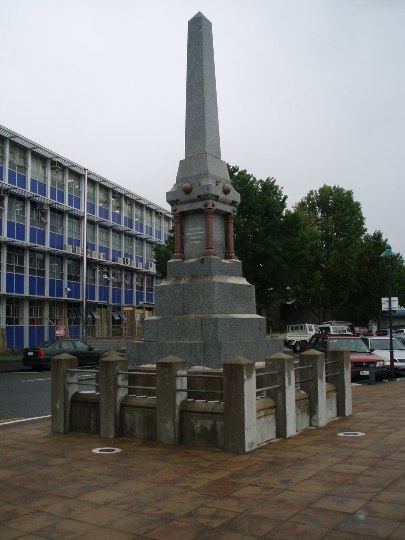
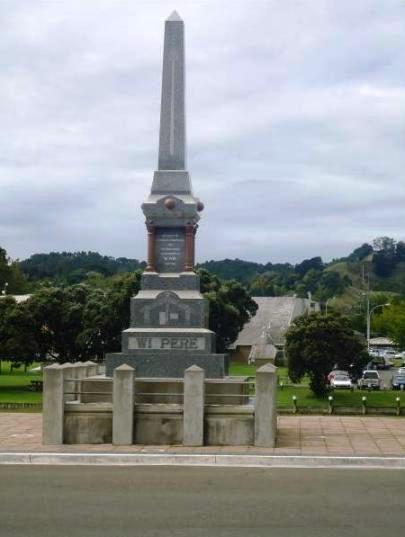
The Wi Pere Monument stands proudly on the bank of the Taruheru River in Gisborne, unveiled in 1919 as a memorial to a well-known Maori leader and politician. Wiremu Pere (1837-1915) was born in Gisborne, the son of Pakeha trader Thomas Halbert and Riria Mauaranui. Known as Wi Pere he was connected to Te Kooti Arikirangi Te Turuki by whakapapa and through his involvement in the turbulent events of the land wars in the 1860s and 1870s. Pere was a strong critic of Pakeha policy regarding Maori land, a Member of Parliament and the Legislative Council, and later in his life, a staunch supporter of the British Empire. His son, Moanaroa, was responsible for the superbly decorated Rongopai Marae which opened in 1888 in honour of Te Kooti. One of the paintings inside portrays Wi Pere in parliamentary garb with his mother perched on his shoulder. A Wi Pere monument was proposed in June 1918, and a design selected by Hetekia Te Kani Pere at a Hui in Manutuke. The borough council approved the monument and construction of the monument’s base began in Reads Quay in November 1918. The project was beset by controversy and a petition against the memorial by some locals argued that ‘Wi Pere never had the confidence or esteem of the majority of Poverty Bay people European or Maori’, and that such recognition was inappropriate. The council heard arguments for and against the monument, and in February 1919 unanimously agreed to allow the memorial to proceed, there being ‘no evidence…that Wi Pere had been a rebel’.
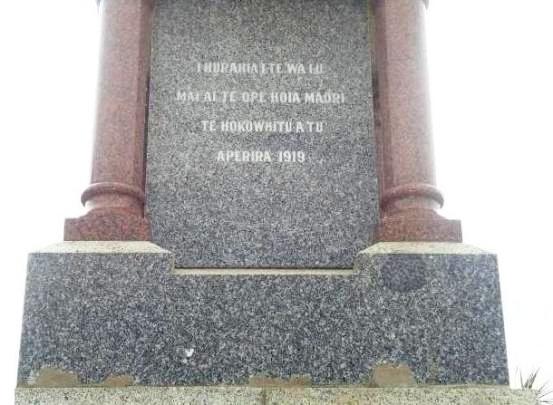
The local paper reported that the obelisk was imposing and constructed of fine Haricourt Victorian granite. It stood 24 feet tall on a concrete base 12 feet square and 2 feet 6 inches high of two steps, the top one decorated with a border of black and white tiles. ‘On the first base is carved the design of a meeting house peculiar to this district, the various marks representing certain historical facts. On the spire was engraved the form of a taiha (Maori weapon).’ The monument featured a number of inscriptions. On the front panel, in English: ‘Erected by the Government of New Zealand and the Maori people in memory of Wi Pere, 1837-1915.’ The left hand side was inscribed in te reo Maori, which according to the newspaper said, in English, ‘Unveiled at the time of the Maori hui to raise money for the soldiers.’ The right hand side inscription, also in te reo Maori, was translated as ‘To commemorate the landing of the Maori troops at Gisborne. April, 1919.’ The monument was erected by H. E. Tweed of Gisborne, and it cost £640. The Native Department gave a grant of £320.
The Wi Pere Monument was unveiled on 9 April 1919 by Sir James Carroll, in front of a huge gathering of local Maori and the Maori Pioneer Battalion, recently returned from service in World War One. Carroll and Apirana Ngata both spoke, addressing the various criticisms of the memorial and of Wi Pere’s loyalty, and affirming his contribution. The Maori people said Ngata, ‘would cherish his memory for generations because he stood head and shoulders above the people of his day.’
The Wi Pere Monument is historically significant as a reminder of the contribution that Wi Pere made to the development of the Tairawhiti region as a Maori leader, politician and strong critic of government land policy. It is socially significant as it represents the esteem in which Wi Pere was held by local citizens. The inscriptions in English and Maori provide evidence of the development of New Zealand as a bi-cultural society. The monument has the potential to contribute through public education to people’s awareness and appreciation of New Zealand history and culture. The obelisk has aesthetic significance as a landmark on the riverside and is easily viewed from the road. It holds a prominent position when viewed from the Marina Park reserve on the opposite bank of the river.
The local paper reported that the obelisk was imposing and constructed of fine Haricourt Victorian granite. It stood 24 feet tall on a concrete base 12 feet square and 2 feet 6 inches high of two steps, the top one decorated with a border of black and white tiles. ‘On the first base is carved the design of a meeting house peculiar to this district, the various marks representing certain historical facts. On the spire was engraved the form of a taiha (Maori weapon).’ The monument featured a number of inscriptions. On the front panel, in English: ‘Erected by the Government of New Zealand and the Maori people in memory of Wi Pere, 1837-1915.’ The left hand side was inscribed in te reo Maori, which according to the newspaper said, in English, ‘Unveiled at the time of the Maori hui to raise money for the soldiers.’ The right hand side inscription, also in te reo Maori, was translated as ‘To commemorate the landing of the Maori troops at Gisborne. April, 1919.’ The monument was erected by H. E. Tweed of Gisborne, and it cost £640. The Native Department gave a grant of £320.
The Wi Pere Monument was unveiled on 9 April 1919 by Sir James Carroll, in front of a huge gathering of local Maori and the Maori Pioneer Battalion, recently returned from service in World War One. Carroll and Apirana Ngata both spoke, addressing the various criticisms of the memorial and of Wi Pere’s loyalty, and affirming his contribution. The Maori people said Ngata, ‘would cherish his memory for generations because he stood head and shoulders above the people of his day.’
The Wi Pere Monument is historically significant as a reminder of the contribution that Wi Pere made to the development of the Tairawhiti region as a Maori leader, politician and strong critic of government land policy. It is socially significant as it represents the esteem in which Wi Pere was held by local citizens. The inscriptions in English and Maori provide evidence of the development of New Zealand as a bi-cultural society. The monument has the potential to contribute through public education to people’s awareness and appreciation of New Zealand history and culture. The obelisk has aesthetic significance as a landmark on the riverside and is easily viewed from the road. It holds a prominent position when viewed from the Marina Park reserve on the opposite bank of the river.