

A proposal was made to replace Rees's Folly with a reinforced concrete bridge 'of plain and substantial character', with the bridge's designer, Borough engineer J.A. McDonald estimating the cost of a suitable ferro-concrete bridge to be £28,000.
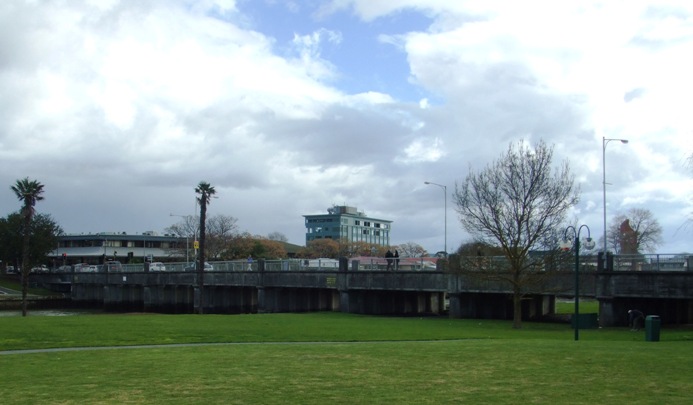
This 420 foot long, 40 foot wide bridge was constructed in nine spans using reinforced concrete girders resting on octagonal piles. At the Reads Quay corner of the bridge, a set of concrete steps adjoining the rail end runs down onto the esplanade reserve were designed as part of the bridge structure. The contractor was Mr Fred Goodman, who had been associated with the construction of Grafton Road Bridge in Auckland.
Opened with great fanfare in November 1923 by the Mayor, Mr George Wildish, the Peel Street Bridge was celebrated as the first and only permanent public work in Gisborne, and an investment in the future prosperity and prospects of the town. Flags and streamers decorated the bridge and shops and were festooned with coloured lights in the evening, described as a ‘Fairyland' scene to be remembered.
In 1977 the concrete handrails were removed and replaced with galvanised steel rails to increase the visibility for motorists and to reduce the dead load on the bridge. At the same time repairs were made to spalling (damage from water absorption in the concrete) on the bridge structure.
The Peel Street Bridge is historically significant because of its role in the development of Gisborne's transport and communications systems, and the development of the Whataupoko and Mangapapa areas. It is a good example of reinforced concrete bridges, which began to be built in New Zealand in substantial numbers in the early twentieth century. As one of three bridges designed by J.A. McDonald that cross the Taruheru and Turanganui Rivers in the centre of Gisborne, the Peel Street Bridge makes a substantial contribution to the urban fabric of the city, and to the important role that rivers have played in the region's development.
List Entry Information
Status
Listed
List Entry Status
Historic Place Category 2
Access
Able to Visit
List Number
3569
Date Entered
5th April 1984
Date of Effect
5th April 1984
City/District Council
Gisborne District
Region
Gisborne Region
Extent of List Entry
Extent includes the land described as Pt Sec 25-26 Blk III Turanganui SD (RT GS5B/1247), Pt Lot 25 DP 7819 (RT GS5B/1147), Gisborne Land District and the structure known as Peel Street Bridge thereon.
Legal description
Pt Sec 25-26 Blk III Turanganui SD (RT GS5B/1247); Pt Lot 25 DP 7819 (RT GS5B/1147), Gisborne Land District
Status
Listed
List Entry Status
Historic Place Category 2
Access
Able to Visit
List Number
3569
Date Entered
5th April 1984
Date of Effect
5th April 1984
City/District Council
Gisborne District
Region
Gisborne Region
Extent of List Entry
Extent includes the land described as Pt Sec 25-26 Blk III Turanganui SD (RT GS5B/1247), Pt Lot 25 DP 7819 (RT GS5B/1147), Gisborne Land District and the structure known as Peel Street Bridge thereon.
Legal description
Pt Sec 25-26 Blk III Turanganui SD (RT GS5B/1247); Pt Lot 25 DP 7819 (RT GS5B/1147), Gisborne Land District
Construction Professional
Name
McDonald, J
Type
Architect
Biography
No biography is currently available for this construction professional
Name
Goodman, Frederick
Type
Builder
Biography
English-born Frederick Goodman learnt his trade as a civil engineering contractor working on the four major concrete bridges in Auckland, including the Grafton Bridge and being the foreman of the Mangere Bridge contract, completed in 1915. In 1912-13 he constructed the Orakei sewerage outfall station for Auckland. In 1917 he moved to Gisborne to work on the Mangapoike pumping station. He was responsible for the construction of major structures in Gisborne, including Peel Street Bridge (Record no. 3569), Kaiti Bridge aka Gladstone Road Bridge (Record no. 3534) and the railway bridge (Record no. 3533), plus the middle section of the diversion wall for the harbour in Gisborne. Goodman was also involved in engineering work for the Otago Harbour Board in the early 1930s. He was involved with the construction of the 1935 improvements to the Earnscleugh Bridge in Central Otago (Record no. 2370). Fred Goodman died in 1946 at Napier.
Construction Details
Start Year
1919
Finish Year
1923
Type
Original Construction
Start Year
1977
Type
Modification
Description
Concrete handrails removed and replaced with galvanised steel rails
Start Year
1977
Type
Other
Description
Repairs made to spalling (water damage to concrete fabric of bridge)
Construction Professional
Name
McDonald, J
Type
Architect
Biography
No biography is currently available for this construction professional
Name
Goodman, Frederick
Type
Builder
Biography
English-born Frederick Goodman learnt his trade as a civil engineering contractor working on the four major concrete bridges in Auckland, including the Grafton Bridge and being the foreman of the Mangere Bridge contract, completed in 1915. In 1912-13 he constructed the Orakei sewerage outfall station for Auckland. In 1917 he moved to Gisborne to work on the Mangapoike pumping station. He was responsible for the construction of major structures in Gisborne, including Peel Street Bridge (Record no. 3569), Kaiti Bridge aka Gladstone Road Bridge (Record no. 3534) and the railway bridge (Record no. 3533), plus the middle section of the diversion wall for the harbour in Gisborne. Goodman was also involved in engineering work for the Otago Harbour Board in the early 1930s. He was involved with the construction of the 1935 improvements to the Earnscleugh Bridge in Central Otago (Record no. 2370). Fred Goodman died in 1946 at Napier.
Construction Details
Start Year
1919
Finish Year
1923
Type
Original Construction
Start Year
1977
Type
Modification
Description
Concrete handrails removed and replaced with galvanised steel rails
Start Year
1977
Type
Other
Description
Repairs made to spalling (water damage to concrete fabric of bridge)
Historical and Associated Iwi / Hapū / Whānau
Completion Date
21st June 2010
Report Written By
Damian Skinner, Gail Henry, Linda Pattison
Information Sources
Mackay, 1949
J A Mackay, Historic Poverty Bay and the East Coast, N.I., N.Z, Gisborne, 1949.
Poverty Bay Herald
Poverty Bay Herald
Thornton, 2001
Geoffrey Thornton, Bridging the Gap, Early Bridges in New Zealand 1830-1939, Auckland, 2001
Gisborne Times
Gisborne Times
Other Information
This place was identified as significant under previous legislation with different information requirements. It remains significant under the current legislation. There is opportunity under our legislation and policies to add to this information. Further information about this place may be available from the Lower Northern Office of Heritage New Zealand Pouhere Taonga. A fully referenced report is available from the NZHPT Lower Northern Area office Please note that entry on the New Zealand Heritage List/Rarangi Korero identifies only the heritage values of the property concerned, and should not be construed as advice on the state of the property, or as a comment of its soundness or safety, including in regard to earthquake risk, safety in the event of fire, or insanitary conditions.
Historical and Associated Iwi / Hapū / Whānau
Completion Date
21st June 2010
Report Written By
Damian Skinner, Gail Henry, Linda Pattison
Information Sources
Mackay, 1949
J A Mackay, Historic Poverty Bay and the East Coast, N.I., N.Z, Gisborne, 1949.
Poverty Bay Herald
Poverty Bay Herald
Thornton, 2001
Geoffrey Thornton, Bridging the Gap, Early Bridges in New Zealand 1830-1939, Auckland, 2001
Gisborne Times
Gisborne Times
Other Information
This place was identified as significant under previous legislation with different information requirements. It remains significant under the current legislation. There is opportunity under our legislation and policies to add to this information. Further information about this place may be available from the Lower Northern Office of Heritage New Zealand Pouhere Taonga. A fully referenced report is available from the NZHPT Lower Northern Area office Please note that entry on the New Zealand Heritage List/Rarangi Korero identifies only the heritage values of the property concerned, and should not be construed as advice on the state of the property, or as a comment of its soundness or safety, including in regard to earthquake risk, safety in the event of fire, or insanitary conditions.
Former Usages
General Usage: Transport
Specific Usage: Bridge/ Viaduct
Former Usages
General Usage: Transport
Specific Usage: Bridge/ Viaduct
Location
Sign up to hear more
Get the latest heritage news, features and events delivered
straight to your inbox.
