

Fendalton was originally part of the parish of Riccarton and the 1876 church of St Barnabas was constructed as a chapel-of-ease for the local residents. Fendalton became a separate parish in 1883, the same year the 1876 church was enlarged. Plans to build a second church in permanent materials first took shape in 1903 when the Vestry acquired shares in the Christchurch Building Society in order to establish a fund for the construction of a new church. In 1918 the vicar, Canon T.A. Hamilton (1849-1937), suggested that the new church be erected as a memorial to the dead of the First World War. His suggestion was adopted and noted Christchurch-born architect, Cecil Wood, (1878-1947) was invited to draw up plans for a 'suitable village church' to cost around £10,000.
The foundation stone was laid in 1925 with over 800 people attending the ceremony. (Interestingly no children were present at the ceremony because of a nation-wide infantile paralysis epidemic.) Mention was made at the ceremony that the church was to honoured both the dead and the alive who had fought in World War I. One of the speakers, Mr K.M. Gresson, a returned serviceman, also stated that he was sure that the memorials being established throughout the Dominion would 'do much to restrain men from the hideousness of war'; that is it would have an educational function as well. The church was completed by November 1926 and representatives of the army were present at the consecration ceremony.
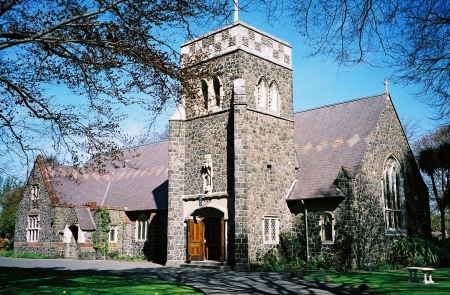
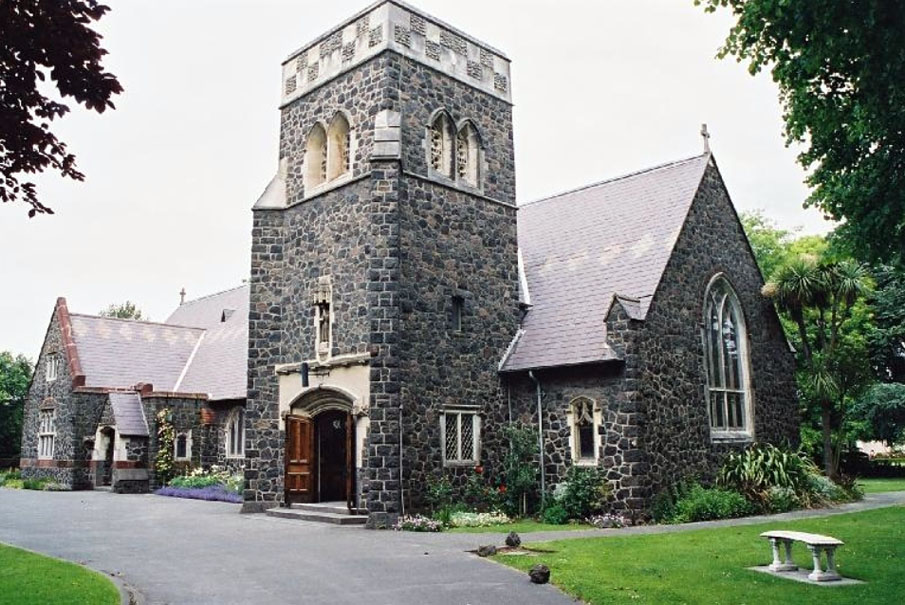
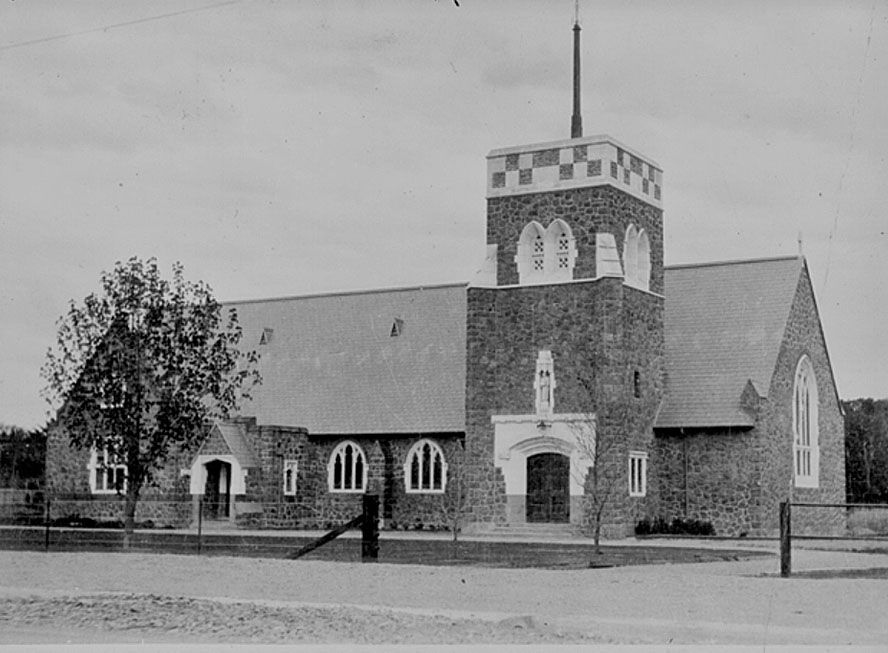
The church Wood had designed was long and low, built in stone from a local quarry, with facings of redstone and Oamaru stone. It is roofed in slate with a pattern of lighter coloured diamonds. The long plan, with a squat square tower over the main entrance, is similar to other of Wood's churches. In her thesis on Wood, Ruth Helms made the comparison between the long plan, the low stone walls, the massive timber roof, and the lack of differntation between nave and chancel of St Barnbas's with the English tradition of medieval tithe barns. Such barns were seen as pure examples of vernacular design by Arts and Crafts architects whom Wood was influenced by. He was not, however, committed to the tenents of the movement, choosing for example, jarrah and oak for St Barnabas rather than an indigenous timber. St Barnabas is set back from the road because the old timber church remained in situ and in use until after the new one was consecrated.
St Barnabas is significant as one of the few churches erected in New Zealand as a war memorial. While church communities were one of the likely to erect memorials to the dead, it was far more common to have memorials erected within existing churches, than to have the church itself built as a memorial. Maclean and Phillips, in their book on New Zealand's war memorials argue that the number of World War I church memorials reflect both the importance of religion to New Zealanders at the time and 'the close involvement of the church in encouraging and supporting the war effort'. (Maclean & Phillips, 1990: 83)
Set back amongst trees which date from the 1870s, St Barnabas is the largest of Wood's Arts and Craft-influenced churches and its success led to further commissions for him. With its carvings by Frederick Gurnsey (see Notable Features) St Barnabas is also a fine example of the combined work produced by these two men, first seen in the Hare Memorial Library at Christ's College. St Barnabas's English antecedents were appreciated by the congregation and, at the time of its opening, it was described as 'further enrich[ing] the heritage left by the Anglican founders of the province'. St Barnabas continues to be used for Anglican worship today.
List Entry Information
Status
Listed
List Entry Status
Historic Place Category 1
Access
Private/No Public Access
List Number
3681
Date Entered
2nd April 1985
Date of Effect
2nd April 1985
City/District Council
Christchurch City
Region
Canterbury Region
Legal description
Lots 4-6 DP 2528, Pt RS 18
Status
Listed
List Entry Status
Historic Place Category 1
Access
Private/No Public Access
List Number
3681
Date Entered
2nd April 1985
Date of Effect
2nd April 1985
City/District Council
Christchurch City
Region
Canterbury Region
Legal description
Lots 4-6 DP 2528, Pt RS 18
Construction Professional
Name
Gurnsey, Frederick George
Type
Carver
Biography
Frederick George Gurnsey (1868 - 1953) was born in Wales. He was apprenticed to Harry Hems and Company, a leading ecclesiastical carving firm in Exeter, and worked for them once his apprenticeship was complete. Gurnsey visited New Zealand in 1904-1905 and returned in 1907 when he was appointed as an instructor at the Canterbury College School of Art in Christchurch. At the School of Art he taught carving, modelling, casting, enamelling and metalwork, and was the acting director of the school from September 1917 to April 1920. He resigned in 1923 to become a full-time carver. Gurnsey executed thousands of carvings, in both wood and stone, for churches, civic buildings, public monuments and various private commissions. Some of his more prominent carvings include the reredos in the Christchurch cathedral, his work in the Chapel of St Michael and St George, the carvings on the Bridge of Remembrance in Christchurch (1924), those on the Massey Memorial in Wellington (1930), and those in the Church of the Good Shepherd at Tekapo.(1935). During the Depression Gurnsey diversified into making domestic furniture. He has been described as 'one of the greatest European carvers ever to have worked in New Zealand', although due to his personal modesty and the way in which carving falls somewhere between fine arts and craft, his achievements have, until recently, largely been unrecognised. Confident with carving in both wood and stone, Gurnsey was responsible for many beautiful works, particularly in the South Island.
Name
Wood, Cecil Walter
Type
Architect
Biography
Born in Christchurch, Wood (1878-1947) was articled to the local architect Frederick Strouts between 1894 and 1899. He worked for a short time as a draughtsman with the firm Clarkson and Ballantyne before travelling to England in 1901. Here Wood was exposed to a high quality of architectural design in the Edwardian Free Style, and was employed by two leading Edwardian architects Robert Weir Shultz and Leonard Stokes. In 1907 Wood returned to New Zealand to take up partnership with Samuel Hurst Seager. The partnership lasted for only one year for Wood set up his own practice in 1908. The years 1908-1915 were dominated by domestic commissions, but it was also during this time that he began his association with Christ's College, which included such commissions as Hare Memorial Library (1915), the Memorial Dining Hall (1923-5), Jacob's House (1931) and Open Air Classrooms (1932). During the 1920s Wood's practice began to expand and a Georgian influence can be seen in such works as Weston House Park Terrace (1923-4) and Bishopscourt (1926-7). A short lived partnership in 1927 with R S D Harman allowed Wood to travel to the United States while another in 1937 with Paul Pascoe allowed him to travel to England, Europe and the United States without neglecting his practice. During this second trip he made preparations for the design of St Paul's Anglican Cathedral in Wellington, which was erected after his death. During his life Wood had made a substantial contribution to the architecture of Christchurch, having an enthusiasm for both European and American styles.
Construction Details
Start Year
1925
Finish Year
1926
Type
Original Construction
Notable Features
St Barnabas has a number of commemorative stained glass windows, one of which (the East Window) had originally been installed in the 1876 timber church. The West Window was donated by Kate Gerard to commemorative those Fendalton men who served in the First World War. It consists of four lights depicting, from left to right, Chivalry, Fortitude, Self-Sacrifice and Justice. Many of the windows in St Barnabas were vandalised in a incident in February 1982. After they were repaired a further window was built from the leftover pieces of the smashed windows. This window also included a piece of glass from Westminster Abbey, which had been damaged in a bomb attack during the Second World War, and is estimated to be around 500 to 600 years old. These pieces of glass were auctioned off for charity and a parishioner of St Barnabas, who had purchased a piece, donated it to the church. The oak reredoes in the sanctuary and the statue of St Barnabas in the niche above the main entrance were both carved by Frederick Gurnsey, the noted Christchurch sculptor. The central panel of the redoes contains a carved relief of Leonardo da Vinci's 'Last Supper'. Gurnsey also carved the roll of honour. Canon Hamilton, along with other members of the congregation, planted a 'peace oak' in 1919, at the east end of the 1876 church.
Construction Professional
Name
Gurnsey, Frederick George
Type
Carver
Biography
Frederick George Gurnsey (1868 - 1953) was born in Wales. He was apprenticed to Harry Hems and Company, a leading ecclesiastical carving firm in Exeter, and worked for them once his apprenticeship was complete. Gurnsey visited New Zealand in 1904-1905 and returned in 1907 when he was appointed as an instructor at the Canterbury College School of Art in Christchurch. At the School of Art he taught carving, modelling, casting, enamelling and metalwork, and was the acting director of the school from September 1917 to April 1920. He resigned in 1923 to become a full-time carver. Gurnsey executed thousands of carvings, in both wood and stone, for churches, civic buildings, public monuments and various private commissions. Some of his more prominent carvings include the reredos in the Christchurch cathedral, his work in the Chapel of St Michael and St George, the carvings on the Bridge of Remembrance in Christchurch (1924), those on the Massey Memorial in Wellington (1930), and those in the Church of the Good Shepherd at Tekapo.(1935). During the Depression Gurnsey diversified into making domestic furniture. He has been described as 'one of the greatest European carvers ever to have worked in New Zealand', although due to his personal modesty and the way in which carving falls somewhere between fine arts and craft, his achievements have, until recently, largely been unrecognised. Confident with carving in both wood and stone, Gurnsey was responsible for many beautiful works, particularly in the South Island.
Name
Wood, Cecil Walter
Type
Architect
Biography
Born in Christchurch, Wood (1878-1947) was articled to the local architect Frederick Strouts between 1894 and 1899. He worked for a short time as a draughtsman with the firm Clarkson and Ballantyne before travelling to England in 1901. Here Wood was exposed to a high quality of architectural design in the Edwardian Free Style, and was employed by two leading Edwardian architects Robert Weir Shultz and Leonard Stokes. In 1907 Wood returned to New Zealand to take up partnership with Samuel Hurst Seager. The partnership lasted for only one year for Wood set up his own practice in 1908. The years 1908-1915 were dominated by domestic commissions, but it was also during this time that he began his association with Christ's College, which included such commissions as Hare Memorial Library (1915), the Memorial Dining Hall (1923-5), Jacob's House (1931) and Open Air Classrooms (1932). During the 1920s Wood's practice began to expand and a Georgian influence can be seen in such works as Weston House Park Terrace (1923-4) and Bishopscourt (1926-7). A short lived partnership in 1927 with R S D Harman allowed Wood to travel to the United States while another in 1937 with Paul Pascoe allowed him to travel to England, Europe and the United States without neglecting his practice. During this second trip he made preparations for the design of St Paul's Anglican Cathedral in Wellington, which was erected after his death. During his life Wood had made a substantial contribution to the architecture of Christchurch, having an enthusiasm for both European and American styles.
Construction Details
Start Year
1925
Finish Year
1926
Type
Original Construction
Notable Features
St Barnabas has a number of commemorative stained glass windows, one of which (the East Window) had originally been installed in the 1876 timber church. The West Window was donated by Kate Gerard to commemorative those Fendalton men who served in the First World War. It consists of four lights depicting, from left to right, Chivalry, Fortitude, Self-Sacrifice and Justice. Many of the windows in St Barnabas were vandalised in a incident in February 1982. After they were repaired a further window was built from the leftover pieces of the smashed windows. This window also included a piece of glass from Westminster Abbey, which had been damaged in a bomb attack during the Second World War, and is estimated to be around 500 to 600 years old. These pieces of glass were auctioned off for charity and a parishioner of St Barnabas, who had purchased a piece, donated it to the church. The oak reredoes in the sanctuary and the statue of St Barnabas in the niche above the main entrance were both carved by Frederick Gurnsey, the noted Christchurch sculptor. The central panel of the redoes contains a carved relief of Leonardo da Vinci's 'Last Supper'. Gurnsey also carved the roll of honour. Canon Hamilton, along with other members of the congregation, planted a 'peace oak' in 1919, at the east end of the 1876 church.
Historical and Associated Iwi / Hapū / Whānau
Completion Date
9th July 2002
Report Written By
Melanie Lovell-Smith
Information Sources
Christchurch Press
Fendalton Church
A Potted History of the Fendalton Church, Christchurch, [196?]
Helms, 1996
Ruth M. Helms, 'The architecture of Cecil Wood', PhD thesis, University of Canterbury, 1996
Lyttelton Times
Lyttelton Times
MacLean, 1990
Chris MacLean and Jock Phillips, The Sorrow and the Pride: New Zealand War Memorials, Wellington, 1990
St Barnabas Church, n.d.
St. Barnabas' Church (Christchurch, N.Z.), Information files, Fendalton Library, Christchurch
Stocker, 1997
Mark Stocker, Angels and Roses: the art of Frederick George Gurnsey, Christchurch, 1997
University of Canterbury
University of Canterbury
Other Information
This place was identified as significant under previous legislation with different information requirements. It remains significant under the current legislation. There is opportunity under our legislation and policies to add to this information. Further information about this place may be available from the Southern Regional Office of Heritage New Zealand Pouhere Taonga. Please note that entry on the New Zealand Heritage List/Rarangi Korero identifies only the heritage values of the property concerned, and should not be construed as advice on the state of the property, or as a comment of its soundness or safety, including in regard to earthquake risk, safety in the event of fire, or insanitary conditions.
Historical and Associated Iwi / Hapū / Whānau
Completion Date
9th July 2002
Report Written By
Melanie Lovell-Smith
Information Sources
Christchurch Press
Fendalton Church
A Potted History of the Fendalton Church, Christchurch, [196?]
Helms, 1996
Ruth M. Helms, 'The architecture of Cecil Wood', PhD thesis, University of Canterbury, 1996
Lyttelton Times
Lyttelton Times
MacLean, 1990
Chris MacLean and Jock Phillips, The Sorrow and the Pride: New Zealand War Memorials, Wellington, 1990
St Barnabas Church, n.d.
St. Barnabas' Church (Christchurch, N.Z.), Information files, Fendalton Library, Christchurch
Stocker, 1997
Mark Stocker, Angels and Roses: the art of Frederick George Gurnsey, Christchurch, 1997
University of Canterbury
University of Canterbury
Other Information
This place was identified as significant under previous legislation with different information requirements. It remains significant under the current legislation. There is opportunity under our legislation and policies to add to this information. Further information about this place may be available from the Southern Regional Office of Heritage New Zealand Pouhere Taonga. Please note that entry on the New Zealand Heritage List/Rarangi Korero identifies only the heritage values of the property concerned, and should not be construed as advice on the state of the property, or as a comment of its soundness or safety, including in regard to earthquake risk, safety in the event of fire, or insanitary conditions.
Current Usages
Uses: Commemoration
Specific Usage: Memorial - World War One
Uses: Religion
Specific Usage: Church
Former Usages
General Usage: Religion
Specific Usage: Church
Themes
War Memorial
Current Usages
Uses: Commemoration
Specific Usage: Memorial - World War One
Uses: Religion
Specific Usage: Church
Former Usages
General Usage: Religion
Specific Usage: Church
Themes
War Memorial
Location
Sign up to hear more
Get the latest heritage news, features and events delivered
straight to your inbox.
