

Before the settlers could build houses of sawn timber they erected small huts of vertical slabs smoothly dressed with a broad axe and roofed in shingles supported on a frame of adzed saplings.
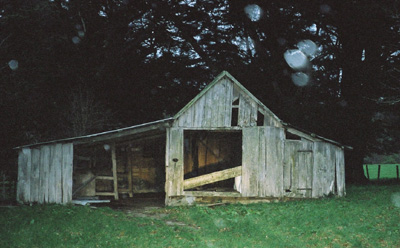
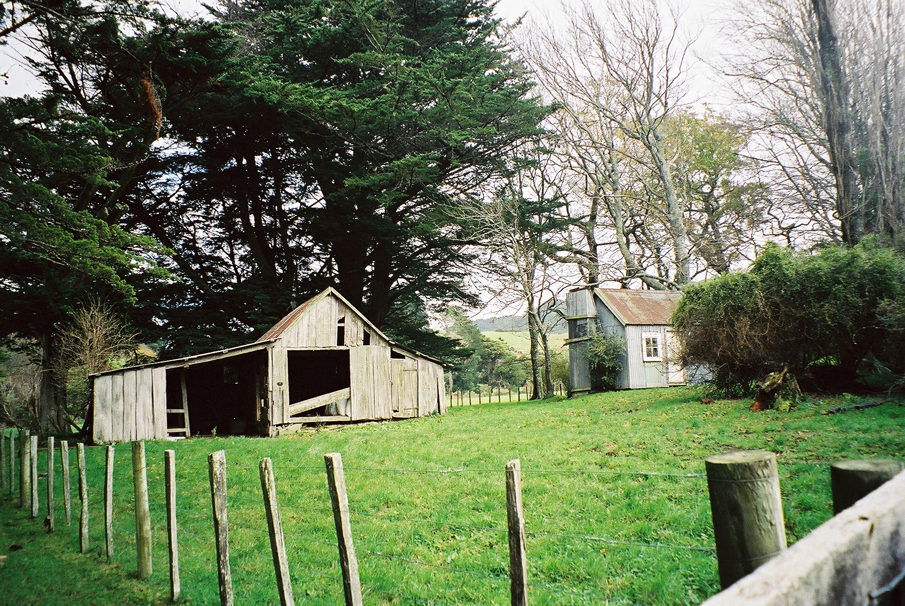
Schou's barn used the same basic materials but the slabs were roughly adzed. As with many of the huts the floor is of earth. The roof now has corrugated iron and as there are no battens under it this is probably the original material.
Squatting below giant Macrocarpas the barn is particularly attractive with its weathered unpainted Totara slabs and steep pitched gabled roof having lean-tos on each side. Lars Andersen Schou was a bachelor who lived a Spartan life in a tiny hut alongside his barn. His hobby was writing indifferent poetry in his native tongue. The barn is significant as being the last recognisable link with the buildings of this Danish settlement.
List Entry Information
Status
Listed
List Entry Status
Historic Place Category 1
Access
Private/No Public Access
List Number
3959
Date Entered
2nd April 1985
Date of Effect
2nd April 1985
City/District Council
Masterton District
Region
Wellington Region
Legal description
Lot 2 DP 5807 Sec 45 Pt Secs4467 68 Mauriceville Settlement
Status
Listed
List Entry Status
Historic Place Category 1
Access
Private/No Public Access
List Number
3959
Date Entered
2nd April 1985
Date of Effect
2nd April 1985
City/District Council
Masterton District
Region
Wellington Region
Legal description
Lot 2 DP 5807 Sec 45 Pt Secs4467 68 Mauriceville Settlement
Construction Details
Start Year
1875
startYearCirca
Type
Original Construction
Construction Details
Start Year
1875
startYearCirca
Type
Original Construction
Historical and Associated Iwi / Hapū / Whānau
Other Information
This place was identified as significant under previous legislation with different information requirements. It remains significant under the current legislation. There is opportunity under our legislation and policies to add to this information. Further information about this place may be available from the Central Regional Office of Heritage New Zealand Pouhere Taonga. Please note that entry on the New Zealand Heritage List/Rarangi Korero identifies only the heritage values of the property concerned, and should not be construed as advice on the state of the property, or as a comment of its soundness or safety, including in regard to earthquake risk, safety in the event of fire, or insanitary conditions. This historic place was registered under the Historic Places Act 1980. The following text is the original citation considered by the NZHPT Board at the time of registration. Information in square brackets indicate modifications made after the paper was considered by the NZHPT Board.
Historical and Associated Iwi / Hapū / Whānau
Other Information
This place was identified as significant under previous legislation with different information requirements. It remains significant under the current legislation. There is opportunity under our legislation and policies to add to this information. Further information about this place may be available from the Central Regional Office of Heritage New Zealand Pouhere Taonga. Please note that entry on the New Zealand Heritage List/Rarangi Korero identifies only the heritage values of the property concerned, and should not be construed as advice on the state of the property, or as a comment of its soundness or safety, including in regard to earthquake risk, safety in the event of fire, or insanitary conditions. This historic place was registered under the Historic Places Act 1980. The following text is the original citation considered by the NZHPT Board at the time of registration. Information in square brackets indicate modifications made after the paper was considered by the NZHPT Board.
Former Usages
General Usage: Agriculture
Specific Usage: Barn
Former Usages
General Usage: Agriculture
Specific Usage: Barn
Location
Sign up to hear more
Get the latest heritage news, features and events delivered
straight to your inbox.
