

Shannon was one of a string of towns founded along the Wellington and Manawatu Railway line, which was completed in 1886. The first land sales occurred in Shannon the following year. Not long after, the Albion Hotel (1889) and Wellington & Manawatu Club Hotel, later known simply as the ‘Club Hotel’ (1891), rose on prominent corner sections along Plimmer Terrace across from Shannon’s railway reserve. Stables were essential parts of period hotel operation given the nature of the business—accommodation for travellers and diversion for local residents. The Club Hotel initially provided ‘secure and well-watered paddocking’ for guests; by the mid-1890s a stable was present on the section.
Not long after it opened, the Club Hotel was advertised as a place where ‘residents and the travelling public will find replete with all conveniences and generally with the comforts of a home.’ The building was larger than the two-year-old Albion Hotel and described as having ‘more pretentions towards a building than the present licensed house.’ Both of the locally imposing buildings were classic examples of small hotels found throughout New Zealand, featuring chamfered corner entrances, and bar and dining facilities on the ground floor with guest rooms above. The Club Hotel was destroyed by fire in November 1904 and quickly rebuilt—larger, but with the same character-defining features—to a design by Thomas Turnbull.
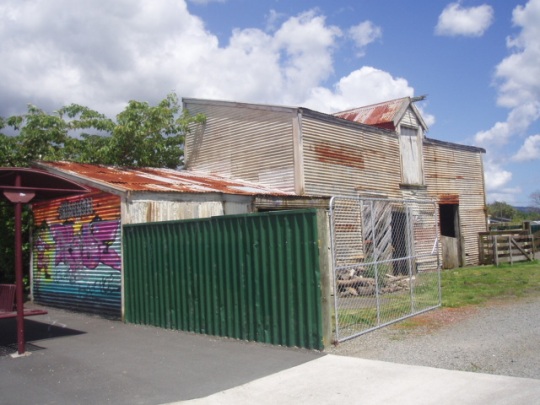
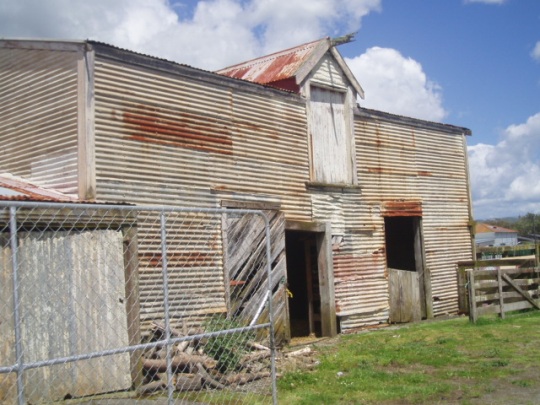
Almost as soon as the new hotel opened, disaster struck again for the owner of the property, Thomas McCarthy, and the proprietor of the hotel, Michael Moynihan. A fire began early in the morning on 28 June 1905 in a pharmacy on Ballance Street, adjacent to the stables—‘within an hour [the fire] had completely destroyed [both] buildings.’ Given their importance to the business, the Club Hotel stables would have been immediately reconstructed. An early-twentieth-century photograph looking up Ballance Street captures a portion of the rebuilt stable. The broad and shallow building with lean-to roofs was positioned on the section boundary, facing the back of the hotel. The two-storey portion had six stalls on the ground level and an upper hayloft accessible via a door under a small central cross gable. The one-storey portion extending out to the sidewalk had rounded openings and might have sheltered a wagon or gig.
The stable remains in fair condition and is now used for storage. Its historic form is fully discernible. The original cladding might have been corrugated iron or possibly weatherboards. The present corrugated iron cladding may have been introduced to mask changes made to the building when the stalls were combined into looseboxes later in the century.
List Entry Information
Status
Listed
List Entry Status
Historic Place Category 2
Access
Private/No Public Access
List Number
4050
Date Entered
5th September 1985
Date of Effect
5th September 1985
City/District Council
Horowhenua District
Region
Horizons (Manawatū-Whanganui) Region
Extent of List Entry
Extent includes part of the land described as Lot 271 DP 368 (RT WN595/211), Wellington Land District, and the building known as Club Hotel Stables thereon.
Legal description
Lot 271 DP 368 (RT WN595/211), Wellington Land District
Status
Listed
List Entry Status
Historic Place Category 2
Access
Private/No Public Access
List Number
4050
Date Entered
5th September 1985
Date of Effect
5th September 1985
City/District Council
Horowhenua District
Region
Horizons (Manawatū-Whanganui) Region
Extent of List Entry
Extent includes part of the land described as Lot 271 DP 368 (RT WN595/211), Wellington Land District, and the building known as Club Hotel Stables thereon.
Legal description
Lot 271 DP 368 (RT WN595/211), Wellington Land District
Construction Details
Start Year
1905
startYearCirca
Type
Original Construction
Type
Modification
Description
Stalls converted into looseboxes
Period
Unknown
Construction Details
Start Year
1905
startYearCirca
Type
Original Construction
Type
Modification
Description
Stalls converted into looseboxes
Period
Unknown
Historical and Associated Iwi / Hapū / Whānau
Completion Date
9th November 2016
Report Written By
James A. Jacobs
Information Sources
Manawatu Standard
Manawatu Standard
Other Information
This place was identified as significant under previous legislation with different information requirements. It remains significant under the current legislation. There is opportunity under our legislation and policies to add to this information. Further information about this place may be available from the Central Regional Office of Heritage New Zealand Pouhere Taonga. Please note that entry on the New Zealand Heritage List/Rarangi Korero identifies only the heritage values of the property concerned, and should not be construed as advice on the state of the property, or as a comment of its soundness or safety, including in regard to earthquake risk, safety in the event of fire, or insanitary conditions. A fully referenced upgrade report is available on request from the Central Region Office of Heritage New Zealand.
Historical and Associated Iwi / Hapū / Whānau
Completion Date
9th November 2016
Report Written By
James A. Jacobs
Information Sources
Manawatu Standard
Manawatu Standard
Other Information
This place was identified as significant under previous legislation with different information requirements. It remains significant under the current legislation. There is opportunity under our legislation and policies to add to this information. Further information about this place may be available from the Central Regional Office of Heritage New Zealand Pouhere Taonga. Please note that entry on the New Zealand Heritage List/Rarangi Korero identifies only the heritage values of the property concerned, and should not be construed as advice on the state of the property, or as a comment of its soundness or safety, including in regard to earthquake risk, safety in the event of fire, or insanitary conditions. A fully referenced upgrade report is available on request from the Central Region Office of Heritage New Zealand.
Former Usages
General Usage: Trade
Specific Usage: Stables - commercial
Former Usages
General Usage: Trade
Specific Usage: Stables - commercial
Location
Sign up to hear more
Get the latest heritage news, features and events delivered
straight to your inbox.
