

List Entry Information
Status
Listed
List Entry Status
Historic Place Category 1
Access
Private/No Public Access
List Number
4471
Date Entered
27th July 1988
Date of Effect
27th July 1988
City/District Council
Auckland Council
Region
Auckland Council
Legal description
Pt Allot 106 Sec 6 SBRS of Auckland (RT 185707), North Auckland Land District
Status
Listed
List Entry Status
Historic Place Category 1
Access
Private/No Public Access
List Number
4471
Date Entered
27th July 1988
Date of Effect
27th July 1988
City/District Council
Auckland Council
Region
Auckland Council
Legal description
Pt Allot 106 Sec 6 SBRS of Auckland (RT 185707), North Auckland Land District
Why is this place significant?
Historic Significance
Historical Significance or Value Governor Grey initiated the foundation of the A.G.S. with a land grant in 1850, and in 1869 a small school opened in Howe Street by Alfred, Duke of Edinburgh. Subsequently, the school occupied various other buildings, and Albert Barracks Building, District Court House, Maori Chapel, St Andrews Church, Ponsonby Branch School and eventually a building in Symonds Street in 1880. But in 1903 Government measures were introduced providing free education for all children. The school roll was greatly expanded over the following years requiring a larger building, and the Mt Eden School was Opened in 1916. J.W. Tibbs was the headmaster during the building of the present school, retiring in 1922 after 30 years in that position. He was one of a number of notable personalities who became headmaster of Auckland Grammar School, J.D. Mahon (1929-35), C.M. Littlejohn (1935-54) and W.H. Cooper (1954-72). Under these men the school had become a major sporting school with notable ex Grammar boys, Sir Edmund Hillary, Wilson Whineray, All Black Captain 1958-65 and Geoffrey Howarth. Prominent ex Grammar boys outside of sport include Sir William Liley, R.A.K. Mason, A.R.D. Fairburn and Professor E.M. Blaiklock. Not only drawing upon the wealthy Auckland suburbs of Remuera and Epsom for its pupils, the school has also consistently maintained a high standard of academic achievement and has therefore attracted those of above average scholastic ability throughout the province. With educational policies always somewhat outside mainstream, the school has often contributed to debates on the theory and practice of education. Having educated a large number of Auckland's prominent citizens and achieved academic success, the school has always been a notable part of Auckland's educational and general history.
Physical Significance
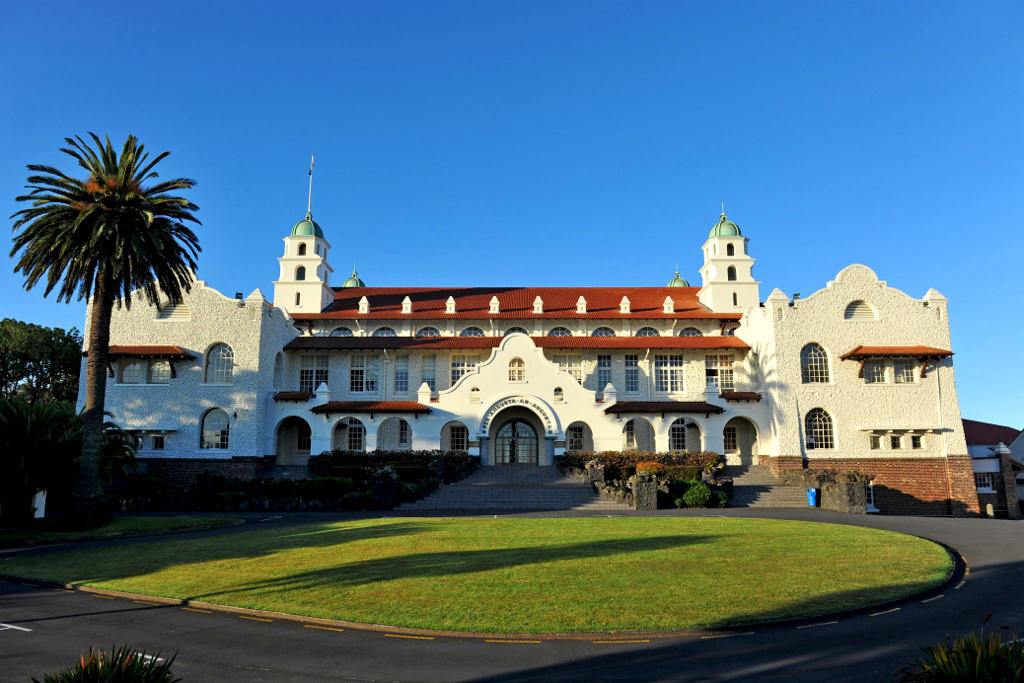
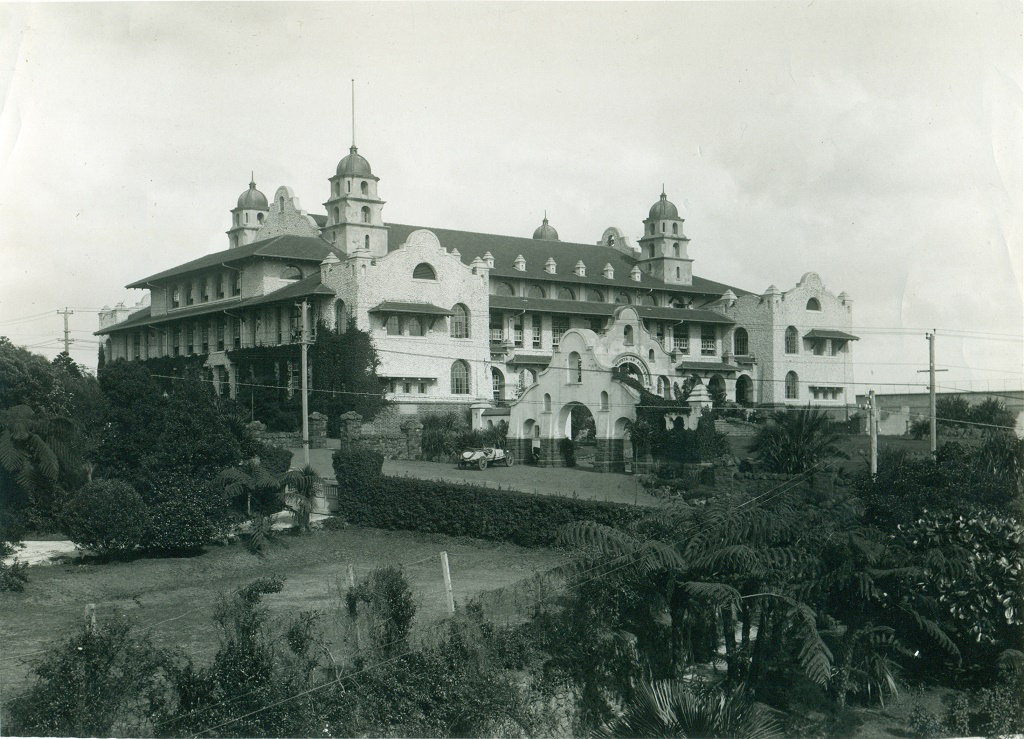
Architectural Significance: The Auckland Grammar School building is a very early example of the style to be found outside California. It was designed during the main period of Spanish Mission School design in America - 1900 through to 1915. The design was chosen by a competition for which there were 53 entries. The Spanish Mission style was associated with an educational philosophy concerning 'aesthetic, health and safety rationales'. One example of the design appeared in the American periodicals. By 1910 architects were citing climate, quality of light, extensive open spaces, educational requirements and structural mechanics as sound reasons for the erection of Mission Revival schools. In a contemporary report in the Herald the style is discussed; 'What is known as the Mission Style of Architecture has been adopted. This class of building is well known in Southern California and the architects have no doubt had in mind the similarity in that country and in Auckland. The outstanding feature of the building will be the large window space provided on every floor to allow maximum light and ventilation. The predominant style associated with educational facilities was English 'collegiate' Gothic. The choice of Spanish Mission Style marked a radical departure from this trend and the associations of 'red brick'. The school was a state school not private. Townscape/Landmark Significance: The prominent building, sited on the slopes of Mt Eden forms an important Auckland landmark. Its character is clearly noticeable while travelling out of the city on the motorway.
Why is this place significant?
Historic Significance
Historical Significance or Value Governor Grey initiated the foundation of the A.G.S. with a land grant in 1850, and in 1869 a small school opened in Howe Street by Alfred, Duke of Edinburgh. Subsequently, the school occupied various other buildings, and Albert Barracks Building, District Court House, Maori Chapel, St Andrews Church, Ponsonby Branch School and eventually a building in Symonds Street in 1880. But in 1903 Government measures were introduced providing free education for all children. The school roll was greatly expanded over the following years requiring a larger building, and the Mt Eden School was Opened in 1916. J.W. Tibbs was the headmaster during the building of the present school, retiring in 1922 after 30 years in that position. He was one of a number of notable personalities who became headmaster of Auckland Grammar School, J.D. Mahon (1929-35), C.M. Littlejohn (1935-54) and W.H. Cooper (1954-72). Under these men the school had become a major sporting school with notable ex Grammar boys, Sir Edmund Hillary, Wilson Whineray, All Black Captain 1958-65 and Geoffrey Howarth. Prominent ex Grammar boys outside of sport include Sir William Liley, R.A.K. Mason, A.R.D. Fairburn and Professor E.M. Blaiklock. Not only drawing upon the wealthy Auckland suburbs of Remuera and Epsom for its pupils, the school has also consistently maintained a high standard of academic achievement and has therefore attracted those of above average scholastic ability throughout the province. With educational policies always somewhat outside mainstream, the school has often contributed to debates on the theory and practice of education. Having educated a large number of Auckland's prominent citizens and achieved academic success, the school has always been a notable part of Auckland's educational and general history.
Physical Significance
Architectural Significance: The Auckland Grammar School building is a very early example of the style to be found outside California. It was designed during the main period of Spanish Mission School design in America - 1900 through to 1915. The design was chosen by a competition for which there were 53 entries. The Spanish Mission style was associated with an educational philosophy concerning 'aesthetic, health and safety rationales'. One example of the design appeared in the American periodicals. By 1910 architects were citing climate, quality of light, extensive open spaces, educational requirements and structural mechanics as sound reasons for the erection of Mission Revival schools. In a contemporary report in the Herald the style is discussed; 'What is known as the Mission Style of Architecture has been adopted. This class of building is well known in Southern California and the architects have no doubt had in mind the similarity in that country and in Auckland. The outstanding feature of the building will be the large window space provided on every floor to allow maximum light and ventilation. The predominant style associated with educational facilities was English 'collegiate' Gothic. The choice of Spanish Mission Style marked a radical departure from this trend and the associations of 'red brick'. The school was a state school not private. Townscape/Landmark Significance: The prominent building, sited on the slopes of Mt Eden forms an important Auckland landmark. Its character is clearly noticeable while travelling out of the city on the motorway.
Construction Professional
Name
Abbott, Richard Atkinson
Type
Architect
Biography
Abbott (1883-1954) began his career in the office of C L N Arnold and became his partner in 1910. Abbott, whose career began prior to the passing of the New Zealand Institute of Architects Act in 1913, became registered under that Act. He is best known for the design of Auckland Grammar School (1913) which is one of the earliest Spanish Mission style buildings in New Zealand. He also designed several branch buildings for the Bank of New Zealand including the Upper Symonds Street branch (1937) and several buildings at King's College, Middlemore, including the Memorial Chapel (World War I), the Memorial Library (World War II) and the Assembly Hall (1954). Abbott was active in the New Zealand Institute of Architects, serving on its Council (1926-28), and on its Education Committee (1926-36). In addition he was Chairman of the Auckland branch of the Institute (1927-28). Abbott was born at Parnell, Auckland. He was educated at St John's College and King's College after which he joined the architectural firm established in the 1870s by Charles Le Nevre Arnold. Abbot became Arnold's partner in practice in 1910. After Arnold's retirement in 1927, Abbot remained in sole practice for a time, but was later joined by G.I. Hole. Abbott's first major achievement was in 1913 when he submitted the winning design for the Auckland Grammar School. The janitor's cottage was part of the design brief. Abbot became a Fellow of the New Zealand Institute of Architects in 1913. Five years later he prepared the winning site layout for the King's College site at Middlemore. In contrast to Auckland Grammar School, the buildings on the King's College campus were designed in a more conservative Gothic collegiate style. In addition to the main building at King's (Kings College Main Block, NZHPT Registration # 529, Category II historic place), Abbott designed the memorial church to Old Boys who died in the First World War (Kings College Chapel, NZHPT Registration # 90, Category I historic place); the library; a memorial to old boys killed in the Second World War; and the School's assembly hall. For over 25 years Abbot was the architect for the Bank of New Zealand in the Auckland region. He is also remembered as the designer of the One Tree Hill Obelisk (NZHPT Registration # 4601, Category I historic place), constructed on Maungakiekie, One Tree Hill in 1939-1940.
Construction Details
Start Year
1916
Type
Original Construction
Construction Materials
The building is constructed of reinforced concrete with salt glazed brick faced pillars. The exterior finish consists of brick chip plastered to resemble adobe. The roof is tiled.
Notable Features
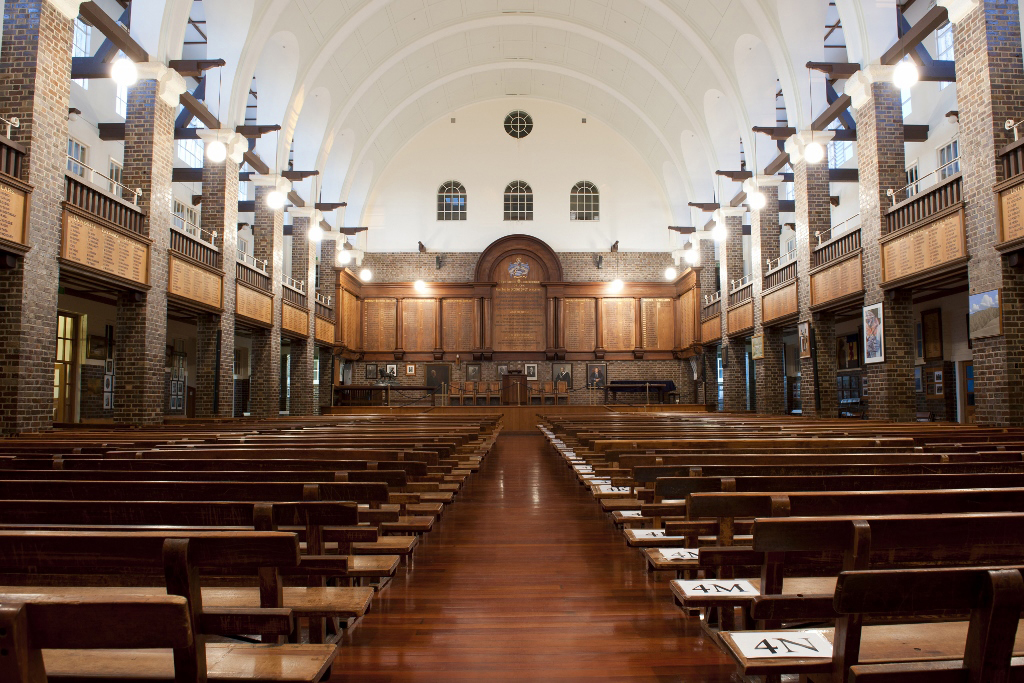
The school hall contains, as a memorial, rolls of honour of those killed during the war.
Construction Professional
Name
Abbott, Richard Atkinson
Type
Architect
Biography
Abbott (1883-1954) began his career in the office of C L N Arnold and became his partner in 1910. Abbott, whose career began prior to the passing of the New Zealand Institute of Architects Act in 1913, became registered under that Act. He is best known for the design of Auckland Grammar School (1913) which is one of the earliest Spanish Mission style buildings in New Zealand. He also designed several branch buildings for the Bank of New Zealand including the Upper Symonds Street branch (1937) and several buildings at King's College, Middlemore, including the Memorial Chapel (World War I), the Memorial Library (World War II) and the Assembly Hall (1954). Abbott was active in the New Zealand Institute of Architects, serving on its Council (1926-28), and on its Education Committee (1926-36). In addition he was Chairman of the Auckland branch of the Institute (1927-28). Abbott was born at Parnell, Auckland. He was educated at St John's College and King's College after which he joined the architectural firm established in the 1870s by Charles Le Nevre Arnold. Abbot became Arnold's partner in practice in 1910. After Arnold's retirement in 1927, Abbot remained in sole practice for a time, but was later joined by G.I. Hole. Abbott's first major achievement was in 1913 when he submitted the winning design for the Auckland Grammar School. The janitor's cottage was part of the design brief. Abbot became a Fellow of the New Zealand Institute of Architects in 1913. Five years later he prepared the winning site layout for the King's College site at Middlemore. In contrast to Auckland Grammar School, the buildings on the King's College campus were designed in a more conservative Gothic collegiate style. In addition to the main building at King's (Kings College Main Block, NZHPT Registration # 529, Category II historic place), Abbott designed the memorial church to Old Boys who died in the First World War (Kings College Chapel, NZHPT Registration # 90, Category I historic place); the library; a memorial to old boys killed in the Second World War; and the School's assembly hall. For over 25 years Abbot was the architect for the Bank of New Zealand in the Auckland region. He is also remembered as the designer of the One Tree Hill Obelisk (NZHPT Registration # 4601, Category I historic place), constructed on Maungakiekie, One Tree Hill in 1939-1940.
Construction Details
Start Year
1916
Type
Original Construction
Construction Materials
The building is constructed of reinforced concrete with salt glazed brick faced pillars. The exterior finish consists of brick chip plastered to resemble adobe. The roof is tiled.
Notable Features
The school hall contains, as a memorial, rolls of honour of those killed during the war.
Architectural Style: The style of the school is Spanish Mission. It consists of a main block with a bell gable at each end, cantered between two cupolas. These cupolas are copies of those at the Santa Barbara Mission, Santa Barbara, California. The same detail appears on the Madison School, Pasadena 1905 by Frank S. Allen. The four pavilions at the ends of the wings each have four small corner arrow slit details with a gable between. The front court has an arched entrance. The internal arrangement of the school centres on the hall which extends the full height of the building. Modifications: Only minor modifications have been carried out to the main block. Some of the functions of the rooms have been altered, the laboratories are no longer used as such and extra offices occupy what was once classrooms. The heating and lighting has been upgraded and extra toilets installed.
Architectural Style: The style of the school is Spanish Mission. It consists of a main block with a bell gable at each end, cantered between two cupolas. These cupolas are copies of those at the Santa Barbara Mission, Santa Barbara, California. The same detail appears on the Madison School, Pasadena 1905 by Frank S. Allen. The four pavilions at the ends of the wings each have four small corner arrow slit details with a gable between. The front court has an arched entrance. The internal arrangement of the school centres on the hall which extends the full height of the building. Modifications: Only minor modifications have been carried out to the main block. Some of the functions of the rooms have been altered, the laboratories are no longer used as such and extra offices occupy what was once classrooms. The heating and lighting has been upgraded and extra toilets installed.
Historical and Associated Iwi / Hapū / Whānau
Information Sources
Metro
Metro
New Zealand Herald
New Zealand Herald, 12 July 1932, p. 6; 28 September 1933, p. 6.
University of Auckland
University of Auckland
Weitze, 1984
Karen J Weitze, California's Mission Revival, Los Angeles, 1984
Other Information
This historic place was registered under the Historic Places Act 1980. This report includes the text from the original Building Classification Committee report considered by the NZHPT Board at the time of registration. Please note that entry on the New Zealand Heritage List/Rarangi Korero identifies only the heritage values of the property concerned, and should not be construed as advice on the state of the property, or as a comment of its soundness or safety, including in regard to earthquake risk, safety in the event of fire, or insanitary conditions.
Historical and Associated Iwi / Hapū / Whānau
Information Sources
Metro
Metro
New Zealand Herald
New Zealand Herald, 12 July 1932, p. 6; 28 September 1933, p. 6.
University of Auckland
University of Auckland
Weitze, 1984
Karen J Weitze, California's Mission Revival, Los Angeles, 1984
Other Information
This historic place was registered under the Historic Places Act 1980. This report includes the text from the original Building Classification Committee report considered by the NZHPT Board at the time of registration. Please note that entry on the New Zealand Heritage List/Rarangi Korero identifies only the heritage values of the property concerned, and should not be construed as advice on the state of the property, or as a comment of its soundness or safety, including in regard to earthquake risk, safety in the event of fire, or insanitary conditions.
Former Usages
General Usage: Education
Specific Usage: School
Former Usages
General Usage: Education
Specific Usage: School
Location
Sign up to hear more
Get the latest heritage news, features and events delivered
straight to your inbox.
