

Prior to European arrival, successive iwi and hapu groups occupied Horotiu including the present-day Queen Street gully. Traditions refer to a small pa on or near the current Town Hall. Following Auckland’s creation as colonial capital in 1840, baker Peter Robertson subdivided his holding in 1859. Bookbinder and stationer James Leighton bought the subject property in 1863. A two-storey shop of timber construction occupied the site until at least 1919. Possibly attracted by proximity to the Town Hall, Auckland’s premier concert venue on the adjoining site, piano importers Minnie Moses and her son Harold bought the property in December 1924 having announced plans the month before for the erection of a building. The No Deposit Piano Company had been founded some decades before by Minnie’s late husband Lewis Moses (d.1903).
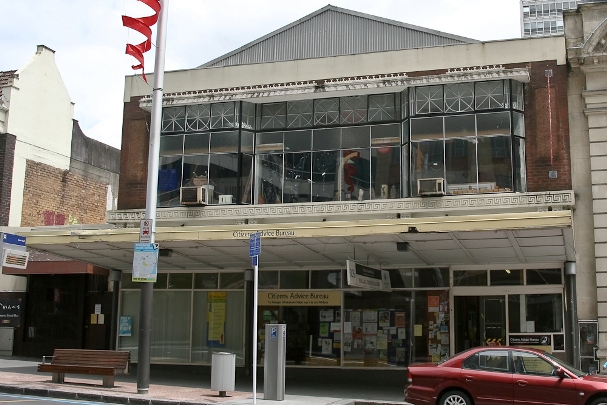
The contract for the building of four floors with a two-storey façade to Queen Street was let in March 1925. The design was prepared by the architectural practice of Lewis’ nephew Lance V. Moses. Brick and plaster detailing contributed to the overall unity of the streetscape while the large steel-framed windows reflected a general change in design approaches for commercial buildings. Design elements including upper-floor bay windows, key- and wave-patterned friezes, and geometric-patterning in the upper transoms were adopted in the later Vulcan Buildings (1928) a visually eclectic, high-quality Queen Street office building.
Whilst the ability to play was considered a valuable social skill and part a well-rounded education, the increasing availability of radio and gramophone entertainment in the 1920s and a difficult economic climate may have hastened closure of the business in 1929.
The Christchurch-based E.W. Pidgeon and Company, the national distributor for Goodrich tyre products and a tenant in the building since September 1926, bought the property in 1929 - one of the last sales of a Queen Street commercial premises until the end of the Great Depression. The building parapet incorporating a musical horn motif was cut down after 1931. Auckland City Council bought the building in 1961. Alterations were made to accommodate the Council’s Traffic Department, a tenancy followed in 1966 by the processing Department of Auckland Public Library. In 1983 the Queen Street Citizens Advice Bureau became the occupier in 1983 remained two-and-a-half decades . The building was adapted for re-use as part of the new Q Theatre, opened in 2011. Whilst retaining the overall external appearance, the building became the café / bar and foyer space serving a new auditorium erected behind the building. The upper basement became a rehearsal room and dressing rooms; and the upper storey, a performance space with dressing rooms.
List Entry Information
Status
Listed
List Entry Status
Historic Place Category 2
Access
Private/No Public Access
List Number
4586
Date Entered
10th September 1987
Date of Effect
10th September 1987
City/District Council
Auckland Council
Region
Auckland Council
Extent of List Entry
Extent includes the land described as Lot 14 DP 18506 (RT NA417/256) and Pt Lot 15 Allots 1‐5, Pt 56 Sec 29 City of Auckland (RTNA2D/571), North Auckland Land District, and the building known as the No Deposit Piano Company Building (Former) thereon.
Legal description
Lot 14 DP 18506 (RT NA417/256) and Pt Lot 15 Allots 1‐5, Pt 56 Sec 29 City of Auckland (RTNA2D/571), North Auckland Land District
Status
Listed
List Entry Status
Historic Place Category 2
Access
Private/No Public Access
List Number
4586
Date Entered
10th September 1987
Date of Effect
10th September 1987
City/District Council
Auckland Council
Region
Auckland Council
Extent of List Entry
Extent includes the land described as Lot 14 DP 18506 (RT NA417/256) and Pt Lot 15 Allots 1‐5, Pt 56 Sec 29 City of Auckland (RTNA2D/571), North Auckland Land District, and the building known as the No Deposit Piano Company Building (Former) thereon.
Legal description
Lot 14 DP 18506 (RT NA417/256) and Pt Lot 15 Allots 1‐5, Pt 56 Sec 29 City of Auckland (RTNA2D/571), North Auckland Land District
Historical and Associated Iwi / Hapū / Whānau
Completion Date
2nd April 2015
Report Written By
Joan McKenzie
Other Information
This place was identified as significant under previous legislation with different information requirements. It remains significant under the current legislation. There is opportunity under our legislation and policies to add to this information. Further information about this place may be available from the Northern Regional Office of Heritage New Zealand Pouhere Taonga. Please note that entry on the New Zealand Heritage List/Rarangi Korero identifies only the heritage values of the property concerned, and should not be construed as advice on the state of the property, or as a comment of its soundness or safety, including in regard to earthquake risk, safety in the event of fire, or insanitary conditions. A fully referenced upgrade report is available on request from the Northern Regional Office of Heritage New Zealand.
Historical and Associated Iwi / Hapū / Whānau
Completion Date
2nd April 2015
Report Written By
Joan McKenzie
Other Information
This place was identified as significant under previous legislation with different information requirements. It remains significant under the current legislation. There is opportunity under our legislation and policies to add to this information. Further information about this place may be available from the Northern Regional Office of Heritage New Zealand Pouhere Taonga. Please note that entry on the New Zealand Heritage List/Rarangi Korero identifies only the heritage values of the property concerned, and should not be construed as advice on the state of the property, or as a comment of its soundness or safety, including in regard to earthquake risk, safety in the event of fire, or insanitary conditions. A fully referenced upgrade report is available on request from the Northern Regional Office of Heritage New Zealand.
Current Usages
Uses: Civic Facilities
Specific Usage: Theatre
Former Usages
General Usage: Civic Facilities
Specific Usage: Civic facilities - other
General Usage: Civic Facilities
Specific Usage: Information/Visitors Centre
General Usage: Trade
Specific Usage: Office building/Offices
General Usage: Trade
Specific Usage: Shop
General Usage: Trade
Specific Usage: Showrooms
Current Usages
Uses: Civic Facilities
Specific Usage: Theatre
Former Usages
General Usage: Civic Facilities
Specific Usage: Civic facilities - other
General Usage: Civic Facilities
Specific Usage: Information/Visitors Centre
General Usage: Trade
Specific Usage: Office building/Offices
General Usage: Trade
Specific Usage: Shop
General Usage: Trade
Specific Usage: Showrooms
Location
Sign up to hear more
Get the latest heritage news, features and events delivered
straight to your inbox.
