

Prior to European arrival, successive iwi and hapu groups occupied Horotiu including the present-day Queen Street gully. Traditions refer to a small pa on or near the current Town Hall. Following Auckland’s creation as colonial capital in 1840, baker Peter Robertson subdivided his holding in 1859. In 1863, carpenters Richard Monk and James Rice Morgan bought a holding and established a steam saw mill. Following the death of Sir William Martin who had become the owner in 1880, the current site was created within a vacant portion of the former sawmill property. The vacant site bought in 1882 by William Row Bridgman, a draper, changed hands several times before its purchase by baby carriage manufacturers William Augustus Thompson and Alfred Thompson in late 1923. The enterprise established in 1893 in Victoria Street West as machinists, W.A. Thompson and Company, diversified into sewing machine sales and repair, with the first mention of perambulator manufacture late in 1896. Moving to Queen Street in 1899, the venture remained primarily a sewing machine agency. Perambulator manufacture, again mentioned in 1907, was carried out in a factory in nearby Wakefield Street by 1910.
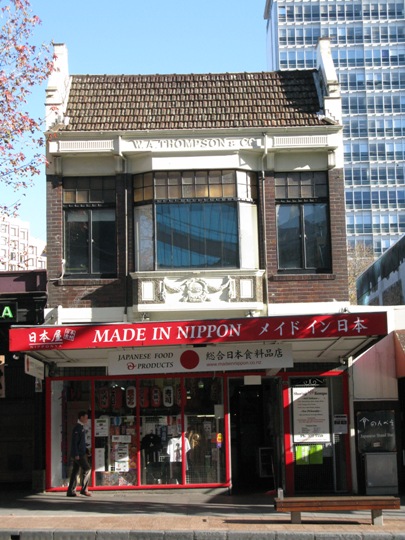
Tenders for a new Queen Street retail premises were called by Auckland architects Holman and Moses in September 1923. The brick and concrete building of four floors with a two-storey façade to Queen Street was constructed by Auckland builder G.G. Pollard. Brick and plaster detailing contributed to the overall unity of the streetscape while the large steel-framed windows reflected a general change in design approaches for commercial buildings. Finished with a tiled Mansard roof and steel oriel windows, the glazed brick shopfront with plaster dressings was a departure from common concrete plaster. By this time the Company was specialising in baby products, basket-ware and invalid chairs.
Early tenancies were taken up by a retailer of electrical goods including gramophones; James Wilson tailor; and furniture manufacturers Grief and Esterman. In the 1930s the Thompson Building, also known as Thompson’s Pram House, housed the clubrooms of several English associations and clubs, and a German Club.
Following William Thompson’s death in 1945, his brother Alfred became the sole owner of the business, establishing W.A. Thompson and Company Limited with his two sons in 1946. Alterations included re-partitioning and modernisation of the building’s ground floor shop front in 1946. A mezzanine floor was built in the ground floor retail area in 1955. The firm, reputedly New Zealand’s largest pram and pushchair manufacturer by 1964, gave up its Queen Street premises and moved to Otara in 1966. Following purchase of the property by Auckland City Council, tenants over the years included Council’s valuation staff; Mollers’ Gallery; and a Japanese specialty store.
List Entry Information
Status
Listed
List Entry Status
Historic Place Category 2
Access
Private/No Public Access
List Number
4587
Date Entered
10th September 1987
Date of Effect
10th September 1987
City/District Council
Auckland Council
Region
Auckland Council
Extent of List Entry
Extent includes the land described as Pt Allots 4‐5, Sec 29 City of Auckland (RT NA2D/938) North Auckland Land District, and the building known as W.A. Thompson and Company Building (Former) thereon.
Legal description
Pt Allots 4‐5, Sec 29 City of Auckland (RT NA2D/938) North Auckland Land District
Status
Listed
List Entry Status
Historic Place Category 2
Access
Private/No Public Access
List Number
4587
Date Entered
10th September 1987
Date of Effect
10th September 1987
City/District Council
Auckland Council
Region
Auckland Council
Extent of List Entry
Extent includes the land described as Pt Allots 4‐5, Sec 29 City of Auckland (RT NA2D/938) North Auckland Land District, and the building known as W.A. Thompson and Company Building (Former) thereon.
Legal description
Pt Allots 4‐5, Sec 29 City of Auckland (RT NA2D/938) North Auckland Land District
Construction Professional
Name
W.A. Holman and L.V. Moses
Type
Architectural Partnership
Biography
No biography is currently available for this construction professional
Name
G. G. Pollard
Type
Builder
Biography
No biography is currently available for this construction professional
Construction Details
Start Year
1955
Type
Modification
Description
Mezzanine floor constructed
Construction Professional
Name
W.A. Holman and L.V. Moses
Type
Architectural Partnership
Biography
No biography is currently available for this construction professional
Name
G. G. Pollard
Type
Builder
Biography
No biography is currently available for this construction professional
Construction Details
Start Year
1955
Type
Modification
Description
Mezzanine floor constructed
Historical and Associated Iwi / Hapū / Whānau
Completion Date
2nd April 2015
Report Written By
Joan McKenzie
Other Information
This place was identified as significant under previous legislation with different information requirements. It remains significant under the current legislation. There is opportunity under our legislation and policies to add to this information. Further information about this place may be available from the Northern Regional Office of Heritage New Zealand Pouhere Taonga. Please note that entry on the New Zealand Heritage List/Rarangi Korero identifies only the heritage values of the property concerned, and should not be construed as advice on the state of the property, or as a comment of its soundness or safety, including in regard to earthquake risk, safety in the event of fire, or insanitary conditions. A fully referenced upgrade report is available on request from the Northern Regional Office of Heritage New Zealand.
Historical and Associated Iwi / Hapū / Whānau
Completion Date
2nd April 2015
Report Written By
Joan McKenzie
Other Information
This place was identified as significant under previous legislation with different information requirements. It remains significant under the current legislation. There is opportunity under our legislation and policies to add to this information. Further information about this place may be available from the Northern Regional Office of Heritage New Zealand Pouhere Taonga. Please note that entry on the New Zealand Heritage List/Rarangi Korero identifies only the heritage values of the property concerned, and should not be construed as advice on the state of the property, or as a comment of its soundness or safety, including in regard to earthquake risk, safety in the event of fire, or insanitary conditions. A fully referenced upgrade report is available on request from the Northern Regional Office of Heritage New Zealand.
Current Usages
Uses: Trade
Specific Usage: Shop
Former Usages
General Usage: Trade
Specific Usage: Office building/Offices
General Usage: Trade
Specific Usage: Showrooms
Current Usages
Uses: Trade
Specific Usage: Shop
Former Usages
General Usage: Trade
Specific Usage: Office building/Offices
General Usage: Trade
Specific Usage: Showrooms
Location
Sign up to hear more
Get the latest heritage news, features and events delivered
straight to your inbox.
