

The freehold of the block was acquired in 1877 by Sir Edward Chetham Strode, the father of Alfred R.C. Strode, Dunedin's first resident magistrate. After the former's death in 1886, his widow held the land until 1922.
There were probably houses on this land from the early 1860s. From this time many leases were registered until a 99 year lease was granted to Daniel Haynes in 1886, backdated to 1874. In 1901 Haynes built the houses that stand there today. They originally held seven dwellings and two sets of doctor's rooms. The first inhabitants included a dentist, a music teacher, a surgeon and a music dealer. The lease, and freehold, were acquired by Riccarton horse trainer John William McCombe by 1922.
Yoka Neuman established the Lesbian Mothers’ Defence Fund (LMDF) in Dunedin in 1979 where she was a prominent activist in defending child custody cases for lesbian same-sex households. The LMDF also provided support women leaving heterosexual marriages for lesbian relationships where they risked losing custody of their children. She was also a leading volunteer at Daybreak Bookshop, New Zealand’s first feminist bookshop. The bookshop at 207 Stuart Street specialised in feminist and alternative literature and was opened by the Dunedin Collective for women in 1980. It later closed in 1982. Whilst it was only open for a short time, the significance of this store as a feminist space is significant. The bookstore was founded by eight women; Denny Boothe, Jocelyn Harris, Pat Lawson, Andree Levesque, Judith Medlicott, Edith Mercier, Penny Moore, and Diana Strang.
A succession of landlords have since held the property with the present owner buying the terrace in 1980. The houses have been restored and refurbished using period joinery and furnishings.
List Entry Information
Status
Listed
List Entry Status
Historic Place Category 1
Access
Private/No Public Access
List Number
4709
Date Entered
15th February 1990
Date of Effect
15th February 1990
City/District Council
Dunedin City
Region
Otago Region
Legal description
Lot 1-3 DP 6009 and Pt Lot 4 DP 6009 (RTs OT323/88, OT11B/1069), Otago Land District
Status
Listed
List Entry Status
Historic Place Category 1
Access
Private/No Public Access
List Number
4709
Date Entered
15th February 1990
Date of Effect
15th February 1990
City/District Council
Dunedin City
Region
Otago Region
Legal description
Lot 1-3 DP 6009 and Pt Lot 4 DP 6009 (RTs OT323/88, OT11B/1069), Otago Land District
Why is this place significant?
Historic Significance
Historical Significance or Value These houses provide an interesting comment on the high density living conditions acceptable to the middle income earners of late nineteenth century New Zealand. They also show that the role of the Victorian speculative builder was as well established here as it was in London, Melbourne or Sydney during the same period.
Physical Significance
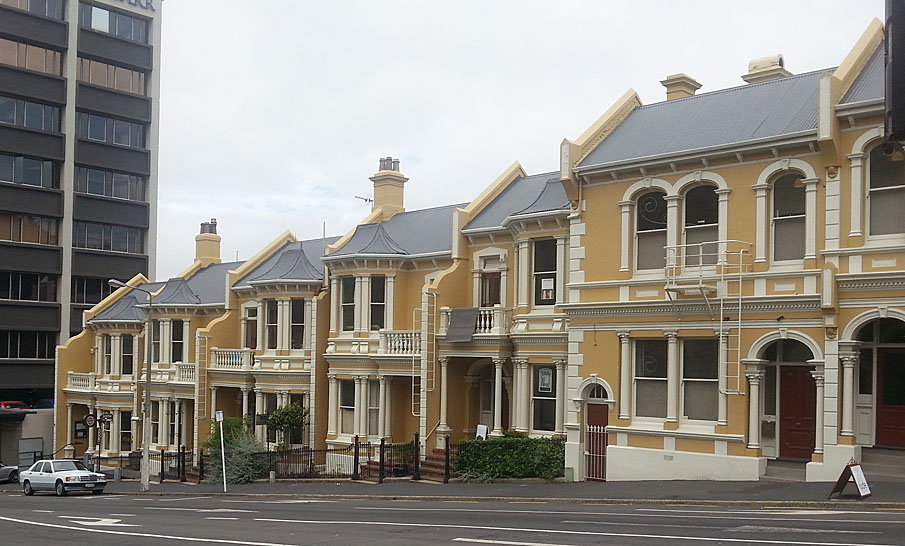
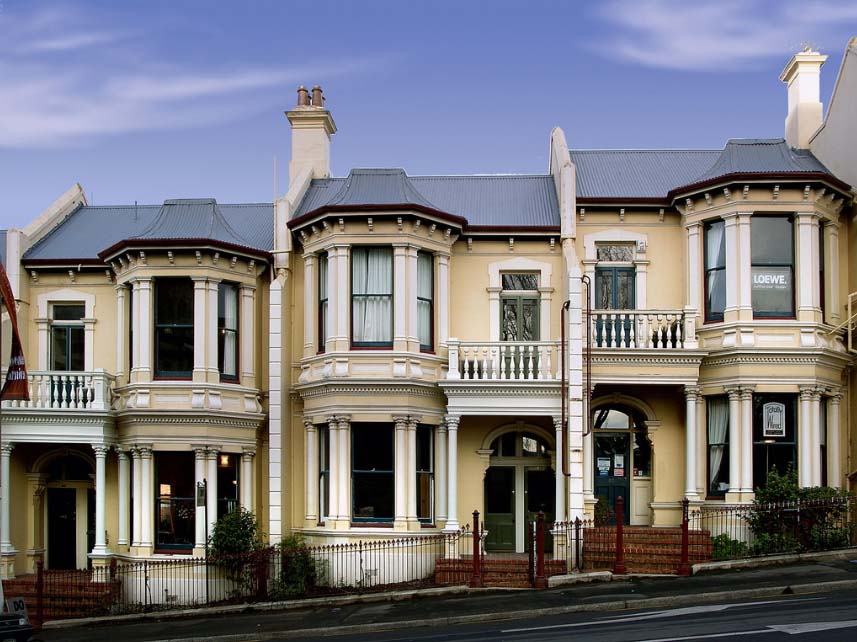
ARCHITECTURAL QUALITY: Terrace housing is rare in New Zealand and this is a well preserved example. By modern standards the houses are very small and yet they were obviously designed for people of some wealth. There is considerable attention to decorative Classical detail exhibiting economic well being and stability. The free use of Classical motifs is reminiscent of the Rennaisance during which the close relationship between neighbouring buildings often led to the illusion of a continuous street facade. This group of terrace houses offers a considerable contrast to the often disjointed streetscapes found in urban New Zealand. The rarity of the design reinforces the uniquely Victorian character of Dunedin City architecture. TOWNSCAPE/LANDMARK VALUE: This corner site complex has considerable streetscape prominence. It also overlooks the grounds of St Paul's Cathedral and is sited close to several other green areas of central Dunedin.
Why is this place significant?
Historic Significance
Historical Significance or Value These houses provide an interesting comment on the high density living conditions acceptable to the middle income earners of late nineteenth century New Zealand. They also show that the role of the Victorian speculative builder was as well established here as it was in London, Melbourne or Sydney during the same period.
Physical Significance
ARCHITECTURAL QUALITY: Terrace housing is rare in New Zealand and this is a well preserved example. By modern standards the houses are very small and yet they were obviously designed for people of some wealth. There is considerable attention to decorative Classical detail exhibiting economic well being and stability. The free use of Classical motifs is reminiscent of the Rennaisance during which the close relationship between neighbouring buildings often led to the illusion of a continuous street facade. This group of terrace houses offers a considerable contrast to the often disjointed streetscapes found in urban New Zealand. The rarity of the design reinforces the uniquely Victorian character of Dunedin City architecture. TOWNSCAPE/LANDMARK VALUE: This corner site complex has considerable streetscape prominence. It also overlooks the grounds of St Paul's Cathedral and is sited close to several other green areas of central Dunedin.
Construction Professional
Name
Salmond, James Louis
Type
Architect
Biography
James Louis Salmond (1868-1950) was born in North Shields, England. He was educated at Otago Boys' High School and began his career articled to Robert Arthur Lawson (1833-1902). Salmond initially practised on his own account but later rejoined Lawson in partnership. Salmond took over the practice when Lawson died in 1902. Salmond was the architect of over 20 churches in Otago including the Presbyterian churches at Roslyn, Kaikorai, North Dunedin and the Wesleyan church at Mornington. He designed many private residences including Watson Shennan's house at 367 High Street, as well as those at 114 Cargill Street and 14 Pitt Street, all in Dunedin. Salmond was president of the Otago Art Society, and also served a term as president of the New Zealand Institute of Architects. His son Arthur joined the firm having studied in London and his grandson John continues to work in the firm today. It is now known as Salmond Anderson Architects.
Construction Details
Start Year
1901
Type
Original Construction
Construction Materials
Plastered brick; roofs clad with corrugated iron.
Notable Features
The integrity of the Classically detailed terrace design. The stepped form on the street slope.
Construction Professional
Name
Salmond, James Louis
Type
Architect
Biography
James Louis Salmond (1868-1950) was born in North Shields, England. He was educated at Otago Boys' High School and began his career articled to Robert Arthur Lawson (1833-1902). Salmond initially practised on his own account but later rejoined Lawson in partnership. Salmond took over the practice when Lawson died in 1902. Salmond was the architect of over 20 churches in Otago including the Presbyterian churches at Roslyn, Kaikorai, North Dunedin and the Wesleyan church at Mornington. He designed many private residences including Watson Shennan's house at 367 High Street, as well as those at 114 Cargill Street and 14 Pitt Street, all in Dunedin. Salmond was president of the Otago Art Society, and also served a term as president of the New Zealand Institute of Architects. His son Arthur joined the firm having studied in London and his grandson John continues to work in the firm today. It is now known as Salmond Anderson Architects.
Construction Details
Start Year
1901
Type
Original Construction
Construction Materials
Plastered brick; roofs clad with corrugated iron.
Notable Features
The integrity of the Classically detailed terrace design. The stepped form on the street slope.
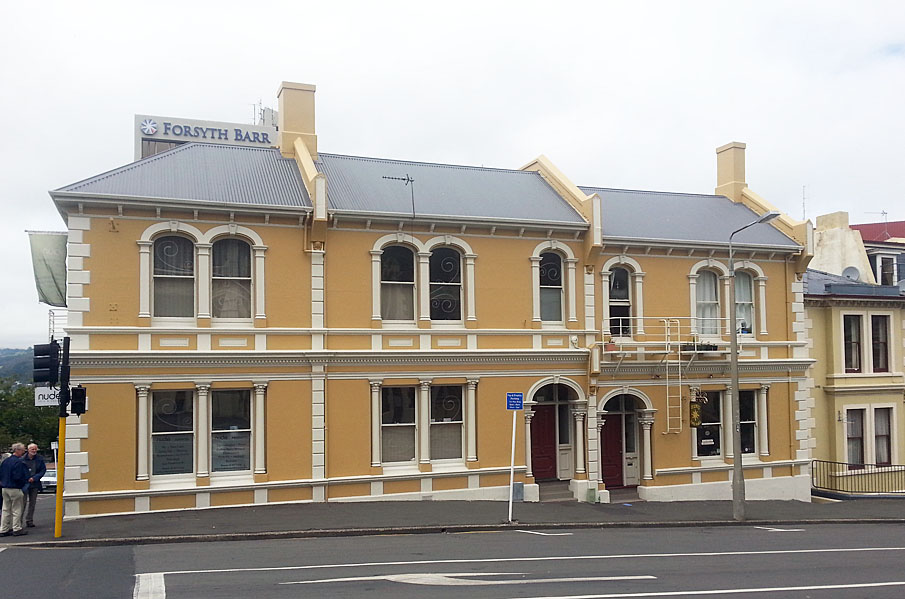
ARCHITECTURAL DESCRIPTION: This complex consists of five narrow houses facing Stuart Street and a corner block of two houses facing Stuart Street and two facing Moray Place. The Stuart Street terrace houses are two storeyed and feature classical embellishments. The street facade of each house has a small balustraded balcony and a double height bay with square headed windows. Pilasters flank these windows and each bay is crowned with a turret with convex roof lines reminiscent of French Renaissance architecture. Each of the Stuart Street houses is on a different level, producing a repetitive stepped pattern in the roof line. Like the Stuart Street terrace houses, the corner block is two storeyed. It is larger in scale but has more conventional classical detailing. It has arched entrances, square headed windows at ground floor level, arched windows at first floor level and quoins which simulate the use of stone. While the complex appears to consist of two separate buildings, it was planned as a whole. Features which unite the two portions include the use of Corinthian columns flanking ground floor windows, the repetition of eaves brackets, the plastered party walls which project beyond the roofline, and the roofs themselves, which are pitched at the same angle throughout. MODIFICATIONS: Facades appear to be little modified. Interiors have been adapted to various uses over the years. The lowest two Stuart Street houses were made into one from c.1948-1980. The present owner has carried out considerable restoration work.
ARCHITECTURAL DESCRIPTION: This complex consists of five narrow houses facing Stuart Street and a corner block of two houses facing Stuart Street and two facing Moray Place. The Stuart Street terrace houses are two storeyed and feature classical embellishments. The street facade of each house has a small balustraded balcony and a double height bay with square headed windows. Pilasters flank these windows and each bay is crowned with a turret with convex roof lines reminiscent of French Renaissance architecture. Each of the Stuart Street houses is on a different level, producing a repetitive stepped pattern in the roof line. Like the Stuart Street terrace houses, the corner block is two storeyed. It is larger in scale but has more conventional classical detailing. It has arched entrances, square headed windows at ground floor level, arched windows at first floor level and quoins which simulate the use of stone. While the complex appears to consist of two separate buildings, it was planned as a whole. Features which unite the two portions include the use of Corinthian columns flanking ground floor windows, the repetition of eaves brackets, the plastered party walls which project beyond the roofline, and the roofs themselves, which are pitched at the same angle throughout. MODIFICATIONS: Facades appear to be little modified. Interiors have been adapted to various uses over the years. The lowest two Stuart Street houses were made into one from c.1948-1980. The present owner has carried out considerable restoration work.
Historical and Associated Iwi / Hapū / Whānau
Information Sources
Cyclopedia of New Zealand, 1905
Cyclopedia Company, Industrial, descriptive, historical, biographical facts, figures, illustrations, Wellington, N.Z, 1897-1908, Vol. 4 Otago and Southland, Cyclopedia Company, Christchurch, 1905
Otago Daily Times
Otago Daily Times, 1 Jun 1915, p.10.
McCoy, 1968
E McCoy and J G Blackman, Victorian City of New Zealand, Dunedin, 1968
Porter, 1983
Frances Porter (ed), Historic Buildings of Dunedin, South Island, Methuen, Auckland, 1983.
Knight, 1983
H Knight, Otago Calvacade 1901-1905, 1983
Other Information
This historic place was registered under the Historic Places Act 1980. This report includes the text from the original Building Classification Committee report considered by the NZHPT Board at the time of registration. Please note that entry on the New Zealand Heritage List/Rarangi Korero identifies only the heritage values of the property concerned, and should not be construed as advice on the state of the property, or as a comment of its soundness or safety, including in regard to earthquake risk, safety in the event of fire, or insanitary conditions.
Historical and Associated Iwi / Hapū / Whānau
Information Sources
Cyclopedia of New Zealand, 1905
Cyclopedia Company, Industrial, descriptive, historical, biographical facts, figures, illustrations, Wellington, N.Z, 1897-1908, Vol. 4 Otago and Southland, Cyclopedia Company, Christchurch, 1905
Otago Daily Times
Otago Daily Times, 1 Jun 1915, p.10.
McCoy, 1968
E McCoy and J G Blackman, Victorian City of New Zealand, Dunedin, 1968
Porter, 1983
Frances Porter (ed), Historic Buildings of Dunedin, South Island, Methuen, Auckland, 1983.
Knight, 1983
H Knight, Otago Calvacade 1901-1905, 1983
Other Information
This historic place was registered under the Historic Places Act 1980. This report includes the text from the original Building Classification Committee report considered by the NZHPT Board at the time of registration. Please note that entry on the New Zealand Heritage List/Rarangi Korero identifies only the heritage values of the property concerned, and should not be construed as advice on the state of the property, or as a comment of its soundness or safety, including in regard to earthquake risk, safety in the event of fire, or insanitary conditions.
Current Usages
Uses: Accommodation
Specific Usage: Terrace/ cojoined houses
Former Usages
General Usage: Accommodation
Specific Usage: Terrace/ cojoined houses
General Usage: Civic Facilities
Specific Usage: Library
General Usage: Trade
Specific Usage: Restaurant/cafe/tearoom
General Usage: Trade
Specific Usage: Retail and Commercial - other
Themes
Rainbow List
Current Usages
Uses: Accommodation
Specific Usage: Terrace/ cojoined houses
Former Usages
General Usage: Accommodation
Specific Usage: Terrace/ cojoined houses
General Usage: Civic Facilities
Specific Usage: Library
General Usage: Trade
Specific Usage: Restaurant/cafe/tearoom
General Usage: Trade
Specific Usage: Retail and Commercial - other
Themes
Rainbow List
Location
Sign up to hear more
Get the latest heritage news, features and events delivered
straight to your inbox.
